

An operator of two aircraft types files its approval application with a six-box organisation chart and four names. The career paths hold up, the experience is there, the responsibilities are spelled out in black and white. Yet the application comes back with a single-line objection: the person designated for flight operations is also the one who holds compliance monitoring. Neither competence nor available hours is in question — the chart is simply asking someone to audit their own work. Not all combinations of duties are equal, and the acceptance interview does not look where you would expect.
What the authority accepts is not a post
An operating certificate is not issued to an organisation chart: it is issued to named individuals occupying described positions. On the European side, the expected structure combines an accountable manager, who holds financial authority and ultimate responsibility for the operation, a set of nominated post holders covering flight operations, crew training, ground operations and continuing airworthiness, then two roles belonging to the management system: safety management and compliance monitoring. On the American side, the list changes names and breakdown — director of operations, chief pilot, director of maintenance, director of safety, director of inspection — but the logic stays the same: identified management posts whose holders must meet experience criteria, and a waiver mechanism provided for operations that cannot fill every post separately.
Acceptance therefore bears on a pair: a person and a scope. It does not follow the person if that person changes operator, it does not follow the post if the post holder changes, and it does not survive unchanged through a substantial change to the declared scope. That is what makes combining duties worth analysing: it is never judged in the abstract, only against the scope declared at the time of filing. The same combination is routine for an operator of a single type on a single base, and untenable for an operator of three types across four bases.
Two causes of failure that have nothing to do with each other
When a combination of duties is refused, it is for one of two reasons, and confusing them is costly because they are not addressed the same way.
The first is a matter of capacity. A designated person must be reachable, present where operational decisions are made, and have real time compatible with the scope of the function. The authority then looks at very concrete elements: the contracted proportion of time, the existence of another employer, the distance between home and the main base, the number of types operated, the volume of flights, and — a point applications regularly forget — the time the person spends flying the line when they also fly. A combination refused for capacity can be remedied: the scope is reduced, a deputy is appointed, part of the work is contracted out, responsibilities are redrawn. The application then goes forward on the amended documents, without the person necessarily being interviewed again.
The second is structural. It appears as soon as one of the two functions exists to control, audit or validate what the other produces. No amount of reinforcement fixes it: giving more time to someone who must audit themselves only gives them more time to audit themselves. This is the one family of combinations an authority refuses without even discussing the candidate’s résumé, and it is also the one applications most often present without realising it, because the combination looks economical on paper — both functions call for the same knowledge of the operation, so why not give them to the person who already has it.
Some job combinations are rejected because the person would have to check their own work, which creates a conflict of interest. Other combinations are rejected because the person simply doesn’t have enough time to do both jobs properly. These two problems are treated differently, so it’s important to know which one applies to your situation.
A small charter operator with two Pilatus PC-12s and a single base applies to combine flight operations and crew training under one manager. The authority accepts this because the workload is low (200 flight hours/month) and the manager has a deputy for training. However, if the same operator later adds a third aircraft and a second base, the combination becomes unacceptable because the workload exceeds the manager’s available time (now 400 flight hours/month) and the deputy cannot cover both locations.
The map of combinations: what goes through, what goes through with conditions, what does not go through
The pairings encountered in practice are few, and each runs into an obstacle of a precise nature. Classifying them by that obstacle, rather than by their frequency, avoids preparing the wrong demonstration.
| Combination envisaged | Nature of the obstacle | Usual verdict | What the authority wants to see |
|---|---|---|---|
| Flight operations and crew training | Workload alone; same field of expertise | Commonly accepted in a small organisation | Annual training volume, appointed deputy, post holder’s own flight time |
| Flight operations and ground operations | Workload, and two distant professional fields | Accepted with conditions | Share of handling subcontracted, number of stations, oversight arrangement for providers |
| Continuing airworthiness and an operational function | Economic trade-off between aircraft availability and technical condition | Accepted with a reservation | Who decides to defer a technical tolerance, on what criterion, and where the decision is recorded |
| Operational function and compliance monitoring | The person audits the domain they run | Refused | An independent auditor, employee or contractor, reporting to the accountable manager |
| Safety management and compliance monitoring | Two distinct logics carried by a single voice | Accepted with conditions in a simple organisation | Separate records, and an answer to the question: who audits the safety function? |
| Accountable manager and a nominated post | No one left above to arbitrate | Accepted only in a very small operation | Through which channel a finding leaves the company without passing through him |
| Training manager and examiner of the crews they train | Judge and party on the outcome of their own programme | Accepted under oversight | Sampling by a third-party examiner and follow-up of check results |
Two lessons emerge from this classification. First, the only line that is flatly closed is the one pairing an operational function with compliance monitoring: everywhere else, the debate is about conditions, hence about documents to produce. Second, several acceptable combinations conceal a hidden economic trade-off — continuing airworthiness paired with an operational function is the prime example, since the same person feels the pressure of the flight programme and decides on the technical condition that authorises it. These combinations are not refused, but they are investigated: what is asked for is the written criterion that settles the matter in the person’s place.
The structural conflict: the finding that has nowhere to go
The independence required of the compliance monitoring function has nothing to do with the presumed honesty of its holder. It concerns the path a finding follows, not the character of the person who raises it. An arrangement is independent when the finding can reach the accountable manager without passing through the manager of the audited domain, and when the corrective action is validated by someone who had no interest in the finding not existing. As soon as these two conditions fall away, the loop closes: the finding is born, circulates and dies in the same hand.
The same reasoning applies to two other combinations that applications tend to treat too lightly. A training manager who checks in flight the crews trained under their own programme is really assessing their own programme as much as the candidate: the check result becomes a judgment on their own work. This combination remains common and acceptable, provided a sample of the checks goes to a third-party examiner and the results are tracked over time. Likewise, the person who holds both safety management and compliance monitoring must carry two opposing logics: one collects reports by promising no sanction, the other raises findings that are enforceable. Simple organisations manage it, but only by keeping the records separate and designating who audits the safety function itself.
The trap. The organisation chart shows two distinct boxes, with two titles and two lines — and the loop still closes, because the manual designates the manager of the audited domain to validate corrective actions. The inspector reads both documents, and in case of contradiction it is the written procedure that prevails over the diagram. Check the validation chain in the text of the manual before touching the chart.
What the acceptance interview actually examines
The interview is not a knowledge test. The career path has already been assessed on paper; if it did not fit, the interview would not take place. What plays out in the room comes down to five points, and each is prepared with a document rather than an answer.
- Real authority. Who can the person stop, what budget do they commit alone, who reports to them in writing? A designated function with no power to ground or suspend is just a title.
- The arbitration path. « You find a discrepancy in the domain you run: who decides? » The question sounds theoretical; it is the heart of the interview whenever a combination is on file.
- Availability. Contracted proportion of time, another employer, line flying activity, geographic distance, foreseeable periods of absence.
- Deputisation. Who acts in case of absence, with what limits, up to what duration, and from when the authority must be informed.
- Traceability. Where will the decision be found in six months, and in what form could a third party reconstruct it without questioning its author?
What makes a candidate fail is almost never a technical gap. It is the answer « we discuss it among ourselves », or « the case has never come up ». The first describes an organisation with no arbitration rule; the second describes a control function that has found nothing, which is more worrying than a list of closed findings. The inspector is looking for a procedure that works on a bad day, not for good intentions.
The right reflex. Before the interview, take a real finding already closed out in the domain concerned and walk through it out loud: who raised it, who it was sent to, who validated the corrective action, where the record stands today. If the demonstration passes at any point through an informal conversation between two people, the procedure does not exist — and that is exactly where the question will land.
The organisation chart that closes the discussion
An organisation chart in an approval application is not a photo board: it is a document that can be held against you. A few drafting rules settle most objections before they are even raised. One function, one box, even when a single name appears in two of them: the reader must see the combination, not discover it in a footnote. Reporting lines are distinguished from lines of authority — the solid line carries authority downward, the dashed line carries information upward — and the compliance monitoring function’s reporting line must reach the accountable manager without crossing any operational box.
The deputy is named on the chart, not only in the manual, and never reports hierarchically to the person they deputise for: a deputy who reports to the person they deputise deputises for nothing. Finally, each box carries its scope in one line — types, bases, kinds of operation. It is this detail that will later make it possible to show that a fleet change falls outside the accepted scope, or stays within it.
The compensating measures that hold up, and those that do not
When the combination is requested for good reasons — an organisation too small to carry as many management staff as functions to fill — acceptance is won on the compensating measures. Three of them hold up under scrutiny. The first is outsourcing the audit to a third party, under a contract guaranteeing access to records and a report addressed directly to the accountable manager; the operator keeps the responsibility, but the scrutiny is no longer their own. The second is direct reporting to the accountable manager, written into the manual with a deadline and a form, not left to the judgment of the moment. The third is the physical separation of records when the same person holds both safety and compliance: two logs, two access levels, two confidentiality regimes.
Conversely, some measures do not survive ten minutes in the room. A statement of principle to « keep things separate » describes no mechanism. A deputy subordinate to the person they deputise for reproduces the very loop it claims to open. Availability announced as a percentage with no contractual backing is unverifiable, hence unenforceable. And a review clause with no triggering threshold is nothing but an intention: it must name the event — adding a type, opening a base, crossing a volume of activity — that reopens the question of the combination.
The second trap. A compensating measure that relies on the person whose combination it is meant to compensate compensates nothing. This is the case of an external auditor whose contract is signed, managed and renewed by the manager of the audited domain, or of a safety register whose only key is held by that same person. The question to ask of every measure: what becomes of it if the person concerned decides it is not necessary this month?
The combination that ages badly
An acceptance is granted for an operation of a given size, on a given date. Growth, however, is continuous: one aircraft, then one base, then one type. The workload of a single function grows roughly in step with activity; that of a combination grows faster, because the two functions grow together and the time spent arbitrating between them adds on top. There is therefore a point where the combination becomes untenable, and that point always arrives before anyone has declared it.
This is why the change management procedure should treat the combination as a subject in its own right, on the same footing as adding a type or a new special approval. Good practice is to write, in the initial application itself, the event that will reopen the review. The operator then keeps control of the timetable; failing that, it is an oversight visit that raises the question, and it raises it in the form of a finding.
Before filing: what can be checked on paper
Three checks can be run on an already drafted application, without waiting for any response from the authority. First, take every pair of functions carried by the same name and ask the single question: must one of the two control, audit or validate what the other produces? If so, no demonstration of capacity will save the application, and the split must be done before filing. Next, follow a fictitious finding from detection to closure reading only the manual: note the name of each validator; if a name appears twice on the path, the loop is closed. Finally, compare the organisation chart, the job descriptions and the contracted proportions of time: the three documents must say the same thing, and it is almost always the job description, drafted last, that reveals a scope wider than the one declared.
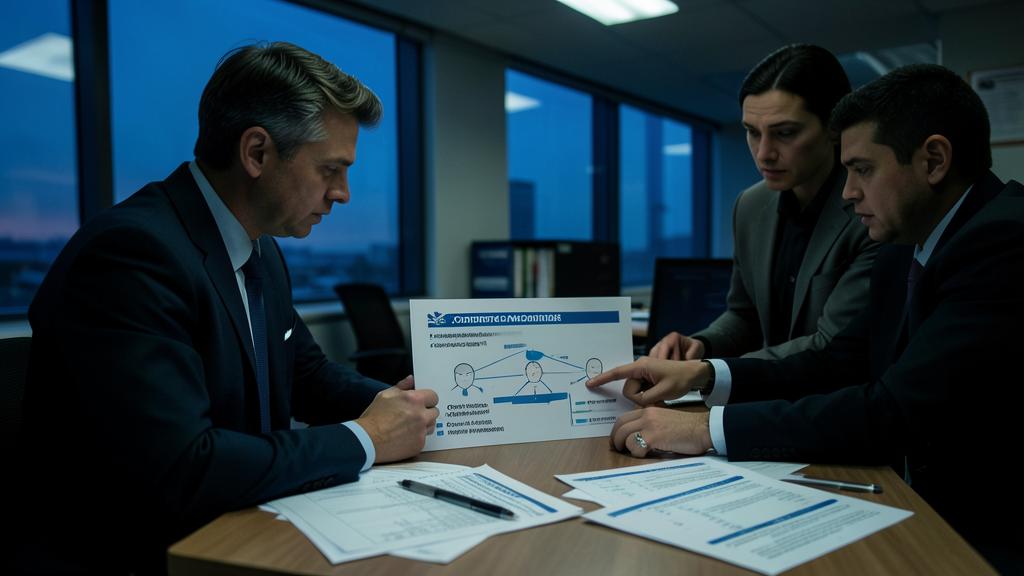
Two grey areas remain, better addressed in advance than discovered in the interview room. The first is a designated person shared between two operators, a frequent situation in groups and among specialised service providers: each authority reviews the file on its own side, but availability does not double, and the declaration made to one must be consistent with the one made to the other. The second is an acting appointment that settles in: bounded and notified, it is manageable; silent and prolonged, it is one of the simplest findings to raise, since it shows up on an outdated organisation chart. For anyone preparing to take up a post, the practical consequence is clear: the application that wins acceptance is not the one stacking up the most flight hours, it is the one that proves, with supporting documents, exactly what the person has the power to decide alone — and to whom they answer for it.
This text describes a mechanism, not a binding requirement: the regulation applicable in the operator’s state, the means of compliance adopted by the authority, and the operator’s approved documentation prevail over everything above, including where they lead to a stricter reading of the combination.
Questions fréquentes
Can the same person hold two designated functions?
Yes, this is common in small operations and both systems provide for it. The authority then examines two distinct things: the person’s real capacity to take on the combined scope, and the absence of a control link between the two functions. The first point is demonstrated with documents: contracted proportion of time, deputisation, volume of activity. The second is not demonstrated, it is settled by redrawing the organisation.
Can the head of compliance monitoring also run an operational domain?
Not in the general case, because they would have to audit the domain they run and validate the corrective actions of their own department. This is the combination authorities refuse without even discussing the candidate’s career path. The usual solution in a small organisation is to contract the audit out to a third party, with guaranteed access to records and a report addressed directly to the accountable manager.
Can the accountable manager also be a designated person?
The authority can accept this in very small operations, but it then looks at one precise question: through which channel a finding can leave the company without passing through him. It must therefore be shown that an independent audit exists, and that it is neither commissioned nor renewed by the person concerned. Without that channel, no one is left above the combination to arbitrate.
Can a designated person work for two different operators?
Nothing forbids it in principle, and the practice exists in groups as well as among certain service providers. Each authority reviews the file on its own side, but the availability declared cannot be counted twice: the proportions announced to both operators must be consistent with each other and verifiable against contracts. It is the inconsistency between two declarations, more than the sharing itself, that causes acceptance to fail.
What happens to an accepted combination when the fleet grows?
The acceptance was granted for a given scope; substantial growth exceeds it without any document announcing the fact. Good practice is to write into the initial application the triggering event that will reopen review of the combination — adding a type, opening a base, crossing a volume of activity. Failing that, the question comes back during an oversight visit, and it comes back in the form of a finding.
Must an acting appointment for a designated person be notified to the authority?
As a general rule, yes, once it goes beyond a one-off nature, and it is the operator’s change management procedure that sets its limits and its permissible duration. An acting appointment that is bounded, notified, and given to someone who does not report hierarchically to the absent post holder is managed without difficulty. An acting appointment that settles in without a file is one of the simplest findings to raise, since it can be read directly off an outdated organisation chart.


Leave a Reply
You must be logged in to post a comment.