
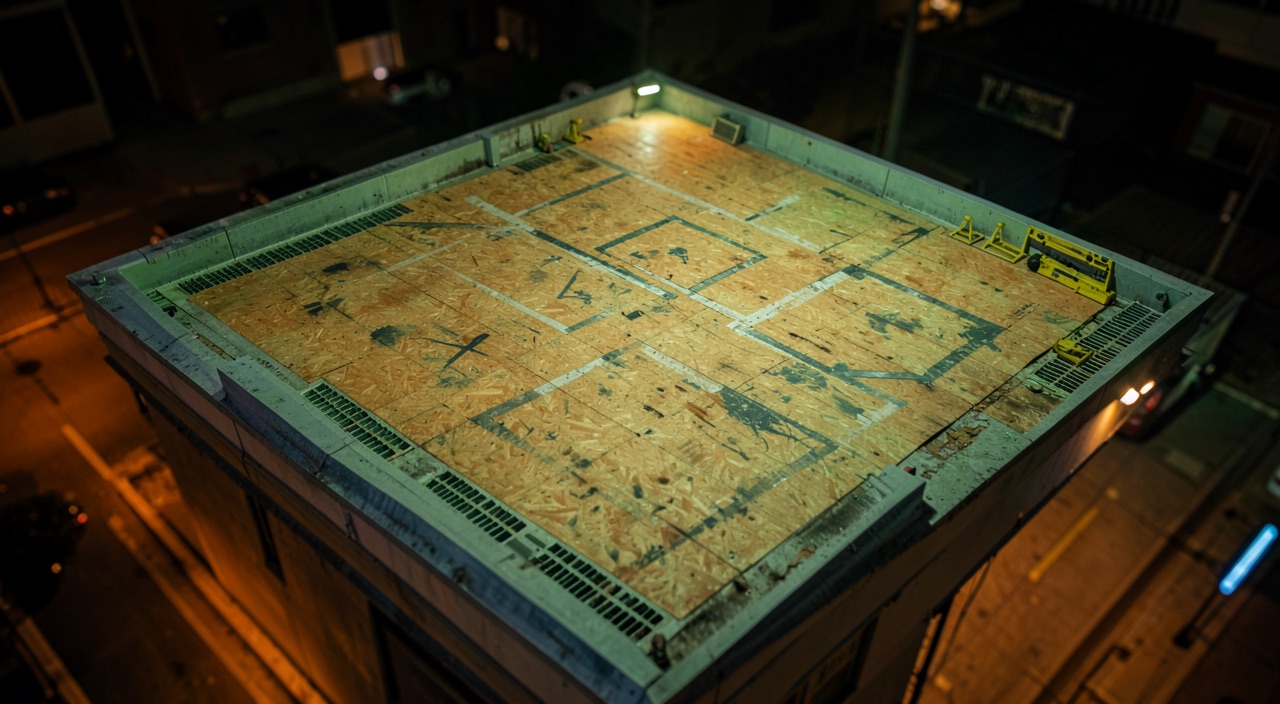
The program promised four passengers on a twenty-minute leg. On the day of the flight, the destination site offers only one approach corridor, the wind has settled crosswise, the charging bay is booked until the next slot, and the aircraft departs with three seats filled. None of these constraints come from the machine: the site had fixed the mission before the crew ever opened the performance chapter.
The aircraft’s footprint dictates the site, never the reverse
The geometry of a vertiport is derived first from a single value: the largest overall dimension of the reference aircraft, rotors or propellers turning. It is denoted D, and it drives in cascade the touchdown and lift-off area, the final approach area surrounding it, the safety area that encircles the whole, then the obstacle-free surfaces that rise from the edges. A site is therefore not sized for a mass or a category of aircraft: it is sized for a D.
The operational consequence is blunt. A vertiport laid out for a given D does not accommodate a wider machine, even if the structure supports its mass and even if the corridor is clear. The point is sensitive on converted heliports: the geometry there was calculated for a rotorcraft of an earlier generation, and margins that look generous to the eye are already consumed by the original D.
These margins are not decorative. The safety area absorbs the lateral scatter produced by wind, by the imprecision of final guidance and, above all, by the trajectory deviation of an aircraft that has just lost a source of thrust. It is also the surface that must remain physically clear: a service vehicle, a skip, a generator set parked for five minutes removes from the site part of what made the manoeuvre possible in the first place. The file describes an ideal site; the crew lands on the one that exists that day.
The approach is not a line, it is a volume
Above the pad, the design specifications reserve an obstacle-free volume that no structure may penetrate, and from which the approach and departure corridors extend. Two options are possible: a volume open in every direction, or a set of oriented corridors. The second is the rule in cities, for want of sufficient clearance to hold the first.
A single corridor carries an underestimated operational cost: it ties the site’s availability to wind direction. As soon as the crosswind or tailwind component exceeds the flight manual limitation, the site is no longer usable, whatever the visibility. Two corridors sufficiently separated in azimuth are worth, in departure regularity, far more than an extra pad.
The approach to a vertiport is not just a straight line but a protected 3D space. If obstacles block this space, the aircraft can’t land safely. Even a small obstacle like a parked vehicle can make the approach impossible.
A vertiport in downtown Paris has a single approach corridor to the east. On a day with a strong westerly wind, the crosswind component exceeds the aircraft’s limit, and the vertiport must close. Passengers must wait for the wind to shift or take an alternate route.
That interruption must itself stay within the protected volume: a go-around that leaves the corridor is an improvised manoeuvre above an urban fabric, with a heavy machine and a depleted reserve. On a single-corridor site, it uses the same lane as the approach, which rules out two simultaneous movements.
Finally, the urban environment moves: a construction crane erected a few hundred metres away penetrates a clearance surface for several months. The easement protects the volume legally, it does not clear it physically, and the information must reach the crew before departure.
The failure trajectory fixes the takeoff mass
Rotorcraft crews know the reasoning. In the most demanding performance class, a rooftop heliport is left only at a mass that allows, from a decision point, either to reject and set back down on the pad, or to continue clearing the obstacles with one less power source. The mass for the day is therefore not the certificated one, but the smallest of the limits imposed by temperature, altitude, wind and site geometry.
The framework now being built for vertical takeoff aircraft picks up this same logic differently, distinguishing two levels of operation. The more demanding one requires, after the critical failure, continuation of the flight to a safe landing; the second expects only a controlled emergency landing. Commercial passenger transport over populated areas is attached to the more demanding level in the European work, but the detail of the criteria must be read in the text in force on the day of the flight, not in a summary. Yet continuing presupposes somewhere to go, and controlling presupposes a surface that will accept the aircraft: it is the ground around the site that decides, not the aircraft.
Add to this the effects specific to an elevated pad: density altitude on a hot day, downwash recirculation against parapets, loss of lift near the edge, turbulent wake from neighbouring buildings. Hence the rule: on a rooftop site, the only honest reference is out-of-ground-effect hover performance. The downwash, finally, forbids the presence of personnel and light equipment within a radius that extends beyond the safety area.
The ground supplies energy, not power on demand
The charging power shown on a site’s data sheet is an equipment capacity, never a guarantee: what actually limits it is the building’s or plot’s electrical connection, a subscribed power level, shared between the bays, sometimes capped at peak hours and backed by a buffer storage that empties faster than it refills. Two aircraft present at the same time do not each receive the catalogue value.
Chemistry adds its own limit. Fast charging slows near the top of the range, and it slows further when the cells are hot, that is, precisely just after a flight. An aircraft that arrives with a lukewarm pack does not recover its energy at the advertised rate, and thermal conditioning itself consumes power. The resulting downtime is paid for in the site’s throughput.
A vertiport’s charging power is not guaranteed. If multiple aircraft are charging at the same time, they won’t get the full power listed. Also, hot batteries charge slower, which can delay flights and reduce the number of flights per day.
A vertiport in New York has two charging bays but only one pad. On a busy day, two aircraft arrive at the same time. The first aircraft charges at the pad, taking 45 minutes. The second aircraft must wait, even though there is a free charging bay, because the pad is still occupied. If the vertiport had a separate charging bay, the second aircraft could charge while the first one is still on the pad, reducing delays.
Hence a rule that surprises operators coming from conventional aviation: a site’s capacity is not measured by the number of landing pads, but by the time each one is unavailable. Separating the pad from the charging bays, even by a few dozen metres, transforms throughput far more reliably than adding a second pad, at the cost of ground movement whose geometry likewise depends on D.
The trap. The site data sheet gives dimensions and a charging power; it says neither what occupies the safety area that day, nor how many aircraft are sharing the connection at the time of your arrival. A cherry picker parked directly under the corridor, a bay out of service, and the failure trajectory assumed in the file no longer exists. The admissible mass drops while the flight is already loaded, and the only variable still adjustable is the number of passengers.
The alternate is counted in energy, not in distance
The classic reasoning, an alternate at so many miles and so many minutes, transposes poorly to electric propulsion. A battery-powered aircraft does not get lighter in flight: the mass remains that of takeoff all the way to landing, specific consumption therefore does not decrease over the course of the mission, and the reserve is not replenished by any offloading effect. What is set aside for the diversion is taken once and for all, at the mass calculation, and is subtracted from what is carried.
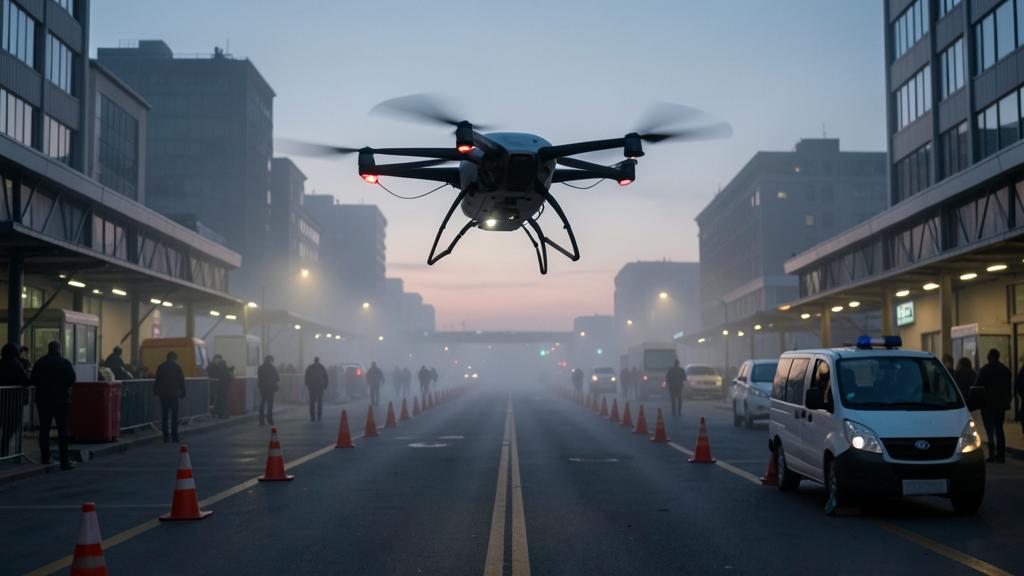
For electric aircraft, the alternate airport is not just about distance. It’s about how much energy the aircraft has left after the flight. If the alternate is too far, the aircraft may not have enough energy to get there and still have a reserve.
An eVTOL aircraft is planning a 50-mile flight with an alternate 20 miles away. On a hot day, the aircraft’s energy consumption increases, and the alternate may no longer be within range. The crew must reduce the payload (passengers or cargo) to ensure they have enough energy to reach the alternate if needed.
The second difference lies in usable energy, which is not installed energy. The usable range shrinks with cell ageing, with cold as with heat, and the power available at the end of the range is not the power available at the start. An alternate that works with a new pack may no longer work after enough charge cycles, for the same mission and the same mass, without a single line of the programme having changed.
The third is the most often forgotten: the alternate must accept the aircraft, not merely welcome it. A pad compatible in size but lacking energy is a one-way alternate, where one lands and does not depart again the same day. Three criteria must therefore be held together: geometry, obstacle environment and energy available at the expected time, with the same rigour as for the destination.
| Alternate chosen | Draw on energy | Weak point | Effect on payload |
|---|---|---|---|
| Return to the departure vertiport | Maximal around the midpoint of the leg | Weather often correlated with that of the destination | Moderate penalty if the leg is short |
| Second pad at the same site | Near zero | Covers neither local weather nor an infrastructure failure | Low penalty, low protection |
| Third-party vertiport a few miles away | Fixed and predictable | Bay availability, aircraft size compatibility | Penalty proportional to distance |
| Conventional heliport or aerodrome | Often the highest | No charging energy on site | Heavy penalty, delayed return to service |
The right reflex. Convert the alternate into energy before converting it into distance. At the day’s mass, wind and temperature, what fraction of usable energy remains after the mission, the diversion and the reserve? The number that decides is neither the displayed range nor the site’s nominal power: it is that fraction, and it is recalculated on every rotation.
Rooftop or ground-level, two families of constraints
The two layouts do not impose the same limits, and it is essential to know which one will bite first. A rooftop pad is governed first by the geometry of the building and the aerology of the surroundings; a ground pad, by the far obstacle environment and the management of people. The structure only reminds the crew of itself the day one wants to lift the aircraft on jacks.
| Element | Rooftop pad | Dedicated ground pad |
|---|---|---|
| Available geometry | Inherited from the building, rarely extendable | Fixed by the layout, extendable if land allows |
| Obstacle environment | Dense and mobile: cranes, antennas, neighbouring buildings | More stable, but fencing and traffic to manage |
| Aerology | Recirculation over parapets, building wake, loss of lift near the edge | Clean ground effect, boundary-layer turbulence |
| Structure | Floor bearing capacity, dynamic loads, support points | Slab and drainage, easier to hold |
| Energy | Building connection, long cable runs | Dedicated connection, easier to size |
| Rescue and evacuation | Access via stairwell, extended response time | Direct access for ground resources |
| Dominant limitation on mass | Out-of-ground-effect hover and failure trajectory | Corridors and distant obstacles |
What to check before signing off on a programme
A route programme is judged on three documents rarely consulted together: the site’s design data sheet, the performance section of the flight manual, and the operations manual. The question to ask of the first is the D value adopted and the date of the last obstacle survey; of the second, out-of-ground-effect hover performance at the temperatures actually encountered; of the third, the internal rule for choosing the alternate and how it expresses the reserve, in flight time or in fraction of usable energy.
Grey areas remain, and are acknowledged as such. Reserve criteria for electric propulsion are not yet stabilised everywhere in the same way, standardisation of charging interfaces is still progressing, and the status of an alternate lacking energy varies from one operator to another. These points are settled in the approved documentation, site by site, and deserve to be asked in writing rather than on the morning of the flight.
For anyone preparing a qualification in this segment, the challenge lies less in the machine than in reading a site: being able to say, in front of a plan, which limit will bite first and what it costs in seats. It is the question asked in technical interviews, as shown by exchanges within the FL330 professional community, and the FL330 training programmes address this reading before handling the machine itself.
The applicable text, the flight manual limitations and the operator’s approved documentation take precedence over the above: this article describes a mechanism, it does not replace site data, an approval, or a performance calculation.
Questions fréquentes
Why does the maximum takeoff mass change from one vertiport to another?
Because the mass adopted is not the certificated one but the smallest of the limits imposed by the site on the day of the flight. Temperature and altitude fix out-of-ground-effect hover performance, corridor geometry fixes the flight path available after a critical failure, and the chosen alternate draws its own share of energy. The same aircraft may therefore carry one fewer passenger departing from a hot rooftop pad with a single corridor.
Can an existing heliport serve as a vertiport?
Often yes for the structure, rarely as is for the geometry. A heliport’s dimensions were calculated from the reference footprint of a given rotorcraft, and a wider aircraft requires reworking the pad, the safety area and the clearance surfaces. Add to that the ground energy supply and traffic flows, which do not exist on a site designed for fuel-based rotations.
How many corridors does a site need to be reliable?
A single corridor ties the site’s availability to wind direction: as soon as the crosswind or tailwind component exceeds the flight manual limitation, the site is closed for the aircraft concerned. Two corridors sufficiently separated in azimuth bring more regularity than a second landing pad. It is a criterion to check before adding a route to the programme, not afterwards.
How should an alternate be chosen for an electrically powered aircraft?
By reasoning in energy rather than distance. Mass does not decrease in flight, so specific consumption does not fall, and the energy set aside for the diversion is lost as soon as the mass calculation is made. The alternate must also be compatible in size, usable given the obstacle environment, and have energy available at the expected time, otherwise it only permits a one-way trip.
Is the charging power shown by a site the power you actually receive?
No: it is an equipment capacity, bounded by the site’s electrical connection and shared between the bays in service. Chemistry adds its own limit, since charging slows near the top of the range and when the cells are hot, which is exactly the case right after a flight. The real downtime should be asked of the site, never inferred from the data sheet.
Does the number of landing pads alone describe a vertiport's capacity?
No, the quantity that matters is the time each pad remains unavailable. A site where charging takes place on the pad itself keeps it occupied for the whole sequence, whereas a site with separate bays only uses the pad for arrival and departure. Separating the pad from the bays improves throughput far more reliably than adding another pad.


Leave a Reply
You must be logged in to post a comment.