
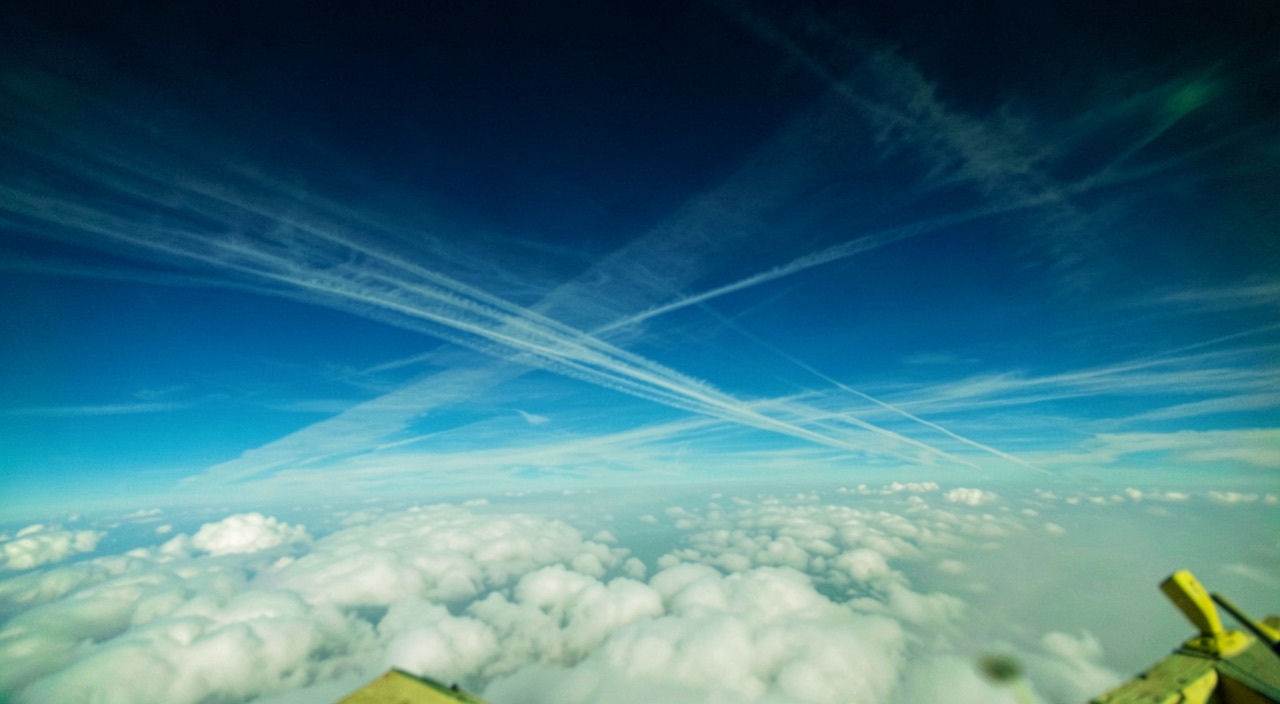
A long-haul night flight over the Atlantic leaves behind a contrail that does not close up: it spreads for hours and ends up as a veil of cirrus. In the operator’s ledger, the same flight will have produced nothing more than a line of tonnes of carbon dioxide. Between the two lies everything that fuel composition can change, and none of what the accounting knows how to record.
What Happens to the Plume in the First Seconds
At the nozzle exit, the plume is hot, laden with water vapour and particles. It mixes with the ambient air within a few tenths of a second, and its state traces a straight line in the temperature/vapour-partial-pressure plane. A contrail appears if this mixing line reaches saturation with respect to liquid water: this is the Schmidt-Appleman criterion. Its slope is set by the fuel’s water emission index, on the order of 1.2 kilograms per kilogram burned, by the ambient pressure, and by the overall propulsive efficiency.
This last term produces a counter-intuitive result. The more efficient the engine, the greater the share of energy leaving the aircraft as thrust, and the less heat remains in the plume to keep it above the saturation point. The mixing line steepens and touches liquid saturation at higher ambient temperatures. A latest-generation engine therefore forms contrails over a wider range of altitude and season than the one it replaces. The fuel-burn saving is real; the widening of the domain appears on no balance sheet.
When an aircraft engine burns fuel, it releases hot gases that mix with the cold air outside. If this mix reaches a certain humidity level, it forms ice crystals, which create contrails. More efficient engines produce less heat, so they can form contrails even in slightly warmer air. This means they might create contrails more often, even though they burn less fuel.
A Boeing 787 Dreamliner flying at 35,000 feet in winter, with an outside temperature of -50°C and high humidity, will produce a persistent contrail. Even though its engines are highly efficient, they still release enough water vapor to form ice crystals that last for hours. A less efficient aircraft might not form a contrail in the same conditions because its hotter exhaust keeps the plume above the saturation point.
This first threshold is thermodynamic: it tells whether crystals form, nothing about their lifetime.
Persistence Is Not Decided Inside the Engine
Everything else is decided by the air being flown through. Sub-saturated with respect to ice, it makes the crystals sublimate within a few seconds to a few minutes, and the contrail closes up behind the aircraft. Supersaturated, it feeds them: they draw on the ambient vapour, grow, the contrail survives, spreads under the effect of wind shear, and eventually becomes indistinguishable from natural cirrus. These layers are thin, irregular and perfectly invisible, with no radar signature. The only immediate clue remains the contrail of nearby traffic at the same level.
The sign of the radiative balance then depends on the time of day. A contrail intercepts upward-travelling infrared radiation at any hour: this effect warms. By day, it also reflects a share of solar radiation, which partially offsets this. By night, only the warming component remains. A night flight, in winter, in cold and humid air, on a dense route, ticks every box.
Aromatics, Naphthalenes, Sulphur: The Chemistry That Sets the Crystal Count
The number of crystals in a young contrail is, to a first approximation, the number of particles able to serve as condensation nuclei. In a conventional engine, these are first and foremost soot, non-volatile particulate matter or nvPM. It forms in the fuel-rich zone of the combustor: aromatic rings are not cracked there into light fragments the way paraffins are, but instead feed directly into the growth of polycyclic aromatic hydrocarbons, the precursors of the nuclei. At equal equivalence ratio and temperature, a more aromatic fuel produces more soot, and it is the naphthalene fraction, not the total, that governs this.
The specification bounds both ends. A ceiling on aromatics, on the order of a quarter of the volume. And, for blends containing synthesised components, a floor of a few percent whose rationale is not chemical but mechanical: a fully paraffinic fuel does not swell elastomers, and a system designed around aromatic kerosene weeps at the seals. It is this material constraint, not combustion, that bounds the blend ratio, and the admissible ceiling is set production pathway by production pathway, never once and for all.
Sulphur follows a different path. It does not form soot; it oxidises into sulphur dioxide and then, in part, into sulphuric acid, which nucleates ultrafine volatile particles in the cooling plume. As long as soot dominates, these barely count; they take over as soon as soot collapses. De-aromatising without desulphurising therefore shifts the problem more than it solves it. The specification tolerates on the order of a few tenths of a percent by mass, well above what a typical batch actually assays at, and the hydrotreating that lowers sulphur also lowers aromatics: the two levers are linked at the refinery.
| Parameter | Aromatic-rich kerosene | Strongly paraffinic blend |
|---|---|---|
| Aromatics and naphthalenes | Close to the specification ceiling | Lowered, bounded by the elastomer floor |
| Sulphur | Variable depending on the refined feedstock | Very low after hydrotreating |
| nvPM in cruise | Plateau, plume saturated with nuclei | Can shift into the sensitive zone |
| Crystals formed | Numerous and small | Fewer, larger |
| Contrail lifetime | Long if the air is supersaturated | Reduced under equal conditions |
| What gets accounted for | Combustion emissions | Only the upstream life-cycle credit |
The Threshold: Less Soot Does Not Mean Proportionally Less Contrail
The relationship between emitted soot and formed crystals is not proportional, and this is the most widely misunderstood point on the subject. At the levels of a conventional engine, the plume is saturated with nuclei: vapour is the limiting factor, it is shared out among the germs present, and removing a fraction of them changes almost nothing. This is the plateau regime. Below a threshold that depends on the engine and the thrust setting, each particle removed means one fewer, larger crystal that sediments faster: the contrail thins optically and lives for a shorter time. Lower still lies a floor, that of ambient and volatile particles.
Reducing soot in jet fuel doesn’t always reduce contrails. If there’s enough soot, cutting it a little won’t change the number of ice crystals much. But if you cut soot a lot, the contrail might become thinner and shorter. The key is finding the right balance to make a real difference.
An Airbus A320 with a standard engine burns fuel that produces 100 million soot particles per kilogram. If the fuel is slightly modified to reduce soot by 10%, the contrail might not change much because the plume is still saturated with nuclei. But if a new engine design cuts soot by 90%, the contrail could become much thinner and disappear faster, especially in dry air.
The practical consequence is unwelcome. A weakly blended mixture, which lowers aromatics by a few percentage points, may change nothing because it does not take the engine off the plateau. Conversely, a staged lean-burn combustor, which cuts cruise soot by an order of magnitude, places the same engine in the sensitive zone without a single drop of fuel having changed. The two levers do not add up: the second decides whether the first is of any use at all.
Measuring What One Claims to Credit
On the engine side, certification has moved beyond the sole smoke number to mass and number limits on non-volatile particles, with a standardised sampling line. Standardisation is not a mere detail: the line itself destroys a share of the particles through diffusion and thermophoresis, and without a conventional correction, two test rigs do not give the same figure. The hard point remains the transfer from the test bed to cruise: tests are conducted on the ground, whereas the contrail forms at altitude with different combustor inlet pressures.
On the aircraft side, verification relies on formation flights: an instrumented aircraft samples the plume of the one flying a few lengths ahead of it, with particle counters and crystal microphysics instruments on board. These flights have established the link between aromatics, soot and crystals, but they yield physics, not a scale: no one has derived from them a credit factor applicable flight by flight.
The certificate is not the molecule. Buying by mass-balance or attribute registry means acquiring an environmental attribute, not a physical batch. The actual blend goes into the tank of the airport that received it, and that is where it produces less soot. A flight credited under a purchase may therefore have burned strictly conventional kerosene: the carbon gain holds at the system level, but the effect on that particular flight’s contrails is nil. Attributing a non-CO2 benefit to an identified flight on the strength of a certificate alone is false.
Why the Gain Stays Off the Books
The global offsetting scheme for international aviation counts carbon dioxide, and carbon dioxide alone; the European emissions trading market works in the same unit. The reduction credited to a sustainable fuel is a life-cycle reduction, from well to wake, and it comes almost entirely from upstream of the supply chain. At the nozzle, burning a kilogram of paraffin releases substantially as much carbon dioxide as a kilogram of kerosene; the higher hydrogen-to-carbon ratio shaves off a few percent per unit of energy, no more.
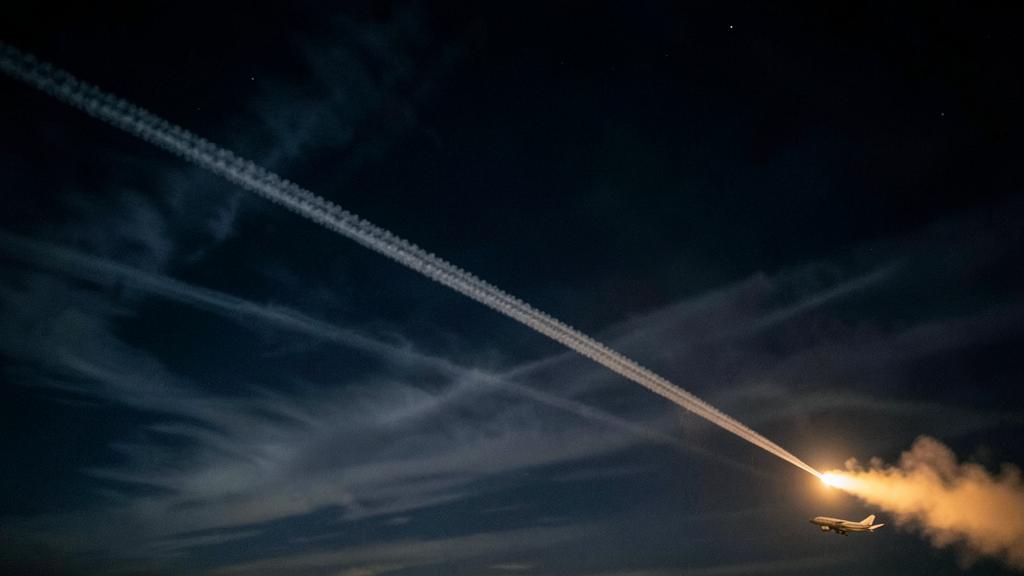
Airlines and regulators focus on CO2 emissions because they’re easy to measure and track over time. Contrails and other non-CO2 effects are harder to account for because they disappear quickly. Since CO2 stays in the atmosphere for centuries, it’s the main target for reducing emissions. Contrails, on the other hand, last only hours, so they’re not included in most climate calculations.
A Boeing 747 flying from New York to London emits about 150 tonnes of CO2. This CO2 will stay in the atmosphere for hundreds of years, contributing to global warming. The same flight might also produce a contrail that lasts for a few hours, trapping heat in the atmosphere during that time. However, because the contrail disappears quickly, it’s not counted in the same way as CO2 in most climate agreements.
The fundamental sticking point is the unit of account. Carbon dioxide is a stock: a tonne emitted today still weighs the same in a century. A contrail is a flow: it forces for a few hours then disappears without a trace. Converting the second into the unit of the first requires choosing a time horizon, and that choice changes everything: on a short horizon, the contrail effect dominates a flight’s balance; on a long horizon, it becomes anecdotal. Neither convention is wrong, they simply tell two different stories. A regulator that puts a price on the tonne cannot live with this ambiguity.
Verification adds a further difficulty. Same aircraft, same fuel, same crew: forcing varies enormously depending on the day, the hour and the flight level. Published studies converge on one point: a small fraction of flights, on the order of a few percent, carries most of the forcing attributed to contrails. An accounting scheme based on fuel uplift is structurally blind to this. The European framework therefore began with the only feasible thing: monitoring and reporting without valuation.
| Effect | Duration | Instrument that counts it | Sticking point |
|---|---|---|---|
| Combustion carbon dioxide | Centuries | Allowances, offsetting, reporting | None, proportional to fuel burned |
| Upstream carbon dioxide | Centuries | Life cycle, attribute certificates | Traceability of the batch and the feedstock |
| Contrails and induced cirrus | Hours | Monitoring and reporting only | Horizon, forecasting, attribution |
| Sulphate aerosols | Days to weeks | No dedicated instrument | Direct and indirect effects of opposite sign |
| Nitrogen oxides and ozone | Months to decades | Engine emission standards | Response depends on latitude |
Ask for the batch’s certificate of analysis, not the blend percentage. The refinery bulletin gives the total aromatics content, often the naphthalene fraction, and the sulphur content: the three quantities that govern soot. The blend ratio says nothing as long as the composition of the base kerosene is unknown, and two deliveries at the same percentage can fall on either side of the threshold that matters.
Avoiding Rather Than Diluting
Since persistence depends on the air being flown through and not on the fuel, the most direct lever is not chemical: it consists of not flying through supersaturated layers. Since a small fraction of flights carries most of the forcing, vertically diverting only those costs very little fuel relative to the fleet: on paper, the fuel spent on diverting remains out of all proportion to the forcing avoided.
The sticking point is forecasting. Numerical models poorly represent humidity with respect to ice at cruise level: the variable is weakly constrained by observations, and a few points of error can tip a region from supersaturated to dry. An avoidance manoeuvre decided on a false forecast burns fuel without avoiding anything. Added to this is air traffic control: requesting a non-standard level on a busy route is not neutral, and the level optimal for contrail avoidance is not the one optimal for fuel burn. Practices diverge, as shown by discussions on the community’s technical forums.
What to Go and Verify at Home
Three checks are worth more than a sustainability report. The first: does the internal memo describe a physical delivery at a given station, or an attribute purchase? Conflating the two exposes the organisation to a misleading claim. The second concerns flight preparation: what humidity source at altitude, and what fuel-penalty rule has the operator set itself for accepting or refusing a diversion? Without a written rule, the decision falls back in flight onto the commander, without cover. The third concerns hardware: the elastomer compatibility limits of the fuel received, since that is where the blend ratio is ultimately bounded.
For anyone preparing for a qualification or a technical interview, the subject has changed in nature. Reciting a share of global emissions is no longer enough: one is expected to be able to explain why a more efficient engine forms contrails over a wider domain, why a weakly blended mixture may change nothing, and why a certificate moves no molecule. These three lines of reasoning appear in the technical modules of our training catalogue.
The grey area that remains is that of responsibility. The day contrail avoidance becomes an enforceable flight-plan constraint, it will be necessary to say who decides it in flight, at what fuel penalty, and with what protection in the event of a deviation. No regulatory text answers this today.
This article sets out mechanisms and constitutes no instruction whatsoever. The applicable regulatory text, the specification of the fuel delivered, and the operator’s approved documentation prevail over everything above; it is their version currently in force that is authoritative.
Questions fréquentes
Does a more fuel-efficient engine form fewer contrails?
No, rather the opposite as far as formation is concerned. Higher propulsive efficiency leaves less heat in the plume, which steepens the mixing line and causes liquid saturation to be reached at milder ambient temperatures. The range of altitude and season over which a contrail can appear therefore widens. The reduction in fuel burn does not mechanically offset this extension.
Does a fuel blend with a low incorporation rate reduce contrails proportionally?
No. The number of crystals depends on the number of particles available as nuclei, and this relationship has a plateau: at the emission levels of a conventional engine, vapour is the limiting factor and removing a few percent of soot changes almost nothing. The benefit only appears below a particle-number threshold. A weakly blended mixture may therefore produce no measurable effect on the contrail.
Why are non-CO2 effects not included in the emissions trading market?
Because they would need to be converted into the unit of carbon dioxide, which requires choosing a time horizon. A contrail forces for a few hours, a tonne of carbon dioxide weighs for centuries: depending on the horizon chosen, the same flight is assigned a very different climate weight. Added to this is the impossibility of verifying the effect flight by flight, since it depends on the humidity encountered. The European framework therefore began with monitoring and reporting, without valuation.
Does fuel sulphur play a role in contrail formation?
Yes, but only at a later stage. Sulphur does not produce soot; it oxidises to form ultrafine volatile particles that remain negligible as long as soot dominates the nucleus count. As soon as soot collapses, these particles become the dominant source and limit the expected benefit. Reducing aromatics without reducing sulphur therefore does not deliver the full gain hoped for.
What should be requested from the supplier to assess the non-CO2 potential of a delivery?
The batch’s certificate of analysis, not just the blend percentage. It provides the total aromatics content, often the naphthalene fraction, and the sulphur content: the three quantities that govern soot production. Two deliveries advertised at the same blend percentage can differ by several points of aromatics depending on the base kerosene used.
Does contrail avoidance cost a lot of fuel?
Little, provided that only the flights concerned are diverted, since a small fraction of traffic carries most of the forcing. The real cost lies in the quality of the humidity forecast at cruise level, which remains poor: an avoidance decided on a false alarm burns fuel while avoiding nothing. The balance is only favourable if the correct-detection rate is good, and air traffic control must still grant the requested level.


Leave a Reply
You must be logged in to post a comment.