

A producer announces that a pathway is ready, a supplier signs an offtake agreement, and the practitioner’s question remains open: at what point does this molecule become Jet A-1 on a delivery note? Between the laboratory flask and the fuelling arm lies a sequence of tests in which each step costs far more than the one before, and whose outcome is not decided before a certification authority.
Approving a fuel is not certifying an aircraft
The vocabulary is misleading. Bringing a new synthesis pathway into the fuelling chain goes through neither a type certificate, nor a supplement, nor a flight manual revision. It is a matter of entering a production pathway into a product specification: obtaining that a hydrocarbon manufactured other than by distillation of a crude can be delivered under the same grade name, with the same certificate of analysis, through the same buried pipelines and the same tanker trucks.
The constraint has a name in the trade: the fuel must be drop-in, indistinguishable in use. Indistinguishable does not mean equivalent on average: it means that no seal, no high-pressure pump, no deposit coalescer, no injector, no zero-fuel-weight calculation should behave any differently than with distillate kerosene. The fleet in service includes airframes designed decades ago and fuelling networks that no one will replace. Adapting the fleet to the fuel would cost far more than adapting the fuel to the fleet: the entire burden of proof rests on the product, and on it alone.
The governance consequence often surprises those coming from airworthiness. The dossier is not filed with a civil aviation authority. It is built within a standards body, reviewed by airframe and engine manufacturers, and concluded by a subcommittee vote. Regulations and authorities then adopt the specification by reference, exactly as they adopt that of conventional kerosene. A newly admitted pathway therefore never appears in an airworthiness document: it appears in a specification annex, then disappears, absorbed into the usual commercial grade.
The fuel must work exactly like regular jet fuel in every way. If it doesn’t, the fuel must be changed, not the planes. The approval process is run by experts, not governments, and the fuel disappears into the normal system once approved.
Four stages, and a hundredfold factor on volume
The standardised practice for evaluating new jet fuels breaks the work down into four successive stages, whose guiding idea can be summed up in one sentence: spend as little as possible to eliminate as early as possible. Each stage requires a product volume far greater than the one before — from a few tens of litres for screening to several thousand for the engine test — and each stage acts as a filter. A candidate that fails at the first stage has consumed a few weeks and a few tens of litres; a candidate that fails at the fourth has tied up an engine test bed and burned several thousand litres that first had to be produced.
This progression has an industrial consequence that is often underestimated from the outside: the pathway must grow at the pace of the trials. A producer operating only a laboratory pilot cannot supply the load of an endurance test, and will not fund a demonstration unit before clearing the earlier stages. The approval timeline is therefore as much one of scale-up as of a test programme, which is why the delays run into years.
| Stage | Volume to supply | What is tested | What a failure means |
|---|---|---|---|
| Property screening | a few tens of litres | The properties of the finished-grade specification: density, distillation, flash point, freezing point, viscosity, sulphur, gums, thermal stability, specific energy. | The molecule does not fall within the product’s domain. Reformulation or abandonment, within a few weeks. |
| Fit-for-purpose testing | a few hundred litres | What the specification does not measure: elastomers and metals, lubricity, conductivity, water separation, low-temperature viscosity, additive response. | Product compliant but unsuitable for the network or the components. Lowered incorporation cap, or blockage. |
| Component rig testing | on the order of a thousand litres | Spray quality, lean blow-out, altitude relight, cold start, combustor outlet temperatures, pump wear, injector deposits. | Margin eaten into at a corner of the envelope the crew never visits, yet which remains available to them. |
| Engine test | several thousand litres | Full engine on the test bed: performance mapping against a reference fuel, endurance, then hot-section inspection. | Measurable deviation from the reference, in either direction. Return to the earlier stages. |
Screening: density settles it quickly
The first stage puts the candidate up against the properties of the finished-grade specification, the very ones that appear on a batch certificate of analysis: density at 15 °C, distillation curve, flash point, freezing point, low-temperature viscosity, sulphur, acidity, existing gums, thermal stability, specific energy. Nothing exotic — these are the tests every batch of ordinary kerosene undergoes. Their value lies elsewhere: they are cheap, they are fast, and they are decisive.
For paraffinic products, which make up the bulk of the pathways admitted to date, the verdict is almost always the same. The freezing point is excellent, often well below the grade’s maximum, because the molecule is regular and clean; thermal stability is good, sulphur content is near zero, specific energy is slightly above the minimum, on the order of 43 megajoules per kilogram. But density falls below the floor: a paraffin is less dense than a distillation cut, and the specification imposes a narrow window — on the order of 775 to 840 kilograms per cubic metre at 15 °C for common kerosene grades, the exact bound values being those of the specification table in force. The pure product falls outside the domain, not because it burns poorly, but because it does not weigh enough.
A Boeing 787-9 with full tanks (47,890 kg) would carry 58,500 litres of Jet A-1 at the minimum density of 775 kg/m³. If filled with pure paraffinic fuel at 760 kg/m³, the same volume would only contain 44,160 kg — 3,730 kg less, reducing payload or range by 1,200 nautical miles on a long-haul flight.
This density deficit has a counterpart the crew must keep clearly in mind. The specific energy of a strongly paraffinic fuel is slightly higher than that of conventional kerosene, its volumetric energy slightly lower: for the same fuel weight, a little more energy is carried in a slightly larger volume. On a sector limited by weight, the effect is neutral to favourable; on a sector where the tanks fill up before maximum weight is reached, it is paid for in range.
The trap. Fuelling is measured in volume, the fuel weight loaded is calculated. When the density of the delivered batch departs from the default value used by the station or habitually carried over in flight preparation, the discrepancy is passed on in full to the weight in the tanks: on a long-haul full load, a few units of density quickly add up to hundreds of kilograms. A blend with a high proportion of paraffinic component tends to sit in the low end of the window. The actual density of the batch appears on the delivery note; that is what must feed the calculation, not a routine value. The trap is all the more discreet because the fuelling order is placed by weight, executed by volume, and reconverted to weight: no one along the chain sees the discrepancy, only the gauging reveals it, and it reveals it late.
Fit-for-purpose testing: where a compliant product can still fail
The second stage is the most instructive, because it examines what the specification does not measure. A fuel can satisfy every line of a certificate of analysis and still be unfit to run through a network and through an aircraft. Fit-for-purpose tests focus on the interfaces: materials, components, additives, water.
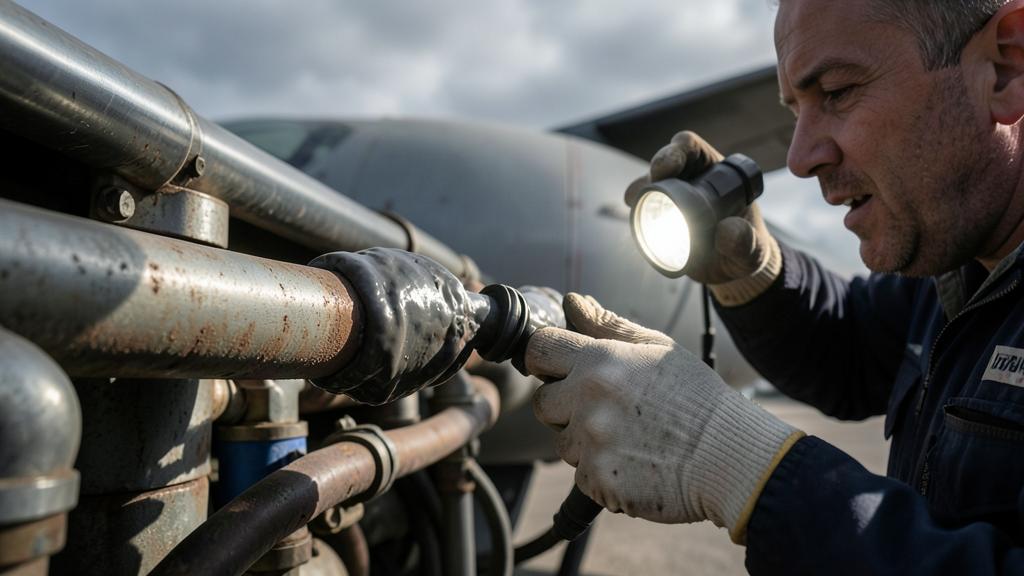
The best-known point concerns elastomers. The aromatic compounds in kerosene dissolve into nitrile elastomer seals and cause them to swell. A static seal that has spent years in an aromatic fuel has taken on its shape and equilibrium state; fed by a product that lacks aromatics, it shrinks back, and the tightness of an old fitting does not always survive. Seepage does not occur on a new test bed: it occurs on aged equipment, on the ground as much as in flight. This particular demonstration is difficult to conduct in a laboratory, and it accounts for much of the engine manufacturers’ caution.
Next comes lubricity — hydrotreatment removes the polar species that lubricated the high-pressure pumps and servo valves, components for which the fuel is the sole lubricant —, electrical conductivity, since a pure paraffin is an excellent insulator and retains charge during high-flow filling, water separation, which governs the effectiveness of coalescers, and low-temperature viscosity, which governs atomisation at exactly the moment it is most needed. Each admits an additive-based response, but an additive is not an answer: it is one more hypothesis, to be demonstrated on the real product.
| Property tested | What it governs | Failure being guarded against | Usual remedy, and what it does not solve |
|---|---|---|---|
| Aromatic content | Swelling of nitrile elastomer seals and sealing compounds. | Shrinkage of an old static seal, seepage at a fuel-system fitting. | Incorporation cap, or a synthetic component itself contributing ring structures. An overall minimum says nothing about the distribution of species: it is the heaviest ones that cause swelling, and two batches at the same percentage are not equivalent. |
| Lubricity | High-pressure pumps and servo valves, lubricated by the fuel itself. | Accelerated wear of components nothing else lubricates. | Lubricity-improver additive dosed at the refinery. It adsorbs onto walls and is depleted along the network; the value at loading is not the value at the fuelling arm. |
| Electrical conductivity | Dissipation of charge during high-flow filling. | Electrostatic build-up in a tank being filled. | Static dissipator additive. Its content decreases over time and with each pass through filters and clay treatment, and a paraffin starts from a lower baseline than a distillate kerosene. |
| Water separation | Effectiveness of deposit coalescers and fuelling filters. | Free water carried aboard, filter icing, an alarm triggered in cruise. | No additive improves it, and earlier additives degrade it. The trade-off is settled upstream and verified on the additised product as it will be delivered, never on the bare product. |
| Thermal stability | Varnish and coke in heat exchangers and on injector nozzles. | Deformed spray cone, then degraded temperature distribution at the combustor outlet. | Margin taken on the test temperature. The specification test is short and deposit formation is slow: only the endurance run of the final stage truly settles it. |
| Low-temperature viscosity | Fineness of the spray at start-up and relight. | Lengthened ignition delay at the very moment margin is shortest. | Bound set by the specification at low temperature. It is measured at a single temperature, whereas start-up draws on the whole domain below it. |
Component rig testing: the corners of the envelope no one visits in line service
The third stage leaves the laboratory for component rigs, and this is where the candidate meets a combustion chamber for the first time. Here spray droplet size at the injector outlet is measured, along with lean blow-out margin, altitude relight envelope, ignition delay on cold-weather start-up, combustor outlet temperature distribution, pump and servo valve behaviour over an extended endurance run, and deposits formed on injector nozzles after prolonged exposure to heat.
This list describes exactly the situations a crew never encounters in normal operation, yet which determine its margins. A relight after a flame-out at high altitude, a start-up after a night outdoors in extreme cold, a go-around with acceleration commanded at full amplitude: these are the points where a difference in atomisation or viscosity translates into a delay. The component rig exists so that these points can be explored somewhere other than in line service, and so that any deviation, should it appear, is reproducible and instrumented.
Deposits deserve a mention of their own. The fuel acts as a coolant before being burned: it passes through heat exchangers and hot lines, and its thermal stability governs the formation of varnish and then coke. A deposit on an injector nozzle distorts the spray cone, shifts the temperature distribution at the combustor outlet, and the bill arrives downstream, on the hot-section parts. The mechanism is slow: no short test reveals it, and that is precisely why the final stage involves endurance rather than performance.
The engine test: proving that nothing happens
The fourth stage takes place on a complete engine, on the test bed. A performance map is established against a reference fuel, an endurance test representative of an operating cycle is conducted, then an inspection follows: borescope examination, removal and expert assessment of hot-section parts, examination of injectors and the fuel circuit. The criterion is not performance, it is the absence of any measurable deviation. A candidate that produced a markedly better result would raise as many questions as a candidate performing slightly worse: a deviation, whatever its sign, signals that something is behaving differently from what the engine’s certification assumed.
A flight test is sometimes conducted, often with one engine fed by the candidate and the other by the reference fuel. It serves as an integration check at the aircraft level — fuel system, transfers, gauging, tank behaviour in cold weather — and, it must be said, as a public demonstration. The technical proof, meanwhile, has already been made on the test bed, where one can instrument, strip down, start again, and control exactly what is done to the engine.
From the research report to the annex: the moment the pathway comes into existence
The results of the four stages are gathered into a research report, submitted for review to airframe and engine manufacturers. This review is no formality: it gives a say to those who bear responsibility for the products, and an unresolved technical objection halts the process. The dossier then goes to a vote in the competent subcommittee, under a consensus procedure in which a negative opinion must be dealt with on its merits rather than overridden by majority — hence delays that look long from the outside, and that are the price of technical unanimity.
What this vote produces is an annex. It describes the process and the nature of the admissible feedstocks, it sets the properties of the pure synthetic component in a table of its own — stricter than that of the finished grade on composition and aromatic content —, and it sets an incorporation cap. The paraffinic families admitted so far commonly cap out at half the volume; pathways delivering a single molecule cap out much lower, on the order of a tenth. This cap is not a chemical boundary: it is the highest proportion for which the test campaign has actually demonstrated equivalence.
What remains is the step that matters to the operator: re-certification. The blend produced is tested against the finished-grade table, property by property. If it passes, it is released as ordinary kerosene and loses all distinct identity in the supply chain. From that point on, from the aircraft’s perspective, there is no longer any « sustainable fuel »: there is Jet A-1, whose quality certificate mentions the origin of the blend. This is also why a batch of pure synthetic component, fully compliant with its annex, is not an aviation fuel until it has been blended and re-tested.
The right reflex. Look for the list of approved fuels in the airframe manufacturer’s and the engine manufacturer’s documentation, never anywhere else. It is the only document that is binding, it names finished grades rather than pathways, and it is updated independently of any commercial communication. Faced with a delivery note, the useful question is therefore not « which pathway?» but « which grade, which density, which quality certificate?»
What remains open, and what should be checked at home
The incorporation cap is the current grey area. Moving to a fully synthetic product requires resolving the aromatics question by some means other than blending: either by producing a synthetic component that itself contributes aromatics, or that contributes cycloparaffins playing a similar role for density and for seals, or by demonstrating that the fleet can do without them. Both routes are being explored, neither is settled by an administrative decision, and the population concerned is not the new fleet but the aged equipment — including the fuelling networks, whose seals are as old as the pipelines.
One side effect deserves to be tracked without being overinterpreted: a strongly paraffinic fuel low in aromatics produces fewer non-volatile particles during combustion. Measurement campaigns are continuing on this point, notably regarding the formation and persistence of contrails. To date, no operational rule follows from this, and it would be unwise to draw an operational conclusion from it in advance or to include it in any argument.
For anyone preparing a qualification, an audit, or taking up a flight-safety post, three points are worth keeping clear. The flight manual has not changed and does not need to change: that is the very meaning of drop-in, and an operator seeking a specific approval to receive a blend would be seeking something that does not exist. The specification, not an airworthiness document, is where a pathway comes into existence and where its cap is written. Finally, the only variable that reaches the flight deck is the batch’s density, because it feeds into the conversion of fuelled volume into loaded weight: everything else plays out upstream of the fuelling arm, in documents the operator receives but does not use in flight. Field feedback circulates mainly among practitioners, notably on the FL330 forums, and it concerns delivery documentation far more than engine behaviour.
The applicable text, the specification in force at the time of delivery, and the operator’s approved documentation prevail in all circumstances over this article, which has explanatory value only.
Questions fréquentes
Does receiving a sustainable fuel require a flight manual amendment?
No, and that is the very principle of the “drop-in” requirement. A pathway is only admitted after demonstrating that it is indistinguishable from distillate kerosene in service, so the finished product is delivered under the usual grade. No special approval is needed to receive a blend; it is the suppliers, not the operators, who carry the incorporation obligations.
Why incorporation caps rather than one-hundred-percent use?
The cap is the highest proportion for which the test campaign has demonstrated equivalence, not a chemical limit. Two mechanisms drive it: the density of paraffinic components, too low to sit alone within the grade window, and the aromatic content that old elastomer seals need to stay swollen. Lifting the cap requires addressing both points, either through a synthetic component that supplies them or through a demonstration covering the existing fleet.
What should be checked on the quality certificate of a blended batch?
The finished grade, which must be one authorised by the airframe and engine manufacturer’s documentation, and the measured density. A heavily incorporated blend tends to sit in the low end of the density window, and this value feeds directly into the conversion of fuelled volume into loaded weight. The originating pathway also appears there, but it has no bearing on how the flight is conducted.
How long does admission of a new pathway take?
It is measured in years. The limiting factor is rarely the laboratory: it is the producer’s ability to supply growing volumes, several thousand litres being required for the engine test alone, followed by the duration of the review by airframe and engine manufacturers and of the subcommittee vote. A pathway very close to an already admitted one progresses noticeably faster than a wholly new chemistry.
Does a blend change fuel consumption or engine performance?
The tests of the final stage are specifically designed to demonstrate the absence of any measurable deviation from a reference fuel, in either direction. The specific energy of a paraffinic component is slightly higher and its volumetric energy slightly lower, which offsets at the level of the finished product. The only practical effect concerns sectors limited by tank volume rather than by weight.
Who ultimately decides that a pathway is admitted?
A standards subcommittee, by consensus vote, after review of the research report by airframe and engine manufacturers. An unresolved technical objection blocks the dossier, giving manufacturers a decisive say. Authorities and regulations then adopt the specification by reference, without a dedicated airworthiness procedure.


Leave a Reply
You must be logged in to post a comment.