
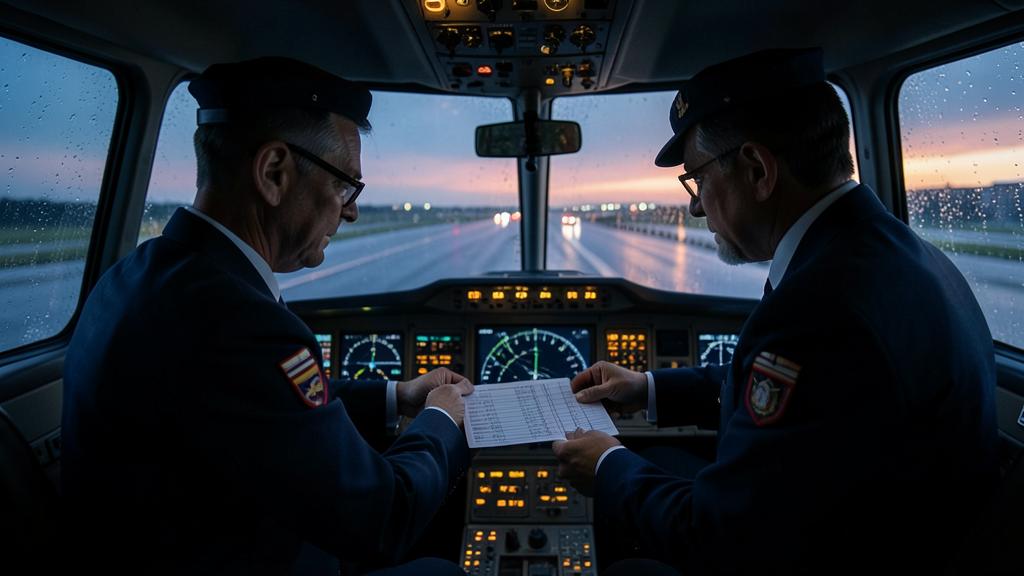
First flight of a mixed crew, a few months after the AOC switch-over. The captain comes from one of the two companies, the first officer from the other, the aircraft arrived with its original fleet, and the laminated checklist stowed in the side pocket is no longer quite the one either of them learned. Nothing is irregular: a single manual applies, it is approved, both pilots have read it and acknowledged receipt. Yet the risk of this period lies neither in that text nor in its approval. It lies in the fact that two operational memories occupy the same flight deck, and neither knows itself to be the minority.
Three clocks that do not run at the same speed
Three clocks A merger is first read as a legal and financial operation, and that is how it is announced. On the ground, it breaks down into three workstreams whose durations have no relation to one another.
The first is administrative: air operator certificate, associated specifications, particular approvals, assistance and insurance contracts. It is settled on a date, because the law requires a date. The second is documentary: a single operations manual, a single standard operating procedures policy, a single minimum equipment list, a single set of aerodrome documentation. It is settled through successive amendments, each approved or simply notified depending on its nature, and it takes months. The third is written nowhere: it is the rewriting of the procedural memory of several hundred or several thousand flight crew members. It is settled through repetition, at the rate of a few sectors a week and, roughly, a few simulator sessions a year.
The speed of this third clock depends directly on the type of operation, and the gap between two fleets within the same company is considerable. A short-haul crew member flies several departures and several arrivals per duty day: the new sequence is repeated a great many times per month, and their memory is rewritten within a few weeks of line flying. A long-haul crew member executes the same sequence only a few times over the same interval, and often executes it at the end of the night, precisely the conditions under which the old version resurfaces. For an identical training plan, the exposure window for a long-haul fleet therefore lasts far longer than for a medium-haul fleet, which argues for concentrating directed pairing and line observation there rather than spreading the effort in proportion to headcount.
The risk window is therefore not the one people assume. It does not open on signing day, when everyone is alert and everyone knows that nothing has yet changed on the flight deck. It opens on the day the single manual comes into force, that is, at the precise moment the organisation considers the operation complete, the working groups disband, and attention drops away. From that point on, a single text applies while two sets of reflexes persist.
The merger has three phases: legal (fast), documents (months), and crew memory (years). The dangerous period starts when documents are unified but crew habits still differ.
An A320 long-haul crew flying 4 sectors per week takes 6 months to fully adapt, while a short-haul crew flying 12 sectors per week adapts in 3 months. The long-haul crew’s first officer still uses the old checklist sequence 4 months post-merger during a night arrival at 3AM.
What merges painlessly, and what resists
The most visible procedures are the least problematic. Engine failure at take-off, decompression, evacuation: these sequences are largely constrained by the manufacturer, carried by type documentation, executed from a display or a quick reference handbook that neither operator has rewritten. Two airlines operating the same aircraft have very little latitude there, and what little there is, is documented in black and white. A gap analysis handles them in a few hours.
What genuinely differs is the company layer, the one nobody calls a procedure because it seems too mundane to deserve the name: who calls out what and when, what level of automation is expected in which phase, from what reference point an approach is declared stabilised, who operates the gear and on whose order, in what order an arrival briefing is conducted, when the configuration is selected, how a checklist is read — called and responded to, or read and actioned —, how much extra fuel is carried and on what justification, who is spoken to first when a defect appears on stand.
This layer has two unpleasant properties. It is executed massively: it fills the first minutes of every departure and the last minutes of every arrival, whereas emergency procedures almost never come out. And it is incompletely written: part of it lives in the manual, another in ad hoc instructions, a third in what instructors pass on without any written support. Comparing two manuals therefore only reveals half of it, and the missing half is precisely the one executed without thinking.
| Criterion | Text gap | Reflex gap |
|---|---|---|
| Where it resides | Between two versions of the documentation | Between the text in force and the trained gesture |
| How it is found | Line-by-line comparison, before the switch-over | Line or simulator observation, after the switch-over |
| Moment it manifests | On reading, on the ground, without consequence | On execution, often under load, with consequence |
| Perception by the person committing it | Immediate: they cannot find what they are looking for | None: the gesture feels fluid and correct |
| Detection by the other pilot | Easy if they read the same version | Uncertain in a mixed crew: they too are translating |
| Cost of correction | An amendment and a distribution cycle | Repetition, hence flying and simulator time |
| Trace left | Amendment log | None, except a voluntary report |
Under load, memory reverts to its most rehearsed version
A gesture performed a few thousand times is no longer recalled, it is triggered. It costs almost no attention, it resists interruption, and it occurs before its author has decided to execute it. A procedure learned a few months ago, by contrast, requires deliberate recall: one formulates it, checks it is not being got wrong, monitors it while executing it. This difference in cost is unimportant on a calm flight. It becomes decisive as soon as attention is taken up elsewhere, by a late runway change, by a minor but chatty technical fault, by a clearance that comes at the wrong moment.
The consequence is counter-intuitive and must be stated plainly: the crew member most exposed to the return of the old procedure is not the first officer who joined after the merger, it is the captain who spent a decade on the standard that has disappeared. Their experience, an asset in every other circumstance, works against them here. And because the old gesture is fluid, it triggers no error signal in them: they do not catch themselves, because they felt nothing go wrong.
The second effect is more insidious: cross-contamination. Two close versions do not replace each other cleanly, they blend. Hybrids then appear, the gesture of one with the call-out of the other, the new sequence interrupted midway by an old automatism. This hybrid appears in neither manual: no one has trained on it, and the other pilot has never heard it, whichever company they come from. This is why a poorly accompanied transition produces situations that neither the old nor the new safety reporting system describes.
Under stress, pilots revert to their most practiced habits. The experienced captain is more likely to fall back to old procedures than the new first officer, even if they don’t realize it.
During a high-workload arrival at Paris CDG, a captain with 15 years on the old standard automatically calls “Gear down” at 1500ft instead of the new standard’s 1800ft, while the first officer (trained 6 months ago) expects it at 1800ft. The captain doesn’t notice the discrepancy until the first officer hesitates to respond.
Crew pairing, the lever that acts fastest
During the exposure window, the operator has few fast levers available. A manual cannot be rewritten overnight, hundreds of crew members cannot be recycled through the simulator in a quarter, and the flying programme cannot be stopped. One variable remains entirely controllable, at low cost and with immediate effect: crew composition, and the choice of standard applied to each flight.
Three policies exist, and they are not equally suited to every moment. Keeping crews homogeneous on their original standard buys time without solving anything: comfortable for the first few weeks, this choice becomes costly because it postpones the debt and makes the final switch-over more abrupt. A single-date switch-over is the clearest and most demanding: it assumes training has been completed beforehand, failing which it instantly turns the entire fleet into crews that are translating. The progressive opening of mixed pairings, on a designated standard and with dedicated preparation, spreads the load, but requires knowing flight by flight who comes from where, which in turn requires a planning system capable of carrying that information and enough instructors to support it.
| Policy | Training load | Exposure to mixed crewing | Reversibility | Main risk |
|---|---|---|---|---|
| Homogeneous crews kept on their standard | Deferred | None while it lasts | Good | Two operations in one; growing debt |
| Single-date switch-over | Concentrated before the date | Total from day one | Low | A training delay contaminates the whole fleet |
| Progressive opening of pairings | Spread out | Growing and chosen | Good | Requires planning to know each person’s origin |
Whatever scheme is chosen, gaps are not distributed uniformly through the flight. They manifest where a procedure is executed, that is, at configuration changes, role changes and phase transitions, and these moments are also when workload rises. Cruise, on the other hand, reveals almost nothing, which is why a long flight can pass without the slightest sign and give the impression the transition is complete.
The briefing as a reconvergence device
In an established crew, the briefing serves to share a plan. In a mixed crew during a transition period, it first serves something else: to establish which grammar is being spoken. This fits in one sentence, before any technical content, and that sentence states three things: the manual and revision applicable, each person’s company of origin, the date of the last training actually completed under the standard in force. This is not a courtesy: it is the information the other pilot needs in order to know whether what they hear next will be a reference or a translation.
Next comes the interruption convention, and this is the part that gets neglected. Flagging a procedural gap in the other pilot is already delicate in ordinary times; during a merger, social load is added, because one of the two companies has seen its text disappear and nobody wants to replay that particular scene on the flight deck. What is needed, then, is a neutral word, agreed on the ground, that does not presume error and does not engage anyone’s pride, along with a resolution rule decided in advance: in case of divergence, the version in force as it appears on the aircraft’s onboard documentation is applied, it is not debated in flight, and it is documented afterwards.
The right reflex: open the first flight of a mixed crew by naming the standard — manual and revision applicable, each person’s company of origin, date of the last training completed under that standard — then agree on the two or three differences that matter for this particular flight, and on a neutral word to flag a gap. Thirty seconds on stand are worth more than a clarification on short final.
The seams, where two systems touch without seeing each other
Operations documentation is only the visible part of the matter. A merger stitches together systems that each have their own internal conventions, and defects lodge at the joints rather than in the middle.
Aerodrome documentation comes from suppliers who do not represent the same objects the same way: the same airfield does not read the same depending on the chart, and the eye looks in the wrong place. Performance calculation tools carry default assumptions — runway condition assumed, reduced thrust, preferential configuration — that are not identical and are not displayed on screen. The consolidated minimum equipment list retains inherited items, with deferral intervals and associated procedures that a crew member coming from the other company has never had to apply. Physical checklists, finally, travel with the aircraft: they are objects, not files, and it is that object the crew reads aloud, whatever revision is in force back at the office.
A borderline case deserves mention, as it is at least as common as the one described so far: the two fleets do not overlap. No flight deck then brings two memories together, since no one changes aircraft type, and it is too quickly concluded that the question does not arise. It simply moves elsewhere. Flight dispatch, flight preparation, ground handling and cabin crew all work for both fleets from day one, with a single set of rules and two inherited ways of applying them. Coordination between the flight deck and the cabin is the most exposed, because it belongs to no manufacturer: preparation signals, pre-landing announcements, the response to an alert raised from the cabin, role allocation during an evacuation. Each company had written these conventions for itself, and they are executed during the same high-workload phases as those on the flight deck.
The trap: identical wording that does not designate the same thing. A gap analysis compares texts and flags what differs; it flags nothing when the two manuals use the same word for two distinct gestures — a call-out that triggers an action for one crew and is merely a statement for the other, the same configuration term expected at two different points in the sequence. This is the one family of gaps that no documentary comparison can uncover, and it is the one that produces the sharpest surprises in flight, since both pilots are convinced they said and understood the same thing.
The second trap: the crew member converted on paper. A file may show the differences course recorded and the new manual acknowledged, while the last recurrent training and the last check were conducted under the old programme, with the old scenarios and the old call-outs, by an instructor who had not yet switched over. Qualification tracking then says « current » where practice says « unchanged ». Checking the date of the session, the programme under which it was conducted and the standard used by the instructor is worth more than checking a box.
What the period must leave as traces
A transition produces information that expires quickly. Gaps observed during the window will not recur once memory has been rewritten: what is not collected at the time is lost, and the next merger, because there will be one in this sector, will start again from exactly the same point.
Two simple provisions change the value of this data collection. The first is to tag reports from the period, so they can be read as a set instead of being drowned in the ordinary flow. The second is to analyse them by frequency and by pairing rather than by severity: a gap with no consequence whatsoever, logged dozens of times by mixed crews at the same moments of the flight, says far more about the real state of the transition than an isolated, spectacular event. The useful question is not « was it serious? » but « where, and with whom, is this still happening? »
Then there is closure. A change management process normally closes when the planned actions are done. But those actions concern texts and sessions, and their completion proves nothing about what a crew does on a Friday evening at the end of a rotation, at an airfield neither of them knows well. An honest closure rests on line observations and on the measured disappearance of gaps, not on a tracker showing one hundred percent.
What to check in your own house
Three checks can be made without delay and cost almost nothing. The first, person by person: compare the date of the documentary switch-over with that of the last training actually conducted under the new standard, and treat the gap between the two as the measure of that person’s exposure. The second, on the aircraft: verify that the onboard documents, checklists, deferral log, charts, carry the revision in force, because a transferred aircraft rarely arrives with the complete correct set. The third, in the manual itself: look there for what is written about the transitional case, namely which standard applies to a transferred aircraft before full integration, and who decides in case of doubt on stand. This is often the one point the documentary merger forgets to address, precisely because it is supposed to be temporary.
The grey area, for its part, never closes. No text defines the moment a crew has assimilated a procedure: the authority approves a manual, a training programme and a management system, never a state of memory. The only available indicators are indirect — line observation, flight data analysis, crew reports — and they measure symptoms rather than the cause. This is a structural limitation, not a flaw in method, and admitting it prevents mistaking the completion of an action plan for the end of a risk.
For anyone preparing a type rating or going through an interview during a period like this, the consequence is direct. The differences course is not an administrative formality: it is the one moment when someone will tell you explicitly what has changed, and it is worth arriving with written questions. Knowing where the other side comes from, that is, also reading the manual that is disappearing, is worth more than knowing perfectly the only text in force. Crew feedback on these periods circulates faster among practitioners than in internal notes, and the FL330 forum gives a useful preview before an interview.
In case of any discrepancy between the foregoing and an applicable text, the regulations in force, the decisions of the competent authority and the operator’s approved documentation prevail in all circumstances.
Questions fréquentes
How long does the period when two procedures coexist actually last?
It is not measured in weeks but in training cycles. The single manual can come into force within a few months, while rewriting reflexes requires every crew member to have reviewed the procedure in the simulator and then executed it a great many times on the line. As long as part of the workforce has not yet gone through a recurrent session under the new programme, the period is not over, whatever the action plan’s stated progress.
Is a differences course necessary when the two operators fly the same aircraft type?
The type rating does not change, but that is not what causes the problem. What changes is the operator’s standard operating procedures, task sharing, call-outs and internal thresholds, which fall under the operations manual rather than the manufacturer’s documentation. Transition training on this company layer is therefore useful even on an identical type, and its content should be decided from a comparison of the two manuals supplemented by line observation.
How can a reflex gap that produces no incident be detected?
Through direct observation and voluntary reporting, since these gaps leave no automatic trace. A line observation campaign conducted during the transition, targeted at the transition phases of flight rather than cruise, reveals far more than a review of reported events. The analysis should focus on frequency and on the pairing of the crew involved, not on severity, since by definition these gaps have no immediate consequence.
Is a mixed crew less safe than a homogeneous crew during the transition?
It is exposed differently. The homogeneous crew shares a common reference and therefore loses nothing in mutual monitoring, but keeps its debt to the target standard intact. The mixed crew, by contrast, forces the differences to be made explicit, which is beneficial if there is time and method for it, and costly if the gap is discovered in flight. It is flight preparation, not crew composition itself, that tips the balance.
What should be done in flight when the two pilots disagree on the applicable procedure?
The version in force as it appears on the onboard documentation is applied, without opening a discussion on the origin of the disagreement. The substantive debate takes place after the flight, in a report, where it has value for the whole fleet. Deciding this rule at the briefing, before the first flight together, avoids having to build it at the moment when there is the least time to do so.
Does a merger change anything for a candidate currently being recruited?
It shifts the content of initial training more than the selection criteria. A candidate joining during the transition will be trained on the target standard and will find themselves flying with crews who, for their part, come from it. Knowing that two procedural cultures exist and knowing how to raise the question at the briefing is a real advantage, and it is learned by reading both sets of documentation rather than only the one still in force.


Leave a Reply
You must be logged in to post a comment.