
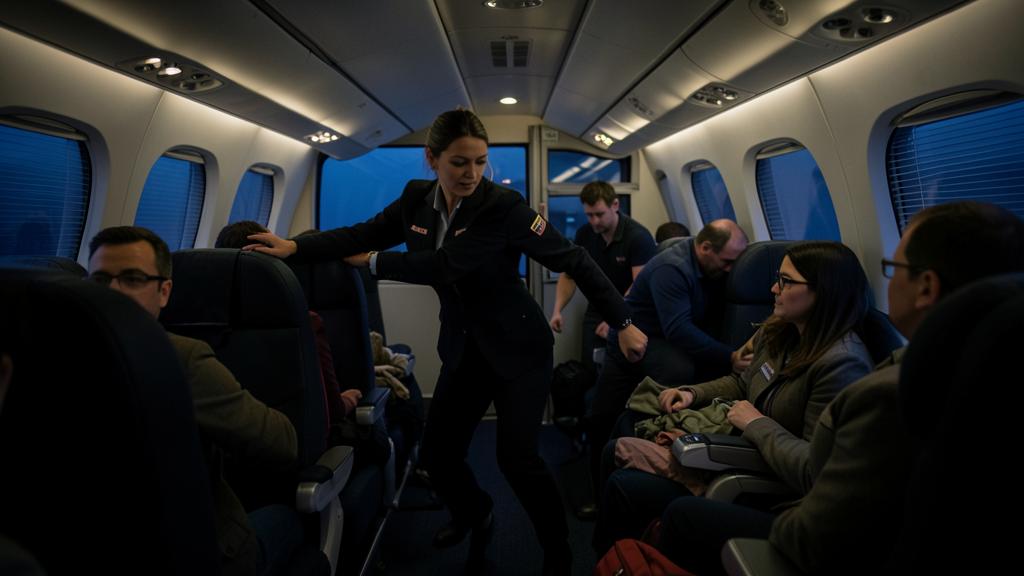
Ask a cabin crew member what changes between preparing the cabin for a land evacuation and preparing it for a ditching, and the answer is often “everything”. It is not true, and believing it is expensive: it turns a short list of genuinely different actions into a second full procedure to be recalled whole, under time pressure, in the one situation where recall is worst. Laid side by side, station by station, the two preparations share almost all of their content. Four decisions change.
Why the belief takes hold
Training reinforces it. Ditching is taught in its own module, often in a pool, with its own equipment and its own vocabulary, and a wet drill is memorable in a way that a dry cabin-securing exercise is not. Add the fact that most operators publish the ditching preparation as a distinct checklist rather than as a delta on the land one, and the mental model that results is two parallel procedures rather than one procedure with branches.
That model has a specific failure mode. Under a compressed notification — the flight deck gives the cabin two minutes, not fifteen — a crew member reaching for “the ditching procedure” as a separate object has to load the whole thing before starting. A crew member who knows that the preparation is the standard one plus four changes starts immediately with the shared part, which is also the part that occupies most of the available time.
The shared skeleton
Everything below is identical whether the aircraft is going to stop on a runway, in a field or on water.
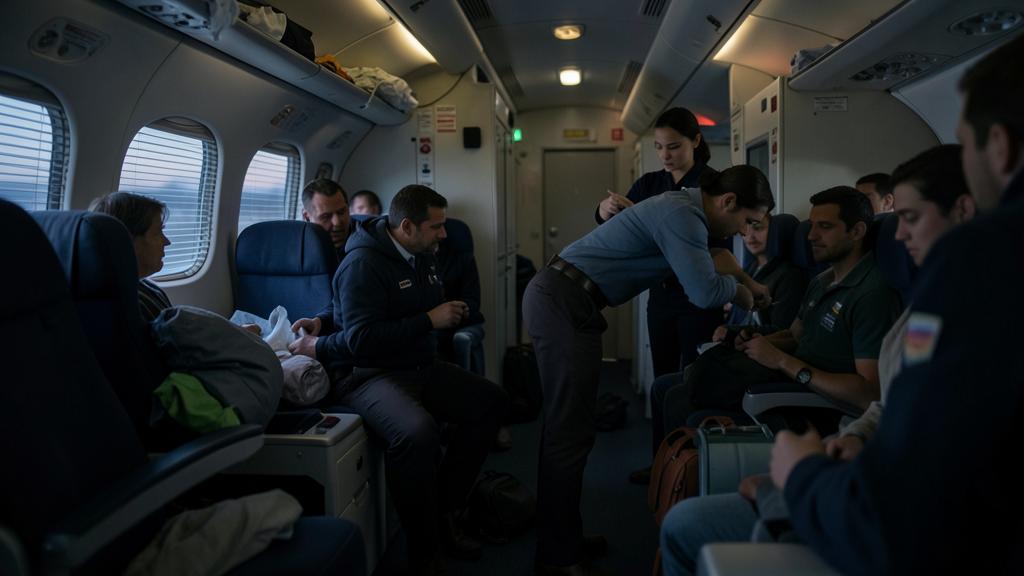
The sequence begins with a structured briefing from the flight deck. Most operators use a fixed mnemonic covering the nature of the problem, the intentions, the time available and any special instructions; the letters vary between operators, the content does not. The single most important element for the cabin is the time figure, because every subsequent decision is a rationing decision. The cabin’s reply — an acknowledgement of the time and, where the operator requires it, a readback — closes the loop.
Then the standard content: crew coordination and redistribution of tasks; the passenger briefing, delivered as a demonstration rather than as an announcement wherever language and cabin layout allow; identification and briefing of able-bodied passengers at the exits; relocation of passengers who cannot help themselves or who sit where they would obstruct; securing the cabin — galleys latched, carts stowed and locked, loose items collected, service equipment restrained, dividers and curtains secured; hand baggage stowed under seats and in bins rather than in laps; seat backs upright, tray tables stowed, window blinds up; removal of items on the body that will cause injury or snag, notably sharp objects, spectacles at the appropriate moment and high-heeled shoes; and the brace command, its trigger and its wording.
The brace position itself does not vary with the surface. It varies with the seat: forward-facing with a seat back within reach, forward-facing without one, aft-facing, bulkhead row, infant on lap, child in a restraint. That is a seat-geometry decision, not a land-or-water decision, and treating it as the latter is one of the more common confusions.
The evacuation commands, the assertive shouting, the exit assessment discipline, the flow of passengers, the accounting for crew and the refusal to re-enter a compartment that has been cleared — all identical.
| Element of the preparation | Land | Water | Verdict |
|---|---|---|---|
| Flight deck briefing and time budget | Structured briefing, time figure drives depth | Identical | Same |
| Passenger briefing and demonstration | Brace, exits, commands, ABP tasking | Same, plus the life jacket sequence | Extended |
| Cabin securing | Galleys, carts, loose items, baggage, seat backs, blinds | Identical | Same |
| Brace position | Determined by seat type and direction | Determined by seat type and direction | Same |
| Life jackets | Not worn | Donned, never inflated inside | Changes |
| Exit assessment criteria | Fire, obstacle, slide condition, external hazard | Waterline first, then the same list | Changes |
| Door drill | Slide deployment and inflation check | Raft mode, mooring line, loading order | Changes |
| Equipment leaving the aircraft | Nothing, as a rule | A defined list, assigned by station | Changes |
| Commands and passenger flow | Assertive, exit-specific, continuous | Identical | Same |
Change one: life jackets, and the thing that must not happen inside
This is the only change that alters the physical state of the cabin during the preparation, and it is the one that consumes the most time. Two hundred people locating, extracting, donning and securing a jacket is not a thirty-second task, and the extraction step is where it fails: stowage varies by aircraft and by seat, jackets migrate, pouches are found empty, and passengers who have not watched the safety demonstration search the wrong place. The demonstration therefore has to say where, not merely how.
The rule with no exception is that the jacket is not inflated inside the aircraft. It is taught as a slogan and it is worth understanding as a mechanism. An inflated jacket makes the wearer bulky enough to jam an aisle and to foul a small overwing aperture; it prevents bending, so it prevents assuming a brace position; and if the cabin floods, buoyancy pins the occupant against the ceiling, away from an exit that is by then below them. Inflation happens outside, at the exit or in the water, and the crew member at the door is the last check on it.
The reciprocal is equally firm: life jackets are not donned for a land evacuation. There is nothing to be gained and there are three things to be lost — time during the preparation, mobility in the aisle, and a snag hazard on the slide.
The trap. A partially inflated jacket is worse than an uninflated one, because it is not obviously wrong. Somebody who pulls the toggle early while still seated may present at the exit with a half-filled bladder that clears the aperture, then find it cannot be topped up because the cylinder is spent and the oral tubes are buried behind the inflated cells. Brief the toggle as an outside action and say why, not just when.
Life jackets must be worn in water but never inflated inside the plane. If they are, they can block aisles or trap people. On land, they’re not used at all to save time and avoid hazards.
On an Airbus A320, passengers in row 15 find their life jackets under the seat in front. A crew member must confirm no one inflates them before exiting, even if the plane is sinking. On a Boeing 737, the jackets are in overhead bins, and the crew must check the waterline before opening any door.
Change two: the exit is chosen against a waterline
On land, the exit assessment asks a familiar set of questions: is there fire outside, is there an obstacle, is the slide inflated and usable, is the surface below survivable. On water the same questions still apply, but a new one comes first and it overrides the rest: is this exit at or below the waterline.
The reason is that opening a submerged or nearly submerged exit does not produce a bad evacuation route, it produces a flooding path that shortens the time available at every other exit in the aircraft. This is one of the few cases in cabin operations where a wrong action at one station degrades the entire evacuation rather than one station’s share of it.
Which exits are usable is a type-specific matter, and the aircraft flight manual ditching section is the authority for the flotation attitude assumed by the design. The general pattern crews are taught — that the aircraft tends to float with the aft fuselage low, so that overwing and forward exits become the primary routes — is a pattern, not a certainty; damage, loading and the touchdown itself all move it. What is portable between types is the discipline: assess before opening, and be prepared to redirect a flow that has already started.
The right reflex. On water, the assessment does not end when the door opens. A floating aircraft settles, and an exit that was clear at the start of the flow can be at the waterline by the middle of it. The crew member at the door owns that judgement continuously, and owns the decision to stop the flow and redirect — which is why the command vocabulary for redirection has to be as rehearsed as the command vocabulary for evacuation.
On water, the first question is: Is this exit underwater? If yes, keep it closed. Opening a submerged exit can flood the plane, making escape harder for everyone. On land, you just check for fire or obstacles.
On a Boeing 777 ditching in the Atlantic, the crew checks that the forward exits (L1 and R1) are above water before opening them. If the plane tilts, they may have to close one and redirect passengers to another exit, even mid-evacuation.
Change three: the door drill gains a raft
On land, the door drill ends when the slide is inflated and confirmed usable. On water it continues. Whether the exit carries a slide-raft, a slide only, or gives access to a separately stowed raft is a question of type and of exit, and the answer is not uniform even within one aircraft.
Three additional elements appear. First, the mode: on types where the escape device serves both functions, the drill includes detaching it from the aircraft in the raft configuration, which is a different action from arming the door. Second, the mooring line: the raft stays attached to the aircraft while it is being boarded, and is cast off only when loading is complete and the aircraft is about to become a hazard rather than a mooring. On most types the knife for that purpose is part of the raft equipment rather than something to be fetched from a galley. Third, the loading order: many operators direct able-bodied passengers into the raft first, so that there is someone inside to receive and stabilise those who follow. That inverts the land instinct, where the priority is throughput at the sill.
None of this transfers between fleets. It is the part of the ditching preparation that genuinely has to be learned per type, and it is a reasonable argument for spending a disproportionate share of type conversion time on it.
Change four: what leaves the aircraft with you
The land rule is simple and is briefed as an absolute: leave everything. The water rule is not, and this is the change most often missed in a compressed preparation.
An extended overwater flight carries equipment whose whole purpose is to be outside the aircraft: life rafts with their attached survival packs, a portable emergency locator transmitter, and whatever the operator adds — pyrotechnics, water, first aid. That equipment is useless if it stays in a stowage, and nobody retrieves it spontaneously during an evacuation. It gets out because a named crew member has it as an assigned task, listed by station, and because it was confirmed during the preparation rather than assumed.
The carriage requirements themselves come from the operating rules — the ICAO Annex 6 provisions on overwater flight and their European counterparts in Part-CAT — and the trigger, expressed as a distance or a flying time from a shore suitable for a forced landing, differs between the standards and between states. What matters at cabin level is not the threshold but the consequence: on some sectors the equipment is aboard and on others it is not, and the preparation cannot be the same in both cases.
| Failure | Where it originates | What it costs | Countermeasure during preparation |
|---|---|---|---|
| Jacket not found | Stowage location not briefed, pouch empty | Minutes, multiplied by the number of rows affected | Say the location in the demonstration; ABPs check their own row |
| Jacket inflated in the cabin | Toggle briefed as a step rather than as a place | Aisle blocked, exit aperture obstructed | Brief the toggle as an outside action, with the reason |
| Submerged exit opened | Assessment skipped in the momentum of the flow | Flooding path, time lost at every other exit | Waterline check named as the first question at the door |
| Raft cast off early | Mooring line treated as an obstacle | Raft separates before it is loaded | Cast-off named as the last action, after loading |
| Survival equipment left aboard | Task not assigned to a person | No beacon, no water, no signalling | Assign by station and confirm during the preparation |
The one difference that is not part of the preparation
There is a fifth divergence, and it matters, but it belongs after the exit rather than before the impact. On land, the evacuation ends when everyone is at a safe distance, upwind, away from the aircraft. On water it does not end there at all: people have to be got out of the water and into rafts, the rafts tied together, the sea anchor deployed, the canopy closed, the beacon activated, and a survival regime started that may last a long time. Immersion, not impact, is what kills after a survivable ditching.
Keeping this out of the preparation section is deliberate. It is genuinely different and genuinely a separate body of knowledge, but nothing in it competes for the minutes between the briefing and the impact. Mixing it in is part of what makes the ditching procedure feel like a second procedure.
What a compressed notification actually costs
The useful way to hold this is as a ranked list of what survives as time shrinks, because that is the decision a crew makes in real time. The briefing and the time figure never go. Cabin securing and the brace command never go, because they determine survivability of the impact itself, which everything else depends on. The life jacket sequence is the first substantial item to be compressed, and it compresses badly — a partial distribution produces a cabin in which some people are equipped and some are not, which becomes a briefing problem at the door. Passenger relocation goes early. The ABP briefing shortens to exit assignment only.
An unprepared ditching — no notification, no time — is operationally close to an unprepared land evacuation, with the jackets and the raft drill arriving after the aircraft has stopped rather than before. That case is worth rehearsing precisely because it removes the comforting structure of the checklist and leaves the four changes standing on their own.
What this means for training and for checking
Cabin crew training requirements under the European operating rules cover ditching drills and the use of life jackets and rafts, with a practical water element in the training programme and arrangements for its renewal that vary by operator and by state. Where an operator has latitude is in how the material is framed, and framing it as a delta rather than as a parallel procedure costs nothing.
Two things are worth testing in a check rather than merely taught. The first is the waterline question at the door, tested by presenting a scenario in which the correct answer is to keep an exit closed — a scenario crews rarely see, because exercises default to a usable exit. The second is the equipment carriage task, tested by asking who has it and at which station, rather than by asking whether it is required. Both are cheap to run and both catch the failure modes above. Crews comparing how different operators structure this material will find the discussion worth having on the FL330 professional forums, where differences between fleets surface faster than they do in a manual revision.


Leave a Reply
You must be logged in to post a comment.