
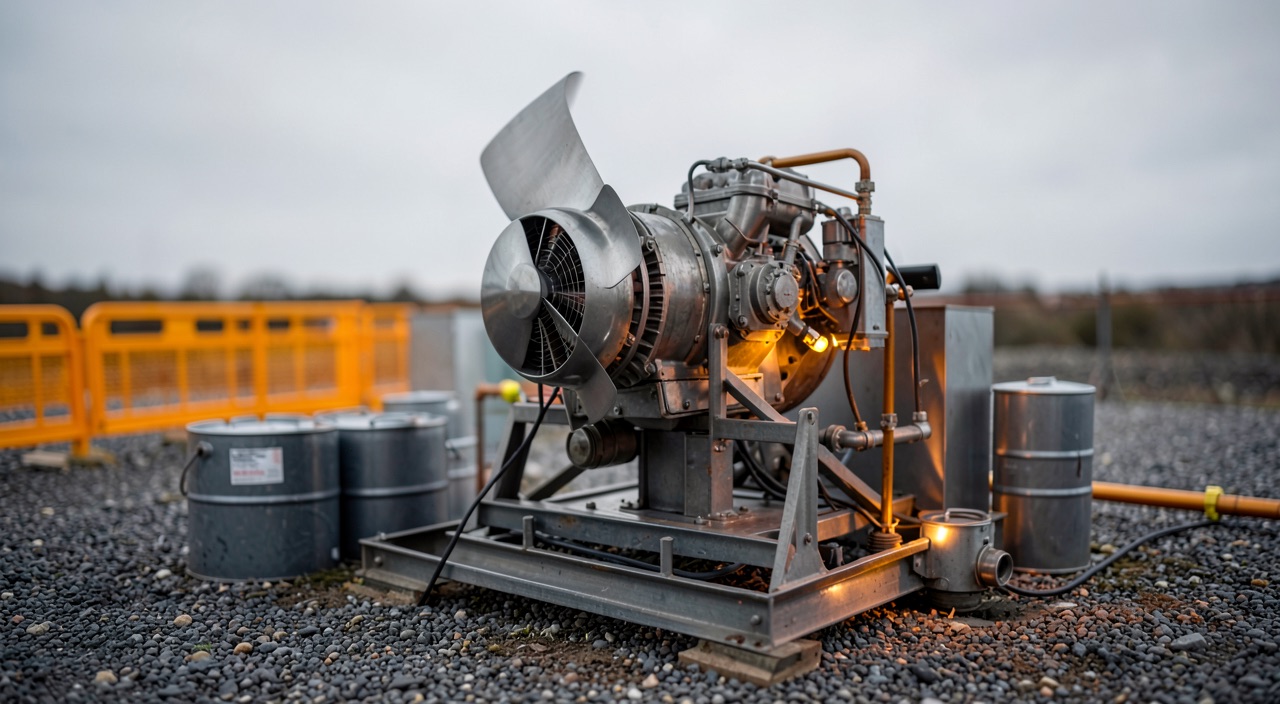
A demonstration flight takes off with both engines running on unblended synthetic kerosene, the news does the rounds of the newsrooms, and the next day the technical manager fields the same question three times over: when do we start fuelling the fleet like this? The answer has nothing to do with fuel performance, which was never the hard part. It comes down to an aromatics floor written into the product specification, seals that have aged for years in a different fluid, and a fuelling chain that, at the ramp, has no way of keeping two products apart.
What “100%” actually means, and what it doesn’t
Three distinct things circulate under the same figure, and conflating them is enough to make any technical discussion useless. The first is an accounting matter: the operator buys a volume of sustainable fuel produced elsewhere and has it attributed to them through a mass-balance mechanism or a tradeable certificate. Nothing changes in the wing; the product delivered to the truck remains a turbine fuel meeting the usual specification. The second is a high-ratio physical blend, up to the incorporation limit set by the annex for the pathway concerned, on the order of half the volume for the most widespread pathways. The third, the only one that deserves the term, is pure synthetic fuel: what is loaded is not a blend but the synthesised cut alone.
This third case falls outside the ordinary framework, not because the fuel is poor, but because it does not meet the specification the aircraft is certified against. A synthetic paraffinic kerosene is cleaner than a refinery kerosene: virtually no sulphur or nitrogen compounds, very few olefins, a tighter cut distribution. Its combustion is excellent and its thermal stability better. What it lacks is not a quality, it is an entire chemical family, the aromatic hydrocarbons, whose presence the specification requires precisely because the installed hardware depends on them.
The operational consequence is stark: a flight on pure fuel is not a scheduled flight with a different product, it is a test flight with an off-specification product, conducted under a special authorisation and a written programme. All the difficulty of moving to routine operation lies in that gap, and it is not closed by repeating flights.
Pure synthetic fuel doesn’t meet current aircraft specifications because it lacks aromatics, which are needed for seals and other parts to work properly. Flying with it is like a test, not normal operation.
An Airbus A320 flying on 100% synthetic fuel at 30°C with a full load of passengers and cargo would need special approval, extra checks, and a dedicated fueling system—none of which exist at most airports today.
Aromatics are not an impurity, they are a function
The elastomers of the fuel system, nitriles, fluorosilicones and fluorocarbons, provide sealing through compression, but their in-service margin depends on the swelling that aromatic absorption produces. A new seal fitted in a fuel poor in aromatics simply returns to its nominal dimension and holds. A seal that has spent long years in service, however, has taken on a permanent set: it no longer has its own elastic recovery, and its seal relies on the volume the fluid contributes to it. Remove the aromatics and the seal shrinks back; weeping appears where no one has ever had a leak, on fittings nobody has touched.
The same constituent performs three other services. Density first: paraffinic cuts are light and, taken alone, fall below the specification floor, with immediate consequences for volumetric gauging, for mass-to-volume conversion at fuelling and for the load a volume-limited tank can carry. Lubricity next: hydrotreatment removes the polar compounds that protect pumps and fuel-lubricated components, a shortfall that has to be made up with an additive. Electrical conductivity last: the same process removes the naturally conductive species, so that a synthetic fuel can charge dangerously as it flows if it does not receive a static dissipator additive.
Conversely, the absence of polycyclic aromatics is a clear gain wherever the fuel serves as a heat-transfer fluid: less gum, fewer deposits in injectors and heat exchangers, a markedly higher thermal-stability breakpoint, sharply reduced particulate emissions. Pure fuel is therefore neither better nor worse in absolute terms: it shifts the constraints, and all the work of qualification consists in establishing where they have shifted to.
The real scope of a demonstration flight
A flight on pure fuel is prepared like a flight test, because that is what it is. The aircraft flies under a specific authorisation issued for a bounded programme, with a test crew, added instrumentation, a restricted envelope and weight, most often without passengers. None of this has any bearing beyond the particular airframe, engine manufacturer and configuration involved.
The logistics weigh at least as heavily as the aeronautical side. The product cannot pass through the airfield’s hydrant network, which mixes by design: a separate storage tank is needed, a dedicated truck, documented flushing of the receiving tanks, a witnessed sample taken before and after, and a batch certificate that follows the product all the way to the wing. On an ordinary stop none of these conditions exist, and this part of the problem is the heaviest to solve.
What such a flight genuinely establishes is valuable and narrow: engine behaviour at start-up, relight, acceleration and in transients, fuel-system temperatures in cruise and after cold soak, non-volatile particulate emissions measured at the nozzle exit, and, when a chase aircraft is planned, the plume’s microphysics. What it does not establish is just as clear: the behaviour of an aged fleet, that of a different airframe-engine pairing, the endurance of ground equipment, and the effect of repeated exposure over several years.
Four qualification tiers, and one flight that replaces none of them
Admitting a pathway into the specification follows a standardised evaluation practice that stacks four tiers of requirements. The first checks that the product meets the specification properties: distillation cut, flash point, freeze point, cold viscosity, density, sulphur content, thermal stability. The second examines fitness for purpose, that is, everything the specification does not measure but the hardware experiences: compatibility with elastomers, coatings and metals, water separation, storage stability, toxicity, electrostatic behaviour. The third goes down to component test rigs, pumps, regulators, injectors, seals, heat exchangers, and looks for the slow drifts a flight does not reveal. The fourth covers the complete engine and the auxiliary power unit, including cold ignition and relight at altitude.
Then comes the part everyone always forgets: the review by manufacturers, followed by the vote that enters the pathway and its incorporation ratio into an annex of the specification. It is this last step, and this one alone, that has a fleet-wide effect. The flight manual names neither a producer nor a process: it names a specification. When the specification changes, every aircraft that cites it follows suit, with no individual type-certificate revision and no action by the operator. As long as it does not change, a demonstration flight, however successful, changes nothing for anyone but its sponsor.
The move to pure fuel in fact follows two routes best not confused. The first is to produce a complete synthetic fuel, containing its own aromatic or cycloparaffinic fraction, and therefore compliant without blending within an unchanged framework: the problem becomes industrial, not regulatory. The second is to demonstrate that a fuel devoid of aromatics is acceptable and to have the specification evolve accordingly, which means dealing with the case of older hardware, that is, precisely the hardware never instrumented.
What has been demonstrated, what remains to be established
The table below separates the two columns that press releases blur together. It does not say that any obstacle is insurmountable; it says where the burden of proof lies, domain by domain.
| Domain | Established by the demonstrations | Remains to be established for routine operation |
|---|---|---|
| Engine behaviour | Start-up, relight, transients and specific consumption on the installations tested | Behaviour across the whole fleet, including older models and derivative configurations |
| System sealing | No leak found on recent airframes, over a short exposure | Behaviour of seals aged in aromatic fuel, and the effect of alternating products |
| Density and gauging | Compliance achieved by blending or by adjusting the cut | Conversion rules and gauging tolerances for a durably lighter product |
| Ramp fuelling | Delivery possible via a dedicated circuit, with batch certificate and documented flushing | Segregation within a shared network, or forgoing segregation with documentary traceability instead |
| Ground equipment | No incident reported on the dedicated means set up for the test | Seals, filters, water separators and sump probes, qualified for a different product |
| Non-CO2 effects | Measured reduction in soot particles and in the number of ice crystals formed | Net effect on contrail lifetime, depending on the atmospheric conditions encountered |
| Documentation | Approved test programme, one-off and bounded | Flight manual limitations, maintenance programme, fuel policy and crew training |
The trap: a product change is not judged on the first fill. A highly paraffinic fuel lifts gum long deposited in tanks and piping, and it is the filters that receive it, with premature clogging and unplanned removal, sometimes several weeks after the switch. The same delay applies to seals that have taken a permanent set: weeping does not appear on the ground run, it appears after a few thermal cycles. A test that stops at landing sees neither one nor the other.
The right reflex: before any discussion of a percentage, open the limitations section of the flight manual and read which specification is named there, with which annexes and which incorporation restriction. That is the only binding reference; a purchase certificate, a marketing communication or a precedent at another operator are no substitute. Then require that the quality certificate of the delivered batch state the requalification of the blend against the specification that manual cites.
Non-CO2 effects, the main argument for pure fuel
The most solid benefit of pure fuel does not play out on the life-cycle carbon balance, which depends on the production pathway and not on what happens in the combustor. It plays out on condensation trails. Aromatics and sulphur govern soot particle production, and these particles serve as condensation nuclei in the plume. With fewer nuclei, the same quantity of vapour is spread over fewer crystals, which grow larger, sediment faster and form a contrail that is optically less dense and shorter-lived.
Two technical nuances separate a practitioner’s reading from a press release here. First, the effect is continuous: it tracks the fall in aromatics content, so a blend already delivers a proportional share of it. Pure fuel does not open a new regime, it goes to the end of a slope that is already there. Second, the quantity of water vapour emitted is not reduced; it even rises slightly, since a paraffinic fuel is richer in hydrogen for equal energy. Contrail formation therefore remains governed by the atmospheric conditions encountered, and what changes is its microphysics, its optical density and its persistence.
For operations, this shifts the question. The non-CO2 gain depends on where and when one flies as much as on what is burned, which brings part of the subject back to flight planning and avoidance of supersaturated regions, rather than to fuelling alone. An operator who invests in the fuel without touching planning leaves part of the benefit on the ground.
What to check at home, and the grey area that remains
Three documents carry the answer for a given operator, and none of them is found in the trade press. The flight manual sets the specification allowed and its restrictions. The maintenance programme sets the intervals for filter removal and fuel-system inspection, which are the first to move after a product change. The operations manual sets the fuel policy, the density used for the mass and balance calculation and the product check on receipt. A change in incorporation ratio that is not reflected in any of the three has not been properly instructed, whatever memo announces it.
The grey area lies on the ground. Tanks, trucks, filter-separators and sump probes were qualified for a product from which a chemical family is now being removed, and no one issues a type certificate to a fuelling network. That is where the real timeline will be decided: the industry knows how to fly an aircraft on pure fuel, it does not yet know how to deliver that product to dozens of stops a day without segregation. Ramp reports exchanged between operators on this point are often worth more than a summary note, and the FL330 professional forum gathers a share of them.
For anyone preparing a type rating or a recruitment interview, the consequence is direct: the relevant question is no longer the announced percentage, but the specification annex concerned, the aromatics floor adopted and the restriction written into the flight manual. These are the three elements expected of a candidate who claims to follow the subject, and they are what structure the fuel and performance modules of FL330 training.
This article sets out mechanisms, not an authorisation. The applicable fuel specification, the aircraft’s flight manual limitations and the operator’s approved documentation take precedence over everything above and govern in the event of any discrepancy.
Questions fréquentes
Does a flight announced as “100% sustainable fuel” mean pure synthetic fuel was loaded?
Not necessarily. In most cases, the announcement refers to an accounting purchase: the operator has a volume produced elsewhere attributed to them, while the product actually delivered to the wing remains a blend requalified to the usual specification. Pure synthetic fuel is only loaded during tests conducted under special authorisation, with a dedicated fuelling circuit. The two situations have neither the same regulatory status nor the same technical consequences.
Why does the specification require a minimum of aromatics when they degrade combustion?
Because the elastomers of the fuel system derive their sealing margin from the swelling that aromatic absorption produces. A new seal can do without it, but a seal that has taken on a permanent set after years in service relies on that swelling to stay sealed. The floor therefore protects the installed fleet, not combustion, which would in fact be better without aromatics.
What has to be modified on an aircraft to fly on pure synthetic fuel?
Structurally, nothing: the subject is the fuel system, not the airframe. The points that need to be addressed are the condition of seals and sealants, compensating for lubricity and conductivity with additives, and the product’s lower density, which affects gauging and mass-to-volume conversion. The real modification is documentary: it goes through the specification cited in the flight manual.
Does pure fuel eliminate condensation trails?
No. Contrail formation depends on the atmospheric conditions encountered, and the quantity of water vapour emitted is not reduced: it even rises slightly, as paraffinic fuel is richer in hydrogen. What changes is the number of soot nuclei available, so the ice is spread over fewer but larger crystals, which sediment faster. The contrail is optically less dense and persists for less time.
Who decides that a pathway can exceed the current incorporation limit?
Neither an operator nor a producer. The pathway must pass through the tiers of a standardised evaluation practice, from specification properties to full-engine testing, then pass review by engine and airframe manufacturers before being entered, with its ratio, into an annex of the specification. It is this entry that produces a fleet-wide effect, without any individual type-certificate revision.
What is the first symptom to watch for after a product change?
Early filter clogging. A highly paraffinic fuel lifts gum long deposited in tanks and piping, and these deposits end up in the filter elements, sometimes several weeks after the change. The second symptom, appearing later, is weeping at older fittings whose seals are no longer restored by the fluid’s swelling.


Leave a Reply
You must be logged in to post a comment.