
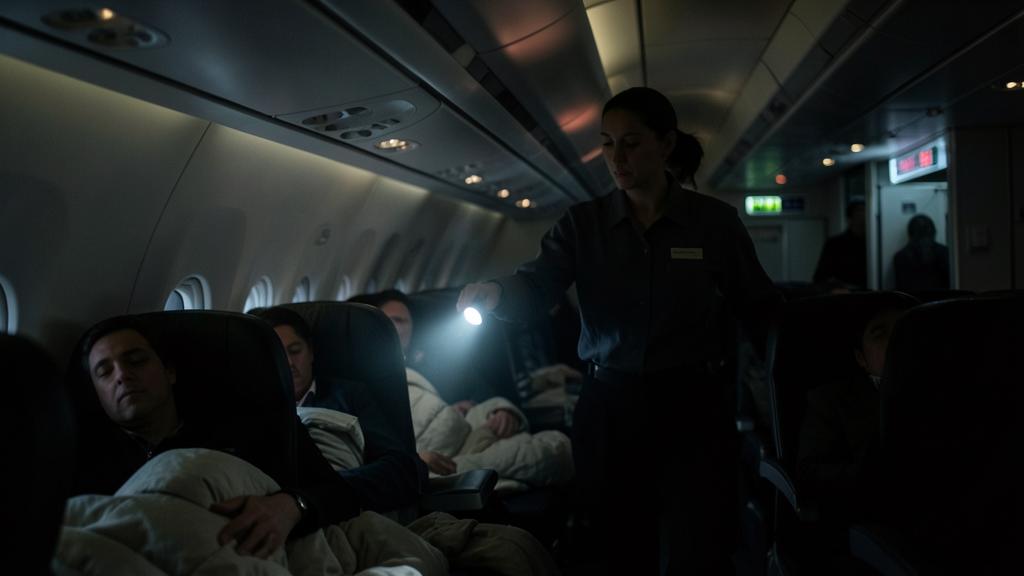
Three hours after service ends, the cabin is dark, two crew members are resting and the others are holding the aft galley. The question is not whether to walk the aisles: every manual requires it. The question is at what cadence, and looking for what. A pass every twenty minutes that wakes half a row is not twice as good as one every forty; eventually it stops happening at all. The trade-off plays out across three dangers that do not share the same clock, and against a cost — passenger sleep — that is not a commercial argument but a factor of drift.
What a round looks for, and what nothing else looks for in its place
No sensors monitor the passenger compartment. The lavatories have a smoke detector because certification requires it; the cargo holds have detection and, depending on their class, a means of extinguishing; the galley has its electrical protections. Between the rows, there is nothing, and this gap is accepted by design: the detection means for the passenger compartment is the occupant. At night, the occupant is asleep. What remains is a single mobile sensor — two or three people walking — whose passage constitutes the entirety of the surveillance.
This sentence is the only truly solid justification for the round, and it dictates its content. A cabin fire does not begin with flames: it begins with a smell — hot plastic, insulation, electrolyte — then with a wisp of smoke that becomes visible against the backlight of a reading lamp well before it becomes visible face-on. A portable electronic device slipped into a seat mechanism and crushed by a recline adjustment moves from incident to thermal runaway in a matter of minutes. A round therefore has a nose as much as eyes, and the places where one stops to smell are not left to chance: overhead bins, outlets, bags under seats, armrest junctions.
The second object is medical, and it is the most counterintuitive. A night cabin is full of motionless people, head against the window, blanket pulled up. A passenger slipping toward unconsciousness produces exactly the same image. Nothing in the silhouette separates sleep from loss of consciousness; it is complexion, chest movement, hand position and absence of reaction to a word that distinguish them, and none of these signs can be read from the galley.
The third is a security matter, and it follows a different logic: one is not looking for a state there, but for a deviation. Someone lingering near a door, a bag that has changed position, a lavatory occupied from one round to the next, a gathering in the aft galley in the middle of the night. None of these facts is abnormal in isolation; it is their repetition that is. Added to this is the most mundane and most cost-effective part of the pass: the seatbelt visible over the blanket, the aisle and the exit surrounds kept clear, the carts locked. In other words, the state in which one wants to find the cabin if turbulence strikes without warning.
At night, the only way to check for fires, medical emergencies, or security threats is by walking through the cabin. Crew members must look for subtle signs like unusual smells, changes in passengers’ appearance, or suspicious movements. Since passengers are sleeping, these checks must be done carefully to avoid waking them too much.
On a Boeing 787 operating a 12-hour flight from Dubai to New York, the crew notices a faint smell of burning plastic during a routine check at 3 AM. They trace it to an overhead bin where a passenger’s laptop, left on charging, has overheated. The crew removes the device and uses a fire extinguisher to prevent a larger incident. This early detection was only possible because the crew was conducting regular, careful checks every 30 minutes.
Three clocks, one interval
These three objects do not share the same time scale, and that is where the cadence is set. An incipient fire typically leaves a delay measured in minutes between the moment it becomes perceptible and the moment it is no longer manageable with a portable extinguisher and a smoke hood. Cardiac arrest degrades the prognosis minute by minute. A malicious preparation unfolds over dozens of minutes, venous stasis over hours. One does not build a cadence by averaging these horizons: one builds it by keeping the shortest of those one claims to cover.
A rule of calculation is needed here that many manuals leave implicit. An event that occurs at any random instant between two passes is discovered, on average, after half a cadence — and at worst after a full cadence plus the walking time, if the event happened just behind you. A forty-minute cadence therefore does not mean a forty-minute worst-case delay: it means roughly a twenty-minute average delay on a medical episode, and more in the unfavourable case. Applied to the horizon of a fire, this arithmetic settles the debate faster than any argument about service.
The table below sets the three clocks against their corresponding signs. Above all it shows what makes them hard to read once the cabin lights are off: each danger has a mask of its own, and that mask is almost always a direct consequence of the night itself.
| Danger | Sign sought during the pass | What masks it at night | Useful horizon |
|---|---|---|---|
| Incipient fire, battery or equipment | Smell of hot plastic or electrolyte, wisp of smoke seen against backlight, abnormally hot bin or armrest | Darkness, ventilation diluting the smell, sleeping neighbours who report nothing | A few minutes |
| Fast-evolving medical episode | Complexion, chest movement, hand position, absence of reaction to a word | The posture of sleep is exactly the same | A few minutes |
| Slow deterioration, dehydration, venous stasis | Pallor, sweating, restlessness, repeated and lengthy lavatory visits | Curtains drawn, dark cabin, absence of service that would make people move | Several hours |
| Security threat | Lingering near a door, a bag that has moved, a lavatory occupied from one pass to the next | The night-time flow to the lavatories makes any movement seem ordinary | Tens of minutes |
| Cabin not secured ahead of turbulence | Seatbelt visible over the blanket, aisle and exit surrounds clear, carts locked | Blankets, belongings dropped to the floor over the course of the night | The announcement lead time, no more |
The right instinct. To judge a cadence, do not reason on the worst case but on the average delay, that is, half the interval. Then ask the question in reverse: what average delay would you accept on an incipient fire in an overhead bin? The answer gives the cadence, and it is almost always tighter than the one practised in the depths of the night.
The cost of waking someone, and why it works against surveillance
What remains is the other side of the scale, which is wrongly treated as a matter of comfort. A poorly conducted round wakes people up: a torch swept across faces, a galley curtain that lets light through on every pass, wheels rolling on the floor, an announcement made over the PA for a reason that did not warrant it. The waking then spreads on its own. Whoever sits up wakes their row neighbour, the lavatory queue reforms, activity picks back up, and the cabin takes a long while to settle again.
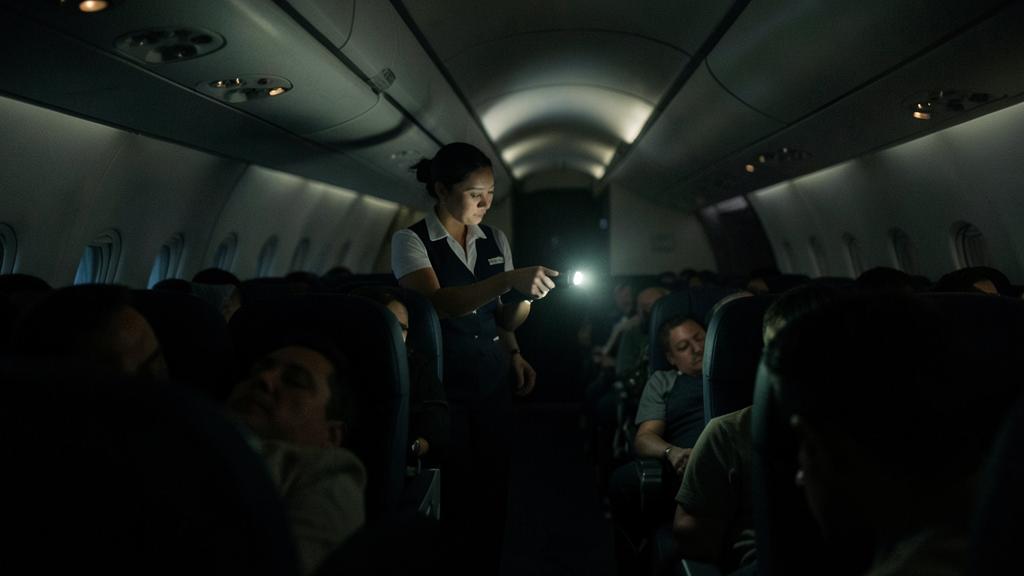
The consequences go beyond passenger satisfaction. A poorly woken person moves at the wrong moment, consumes more, arrives at descent less receptive to an instruction, and occupies the crew instead of letting them watch. But the decisive consequence lies elsewhere, and it is human: a costly round gets postponed. Nobody ever decides to space the passes out. One simply waits for the cabin to settle back down, finishes tidying up, pushes it back ten minutes. In the depths of the night — precisely when the crew is also crossing its own vigilance trough — the actual cadence has stretched without any decision having been made or recorded.
Hence a useful inversion: discretion is not a courtesy paid to passengers, it is what makes the frequency sustainable. Lowering the unit cost of a pass shifts the equilibrium point toward a shorter interval, for the same disturbance to the cabin. It is a matter of technique, not of goodwill.
| What changes | Spaced-out, demonstrative round | Frequent, discreet round |
|---|---|---|
| Actual cadence | Long, in practice set by what the crew is willing to repeat | Short, sustainable because a pass costs almost nothing |
| Lighting used | Ceiling lights raised, beam swept at face height | Floor path lighting, torch held low and shielded by hand, switched on to settle a doubt |
| Shape of the walk | Continuous back-and-forth, with no defined stop | A sequence of stops with fixed content: doors, galley, lavatories, exit rows |
| What it reliably detects | Whatever jumps out during the pass: a bag in the aisle, a visible seatbelt | The same, plus whatever has changed since the previous pass |
| Effect on the cabin | Chain-reaction wake-ups, queue reforming, activity picking back up durably | Imperceptible for most rows |
| What it becomes in the depths of the night | Spaces itself out on its own, with no decision and no trace | Holds, because nobody dreads doing it |
The trap. A cadence never lengthens by decision. It lengthens because a pass woke three rows and nobody wants to repeat it, because everyone is waiting for the lavatory queue to clear, because tidying is not finished. After a few hours, the actual interval may have doubled, the cabin has noticed nothing, and the manual still says the same thing. The only safeguard is a noted time, never an intention.
What the rest period does to surveillance
On a long sector, part of the crew goes on rest, and that is where a flawed line of reasoning creeps in. The minimum cabin crew complement is sized on evacuation: a number tied to the number of installed seats, positions held during critical phases, a demonstration carried out when the cabin layout was certified. The rest rotation is built to preserve this minimum complement at all times, and it does. The regulatory baseline therefore remains satisfied from the start of the night to the end.
What this count does not say is that surveillance capacity is sized by nothing at all. It is a by-product of the evacuation complement. When part of the crew is asleep, the number of people available to walk the aisles can be halved while the length of cabin to cover has not moved an inch. No regulatory figure signals this loss, for the good reason that none measures this quantity.
The remedy is an explicit split. Every zone must have a named holder at every instant of the rest rotation, including during handovers, which are precisely the moment when a zone becomes orphaned without this appearing anywhere. And the handover must carry more than service instructions: the passenger in row 34 who did not eat and has not moved since, the one who has been to the lavatory twice for a long stretch, the family with an infant in a bassinet, the one travelling on oxygen, the one who drank heavily before lights-out. These four or five named facts are worth more than a general instruction to stay vigilant.
The trap. Stillness is the expected state of a night cabin: it therefore carries no information. The useful sign is not that a passenger is not moving, it is that they have not moved between two passes, that they let the service go by, that their hand hangs in the aisle or that their blanket has not shifted a fold. A crew member who does not compare with the previous round can cross the same cabin three times and see the same sleeping person three times.
Discretion is built
A discreet round is not a fast round. It rests on three things that are learned: light, the order of the gaze, and stops that have content.
Light first. Floor path lighting and ambient lighting are enough to walk by; the torch is only for settling a doubt, held low, beam partly shielded by the hand, aimed at the floor or a headrest rather than a face. A face lit from below actually reads very well — complexion, lips, sweat — without needing to wake its owner. The most common fault is the horizontal sweep at head height: it teaches almost nothing and wakes an entire row.
Next, the order of the gaze, because a pass lasts a few seconds per row and one only sees what one has decided to look for. Low down: hands, bags in the aisle, dropped objects, seatbelts. At seat level: face, chest, position, blanket. A blanket pulled over the head masks both complexion and breathing at once, and that is exactly the situation in which one believes one has checked while having seen nothing. Up top, finally: bins properly closed and not forced open by a bag, service panels intact, reading lights and outlets.
Stops, finally. A round is not a continuous back-and-forth, it is a sequence of stations each with its own content. At the doors, the slide indicator and clearance of the surrounding area. At the lavatories, listening, the state of the detector and above all the length of occupancy compared with the previous pass. At the galley, the locks, the ovens, the carts. At the exit rows, actual clearance, which degrades over the course of the night as belongings drop to the floor. This form has a side benefit: a station can be held without light and without noise, whereas a continuous walk pushes one to move fast and compensate with the torch.
The right instinct. Conduct the round differentially rather than as an inventory. Before setting off, retain three or four observations from the previous pass, and look for what has changed rather than what is abnormal. Pass these same observations, named and located, on to the next handover: it is the only thing that gives continuity to a surveillance carried out by crew members who are never all awake at the same time.
The cadence is not constant through the night
A single interval written into the manual is a convenient approximation. The night breaks down into regimes. Just after lights-out, the cabin is still moving: the risk of mistaking sleep for a medical episode remains low, but it is the moment for devices put on charge and belongings stowed in haste. At the heart of the night, activity drops to nothing: detection then rests on the round alone, at precisely the moment the crew is also crossing its own physiological trough. That is when the cadence should be tightest, and that is when it tends most to stretch. Before descent, the pass changes nature: it becomes securing and waking, and it stops being surveillance.
Certain facts should reset the clock without waiting for the deadline: a passenger reported unwell earlier in the flight, visible alcohol consumption before lights-out, a lavatory detector that has triggered, an unexplained smell, a passenger on oxygen, an unaccompanied minor, an infant in a bassinet, a turbulence area announced. In this last case, the constraint is no longer the cadence but anticipation: a securing round must be launched early enough to be finished before entry, or it puts crew members standing in the worst place at the worst moment.
What the text requires, and what it leaves to the operator
The air operations regulation sets a minimum cabin crew complement, requires positions to be held during critical phases, requires the operator to establish its procedures in the operations manual and to train its personnel in fighting fire and smoke as well as in first aid. It places the safety of occupants under the responsibility of the commander; the chain running from the commander to the cabin manager, meanwhile, falls under the operator’s organisation. What it does not do, as a rule, is write down a number of minutes between two rounds.
This number, when it exists, comes from elsewhere. From the operations manual, which is approved or accepted depending on the case and which therefore binds the operator just as a regulatory text would. From the certification assumptions of the layout, which explain why smoke detection stops at the lavatory door and why cabin materials are chosen to delay a spread that someone will still have to notice. From the security programme, for the part that falls under it. Sometimes from a requirement specific to a served state. When the manual simply asks for passes at regular intervals, the grey zone is total — and it is the crew member, not the drafting of the manual, who will be asked afterwards what regular meant that night.
Hence the real function of the log, where one is required. It does not serve to prove something to the authority: it serves the handover between two shifts and the reconstruction after an event, when the only question that will matter is knowing at what time someone last walked past a given row. A time and two or three notable facts are worth more than a ticked box.
What to go check in your own manual
Four questions are enough to place your documentation. Is the cadence defined for the reduced-crew condition, or only in general? A manual that does not distinguish the two leaves the most exposed period of the night without a rule. Is the content of the round written down, stop by stop, or only its existence? Does the list of facts that trigger an extra pass appear anywhere, or does it rest solely on the experience of whoever is on duty? Is the zone split maintained through handovers, with a named holder at every instant?
For anyone preparing a type rating on a long-haul aircraft or joining a new operator, this is also where the real differences between two companies show up. Two airlines can display the same cadence and practise surveillance that bears no comparison, depending on whether the round is described there as a walk-through or as a sequence of checks, and on whether the handover conveys facts or instructions. What remains grey everywhere is the threshold at which a doubt about a motionless passenger justifies waking them. No text sets it, and there is only one way not to get it wrong: settle the doubt the instant it arises, never at the next round.
The applicable regulation, the operator’s operations manual and the approved cabin procedures take precedence over the foregoing. This article describes a trade-off mechanism; it sets no cadence and replaces no instruction.
Questions fréquentes
How often should someone walk through the cabin during a night cruise?
No general text sets a number of minutes: the reference is the operations manual, and it alone binds the crew. The mechanism, however, is constant: the interval must stay shorter than the horizon of the fastest danger one claims to detect, that is, an incipient fire. Remember that an event occurring at random between two passes is discovered, on average, after half a cadence, so judge the cadence on that average delay rather than on the worst case.
Should you wake a passenger you are not certain is asleep?
Yes, once the doubt survives a graduated check. Look first at complexion and chest movement, then hand position and the state of the blanket; then speak at normal volume, and finally touch the shoulder. A passenger woken for nothing has lost a minute of sleep, whereas a medical episode left until the next round has lost half a cadence. Doubt is never carried over to the next pass.
Does a blanket pulled over the head pose a problem?
It masks both signs the round is looking for at once — complexion and breathing — and it also hides the seatbelt, which makes the cabin harder to secure ahead of turbulence. The useful practice is to have the seatbelt stay visible over the blanket and the face stay clear, without turning the request into a wake-up. A blanket that has not shifted a fold between two passes should be treated as an observation, not a detail.
Who watches the cabin when part of the crew is on rest?
The reduced crew, according to the zone split set out in the operations manual. The point to understand is that the minimum complement is sized on evacuation, not on surveillance: it remains satisfied throughout the rest rotation even though passing capacity may have been halved. So check that each zone has a named holder, including during handovers, the moment when a zone becomes orphaned without anything signalling it.
Should rounds be logged, and what does that log actually serve?
That is for the operations manual to decide, and practice varies widely from one operator to another. Where it exists, the log’s primary function is not to prove something to the authority: it serves the handover between two shifts and the reconstruction after an event. A noted time, together with two or three located facts, is worth far more than a ticked box.
Does the round replace smoke detection in the cabin?
It does not replace it, it stands in for it. The lavatories have a detector required by certification, the cargo compartments have detection and, depending on their class, a means of extinguishing; the passenger compartment generally has no fixed sensor at all, because the occupants stand in for it — and at night they are asleep. That is precisely why round cadence is a safety parameter, not a service parameter.


Leave a Reply
You must be logged in to post a comment.