
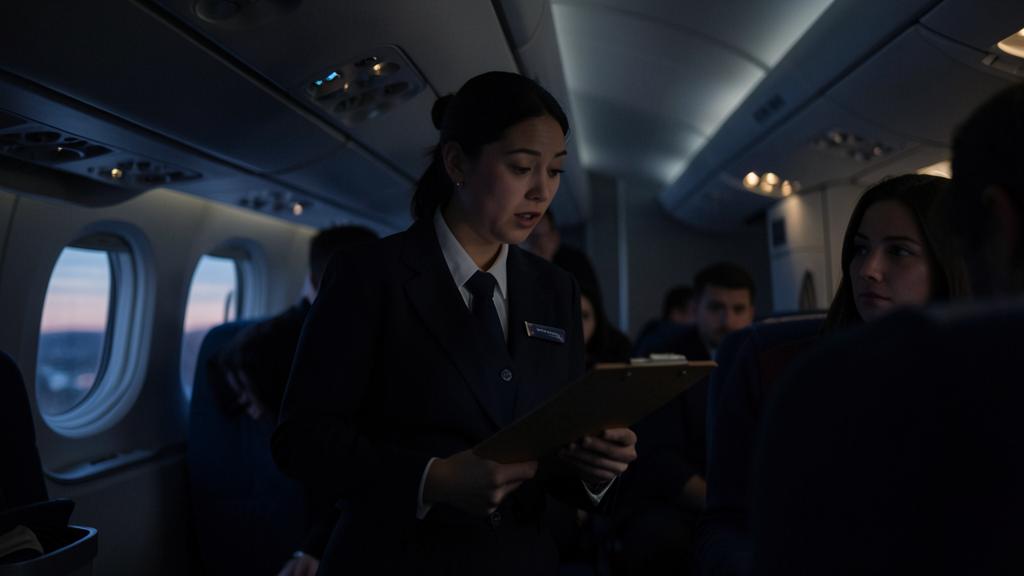
An oven that trips during the second service, a passenger who refuses to return to their seat during descent, a first-aid kit whose seal was broken without anyone knowing when. Three cabin facts that, on paper, call for a written report. Over a day of four short sectors, it is likely that only one of the three ever reaches the safety office, and not necessarily the most useful one. This is not a matter of goodwill: between the lived fact and the usable data point, there is a chain of six links, and every one of them was built by the operator.
What Must Be Reported, and What the Safety Office Actually Receives
The European occurrence-reporting regime draws no line at the cockpit bulkhead. Smoke or a suspicious smell, doors and slides, dangerous goods found in the cabin, incapacitation of a crew member, injury on board, disruptive behaviour, safety equipment found unserviceable: the list of mandatory reportable occurrences is written by the nature of the fact, not by the function of the person who observes it. A locking defect noted by a cabin manager triggers the same mechanism as an alarm noted on the flight deck.
A safety manager who sorts their database by origin nevertheless often finds the same asymmetry. The cabin holds the largest number of eyes on board and the only continuous exposure to passengers, and yet it accounts, in most databases, for a share of reports quite out of proportion to that exposure. The lazy explanation invokes culture or motivation. The useful explanation is to unwind the chain that separates the lived fact from the usable report, link by link, and to note that every one of them is an organisational choice: a form, an access point, a schedule, a sentence in the manual, a response or the lack of one.
The Chain of Discouragement, Link by Link
Six conditions must be met for a fact to become a piece of safety data. The fact must be perceived as abnormal, which requires a reference: training that shows the expected condition of the equipment, not just the gesture. It must then be known to be reportable, which is another matter entirely; many staff know that an event is troublesome without knowing that it appears on a list. One must know where and how to write it up, have the material time to do so, accept the perceived risk of a management response, and finally produce a text that contains enough elements to be usable.
These conditions do not add up, they multiply. A chain whose every link let through four cases out of five — a rate that would look excellent taken in isolation — lets through only a little more than one in four after six such links. This is the mechanical reason why poster campaigns remain without measurable effect: they act on one link, usually the last, whereas the product is dominated by the weakest link. Mapping these links for one’s own network — short-haul, long-haul, outsourced cabin crew — comes before any action, because the weak link is not the same everywhere.
Each step in the reporting process is a hurdle. If any step fails, the whole report fails. Fixing just the last step (like making forms easier) won’t help much if earlier steps (like knowing what to report) are broken.
On a busy short-haul flight, a cabin crew member notices a door handle that feels stiff. They know it’s not urgent, but they also know reporting it is a hassle. By the time they get to the hotel, they’ve forgotten the exact details. The report never gets filed, and the issue repeats on other flights.
Ground Time Is the First Filter
On a shuttle-type rotation, the entire ground-time slot is committed. Deplaning, cabin security check, restocking, checking of emergency equipment, station briefing and boarding follow one another without a gap, and boarding often starts before the cabin reset is complete. The residual margin is counted in handfuls of minutes, and it is already earmarked for the unforeseen: a reduced-mobility passenger announced late, a broken seat to reposition, a connection to catch.
Within this slot, a form that asks the crew member to log in again, look up the flight number, pick a category from a tree menu and then write ten free-text lines does not cost a few minutes of work: it costs a few minutes of rest. Cabin crew do not weigh the report against another task; they weigh it against the only time they have left. Deferring it to the end of the day then becomes the rule, at the exact moment when fatigue is at its peak and the details — time, row, flight phase, exact sequence — have vanished. The report that survives this deferral is often too thin to be analysable, which in turn feeds the belief that it will have served no purpose.
The single-entry trap. « It’s noted in the cabin logbook, so it’s done. » The logbook goes to maintenance and feeds continuing airworthiness; it does not feed the safety database. The same fact can therefore be perfectly resolved on the aircraft and remain completely absent from trend analyses, safety management system indicators and notification to the authority. The reverse is also true: a safety report does not open a technical deferral item.
Three Entries, Three Recipients, One Lasting Confusion
This confusion is not a case of negligence; it is sustained by initial training, which often presents the three channels in the same chapter and under the same word, « report ». Yet they do not share the same trigger, the same deadline, or the same effect, and above all not the same protection. A crew member torn between three entries, two of which look redundant, picks just one, and statistically the cheapest one to produce.
| Entry | What triggers it | Recipient | Deadline | What it produces |
|---|---|---|---|---|
| Entry in the cabin logbook | A faulty cabin item of equipment, an operational deferral to be opened | Maintenance, continuing airworthiness management | Before the next flight | A corrective action on the aircraft, possibly a technical tolerance |
| Mandatory occurrence report | A fact falling within the list of mandatory reportable occurrences | The operator’s safety office, then the supervisory authority | Short deadline set by the regulation and reproduced in the operations manual | An entry in the database, a follow-up analysis, a notification to the authority |
| Voluntary or confidential report | A hazardous situation, a weak signal, a fact outside the mandatory list | Safety office, often after removal of identifying details | No regulatory deadline | A trend data point, an internal alert, rarely an isolated action |
The right reflex: capture first, classify later. In the moment, take a few dozen seconds to note only the perishable elements — time, phase, exact position, seat or door number, people present, immediate action — on the fastest medium you have to hand. Classifying the entry, choosing the category and writing the full report can wait until the hotel or the end of duty; the time and the row, however, cannot be invented after the fact.
The Fear of Management Pushback, and What Just Culture Really Covers
The principle set out in the regulations is clear: the person who reports must not suffer any detriment as a result of reporting, except in cases of intent to cause harm or a deliberate, clearly established breach of an obvious risk. Identifying details are removed before analysis, and access to named versions is restricted to a very small number of designated people. On paper, the protection is broader than what frontline staff perceive it to be.
What discourages people on the ground is almost never sanction — it is rare and known to be rare. It is the intermediate social cost: being summoned « for clarification », the sector manager’s call the next day, the feeling of having become the one who made a slot slip, or the written reply that opens by reminding the reporter of the procedure. Each of these responses teaches, without ever putting it in writing, that reporting exposes you. The substitution test is the tool that puts the question back in its proper place: protection is not judged by the severity of the outcome, but by the nature of the behaviour.
Three written, verifiable, short commitments are worth more than a speech about trust: naming the people who have access to identities, explicitly banning the use of a report’s content in professional appraisal or grading, and setting who may contact a reporter and for what purpose. The fourth commitment is harder: showing once, publicly, a case where the operator corrected its organisation rather than the person. A single visible case carries more weight than three internal memos.
Feedback Is the Only Durable Fuel
The dominant perception of those who have stopped reporting fits in one sentence: « it disappears into a black hole ». It is generally accurate. An automatic acknowledgement of receipt does not count as feedback; it proves transmission, not reading. Useful feedback is twofold. The first is individual: a reply to the reporter, within an announced deadline, saying what was done with their text, including when the conclusion is that no action is being taken, and why. The second is collective: an anonymised recap in a briefing or a cabin bulletin, in which everyone recognises a situation they have lived through.
Management needs to be prepared to read the expected consequence correctly. When feedback becomes established, the number of reports goes up, sometimes markedly, and this rise is regularly read as a degradation of operations. It measures visibility, not a risk level. The only indicator that loses its meaning in this phase is the raw number of events; the ones that keep their meaning are the share of usable reports, the processing time and the rate of feedback to reporters. Exchanges among cabin managers on the professional forum show that this misreading is the main reason a scheme that was beginning to work gets shut down.
What Disappears First: The Effort-Severity Matrix
The events missing from the databases are not distributed at random. Cross-reference the severity perceived by the crew with the effort required by the report: what is perceived as severe gets reported regardless of cost, because the consequence of not reporting becomes greater. What is perceived as minor only gets reported if the write-up is nearly free. The low-severity, high-effort quadrant forms the blind spot, and this is precisely where precursors lodge themselves: a stiff door handle at the same row on several aircraft, a slide indicator that shifts in flight, a cart whose brake always fails at the same spot on the taxiway.
The value of these facts does not lie in their individual severity, it lies in their repetition — and repetition only becomes visible once it is counted. An operator that wants to surface this zone does not need a campaign: it needs a short, two- or three-field channel reserved for minor, recurring facts, one that everyone knows will not trigger an investigation. Reducing the effort shifts the whole quadrant; a speech does not.
What to Check in One’s Own Documentation
Some questions can be settled by checking the paperwork, and their answers distinguish a scheme that is alive from one that merely exists. Is the list of events to notify spelled out in plain language in the cabin crew manual, with cabin-specific examples, or does it simply refer back to the regulation? Is the announced internal deadline the one from the text, or a shorter one invented by the operator, which turns an administrative delay into an apparent fault? Is the form accessible outside the company network, on the device actually in hand at the turnaround? Is the time spent writing counted anywhere within duty time, or does it rest on implicit volunteering? And who, by name, can lift anonymity?
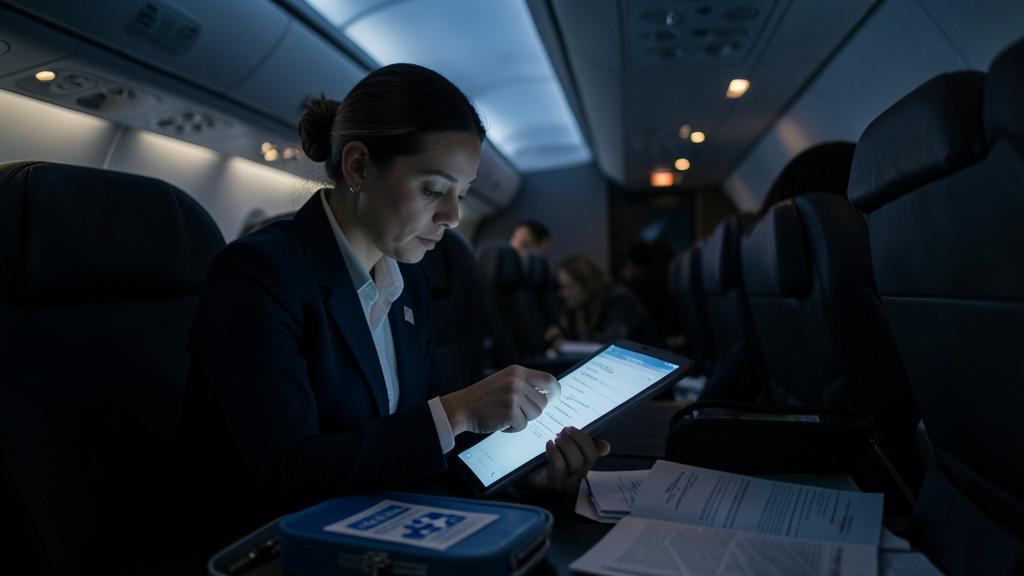
A grey area persists, and it is better to have settled it before the event: how obligations are shared when the cabin does not belong to the operator of the flight. Wet lease, partial outsourcing of a sector, staff resting on board or in transit, a fact occurring on the ground before duty starts or after it ends — in each of these cases, knowing who reports, in which system and under what protection is not something to improvise at the moment the fact occurs. Agreements between operators sometimes provide for it; the staff who apply them almost always remain unaware of it.
For anyone preparing to move up to cabin manager or into a safety role, this subject has become a differentiator: the oral exam turns less on reciting the list than on the ability to distinguish the three entries, to place the protection correctly and to explain what becomes of a text after it is sent. The modules devoted to the safety management system cover this circuit from the point of view of the person who receives the report, which durably changes the way one writes it.
The applicable regulation, the operator’s approved documentation and the instructions of the supervisory authority prevail in every circumstance over this article, which describes a mechanism and replaces no procedure.
Questions fréquentes
Should a cabin fact noted in the logbook also be the subject of a separate occurrence report?
Yes, whenever the fact falls within the list of mandatory reportable occurrences, because the two entries have neither the same recipient nor the same effect. The logbook triggers the technical processing of the aircraft and feeds continuing airworthiness. The occurrence report feeds the safety database, trend analysis and notification to the authority. A fact can therefore be fully corrected on the aircraft and remain invisible to safety.
What exactly does the reporter's protection cover, and where does it end?
It covers freedom from detriment arising from the mere fact of having reported, together with removal of identifying details before analysis and restricted access to named versions. It covers neither intent to cause harm nor a deliberate, clearly established breach of an obvious risk. Nor does it make the consequences of a fact established by some means other than the report disappear. This is why a factual formulation, without any qualification of fault, serves the reporter better than a justification.
Should one report when unsure whether the fact is on the mandatory list?
Yes, and without trying to settle the classification oneself. The voluntary channel exists precisely for facts outside the list, and reclassifying something as a mandatory reportable occurrence is a matter for the safety office, which has the criteria and the overall view. A fact wrongly reported through the wrong channel remains usable; a fact not reported is lost for good.
How can a usable report be written quickly when the turnaround leaves no margin?
Capture only the perishable elements in the moment: time, flight phase, precise position, seat or door number, people involved and the immediate action taken. The full write-up and the choice of category can wait until the end of duty. This two-step sequence preserves the analytical quality of the text, which depends almost entirely on these time-stamped details.
Does a rise in the number of reports signal a decline in safety?
No, it primarily signals a gain in visibility, and it typically accompanies the introduction of feedback to reporters. The raw number of events loses its meaning during this phase and should not be used as a performance indicator. The quantities that remain interpretable are the share of usable reports, the processing time and the rate of feedback to reporters.
Who reports when cabin crew do not work for the operator of the flight?
The obligation follows the operator of the flight, but the practical circuit depends on the agreement between the companies, notably in a wet lease or partial outsourcing arrangement. This point must be settled and put in writing before the event, otherwise the report gets lost between two systems. The staff concerned need to know which safety office to address and under what protection they are writing.


Leave a Reply
You must be logged in to post a comment.