
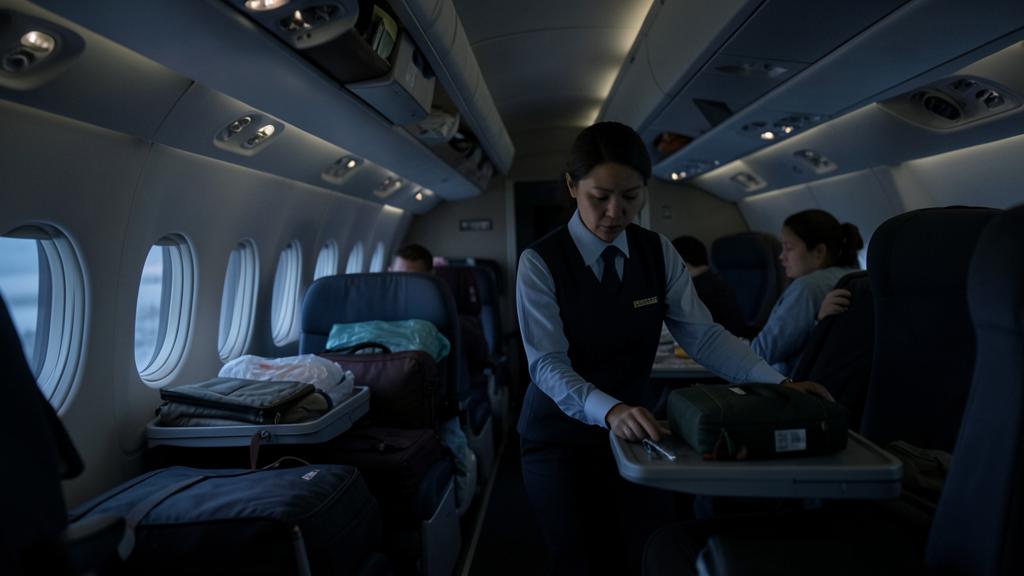
The cabin secure check is not a walk down the aisle. Read as a sequence rather than as a route, it is ordered by two quantities that have nothing to do with the floor plan: how much energy an item carries if it comes loose, and how long it takes to put right once found wrong. A check built around the geometry of the cabin does the opposite — it finds the heaviest, slowest item last, at the point in the approach where there is no time left to do anything about it.
Two jobs asked in one sweep
The check answers two separate questions that happen to be asked at the same moment. The first is about mass: what is in this cabin that is not attached to it? The second is about egress: if the aircraft stops and the order comes to get out, is there anything between a passenger and a door? The questions have different consequences, different remedies and different urgencies, and an item can fail one while passing the other cleanly.
A cabin bag pushed under the seat in front satisfies the mass question — it is restrained, it will not travel. If its owner is sitting in an exit row where nothing may be stowed at floor level, it fails the egress question completely. Conversely a half-full bin latched shut is fine for egress and questionable for mass if its contents can shift and load the door. Treating the sweep as one undifferentiated tidy-up loses this distinction, and with it the ability to prioritise when time runs short.
The cabin secure check has two goals: stopping loose items from becoming dangerous projectiles and keeping escape paths clear. Some items might pass one test but fail the other, so they need different fixes.
On an Airbus A320, a trolley in the galley bay must be latched before landing. If it’s unlatched, it could become a 100 kg projectile in a crash, and it blocks the aisle if it moves. Fixing it takes minutes, while a loose tray table in the last row takes just seconds to stow.
| Family | What fails if it is not secured | Time to correct a finding | Position in the order |
|---|---|---|---|
| Trolleys and containers in their bays | Mass — the largest single unrestrained item in the cabin | Minutes: return to the galley, redistribute if needed, close, latch, verify | First, and at the end of service rather than at the start of descent |
| Ovens, boilers, hot liquids, loose service items | Mass, plus a burn hazard that persists even when stowed | Minutes, and cooling time cannot be compressed | First, with the galley |
| Overhead bins and stowages | Mass, released above head height | Tens of seconds, longer if an owner must be found or an item rehoused | Second |
| Exits, cross-aisles, doorways, exit-row floors | Egress — the path itself | Tens of seconds, longer if the item has nowhere else to go | Second, with the bins |
| Belts, seat backs, tables, footrests, screens | Mass at low energy, and the brace geometry of one row | Seconds each, at arm’s length | Third |
| Crew station, harness, equipment stowage | Mass — the crew member is the heaviest thing still standing | Seconds, but only if the sweep has already finished | Last, always |
What the certification case already assumes
Every latch in the cabin exists because a certification requirement put it there. The airworthiness codes for large aeroplanes require that items of mass in passenger compartments, crew compartments and galleys be retained under the load factors of an emergency landing, and require the seats and their attachments to survive a dynamic test representing the same event. The forward case is the demanding one: the load factors that must be withstood are markedly higher in the forward direction than sideways or upward, because that is the direction in which a survivable impact decelerates the aeroplane.
Read the requirement carefully and it says something specific about the latch. The structure of a galley bay is designed on the assumption that the restraint is engaged. An unlatched trolley is not a trolley that is less secured; it is a mass for which the design case simply does not apply. The bay was never required to contain it, because the certification basis assumed the latch would be doing that job. This is why the check is binary, and why an intermediate state has no useful meaning.
The certification case is a survivable impact, which is rare. The everyday version of the same physics is common: a high-speed rejected take-off, hard braking after a long landing, severe turbulence in the descent. The numbers are smaller, the mechanism is identical, and the same latch decides the outcome.
The trap. A trolley that has rolled into its bay under its own weight and come to rest against the stop looks perfectly stowed from the aisle. Nothing about its appearance distinguishes it from a latched trolley. The only evidence that the restraint is engaged is the latch itself, tested by hand — and a galley checked by eye from two metres away has been checked for tidiness, not for restraint.
The galley goes first because it is the slowest to put right
If the order were driven by consequence alone, the galley would still be first: the loaded trolley is the largest concentrated mass in the cabin that is not bolted down, and it travels along the aisle. But recovery time settles the question on its own.
Consider the arithmetic of a late finding. A tray table found down in the last row is corrected in one second, from where you stand, without interrupting anything. A trolley discovered unlatched requires you to be at the galley, possibly at the other end of the cabin; it may require redistributing a load that has shifted and closing a door that no longer closes cleanly. That is minutes, spent moving against the flow of a cabin already being seated — which is also why the galley check belongs to the end of service rather than to the start of the descent.
Mass overhead, path below
The second block covers the two failures that share the same physical space. Above head height, the overhead bins are the second concentration of unrestrained mass in the cabin, and the mechanism by which they injure people is well documented in turbulence and in rejected take-offs: a latch not fully engaged, or a bin loaded past the point where its contents press on the door, opens under load and empties onto the heads below.
Below, the question changes from mass to path. Exit rows, cross-aisles, the floor area at each door and the assist space in front of a slide pack must be clear, and this is not an aesthetic standard. It is measured against a certified evacuation performance that assumes an unobstructed path. An item in a cross-aisle does not have to injure anybody to be a serious finding — it only has to slow the flow at a point where everyone must pass.
Bins come before belts for the same reason the galley came before the bins: a bin finding may require locating an owner, finding an alternative stowage and negotiating with a passenger. That is a conversation, and conversations do not fit inside short final.
| Finding | Fails the mass test? | Fails the egress test? | What actually has to happen |
|---|---|---|---|
| Cabin bag under the seat in front, ordinary row | No — it is restrained | No | Nothing |
| Same bag, exit row floor | No | Yes — the path is the point of the row | Rehoused overhead, which needs a bin with space |
| Overfilled bin that closes under pressure | Yes — the latch is holding a preload | No | Redistribute, then close freely and latch |
| Coat laid across an unoccupied seat | Marginally — low mass | No | Stow, but not at the cost of a heavier finding |
| Trolley in its bay, unlatched | Yes — total loss of restraint | Yes, once it moves — the aisle is the path | Latch and verify by hand; nothing else counts |
| Wheelchair or bulky item at a door | Depends on the stowage used | Yes | Approved stowage or a different door plan, decided early |
The passenger rows: many items, one second each
The last sweep is the one that looks most like a walk down the aisle, and it is the only part of the check where the cabin plan genuinely governs the order — because every item costs the same and every item is fixed from where you stand. Belts fastened and visible, seat backs upright, tables stowed, footrests and leg rests retracted, screens and tablets put away, infant arrangements as required, and whatever the operator specifies for window shades and cabin lighting.
Two of these deserve their reason stated, because they are the ones passengers argue about. The seat back is not upright for tidiness: an upright back is the geometry the brace position and the certified seat performance were built around, and a reclined back removes space from the person behind at the moment they need it most. The belt is checked by sight over clothing because a belt fastened over a blanket, a coat or a loose garment is not measurably fastened at all — the check is visual precisely because a verbal confirmation does not distinguish the two.
Window shades and cabin lighting are operator policy rather than universal rule. The reasoning is sound — eyes adapted before a possible evacuation, an outside view for crew assessing which side is usable — but the requirement lives in the operations manual, and it varies between operators.
The right reflex. Check the belt where the buckle is, not where the passenger’s hands are. A hand resting on the lap looks identical over a fastened belt and over a loose one, and the polite reflex of not looking closely is the one that lets the finding through. Asking for the buckle to be shown costs a second and removes the ambiguity entirely.
The last item on the list is you
A crew member standing in the aisle at touchdown is the heaviest unrestrained mass in the cabin, moving through the space with the fewest things to hold on to. Every argument made about the trolley applies with more force to a person, and none of the mitigations do — a body has no latch.
This is what makes the ordering more than a matter of efficiency. A check ordered by consequence finishes early with everything of substance already fixed, leaving only cheap findings that can be abandoned without cost if time runs out. A check ordered by geometry arrives at its heaviest findings last, and every one of them creates pressure to keep working past the point where the crew member should be seated and harnessed. The order is not about elegance; it is the mechanism that stops a cabin risk from being converted into a crew risk in the final minute of the approach.
When the cabin is secured, and by whose clock
The trigger comes from the flight deck, and where it sits in the descent is set by the operator, not by the crew’s judgement in the moment. What matters is that the report back — cabin secure — reaches the flight deck early enough for it to be actionable. A cabin that cannot be secured is a reason to extend, to hold, or to go around, and none of those options exist once the report is late.
The other constraint is the restriction on non-essential communication during critical phases, and the two rule sets draw that window differently. The European definition is phase-based: take-off run and take-off flight path, final approach, missed approach and landing including the landing roll, plus whatever else the commander designates. The American sterile flight deck rule adds an altitude band — taxi, take-off, landing, and every other operation below ten thousand feet except cruise. The scope differs; the effect on the cabin does not. A call made inside that window has to be worth the interruption: the cabin secure report is, a question about the connecting gate is not.
Turbulence compresses everything. An early securing costs service; a late one costs options. That trade is the flight deck’s to make, which is why the useful cabin transmission when weather is deteriorating is an early statement of how much time the cabin still needs — not a silent attempt to finish the service anyway.
Finally, the escalation. Every operator’s procedure has a path for an item that cannot be secured: a passenger who will not comply, an item with no approved stowage, a galley door that will not latch. Knowing that path before departure is worth more than any amount of improvisation, because the alternative — an unresolved finding quietly accepted — leaves an unrestrained mass in a cabin that has been reported secure. Crews comparing how different operators word that escalation will find the discussion running on the FL330 forums more useful than any generic guidance.
What a wrong order looks like from the outside
The failure is rarely visible as a failure. It shows up as a pattern in ordinary operations, readable if you know what to look for.
| What is observed | What it says about the order | What to change |
|---|---|---|
| Cabin secure is reported at the same altitude regardless of how the service ended | The report is following a clock, not a state | Move the galley check to the end of service; the later check verifies |
| Crew still walking below the operator’s seat-by point | The heavy findings were left until last | Reorder: galley, then bins and paths, then rows |
| The same category of finding appears repeatedly in the forward cabin only | The sweep starts aft and runs out of time forward | Split the sweep by family rather than by zone |
| Findings are corrected but never reported to the flight deck | The report has become a formality | Report what was found, not only that the cabin is now secure |
| Trolleys are checked by eye from the aisle | Restraint is being inferred from appearance | Hand on the latch, every bay, every time |
None of this replaces the operator’s own sequence, which is written against a specific cabin, a specific galley layout and a specific set of trigger points. What it does is explain why that sequence is the shape it is — so that when the descent is short, the service ran long and something has to give, what gives is the cheap end of the list and not the expensive one. Crews wanting the underlying safety and emergency procedures set out systematically will find them in the recurrent programmes listed on FL330 formations.


Leave a Reply
You must be logged in to post a comment.