
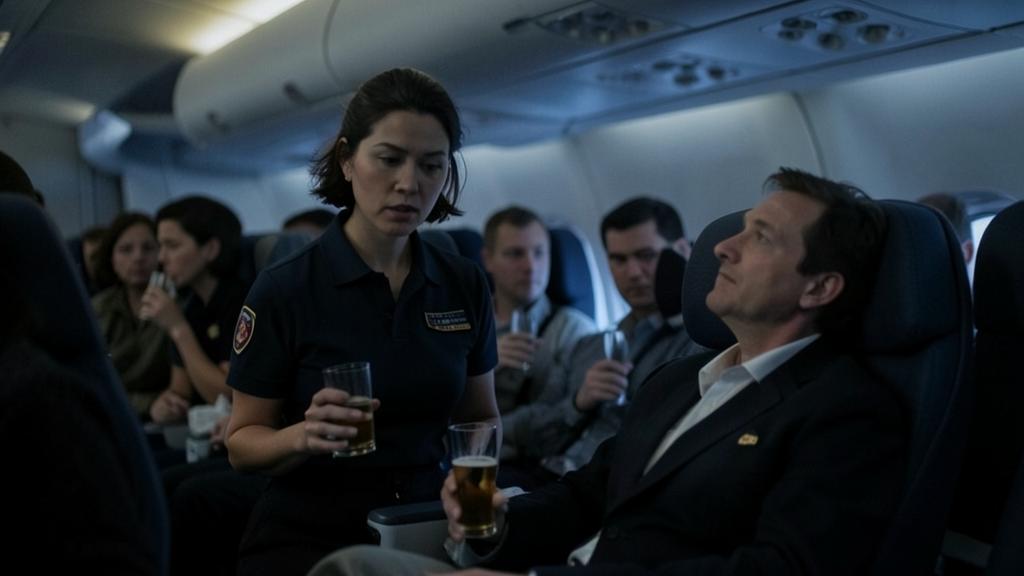
The passenger who becomes a problem in the third hour was almost always served normally in the first two. Nothing unusual happened: a drink at boarding, one with the meal, another when the trolley came back. Alcohol service is one of the few variables in the cabin that crew control directly and continuously, and it is the one most often managed by counting rather than by pacing. Treated as a prevention tool instead of a service item, it removes a large share of the incidents it currently produces.
The problem starts long before the trolley moves
Airport bars serve up to the gate. Delays extend the drinking window, and a delayed departure turns up repeatedly in the circumstances described around cabin incidents. Duty-free is bought airside and, on many sectors, opened quietly at seat level. Some passengers take a sedative before a flight they dread, or a sleeping tablet timed for the overnight, and say nothing about either.
Counting drinks is a poor instrument. The count is real, it is defensible in a report, and it says nothing about the state of the person in front of you. Two glasses of wine served in flight is an unremarkable line in a report and a completely different situation depending on whether the passenger arrived from a two-hour delay in the terminal or from the office.
The gate is a legitimate part of this. Operating rules place an obligation on the operator not to allow a person on board when they are under the influence of alcohol or drugs to a degree likely to endanger the aircraft or its occupants. That obligation is discharged at the gate, by the crew and the ground staff together, and it is far cheaper to exercise there than at cruise altitude with an ocean underneath.
The real issue is that passengers may have already drunk alcohol before boarding, which makes counting drinks in flight unreliable. Crews need to consider what passengers might have consumed before the flight to assess their state accurately.
On a flight from Paris to New York, a passenger who had three glasses of wine in the airport lounge before boarding and then two more in flight appeared fine at first. However, by the third hour, the combined effect of the alcohol led to disruptive behavior, showing how pre-flight consumption complicates in-flight alcohol management.
What actually changes at altitude, and what does not
The most repeated claim in this field is also the least accurate. It is not true that one drink at cruise equals two on the ground. Measurements have consistently found that, at the cabin altitudes used in transport aircraft, blood alcohol concentration is not raised: the same quantity of alcohol produces the same level in the blood. Repeating the myth to a passenger is a bad idea, because a well-informed passenger will correct you and you will have lost the argument you actually needed to win.
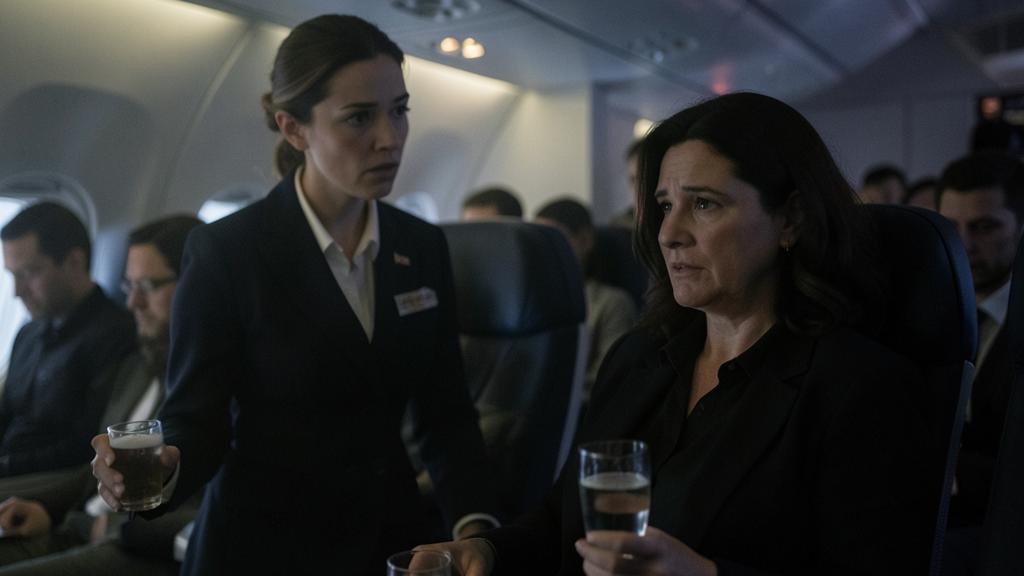
What changes is everything around the alcohol. Cabin altitude at cruise is typically equivalent to several thousand feet, with the maximum fixed by the aircraft’s certification basis, and mild hypoxia produces symptoms — reduced judgment, slower reaction, a certain cheerfulness — that overlap almost exactly with early intoxication. Relative humidity is low enough that dehydration is a normal condition of a long sector rather than an exception. Fatigue, disrupted sleep and a body clock in the wrong time zone all degrade the same functions. Recent aeromedical work also indicates that alcohol combined with reduced cabin pressure lowers oxygen saturation during sleep more than either does alone.
The honest formulation is therefore not that alcohol is stronger on board, but that its effects land on a person whose reserves are already reduced, in an environment where the consequences of poor judgment are much higher than in a bar. That version has the advantage of being true, and it holds up when a passenger challenges it.
| Factor | Effect on blood alcohol | Effect on behaviour and risk |
|---|---|---|
| Cabin altitude | None demonstrated | Mild hypoxia adds symptoms indistinguishable from early intoxication |
| Low humidity | None directly | Dehydration compounds headache, irritability and fatigue |
| Fatigue and time zone shift | None | Degrades judgment and self-control on the same axis as alcohol |
| Empty stomach | Faster absorption, higher peak | The rise arrives sooner than the passenger expects |
| Pre-boarding consumption | Already present, invisible to the crew | Makes the in-flight count meaningless as a measure of state |
| Personal supply opened at seat | Unknown quantity, unknown strength | Removes the crew’s only control; prohibited by rule in some States, by the operations manual in others |
| Sedatives and sleeping tablets | None on the level itself | Combined sedation, confusion on waking, unpredictable arousal |
The trap. Reasoning from the number of drinks served. It is the figure that ends up in the report, so it becomes the figure crews watch — but the alcohol that causes the incident is frequently the alcohol nobody served. A passenger drinking from their own bottle is not consuming an unknown quantity slowly; they are consuming it at their own pace, which is the one variable the service was there to control.
Pace is the variable, not the quantity
The service tools that work are all about rhythm. They cost nothing, they are invisible to the passenger, and they are decided before the first trolley leaves the galley.
- Water goes out with every alcoholic drink, without being asked for. It is service, it slows consumption, and it addresses the dehydration that is making the passenger feel worse than the alcohol alone would.
- Drinks are served one at a time. Handing over two miniatures at once — because it saves a trip — hands over the pacing decision as well.
- Bottles do not stay at the seat. Nor do full cans. What stays at the seat becomes the passenger’s rhythm rather than yours.
- Empties are collected. Not for tidiness: it is the only reliable way to see what someone has actually consumed, and it is the record you will need later.
- Food comes before the second round on a long sector, and a passenger who declines the meal but accepts the drink is worth a second look.
- The trolley’s own speed is a tool. A slower second service on a night sector is a legitimate operational decision, not poor service.
- The bar closes for the descent, and the announcement of that closure is made early enough that it is not a surprise anyone can argue with.
None of this is austerity. Most passengers will never notice a single one of these measures, which is exactly the point: prevention that requires the passenger’s cooperation is not prevention.
Reading the cabin before the incident
Escalation is visible well before it becomes a report. The signals are behavioural rather than quantitative, and crews who work them consistently intervene at a point where intervention is still cheap — a word, a slower service, a glass of water — rather than at the point where it requires the flight deck.
| Level | What you see | What the crew does | Who is told |
|---|---|---|---|
| Watch | Fast pace, drink ordered before the previous is finished, arrived loud from the terminal | Water with each round, slow the service to that row, note the seat | The colleague working the same zone |
| Manage | Volume rising, over-familiarity with crew, ordering for a neighbour, meal declined | Space the rounds, offer food, one crew member owns the interaction | The purser or cabin senior |
| Refuse | Slurring, unsteady, repeating, cannot be reasoned with on a small point | Stop the service, quietly and once, and record the time | The purser, then the flight deck |
| Contain | Refusing to sit, entering the galley, targeting a crew member, tampering with a lavatory detector | Formal warning, seat change if useful, two crew present at every contact | Flight deck, immediately, with the full picture |
| Command decision | Threat to the aircraft, to the crew or to other passengers | Apply the operator’s unruly passenger procedure as briefed | Commander, who decides on restraint, diversion and arrival handling |
Two of these lines are routinely skipped in practice. The first is Watch, because nothing has happened yet and mentioning it feels like making something out of nothing. The second is the flight deck at Refuse, because the situation is under control and the crew does not want to disturb anyone. Both omissions have the same effect: the commander receives the problem at the point where the options have already narrowed.
Refusing well, and holding the refusal
Refusal is a skill, and its quality determines whether the flight continues quietly or becomes an incident. It has a small number of rules, and every one of them is about avoiding a confrontation the passenger cannot back down from.
| What holds | What backfires |
|---|---|
| Refusing early, at the first drink you would rather not serve | Serving one more and refusing the next, which makes the refusal look arbitrary |
| Doing it quietly, at the seat, without an audience | Announcing it across the aisle, which forces the passenger to defend their standing |
| Saying it once, plainly, without negotiating the reason | Explaining at length, which turns a decision into a discussion |
| Offering an alternative in the same sentence: water, coffee, food | Leaving the passenger with nothing, which reads as punishment |
| Keeping it operational: safety, rules, the job | Any wording that sounds like a moral judgment on the person |
| Every crew member knowing and holding the same decision | A colleague serving the same passenger twenty minutes later |
That last line is the single most common failure. A refusal broken by another crew member destroys the crew’s authority for the rest of the flight and teaches the passenger that persistence works. It is not a discipline problem; it is a communication problem, and it is solved by naming the seat out loud in the galley the moment the decision is made.
The right habit. When you decide to stop serving someone, say the seat number aloud in the galley before you do anything else, and make sure it reaches the crew coming on after rest. The refusal only exists once every person who could serve that passenger knows about it.
Coordination: the crew, the purser, the flight deck
Alcohol management is a crew task, not an individual one, and it fails at handovers. The natural break points on a long sector — the change between services, crew rest, the switch of working positions — are exactly where a passenger under watch becomes invisible again. Naming the seat, the time of the last drink and the decision taken is a thirty-second briefing item that costs nothing and survives the handover.
The pre-flight briefing is where the standard is set. A short line on the expected profile of the sector — a night flight, a delayed departure, a sports charter, a destination with a reputation, a heavy premium cabin — aligns the crew before anyone has served anything. Operators who leave this to individual judgment produce inconsistent service across the cabin, and inconsistency is what disruptive passengers exploit.
Informing the flight deck early is not escalation; it is preparation. A commander told at the Refuse stage has time to consider options while they are still cheap: a message to the company, a request for police to meet the aircraft, a decision on whether the destination is still the right destination. A commander told at the Contain stage is deciding under time pressure with a cabin already watching. Cabin crew training on this progression is one of the areas where operator practice varies widely; comparing it across airlines is a recurring subject on forums.fl330.com.
What the record has to contain
Whatever happens afterwards — a warning letter, a refusal to carry, a prosecution in the State of landing — depends entirely on what the crew wrote down while it was happening. A report saying that a passenger was drunk and abusive supports nothing. A report giving times, what was served and when, what was observed, what was said, what warning was given and at what moment, and which crew members witnessed it, supports everything.
Times matter more than adjectives. So does the distinction between what was served and what was observed being consumed: on a sector where personal supply is involved, that distinction is the whole case. Many operators issue a written warning notice to the passenger, and the fact of issuing it, at a recorded time, is often the strongest single element in the file.
Where the authority comes from
The commander’s authority on board rests on a well-established international framework. The 1963 Tokyo Convention gives the aircraft commander the power to take reasonable measures, including restraint, against a person committing or about to commit an offence or an act jeopardising safety or good order on board. Its 2014 Montreal Protocol, in force since 2020 for the States that ratified it, closed the jurisdictional gap that used to let offenders escape prosecution by extending competence to the State of landing and the State of the operator. National law then determines what actually happens on arrival, and it varies enormously.
Underneath that sit the operator’s own procedures, which are the text the crew works to. They define the warning process, the use of restraint devices where carried, the conditions for refusing carriage, and the reporting chain. Where jurisdictions differ noticeably is in the details of service itself: some regulators prohibit outright the serving of a person who appears intoxicated and the consumption on board of alcohol the carrier did not serve, while elsewhere the same prohibitions live in the operations manual rather than in the rule. The effect on the cabin is the same; the legal weight behind it is not.
The commercial pressure nobody briefs
There is a tension here that training material tends to skip. Alcohol is part of the product, particularly in premium cabins where the service is presented as unlimited, and crew are measured on satisfaction scores written by the same passengers whose service they may need to slow down. A crew member who refuses well and early is doing exactly the right thing and is exposed to a complaint for it.
That exposure is an operator problem, not a crew problem, and it is resolved in one place: a written policy that explicitly backs the crew member who refuses, and a management response to complaints that does not undercut the decision after the fact. Where that backing exists, refusals happen early and incidents stay small. Where it does not, crews serve one drink more than they wanted to, and the cabin finds out about it two hours later.


Leave a Reply
You must be logged in to post a comment.