
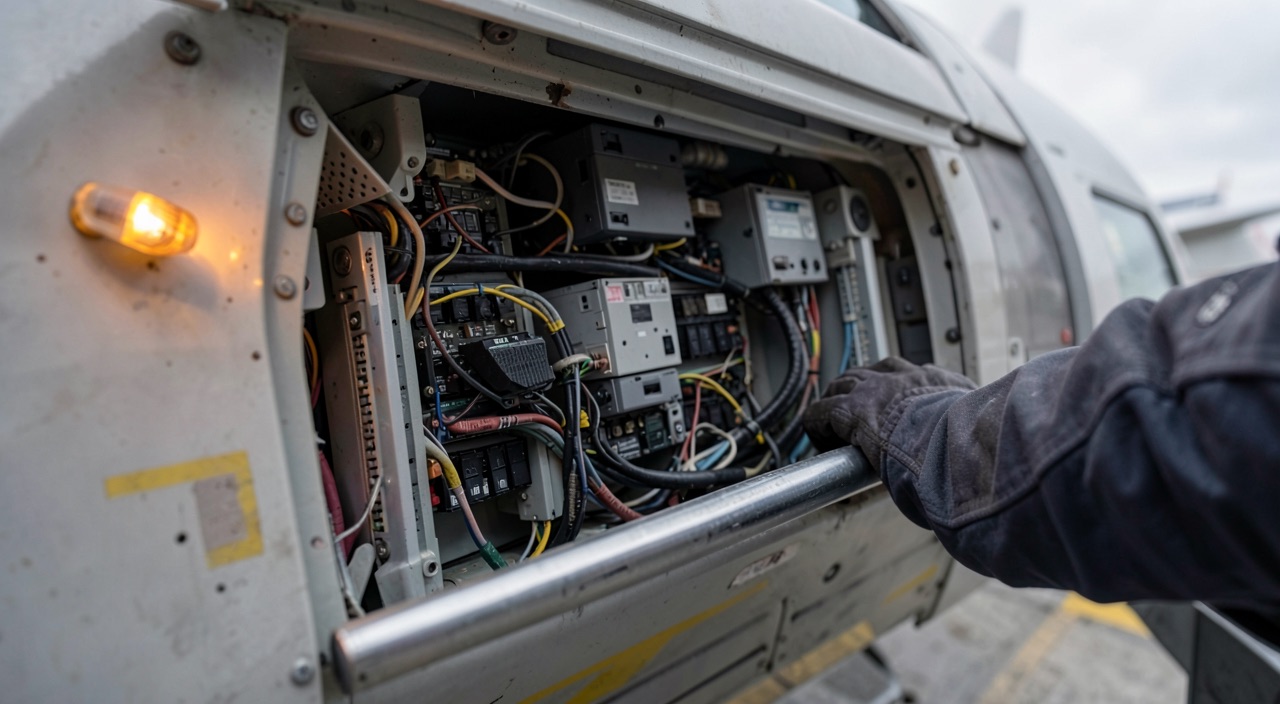
A calculator presented at a trade show, a brochure promising a trajectory gain, and much later a work card counting in tens of hours that lands on the planner’s desk — without anyone, in between, having seen half the journey pass. Between the announcement and the action, five documents are relayed, and as many responsible parties take turns, each only ever engaging their own link. That’s where the schedule is made, and it’s almost always at the same place that it breaks.
Le processus pour transformer une annonce commerciale en modification réelle sur un avion passe par cinq étapes avec cinq acteurs différents. Le vrai retard se crée surtout entre la publication du bulletin de service et la décision de l’opérateur, car c’est là que les choses deviennent concrètes.
What an announcement commits to, and what it doesn’t
A trade show announcement is a commercial act. It establishes that a product exists, sometimes that it has flown on a test aircraft, rarely that it can be installed on yours. Between the two lies the only thing that matters to an operator: a design approval covering the installation, on this type, in this configuration, with this wiring.
The most persistent confusion concerns the equipment standard. A calculator qualified according to a recognized technical specification has demonstrated that it meets its performance in a given environment: temperature, altitude, vibrations, electromagnetic compatibility, software assurance level. This qualification says nothing about the installation — neither the interfaces, nor the behavior of the assembly in case of failure, nor the effect on electrical loads. The installation falls under a design modification, minor or major depending on its effect on airworthiness, carried either by the type certificate holder under its design approval, or by an approved organization through a supplemental type certificate.
This point controls the entire schedule. When the supplier announces availability, they are talking about their box. When the operator requests a date, they are talking about a registered aircraft, in a precise configuration state. The two dates have no reason to coincide, and the gap is rarely counted in weeks.
Un avionneur annonce un nouveau calculateur pour un A320 lors d’un salon en mars. Le calculateur est certifié DO-178C mais son installation nécessite une modification de conception. L’approbation finale n’arrive qu’en novembre, et la première installation sur un avion de ligne n’est prévue qu’en février suivant, soit 11 mois après l’annonce initiale.
The service bulletin is a design document, not a work order
The service bulletin is issued by the type certificate holder, or by the supplemental certificate holder when the modification belongs to them. It covers the applicability domain expressed in serial numbers and previous states, the technical description, the parts list, the specific tooling, the labor estimate, the effect on mass and balance, the documents to be amended, and, if applicable, the industrial compensation offered.
What it does not include is the mandatory nature. A manufacturer cannot make a modification mandatory; it can qualify it as urgent and set a recommended deadline, which is not the same thing. The obligation, when it comes, comes from elsewhere. Confusing the two produces two symmetrical errors: neglecting a bulletin that a navigability directive will later take up, or immobilizing an aircraft for an improvement that nothing imposed.
| Origine | Who publishes it | What it imposes | Operator’s latitude |
|---|---|---|---|
| Recommended or optional bulletin | Holder of the type certificate or supplemental type certificate | Nothing legally; offers a gain in reliability, performance or comfort | Total, but the decision must be recorded and justified |
| Alert service bulletin | Same issuer, following identification of a safety issue | A recommended compliance time, often short, linked to an in-service event | Theoretical: refusal exposes the operator to the directive that follows |
| Airworthiness directive | Authority of the State of Design, adopted by the operator’s authority | An airworthiness condition with a firm deadline, in calendar time, hours or cycles | None, apart from a formal exemption processed in advance |
| Operational or airspace requirement | Autorité de surveillance, prestataire de navigation aérienne, exigence d’accès | A condition for access to an operation or airspace, not an airworthiness condition | Real: give up the route, the approval or the slot |
The distinction is not a matter of vocabulary: it determines who signs the decision, which budget carries it, and when the countdown starts. The same equipment can occupy three of these cases for three aircraft in the same fleet, depending on their serial number and the routes they serve.
From the bulletin to the modification file: the step no one looks at
The bulletin arrives at the technical office of the airworthiness management organization. The first task is not to read it, but to determine its applicability, aircraft by aircraft. Effectiveness is expressed in serial numbers and previous states: an aircraft that has already received a related modification may be out of scope, while another may enter it because a calculator replacement has pushed it in. On a heterogeneous fleet, this single operation can easily take several days, and it is never automatable as long as the actual configuration state is not reliable.

Next comes the impact assessment, the real engineering work of the operator. The file must state what the modification changes for the minimum equipment list, the flight manual and its supplements, the crew procedures and their difference training, the maintenance program, the mass and balance, and the specific approvals when the aircraft holds them — low-visibility approach, performance-based navigation. A bulletin that seems to only affect a black box thus triggers a manual amendment and a training session.
The incorporation decision closes this phase. It is signed, dated, and justified, and it is this that constitutes the execution order — not the bulletin. If the installation must deviate from the bulletin, because the existing wiring differs or because the kit does not cover a variant, the scale changes: a separate design approval is then required, therefore an authorized organization to carry it, and an additional delay counted in months rather than weeks.
A limiting case deserves to be anticipated as soon as the file is opened: the revision of the bulletin during the campaign. A publisher that corrects a procedure, adds a part, or restricts its applicability domain publishes a revision, and the aircraft already processed find themselves in a state that is no longer that described by the current version. The file must therefore record, aircraft by aircraft, which revision each has been modified to, and the impact assessment must be replayed on the difference between the two versions rather than starting from scratch. Without this discipline, a fleet reputed to be homogeneous harbors three modification states bearing the same bulletin number, and the discrepancy is only discovered during the next troubleshooting, when the part ordered according to the latest revision does not match the installation found.
Le vrai travail commence quand l’opérateur doit adapter le bulletin de service à ses propres avions. Il faut vérifier chaque appareil, évaluer les impacts, et parfois demander des approbations supplémentaires. Si le bulletin est modifié pendant les travaux, c’est encore plus compliqué à gérer.
The work card, or the translation into actions
The work card belongs to the maintenance organization, not the manufacturer. It breaks down the modification into executable tasks: areas and accesses to open, prior safety measures, calibrated tooling with their numbers, required personnel qualifications, mandatory inspection points, functional tests and acceptance criteria, return to configuration, then the signatures.
This is when the labor estimate in the bulletin ceases to be relevant. It describes an installation time on an aircraft already open, in the workshop, with the complete kit at hand. The card, on the other hand, must include the opening and closing of accesses, the wait for a shared bench, the availability of a certifying personnel holder of the correct type qualification, and sometimes a test flight. The gap between the two figures is not an error by the manufacturer: these are two different scopes, and the planner who takes the first for the second builds a site that overflows from the first day.
A well-written card is recognized by three details. It names the reference maintenance document for each task instead of paraphrasing it; it isolates the tests that require a resource external to the site, so they can be reserved in advance; and it provides the state in which the aircraft must be left if the site is interrupted.
Where the schedule breaks
Three disruptions, and only one is technical. The first concerns procurement: a harness made to order, an antenna with a long lead time, a small-series machined plate are counted in months. The second concerns arbitration: the file awaits a budgetary decision, and this is by far the longest wait, because it does not appear on any industrial milestone. The third concerns the slot: a wiring job does not fit into a turnaround, it requires a visit. If the next major visit falls well after the deadline, a dedicated immobilization is purchased, and the bill changes in magnitude without a single hour of work having been added.
This is compounded by the deadline effect. As long as a modification remains recommended, it slips into the visits and progresses slowly. Once made mandatory, it causes a scramble: the demand for kits, slots, and qualified personnel is concentrated in the last months, across all operators at the same time. The one who processed their file early buys their slot before the queue; the one who waited for the directive discovers supply delays that lengthen accordingly.
Pour un A330-200, une modification de câblage nécessite 40 heures de travail selon le bulletin. En réalité, l’immobilisation dure 12 jours calendaires car il faut attendre 5 jours pour le kit, 3 jours pour un technicien qualifié, et 2 jours pour la planification. Le travail effectif ne prend que 2 jours.
The size and type of operation shift these disruptions without changing their nature. On a large fleet, incorporation is smoothed out on its own: there is always an aircraft in heavy maintenance, an internal workshop whose workload is known, and a store capable of immobilizing a kit in advance. On one or two aircraft operated in business aviation or aerial work, none of these buffers exist: airworthiness management is often outsourced, the workshop is booked on a case-by-case basis, and the immobilization does not affect a fraction of capacity but the totality. Arbitration becomes calendar-based before being technical — the job is scheduled during the usage lull, and the file must be processed much earlier than the size of the work would suggest.
The trap: the partially modified aircraft. A job interrupted due to lack of parts or time leaves an aircraft that is no longer in the previous state and not yet in the target state — therefore in a configuration that neither the flight manual, nor the minimum equipment list, nor the maintenance program describes. Without an acceptable stop point provided in the work card, the aircraft cannot be returned to service, and this is discovered in the evening, with a flight departing the next day.
The configuration does not stop at the aircraft
A fleet with two configurations costs more than the job: differentiated conditions in the minimum equipment list, difference training for crews, two sets of documentation, duplicated spare parts stock, programming constraints when only the modified aircraft are allowed on certain routes. This duality cost is rarely quantified in the initial economic file, although it is proportional to the duration during which the two configurations coexist — a duration that the operator fully controls.
Configuration management consists of being able to answer, at any time and for each registration, two questions: what state is this aircraft in, and which document describes this state. The weak link is no longer the hardware, it is the loadable software. A load that modifies a function is a configuration modification, even without visible trace in a bay: the loaded version must be tracked, the approval covering it identified, the rollback planned.
The right reflex: open any modification file with an end-of-duality date, and not just a start date. Setting the date on which the last aircraft will be modified at the time of the incorporation decision transforms a floating program into a dated commitment: the kit is ordered on this basis, the slot is reserved, and the minimum equipment list does not remain indefinitely in degraded mode because the last aircraft are lagging.
What to go check in your own documentation
Four points, to look for in the manual of specifications of the airworthiness management organization and in that of the maintenance organization, rather than in the regulation. Who, by name, can declare a bulletin non-applicable, and on what evidence — the trace of this negative decision is the first thing an auditor reads. Where the incorporation decision is filed, and within what deadline the technical office must rule. How the contractual delivery deadline for the kit enters the file. Finally, how the actual configuration state is physically verified, and not just read in an information system.
The remaining gray area concerns purely software modifications and functions activated by license: no tooling or access, and traceability that relies entirely on a recording discipline. For those preparing a type qualification, a certifying personnel authorization, or a position in the technical office, knowing how to read an effectiveness, distinguish a previous state from a target state, and understand exactly what a design approval covers weighs more, in maintenance, than the knowledge of the modified system — the exchanges of the FL330 technical forum confirm this post after post.
This article describes a mechanism and a professional practice; it has no normative value. In case of discrepancy, the applicable regulatory text, the navigability directives in force, and the approved documentation of the operator — specifications manual, maintenance organization manual, maintenance program, and type certificate holder data — prevail in all circumstances over what is written here.


Leave a Reply
You must be logged in to post a comment.