

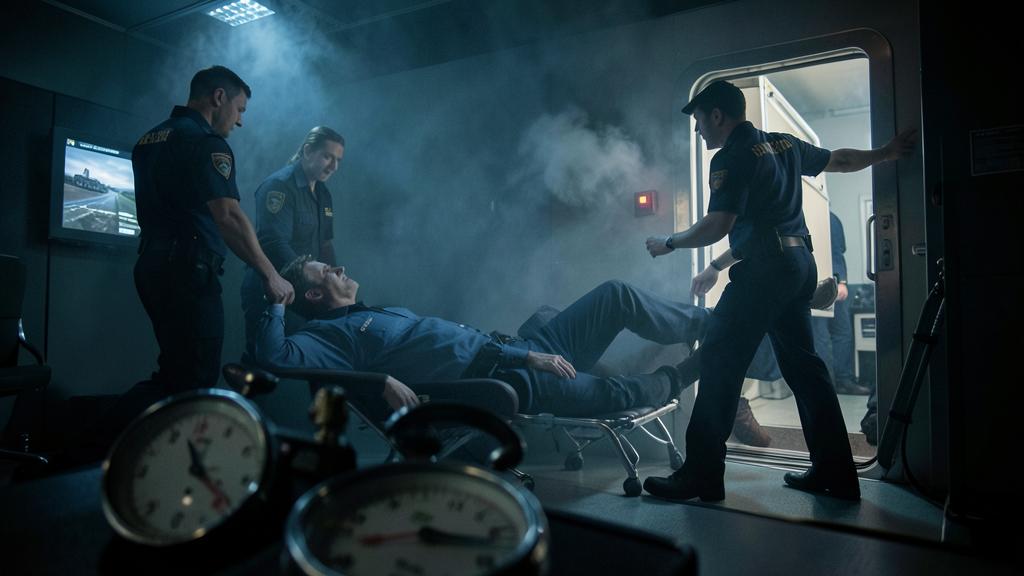
The time falls within the limit the operator has set itself, exercise validated, certificate on file. What the record does not say: the forward right exit was armed and opened without anyone looking through the window, commands did not carry beyond the third row, and the one role-player acting as an immobile passenger was simply walked around. None of this shows up in a time. The stopwatch does not lie — it measures exactly what it is asked to measure — but what it leaves out of frame is precisely what decides a real evacuation. Hence the value of going back to where that figure comes from, what it adds together, and what an exercise completed within the allotted time can perfectly well conceal.
Ninety seconds: a certification criterion, not a training target
Certification does not belong to training: it belongs to type certification. The emergency evacuation demonstration serves to establish that a given exit configuration authorises a given number of seats. It is a certification parameter, on the same footing as a maximum mass, not a prediction of what will happen one day on a runway.
The conditions of this demonstration are strict on some points and generous on others, and both have to be held together to read the result. Strict: darkness, only half the exits and all on the same side, participants who have not rehearsed and whose age and sex distribution is imposed, imposed aisle clutter, and the minimum cabin crew complement, the one given by the rule of one member per block of fifty installed passenger seats, or fraction thereof. Generous: no fire, no smoke, no injuries, no genuine fear, the aircraft in its normal ground attitude, all slides serviceable, and a crew that knows it is performing a demonstration. The result is therefore neither a forecast nor a margin: it is a calibrated test, passed once, and most often never replayed for later evolutions of the type, which are handled through analysis and partial testing instead.
The practical consequence deserves to be stated plainly: the number of seats in a cabin is a product of the number and type of exits, not of a crew’s performance. When the same order of magnitude reappears, years later, on the record of a recurrent exercise, it has changed its meaning without anyone announcing it.
Three regimes carrying the same stopwatch
Regimes can only be compared under equal conditions. Yet the three situations in which an evacuation is timed share neither the population, nor the preparation, nor the number of exits actually available. They therefore do not establish the same thing.
| Regime | Purpose | Population and preparation | Exits available | What the time establishes |
|---|---|---|---|---|
| Certification demonstration | Authorise a number of seats for an exit configuration | Untrained participants, imposed distribution, scenario unknown to them | Half, on one side only, in darkness | That the configuration and the minimum crew complement allow the declared capacity to be evacuated, once, under defined conditions |
| Recurrent exercise in a cabin simulator | Verify and maintain individual proficiency | Trained crew, cooperative role-players, scenario often guessed in advance | All of them, unless the scenario dictates otherwise | That the crew can perform within a framework it knows; nothing about decisions taken under uncertain conditions |
| Real evacuation | Getting everyone out before the cabin becomes untenable | Unprepared passengers, some of them immobilised, luggage taken along, smoke | Unknown until checked one by one | Nothing in advance: time there is an outcome, never a criterion |
The drift happens on its own. The same order of magnitude circulates from one regime to another, and the exercise ends up being judged against a test that did not have the same purpose, with every exit operable and role-players who obey.
What the time adds together: a latency and a throughput
Break the total time into two terms, and the reading changes. The first is a latency: perceiving the anomaly, deciding, passing the command, assessing the outside, opening, waiting for the slide to deploy. The second is a flow: the number of occupants divided by the cumulative throughput of the exits actually opened.
These two terms do not respond to the same levers. Flow is divided by the number of exits, but on a condition that is quickly forgotten: occupants must still spread themselves across them. Two open exits only halve the flow time if the cabin splits; if everyone heads for the same side, the second exit is useless until a voice sends someone to it. Latency, on the other hand, cannot be divided — it is paid once, in full, regardless of the number of doors. And because an exit’s throughput caps quickly, with an occupant passing through it in roughly a second, the flow term collapses rapidly as exits multiply, while latency remains intact.
This is why an exercise can gain several seconds by dropping the outside assessment: those seconds are taken from latency, that is, from the term most visible on the stopwatch. The gain is real, immediate, and falls exactly on what is measured. Its cost, however, only shows up the day the chosen exit opens onto an engine fire.
The total evacuation time is made up of two parts: the time it takes to start the evacuation (latency) and the time it takes for everyone to get out (flow). More exits speed up the flow, but not the latency. Skipping the outside check saves time, but it’s risky if the exit is unsafe.
On an A320 with 180 passengers, using 4 exits (2 front, 2 rear) instead of 2 (both front) reduces the flow time from 90 seconds to 45 seconds. But if the front-left exit is blocked by fire, the crew must reassess and redirect, adding 15 seconds of latency. The total time jumps from 45 to 60 seconds, showing how latency can undo the benefits of more exits.
The stopwatch starts too late and stops too soon
There remains the question of the boundaries, rarely put in black and white. In most exercises, the start is triggered at the evacuation command and the stop at the last role-player passing through a door. Each of these two boundaries excludes a decisive part of the event.
Upstream: the standstill, the wait for an instruction that does not come, the decision to act without it, the alert passed to the other stations. This is where the most seconds and the heaviest errors accumulate, and this is where joint flight-deck and cabin training pays off. Downstream: the final cabin sweep — lavatories, galleys, rear rows, seats from which one cannot rise unassisted —, the headcount, the move away, the report. A crew that gets the last passenger out in a remarkable time and leaves the aircraft without having checked the rear has posted an excellent time and a poor evacuation.
The trap. Replaying the exercise to improve the time teaches the second version, the one in which the crew already knows which exit will be good. The assessment gesture persists, but it becomes a mime: the head turns toward the window and turns away again before reading anything. No stopwatch detects this; only the duration of the glance betrays it, and it takes someone whose sole task is to watch for it.
Exit assessment and the cost of backflow
Looking outside before opening costs a few seconds, always the same ones, and avoids a mistake whose price is out of all proportion. What one looks for through the window comes down to very little: a flame or a glow, smoke running along the fuselage, debris or an obstruction beneath the door, an abnormal attitude that changes the jump height, water. Then, once the door is open, the state of the slide: deployed, inflated, oriented correctly, and not pinned against the fuselage by the wind.
When the exit is bad and has been opened anyway, the bill arrives in two instalments. First there is the time it takes to discover the problem, which is not negligible: a crew member who has armed, opened and started shouting does not give up in a second. Then there is the backflow. In a single aisle, passengers already committed forward have to turn back against the incoming flow, and the aisle’s throughput does not merely decrease: it drops to zero on the section where the two directions meet. A lost exit therefore does not just cost its own throughput; it also degrades that of neighbouring exits, which it saturates.
It is this mechanism that justifies the firmness of the condemnation. An exit judged unusable is closed, announced, and replaced by an unambiguous redirection command — not by hesitation that lets a queue re-form there. The right word, repeated, steers the flow; the absence of a word freezes it.
Command makes the throughput
A door’s throughput is not a property of the door. It depends on what happens two metres in front of it, and that depends on a voice. Three things make that voice effective, and none of them is measured by a time.
- Carrying. The noise of a cabin under evacuation — alarm, engines, shouting, airflow — bears no resemblance to that of a training room. A voice that is enough against a handful of role-players in an enclosed room no longer carries in a full cabin, and the crew has no way of discovering this in an exercise where everyone is already listening.
- Being short and repetitive. Brief commands, in the same format, hammered out without variation: the operator’s standardised phraseology is not a ritual, it is a decoding shortcut. A new sentence needs to be understood; an expected sentence gets executed.
- Pointing, not asking. An able-bodied passenger is recruited by pointing at them and telling them what to do, not by calling for volunteers. An open question produces nothing usable in the seconds when it is needed.
The crew member at the door does not just open it: they regulate it. They space people out, hold for an instant, get the flow moving again, move aside anyone who turns back to wait for someone. It is continuous work, and it is what widens the gap between two crews with equal exits. An exercise in which the role-players flow out on their own says absolutely nothing about this capacity.
Designing the exercise so it measures what matters
The training device, however complete, does not manufacture the difficulty. That comes from the scenario injected and from what the observer has decided to watch for. A systematic injection, drawn at random and not announced, restores exit assessment to its true character as a decision — and mechanically drives times up, which has to be acknowledged to the crew before starting rather than discovered at the debrief.
| Injection | Effect on the measured time | What the observer must note |
|---|---|---|
| Fire visible on one side of an exit | Lengthens noticeably, can cause the exercise to fail | The glance outside before the handle, the firmness of the condemnation, the delay before the redirection command |
| Slide not deployed or pinned by the wind | Lengthens | The immediate abandonment, the announcement made to the other stations, the redirection of the flow without a residual queue |
| Immobile passenger blocking the door | Collapses the local throughput | The taking of command, the explicit designation of an able-bodied passenger, the physical action carried out |
| Incapacitation of a crew member | Often unchanged | The takeover of the function, the redistribution of stations, the announcement of what is no longer covered |
| Abnormal attitude, gear-up landing | Little effect | The choice of exit based on height and slope, the use of overwing exits, the command given before jumping |
| Interphone out of service | Little effect | The command relayed from one to the next, confirmation obtained from the far end of the cabin |
The right reflex. Move both boundaries: trigger at the first abnormal indication, not at the command, and only stop after the final cabin sweep and the report. Then separate the roles — one observer keeps the time and notes nothing else, a second watches only the decisions and has no access to the stopwatch. The two records are then compared, and a good time paired with a poor decision record is the most instructive case of the session.
What the certificate proves, and what it records
The training record retains a date, a device, a content and a mention. It does not capture the quality of decisions, unless the grid used explicitly makes room for it. When the only numeric trace is a time, that time becomes, from the very next session, the crew’s tacit objective — and an instructor who wants to give credit for a well-conducted exit condemnation has no box in which to write it.
The remedy is simple and low-cost: record the injection used and the behaviours observed alongside the time, in the same terms from one session to the next. Three lines suffice. They make the record comparable over time for a given crew, which an isolated figure never allows, and they give the training manager the means to see a collective flaw recurring — the same exit poorly assessed across several crews signals a programme flaw, not an individual one.
What to check at home
Three points can be read in the operator’s documentation and checked within half an hour. Where does the manual place the stopwatch boundaries, if it places them at all? Does the outside assessment of an exit appear as a pass criterion, or merely as a procedural step, which commits to nothing? Is there a list of injections, does it actually rotate, and does anyone check that a crew is not given the same one three times over?
There remains a grey area, and it must be named: time is the only quantity comparable across crews, across bases and across operators. We do not know how to measure command, we know how to measure a duration, and that is why we measure what we know how to measure. The answer is not to do away with the stopwatch, which remains a useful indicator of fluency and the only common reference point; it is to refuse to let it serve alone as the criterion, and to pair it with a written observation whose terms are fixed in advance. Observation grids circulate little from one operator to another; exchanges between instructors on the FL330 forum are often worth more, on this point, than an internal document left isolated.
For anyone preparing a cabin crew qualification, an instructor upgrade or a flight safety position, the stakes are direct: being able to explain why an exercise passed on time can still be a failed exercise distinguishes the candidate who has understood the mechanism from the one who has merely learned the procedure. The FL330 training programmes address this reading of training criteria.
The applicable regulation, the type certification specifications and the operator’s approved documentation take precedence over this article, which sets out a mechanism and does not serve as either a procedure or an assessment criterion.
Questions fréquentes
Does the ninety seconds apply to a training exercise?
No. This figure comes from the emergency evacuation demonstration conducted at type certification, whose purpose is to authorise a number of seats for a given exit configuration. It is established once, under defined and non-reproducible conditions, and nothing designates it as a pass criterion for a recurrent exercise. The operator remains free to set itself a fluency benchmark, but must then own it as an internal target, not as a transposed regulatory requirement.
Where should the stopwatch start and stop in a recurrent exercise?
The most instructive approach is to trigger at the first abnormal indication, before the evacuation command, and to stop only after the final cabin sweep and the report to the commander. The usual boundaries, from the command to the last role-player exiting, exclude the upstream decision phase and the downstream verification, which are the two areas where the heaviest errors lodge. Widening the window mechanically lengthens the measured times: it must be announced to the crew before the session.
How can an exit be assessed in a few seconds without lengthening the total time?
The assessment is not lengthened, it is structured: a look through the window for a flame, smoke along the fuselage, an obstruction under the door, an abnormal attitude or water, then, once the door is open, the state and orientation of the slide. This sequence, always in the same order, takes only a few seconds once automated. Those seconds are taken from latency, the term that is paid only once, whereas a poorly chosen exit costs both the time to discover it and the throughput degraded by backflow.
Should an exercise completed outside the time limit but well conducted be validated?
This depends on the criterion written into the operator’s documentation, and that is precisely what needs to be checked before the session. If time is the sole criterion, a severe injection can fail a crew whose decisions were sound, which produces exactly the wrong learning. The healthiest practice is to make time a fluency indicator and observed behaviours the validation criterion, recording the two separately.
Should a condemned exit be injected in every exercise?
An injection at every session, yes; always the same one, no. The value of the injection lies in its unpredictability: as soon as a crew knows which exit will be bad, the assessment becomes an automatic gesture again and ceases to be a decision. An up-to-date list, drawn at random, with a record of what has been played per crew, prevents the same scenario from recurring three times in a row while the next one is never played.
What should be recorded in the training log for it to serve any purpose?
Alongside the time, the injection used and two or three observed behaviours, written in the same terms from one session to the next: outside assessment carried out or not, firm or hesitant condemnation, commands audible at the back of the cabin, complete final cabin sweep. This standardisation makes the sessions comparable over time for a given crew and allows the training manager to detect a collective flaw. An isolated time, by contrast, compares to nothing.


Leave a Reply
You must be logged in to post a comment.