

The quarterly flight data monitoring report for a fleet with medium-range aircraft shows an increase in unstable approaches at two airports and in poorly executed go-arounds. Simultaneously, the recurrent programme of the same operator, as every year, re-examines engine failure at the decision point and hydraulic failure in the catalog. Evidence-based training was born from this gap: while the simulator executes a fixed checklist, it prepares crews for threats of another era, while the fleet precisely documents those of today. Here is the mechanism by which a program recalibrates with its own data and what it demands in return.
The fixed catalog defends against yesterday’s threats
Classic training programs stem directly from type qualification requirements: a list of failures and maneuvers – engine failure on takeoff, instrument approach with engine failure, fire, loss of pressure – repeated at fixed intervals with superficial variations. This list has a historical logic: it covers the events that killed crews in the era of the first jet aircraft, and partly because they were fought so hard, they have become rare.
Repetition has obscured the initial question: against what should this fleet thisyear, thisyear train? The flight data monitoring answers with a precision that the catalog cannot achieve. It shows where the fleet actually hits its limits: late stabilization, energy management in descent, poorly sequenced go-arounds, automation surprises, long landings on contaminated runways. These families of events dominate the recordings and often take a marginal part of the simulator time, while rare failures monopolize entire sessions.
In short. Classic training programs repeat old scenarios, even if they no longer correspond to current risks. Flight data shows that crews mainly encounter problems like unstable approaches, but the simulator spends more time on rare failures. Data-based training allows refocusing training on real problems.
On an Airbus A320 fleet, data analysis reveals that 60% of unstable approaches occur at Paris-Charles de Gaulle Airport, mainly on runway 27L. The training program is then modified to include scenarios specific to this runway, with weather conditions and traffic configurations similar to those encountered in operations.
Evidence-based training does not erase the catalog: it puts it in the right context. A core of maneuvers continues to be trained in itself, because pure skills erode even without data, and because some events are too rare to emerge from the fleet. But most of the recurrent training time is redistributed on what operations actually encounter, and this allocation is re-examined each time, rather than set in stone from one revision to the next.
What flight data monitoring sees and what it does not see
The flight data monitoring program measures objective deviations in all flights: stabilization altitude, speed at threshold, descent rate below a certain altitude, on-board alerts, parameter ranges set by the operator. Its strength lies in its comprehensiveness: where the report depends on the willingness to write, the data is systematic. They provide the frequency, location, seasonality: the geography of the fleet’s specific risk.
Its limit is clear: it does not explain the why. A persistent unstable approach and a well-executed aborted approach leave similar traces; the data does not see the cockpit discussion, operational pressure, or the well-constructed decision that went wrong. A program calibrated solely on telemetry would train symptoms.
Calibration crosses several sources: safety reports that tell the mechanism; training data from previous cycles, showing where crews actually struggled in sessions; investigation reports for events too rare to emerge from the fleet; and data shared by the industry when the fleet is too small to be statistically significant. Flight data provides the « where » and « how often »; other sources provide the « why ». The program is built at the interface.
From identified deviation to module theme: the filtering chain
Between a peak in the recordings and a simulator scenario, there is an often underestimated filtering chain. First step, aggregation: an isolated event is not a theme; repetitions are sought over several analysis cycles to avoid chasing noise. Second step, lever attribution: if unstable approaches are concentrated at one airport and one approach procedure, the solution may be to address the procedure or the briefing, not a simulator session. Promoting a design flaw as a training theme is treating the fever, not the infection.
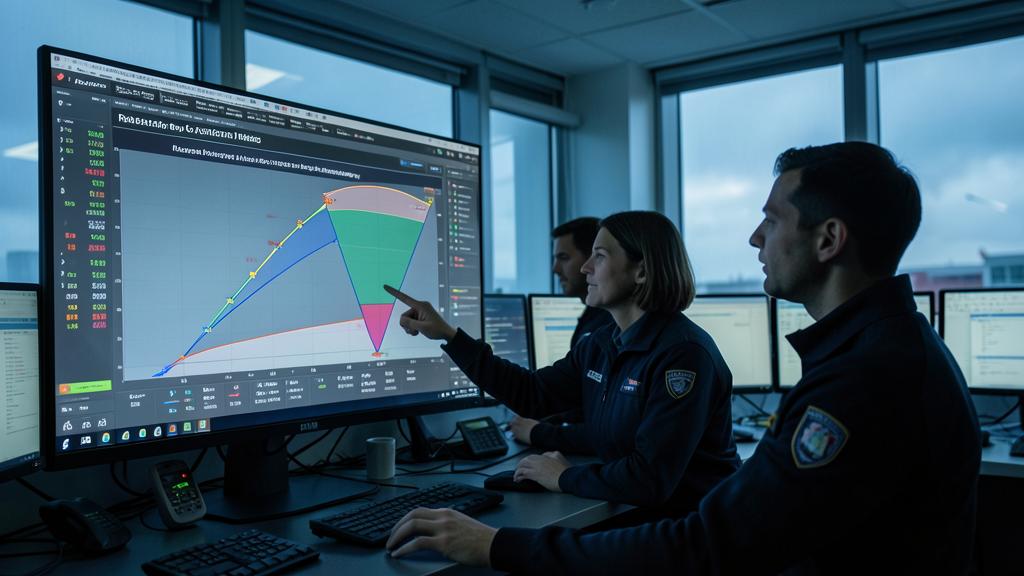
Third step, the most demanding: translating into competence. A precursor does not transform into an identical exercise. Literally replaying the event of the quarter trains crews to recognize a scenario, not to manage a situation. The focus shifts from the event to the necessary competence – flight path management, decision-making, workload management – and a scenario is built that tests this competence in a different context than that of the source event.
The result is feedback: session evaluations feed the analysis, and the theme is pursued, adapted, or removed in the next cycle based on both flight and training data. It is this closed loop, more than the content of a particular module, that defines a data-based program: the program becomes a living object in the safety management system, with an owner, governance, and a review schedule.
Observable competence replaces successful maneuvers
The second transformation concerns assessment. In a classic evaluation, the unit of measurement is the maneuver: within or outside tolerances. In an evidence-based program, the unit is competence, described by observable behaviors: application of procedures, communication, flight path management in manual and automated flight, knowledge, teamwork and leadership, situational awareness, problem-solving and decision-making, workload management.
The difference is not cosmetic. A botched go-around is a symptom; the cause may be eroded situational awareness ten minutes earlier, unequal workload distribution between seats, or a misunderstood automation mode. Evaluating maneuvers leads to repeating the maneuver; evaluating competence allows addressing the root – and it is the competence, not the maneuver, that transfers to unplanned situations.
This change places instructors at the center, and it has an Achilles’ heel: concordance. Two instructors observing the same performance must give similar evaluations, otherwise the training data – which feeds the loop – is just noise. Serious operators devote training to this subject: cross-evaluation of recorded or standardized sequences, comparison of deviations, revision of definitions of observable behaviors, then statistical monitoring of evaluations to identify instructors systematically strict or lenient.
What concretely changes in the recurrent module?
From the seat, a recalibrated module is recognizable by its structure. It begins with an evaluation phase: a flight segment representative of the line, played without scenario announcement, where the crew manages the situation as in operations – this is what captures real competencies. This is followed by a manoeuvres training phase, where maneuvers identified as degraded or fragile in the fleet are treated for themselves, out of context. The module ends with scenario-based training, built on themes derived from analysis, where the instructor moves from evaluator to trainer.
| Fixed catalog | Data-based program | |
|---|---|---|
| Origin of themes | prescribed list, renewed annually | fleet analysis crossed with other sources, verified at each cycle |
| Certification unit | maneuver within or outside tolerances | competence, described by observable behaviors |
| Instructor’s role | item evaluator | observer then trainer, calibrated in concordance |
| Useful preparation | memorization of the known session | daily operation, the session not being announced |
| Program life | fixed between two documentation revisions | closed loop with the safety management system |
| Rare events | all repeated at the same rate | core preserved, the rest reallocated according to exposure |
The most visible consequence for the crew is the inversion of surprise: in a fixed catalog, everyone knows what is coming and prepares the session like an exam; in a data-based module, useful preparation is the operation itself, the session resembling the line – this is precisely the goal.
Risks of data-based training
A recalibrated program has its own pathologies. The first is statistical: a small fleet produces few events, and the temptation is to react each quarter – the program then oscillates with the noise. The second is pedagogical: a scenario recycled from a known event is recognizable from the briefing, and the session measures the memory of the event, not the competence. The third is social: if a crew member thinks they are « called for their curves », the source dries up. Protective measures around flight data anonymization exist precisely to keep the data abundant and honest; the use of the analysis program for collective training must never slip into individual targeting outside the agreed framework with crew representatives.
The risk: turning the last quarter into a program. An isolated peak, a publicized event, or poorly anonymized data directly promoted to a module cause three simultaneous damages: a program that oscillates with statistical noise, crews that recognize the scenario instead of managing it, and crew members who lose confidence in the analysis program – therefore a dried-up source.
The right reflex: Before a deviation is promoted to a module theme, three filters are verified. Repetition – does the deviation persist over several analysis cycles? Mechanism – does a narrative report, a report, or a debriefing explain the why? Lever – is the simulator the right tool, or is it a procedure, an airport, or a manual to correct? A theme that passes the three filters will last more than one cycle.
Before your next module: what to check in your documentation
For those preparing for a qualification or extension with an operator using this type of program, three readings are more valuable than a week of repetition. The training section of the operations manual describes the competence framework, associated observable behaviors, and the evaluation scale: it is this vocabulary, not the list of failures, that structures the debriefing – knowing it changes the way you listen to the instructor. The current cycle program indicates the selected themes and often their justification: reading them is reading the risk map of your own fleet. The agreement governing the use of flight data finally specifies what the analysis can and cannot do with individual data – knowing it protects both parties. Instructors will add what their documentation provides on concordance: calibration frequency and evaluation deviation management.
A gray area persists: the operator whose fleet or data volume does not allow complete recalibration lives with a mixed program, where data-based elements coexist with a prescribed core. The boundary between the two – which themes are fixed, which are dynamic – is precisely the point where questions should be asked, during an examination, a fleet takeover, or a professional interview.
On all these points, this article describes a general mechanism: the applicable texts, the approved program, and the operator’s documentation prevail over what precedes.


Leave a Reply
You must be logged in to post a comment.