
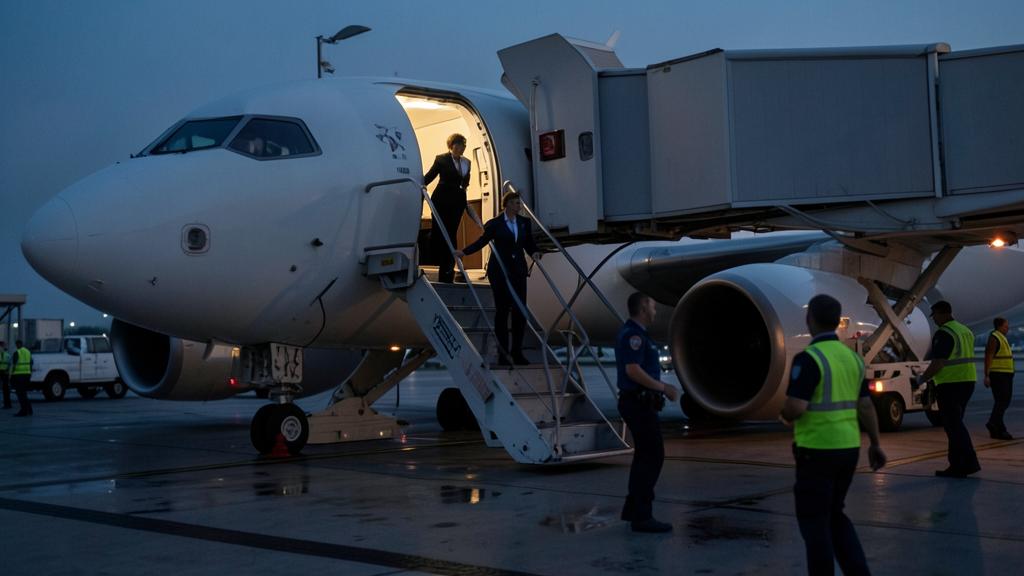
Boarding is complete, the front door has just been closed, and the purser is heading to the cockpit: at the back of the cabin, a passenger who was already loud at the gate is on first-name terms with his neighbors and refuses to return the glass he brought on board. The question asked of the captain is not whether this man is unpleasant, but to choose between a certain cost, immediate, quantifiable by the minute, and a probable cost, deferred, with no common measure with the first. And the answer depends less on the passenger’s character than on three material things: where his checked baggage is, what time it is, and how long it will take for an authority capable of making him disembark.
The window does not close gradually, it closes in stages
Closing the doors changes the nature of the operation. As long as the boarding bridge is in place and passengers are still boarding, making someone disembark costs almost nothing: the boarding agent accompanies them, their baggage has not yet been loaded or is on the top of the stack, and the cabin count is not yet finalized. The operation is so inexpensive that it often goes unnoticed in punctuality statistics. That’s also why it is underused: no one wants to initiate a heavy procedure for a passenger who has not yet done anything other than speak loudly.
Closing the doors changes the nature of the operation, not just its duration. The aircraft must be unarmed, the door reopened, the boarding bridge repositioned or a set of stairs brought in, agents who have already left the post recalled, the cargo hold reopened, the unit load devices (ULDs) between the door and the sought baggage removed and then replaced, and the load and trim documents reissued. It is no longer the same job being mobilized, and above all, it is no longer the same people: instead of a ground handler, a ramp team, a loader, a traffic agent, and, if the passenger resists, a security patrol are needed.
After pushback, another step is taken. Returning to the gate requires authorization, a tow tractor, or a maneuver under its own power, stopping the engines already started, and sometimes freeing up a slot that has since been occupied. The departure slot, if there was one, is lost, and the next one is not guaranteed. To this, add the fuel consumed during taxiing, and, on a long sector, a top-up refueling that in turn triggers a new load sheet. In flight, it is no longer a disembarkation but a diversion: another event, with its consequences on crew duty times and the aircraft’s schedule for the next two days.
The cost of disembarking a passenger skyrockets once the doors are closed. Before that, it’s quick and easy. After, it’s a big operation with many people and steps, and the longer you wait, the worse it gets. The key is to act fast if needed.
On an Airbus A320 at Paris Charles de Gaulle, a passenger is asked to leave during boarding. It takes 5 minutes and no delay. If the same passenger is asked to leave after doors are closed, it takes 45 minutes, requires 8 ground staff, and costs the airline a 30-minute slot. If the aircraft has already pushed back, the delay can exceed 2 hours and require refueling.
| Time of decision | Physical action | Hold baggage | Documents to redo | Order of magnitude of delay |
|---|---|---|---|---|
| Boarding in progress | The passenger leaves via the jet bridge, accompanied by an agent | Still at sorting or on top of the pile | None: the count is not final | Quelques minutes |
| Boarding complete, door still open | Same action, agents and jet bridge still in place | Hold being closed, removal without unloading | Cabin count, loadsheet in preparation | About a quarter of an hour |
| Doors closed, aircraft on stand | Disarming, reopening, repositioning the jet bridge or stairs, recalling agents | Hold reopened, intermediate units removed then reloaded | Last-minute change or new loadsheet | Half an hour to an hour |
| After pushback | Return to stand by towing or under own power, engines shut down | Same, plus a parking stand tied up | Feuille de charge, plan de vol, créneau de départ | An hour or more, slot lost |
| In flight | Unscheduled landing at an aerodrome not planned for it | Unloading possible but pointless: the flight is broken | Everything, including the rest of the aircraft’s schedule | The aircraft’s and the crew’s day |
The right reflex. Ask the question of disembarkation while the door is still open, even when nothing yet justifies it. A single sentence at the cockpit is enough: “Behavior to monitor, seat 32C, if it worsens, we will be doors closed.” The captain then knows that a file exists, and he can ask to delay the door closure by two minutes rather than having to undo it twenty minutes later. The cost of this anticipation is zero; that of its absence is measured in steps.
Who decides, who executes, who has no say
The chain is short, and each of its links has a precise function from which it must not deviate. The cabin crew member provides a report: what was said, word for word when possible, what was done, what was consumed, and at what time, on which seat. They do not qualify. “The passenger is drunk” is a medical conclusion that no one on board is qualified to make; “The passenger brought an opened bottle on board, spilled their drink at 21:10, their speech is slurred, and they stood up three times during boarding” is a report, and that is the one that will stand in a file six months later.
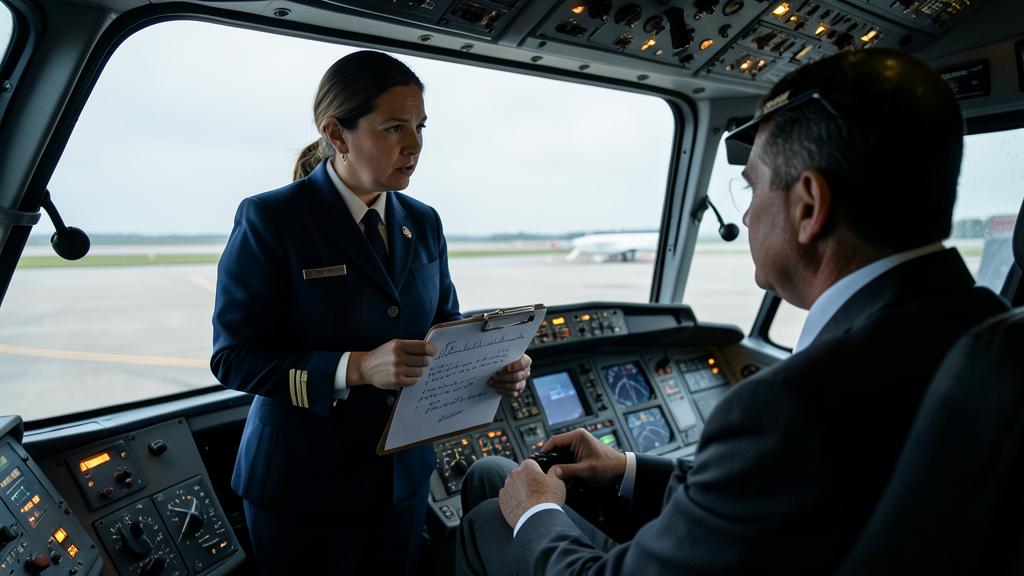
Decision-making is clear. The purser aggregates and carries. Three crew members each coming with a fragment produce a confusing picture at the cockpit at the precise moment when the captain needs a clear request. Its formulation counts: it must state what is observed, what is requested, and what will happen if nothing is done. The captain decides, and once the doors are closed, the decision is not shared: the authority he holds from the operational rules and the international convention on offenses committed on board exists precisely so that a safety arbitration is not made by the one who will pay the bill.
Execution is precise. The station and the control center execute and quantify. They know where the baggage is, how long it will take to remove it, which slot will be lost, which connections will be missed. This information is necessary for the decision, it does not replace it—and an operator who lets the quantification rise as pressure mechanically makes bad decisions. Finally, the authority is the only one who can enforce. A crew can immobilize a dangerous person, which is a security act; they cannot make them disembark by force, which is a police act. Confusing the two exposes the crew far more than the passenger.
| Acteur | What they bring | What they cannot do |
|---|---|---|
| Cabin crew member | The observation: what was said, done, drunk, at what time, in which seat | Qualify the passenger’s condition, negotiate an exit alone, guarantee an outcome |
| Senior cabin crew member | The summary and a single voice to the flight deck, with an explicit request | Decide on the offload, engage the station, contact the authorities |
| Captain | The decision, which is theirs alone once the doors are closed | Use physical force, skip the written record, delegate the decision to the ground |
| Station and operations control centre | Execution, costing, baggage location, schedule consequences | Overturn the captain’s decision or make it conditional on cost |
| Police or security authorities | Compulsion, handling on the ground, taking statements | Intervene without being called, replace the operator’s report |
The checked baggage is the real stopwatch
Baggage handling is critical. The security rule that governs everything is simple: a checked bag only travels with its passenger. As soon as a boarding passenger disembarks, their baggage must also be removed, or switch to a special handling regime that no one triggers lightly for a regular departure. Disembarking a passenger is therefore, in practice, a cargo hold handling operation disguised as a behavior issue.
Time depends on position, not weight. In bulk loading, on a short or medium-haul flight, an identified bag is quickly found if the loading was done in batches and the tracking was kept. In containerized loading, everything depends on the position occupied: a unit loaded furthest from the door requires removing and then replacing those in front of it, each cycle being a complete loader maneuver. And the loading order is not the boarding order: a bag dropped early may well have been stowed at the back, a connecting bag may arrive last and depart first.
Documentary changes are tricky. Removing a passenger and their baggage changes the weight and, depending on the affected position, the center of gravity. As long as the discrepancy remains within the last-minute modification limits defined by the operator, the correction is handwritten on the load sheet. Beyond that, a new sheet is required, edited, transmitted, verified, and signed. On an aircraft whose loading was already tight, removing a single passenger from a front row may be enough to exceed the limits, and it is this document, not the passenger, that then dictates the departure.
The trap. The passenger disembarks, the door closes, and no one ensures that the disembarkation was recorded in the departure control system. The reconciliation between passengers and baggage then continues to count them on board: the hold departs with a bag whose owner remained on the ground, and the discrepancy only appears at the next check, sometimes after takeoff. The missing action cost nothing at the time; it is the one that turns a correctly handled cabin incident into a safety discrepancy to be reported.
What is actually compared: a certain cost against a probable cost
Cost comparison is key. The arbitration does not oppose safety to commerce, contrary to what the scene suggests. It opposes two operating costs, one of which is certain and the other probable. Disembarkation costs a known, bounded delay that can be announced. Keeping the passenger on board costs the mathematical expectation of an in-flight incident: the probability that the behavior escalates, multiplied by what it then costs to manage. But this second quantity has nothing to do with the first as soon as the flight is long.
Diversion costs more. A diversion for an unruly passenger never limits itself to fuel and landing fees. You must add the immobilization on a field that was not expecting this aircraft, the duty times of the crew that expire during the unscheduled stop, the re-routing of all other passengers, the repositioning of the aircraft for the next rotation, and the judicial management at the landing point. Compared to the delay of a disembarkation at the gate, the difference is not a few tens of percent: it changes in magnitude.
Threshold changes with flight length. The consequence is counterintuitive for those who look at the cabin and not the network. The longer the remaining flight, the more distant the diversion fields, the lower the disembarkation threshold should be—and not the opposite. A passenger who is a limit at the departure of a one-hour shuttle to the base, where assistance is complete and the crew knows everyone, does not pose the same problem as the same passenger at the departure of a ten-hour sector or more, with two or three usable fields along the route. The first can be kept; the second is disembarked, and it is not a matter of temperament.
The trap. Announcing to the passenger that they will be disembarked before the station and the authority are involved opens a negotiation that no one can win. The passenger calms down—that is exactly the effect of the announcement—and the crew finds themselves having to either backtrack on a decision made or maintain it against apparent evidence, under the gaze of the entire cabin. In both cases, the captain’s authority comes out damaged from the flight, and the next passenger will have noticed. The order of actions is not indifferent: decide, call, then inform.
The passenger at the gate is not the one at cruising altitude
Behavior changes over time. A significant portion of cases are misjudged because they are judged on a snapshot. Alcohol consumed in the boarding lounge continues to enter the bloodstream after boarding: the peak blood alcohol concentration is not reached at the time of the last consumption but after a delay measured in tens of minutes, variable depending on the person, what they ate, and what they drank. For a regular departure, this peak therefore falls somewhere between door closure and the start of cruise, never at the gate. The man assessed at the gate is on an upward slope, and it is the peak of this slope, not the observation point, that will need to be managed.
Other factors matter too. The same reasoning applies to other scenarios. A person in withdrawal, whatever the substance, will worsen and not calm down as the flight progresses. A treatment taken at boarding will take effect later. An anxiety that remains manageable as long as the door is open changes when it closes, because the exit disappears. Finally, the passenger knows perfectly well that the boarding bridge is the moment when they must behave: the behavior observed during boarding is a controlled behavior, therefore a floor, never a ceiling.
Caution is needed. Caution is advised, however, on an argument often repeated online: the idea that a drink at altitude would be worth two on the ground is not based on solid data, and it is better not to invoke it in a report. What is established and more than sufficient is that the cabin environment does not improve any of these scenarios: noise, proximity, fatigue, lack of exits, inability to isolate oneself. The useful criterion is therefore not the observed state, but the trend: two observations separated in time are better than a judgment, and they are written down.
The right reflex. Observe twice, ten or fifteen minutes apart, and note the time of the two observations. An isolated state says nothing about a trajectory; two points say the essential, and suffice to transform an impression into an actionable element. The second pass must be made by the same crew member, on the same service pretext, without additional interaction: what is then measured is the evolution, not the reaction to a new solicitation.
Write during, not after
Documentation is critical. What survives the event is not what happened, but what was written while it was happening. Words reported verbatim, times, seat, people present, exact gestures. A report written three days later from memory is sincere and worthless: it will have smoothed out the statements, shifted the times, and lost the witnesses. Yet the witnesses are the most fragile point, because they disembark and disappear—their contact details are collected before the reopening of the doors, never after.
Two chains emerge. Two distinct chains then depart from the same event, and confusing them is costly. The first is the safety event report, which feeds the lessons learned and falls under a protected written culture: it describes what happened and what could happen again. The second is the file handed to the authority, which targets a person and may lead to legal proceedings. They do not have the same recipient, the same style, or the same effect, and a single text serving both purposes serves neither well.
Commercial aspects follow. The commercial aspect follows the same documentary logic. The passenger compensation regime does not cover the refusal of transport based on reasonable grounds related to safety or security; however, these grounds must have been observed and recorded at the time of the facts, and not reconstructed once the complaint is received. The operator’s general conditions of transport specify what happens to the ticket, and this answer does not belong to the crew: it is referred to the station, without comment on board.
What to check in your own manual
Manual review is key. Four points deserve to be read calmly rather than discovered on a night of delay. The first: who, in your operation and at each station, is authorized to directly call the authority. Some stations require going through the station manager, who is not always present at night, and this administrative detail alone decides whether the disembarkation takes twenty minutes or an hour. The second: the threshold beyond which a last-minute modification is no longer sufficient and who, exactly, will reissue the load sheet at that time.
Restraint means matter. The third: the inventory and conditions of use of restraint means, which must be known before needing them, including the number of crew members required and what must be written after use. The fourth: the exact wording of the announcement made to the cabin, when it is provided. An improvised announcement turns an individual incident into a collective affair, and the cabin then chooses a side; a short, neutral, and non-detailed formula does exactly the opposite. These points are also exchanged between operators, and line feedback circulates willingly on the FL330 professional forum.
Gray areas remain. Two gray areas remain. The first: is a passenger who agrees to disembark being disembarked, or are they withdrawing? The consequences for the ticket, the file, and the operator’s statistics differ, and the answer lies in the manual’s wording more than in the lived scene. The second: the fate of the companions, who did nothing, and whose on-board retention is discussed on a case-by-case basis—a separated group often produces the second incident of the flight. For those preparing to take up the position of purser, this is where the gap lies between knowing the rule and applying it at the hour when it costs: the FL330 training courses treat this sequence as a timed exercise, which it is.
This article describes a decision-making mechanism, not a procedure. The applicable regulatory text, the instructions of the competent authority, and the operator’s approved documentation prevail in all circumstances over what is written here; in case of discrepancy, it is the operations manual that is authoritative.


Leave a Reply
You must be logged in to post a comment.