
A drunk passenger assaults a flight attendant over the ocean. The aircraft is registered in a state that is neither the departure nor the arrival state, the operator is headquartered in a third, and the victim holds the nationality of a fourth. At the stopover, the police board the plane, record the passenger’s identity — then let him catch his connecting flight. This outcome, which every long-haul cabin crew member has experienced or heard about, is not a local failure: it’s the mechanical product of a legal framework designed in 1963 for a world where the aircraft, operator, and route shared the same flag. Understanding this mechanism is knowing why some cases die — and what the crew, for its part, can still save.
The flag follows the aircraft: the 1963 framework
The cornerstone of the system is the Convention on Offences and Certain Other Acts Committed on Board Aircraft, signed in Tokyo in 1963. It establishes three things that must be carefully distinguished. First, the state of registration is competent to address offenses and acts committed on board, and each contracting state commits to establishing this competence in its law: the flag follows the aircraft, as it does the ship. Second, the convention defines no offenses: it defers to the criminal law of the state of registration. A behavior is only actionable on board if it is punishable under the flag state’s law — a first vulnerability, to which we will return. Finally, it empowers the pilot-in-command with specific authority: reasonable measures, restraint if necessary, disembarking the passenger, handing them over to authorities, with immunity for actions taken in this context.
Two time windows coexist in the text, and confusing them distorts the analysis. For the general application of the convention, the aircraft is “in flight” from engine start for takeoff to the end of taxiing after landing. For the pilot-in-command’s powers, the window is broader: it runs from door closure after boarding to door opening for disembarkation. A passenger restrained during taxiing, doors closed, is therefore acting within the convention’s framework — even though the aircraft is not “in flight” in the general sense of the definition.
The 1963 convention says that the country where the plane is registered (the “flag state”) has the main responsibility for crimes on board. But it doesn’t define what crimes are – that depends on the flag state’s laws. The pilot can also take action, but only within certain time limits. The big problem is that if the flag state doesn’t consider certain behaviors as crimes, nothing happens.
An airliner registered in France flying from Paris to Tokyo with a stop in Seoul has an unruly passenger. The passenger is Japanese, the assault happens over the Pacific. Under the 1963 convention, only France can prosecute – but if French law doesn’t consider the behavior a crime, no charges can be filed. The passenger would be free to continue to Tokyo.
A point often overlooked in galley discussions: the convention does not preclude any criminal jurisdiction exercised in accordance with national laws. It establishes a baseline — the flag — without closing the door to other attachments. All the litigation over unruly passengers plays out in this open space: what the baseline does not cover, each state fills, or not, in its own way.
The structural blind spot of international flights
On a domestic flight, the question of jurisdiction does not arise: the territory, the flag, and the landing point designate the same state. An international flight disconnects these attachments, and it is in the gap they create that cases are lost. Over the high seas, no state has territorial jurisdiction: only the flag state’s law remains, applied by a state that will only learn of the facts through the operator’s report, weeks later, without a victim or witness on its soil. Over a state being overflown, jurisdiction exists in theory; in practice, this state never learns that an offense has crossed its skies, and nothing obliges it to take an interest. The landing state remains: it has everything — the defendant, the victim, the witnesses, the recordings — except, often, the right to use them. Its criminal law applies on its territory; the facts occurred elsewhere. Without an extension provision, its police can detain, hold for a few hours, then must release.
When a crime happens on an international flight, the country where the plane is registered is supposed to handle it. But if that country doesn’t care, and the country where the plane lands doesn’t have special laws for this, the case often falls through the cracks. The landing country has the person but not the legal power, and the flag country has the legal power but not the person.
A Boeing 787 registered in the UK flying from London to Singapore via Dubai has an incident. The passenger is American, the assault happens over the Arabian Sea. The UAE (Dubai) can detain the passenger but can’t prosecute unless they have special laws for this. The UK (flag state) might not even know about it for weeks, and by then all witnesses have left. The passenger would likely be free to continue to Singapore.
An additional vulnerability that practitioners underestimate: double criminality. Since the 1963 convention defers to the flag state’s law, behaviors that poison cabins — drunkenness, obstruction, refusal to fasten seatbelts, insults — are only actionable if they are criminalized there, and they are not everywhere, nor in the same way. A gesture severely punished in the departure state may be, under the flag state’s law, merely an uncivil act without criminal qualification. The case then does not die from lack of jurisdiction: it dies from lack of offense.
National provisions: a net with uneven mesh
States did not wait until 2014 to fill the blind spot, each in its own way — and that is precisely the problem: the net exists, but its mesh varies from one legal system to another. Three provisions recur regularly. Personal jurisdiction, first: the state prosecutes acts committed on board a foreign aircraft when the perpetrator or victim holds its nationality. Territorial extension, next: several legal systems, including French law, retain jurisdiction for their courts when the aircraft lands on their soil after the crime or offense — the first landing attracts the case. Jurisdiction linked to operation, finally, for aircraft leased without crew to a national operator: the management flag supersedes the paper flag.
This patchwork produces the result that the table summarizes: the same gesture, committed in the same seat, is prosecutable in three states on one route and in none on another, depending on the registration, the nationalities of those involved, and the law of the destination. And each national attachment comes with its procedural conditions — prior complaint by the victim, threshold of severity, requirement that the act be also punishable where it was committed — which are so many additional opportunities for dismissal.
| Rattachement | Fondement | Nature | Practical limit |
|---|---|---|---|
| État d’immatriculation | 1963 Convention | Jurisdiction that each State party must establish | Often with no real link to the flight (leasing registration); no victim, witness or accused on its soil |
| État d’atterrissage | 2014 Protocol between its parties; otherwise national law, if any | Required between parties to the protocol, variable elsewhere | Holds the passenger and the evidence, but the legal basis is missing on many routes |
| State of the operator | 2014 Protocol; national laws for dry leasing | Required between parties to the protocol | Designed for leased fleets; ineffective if the protocol does not bind the States on the route |
| State of nationality (offender or victim) | Personal jurisdiction under national laws | Optional, never harmonised | Often conditional on a complaint, a severity threshold or double criminality |
The 2014 Protocol: the blind spot filled, state by state
The Protocol signed in Montreal in 2014, in force since 2020, directly addresses the blind spot. Among the states that are parties to it, it adds two mandatory jurisdictions to that of the flag: the landing state, when the aircraft lands there with the alleged perpetrator on board, and the state of the operator, the one whose company actually operates the flight. The first addition responds to practical evidence — that is where the defendant and the evidence are; the second responds to the growing dissociation between registration and actual operation, now the norm in leased fleets.
The 2014 protocol helps by saying that both the country where the plane lands and the country that operates the flight can also prosecute crimes. This is better because these countries actually have the person and the evidence. But it only works if both countries have signed the protocol, which many haven’t.
An Airbus A380 registered in the UAE flying from Dubai to London via Frankfurt has an incident. The passenger is Canadian, the assault happens over Germany. If Germany and the UK have both signed the 2014 protocol, either country can prosecute. But if Germany hasn’t signed, the case might still fall through because the flag state (UAE) might not care, and the landing state (UK) might not have the legal power.
The text itself tempers its scope: to decide to exercise its jurisdiction, the landing state is invited to consider whether the act also constitutes an offense in the state of the operator — a softened double criminality, which avoids trying a passenger for behavior that neither his company nor the law governing his flight criminalizes. The protocol also encourages states to treat as offenses two specific behaviors, those that fill cabin reports: violence or threats against a crew member, and refusal to obey a lawful instruction given by the pilot-in-command, or on their behalf, for safety purposes.
The protocol’s limit is not in its text, it is on the map: it only binds its parties, and many states have not ratified it. On a given route, the crew therefore never knows a priori whether the 1963 blind spot is filled or gaping — it is information that the operator, for its part, can keep up to date route by route, and some do so in their safety documentation.
Why cases die even when a state can prosecute
Suppose the jurisdiction issue is resolved: a state can prosecute. The case is not saved for all that, as air litigation accumulates causes of attrition that no other litigation combines. The scene of the facts resumes rotation a few hours after landing. The witnesses disperse the same day on connecting flights, to dozens of jurisdictions, without leaving contact details. The victim — the crew member — also leaves, and is at the other end of the world on the day an investigator seeks to hear them. The perpetrator is often a foreigner in transit, who would have to be summoned to appear, or even extradited, for an offense whose penalty does not justify the effort in the eyes of a prosecutor who allocates his resources.
Even when a country can prosecute, cases often fail because the evidence disappears too quickly. Witnesses leave on other flights, the crew member victim is gone, and the passenger might be a foreigner who can’t be easily brought back. Prosecutors often drop cases because it’s too hard to gather evidence and the punishment might not be worth the effort.
A German-registered A350 flying from Frankfurt to Los Angeles via New York has an incident. The passenger is Brazilian, the assault happens over Canada. Canada can prosecute, but by the time they start investigating, the crew has moved on to other flights, the passenger has left for Brazil, and the airline’s report is incomplete. The prosecutor might decide it’s not worth the effort to pursue the case.
The opportunity of prosecutions does the rest. A prosecutor rarely dismisses a case out of indifference; he dismisses it because the file, as it reaches him, does not allow the offense to be characterized: no precise time, no position of the aircraft, anonymous witnesses, a report written from memory after the stopover. Each lost link upstream is paid for downstream — and the funnel closes on what remains of the case.
The trap: believing that handing the passenger over to the police guarantees prosecutions. The handover organized by the convention transfers a person, never a jurisdiction or evidence. If the crew considers the job done when the police board — identities not recorded, report deferred, witnesses disembarked without contact details — the case dies before the question of jurisdiction even arises, regardless of local goodwill.
What the crew controls: the file, never the jurisdiction
The crew does not choose the flag, the route, or the state of ratifications. It does, however, control two decisions and one document, and that is often where the survival of the case is played out. The first decision belongs to the pilot-in-command: disembark or hand over. Disembarking a passenger at the stopover removes him from the aircraft but does not apprehend him: he leaves free, and any eventual procedure will require a complaint and an attachment. Handing him over to local authorities, with serious grounds and the elements justifying the handover, opens the criminal path — without guaranteeing it, as we have seen. The convention protects these measures: the pilot-in-command, crew members, and passengers required benefit from immunity for reasonable restraint exercised in this context, as long as it remains proportionate and ceases with the threat.
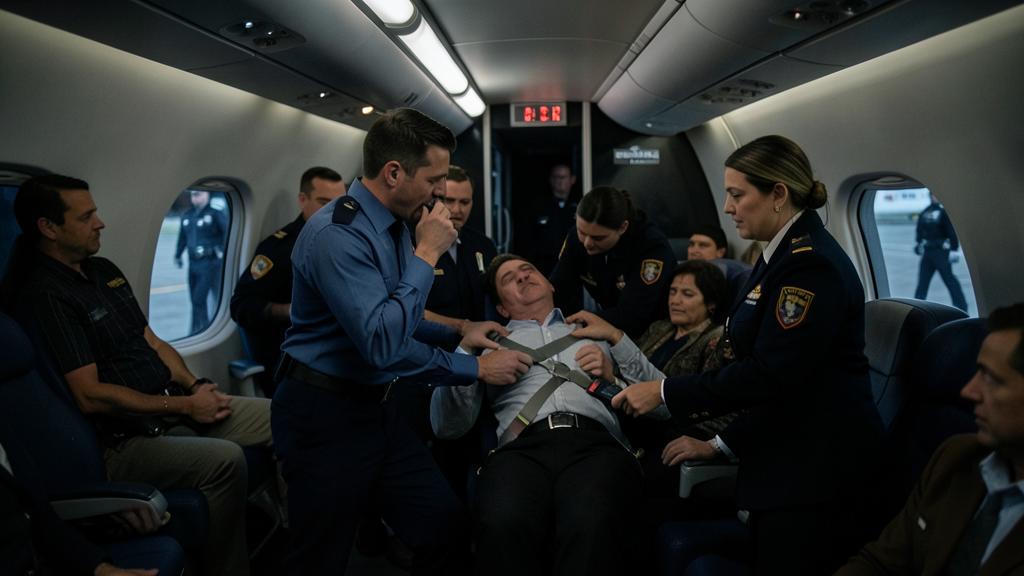
The crew can’t control which country can prosecute, but they can control how they handle the situation. The pilot can either remove the passenger (they go free) or hand them over to police (they might be detained, but only if the country has the legal power). The most important thing is to make sure all the details are recorded before the doors open.
A Boeing 777 flying from Doha to Sydney via Singapore has an incident. The pilot decides to hand the passenger over to Singapore authorities. If Singapore has signed the 2014 protocol, they can detain the passenger. But if they haven’t, the passenger might be free to continue to Sydney, where Australia might not have the legal power to prosecute.
The document is the report, and its value is decided in the minutes before the doors open: identity and seat of the perpetrator, seats and contact details of willing witnesses, time-stamped chronology, verbatim of threats, measures taken with the time of each, position of the aircraft at key moments if the flight deck can document it. The latter is not a refinement: it is what ties the facts to a time window and a space — that is, to a law.
The right reflex: freezing the file before the doors open. As long as they are closed, the witnesses are there, the seats are occupied, the memory is fresh, and the pilot-in-command’s powers still apply. Ten minutes of writing and three witness contact details collected at that moment weigh more than anything that can be reconstructed later — and transmit everything to the operator as soon as the stopover, so that a company complaint doubles that of the crew member.
It remains to confront these mechanisms with your own documentation. Three checks are worth the effort: what your operations manual exactly provides between disembarkation and handover — the gradation of threat levels it retains, the forms it imposes, the transmission circuit of the report; who, at your operator, decides on the filing of a complaint and within what timeframe; and what your procedures provide when the aircraft is operated under wet lease, because the question of which operator counts under the protocol — the one in the contract or the one operating — does not always have a clear answer. It is one of the gray areas of the system, along with code-sharing: the passenger bought a flight under one airline’s name, he will be judged — or not — according to the attachments of another. For those preparing for a qualification or a cabin supervision position, these articulations, far more than the letter of the conventions, make the difference in interviews and at stopovers.
A final reminder is necessary: this article describes general mechanisms, in the state of the texts as they can be summarized. The applicable conventions, the criminal law of each state concerned, and the approved documentation of your operator prevail over all that precedes; for your actions on board, it is your operations manual that is authoritative.


Leave a Reply
You must be logged in to post a comment.