
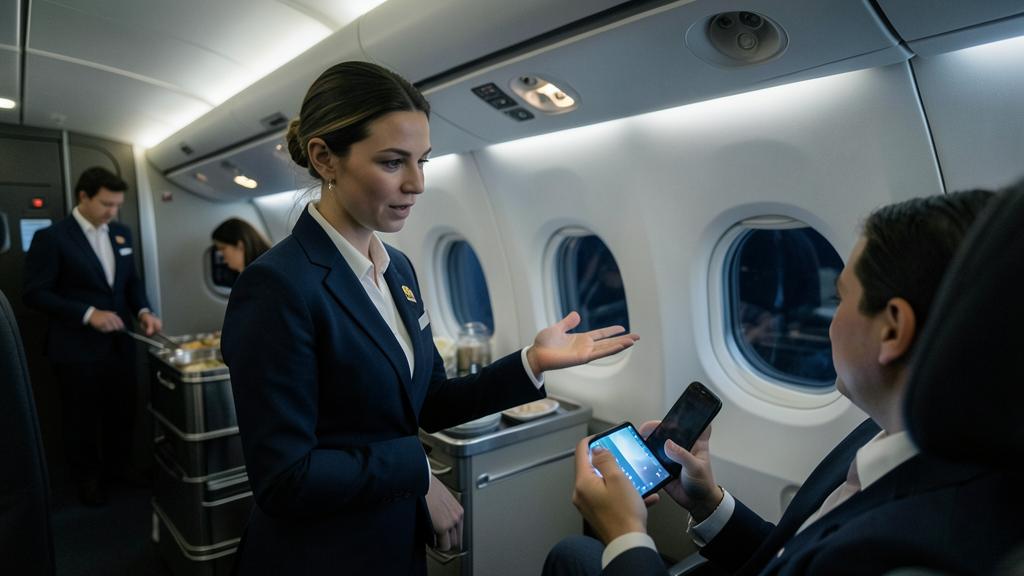
Cruise altitude, in-flight service: a passenger films the galley, frames the crew during meal cart preparation, and responds « it’s a public place, I have the right » to the first remark. Part of the crew wants the video deleted, the other hesitates to intervene. Both are wrong, for the same reason: what the cabin can demand is not based on image rights, but on three distinct foundations — and only one applies without discussion in flight.
Three foundations, three unequal scopes
What a crew member can demand rests on three pillars that initial training rarely presents separately — and this confusion explains most failed interventions. The first is regulatory: European air operations texts require passengers to obey crew instructions for safety. This is the strongest pillar, but it only covers what directly relates to safety: an unsecured item in a critical phase, a passenger standing in the aisle during service, a camera delaying a demonstration. It does not cover filming a normally operating crew in cruise.
The second pillar is the captain’s authority over order and discipline on board, stemming from the international convention on offenses and certain other acts on board aircraft. It allows reasonable measures — up to restraint — when behavior threatens safety, persons, property, or good order. A passenger who continues filming a crew member or another passenger despite an expressed refusal creates exactly this disruption. But this authority requires demonstrable disruption: it does not turn the camera into an offense.
The third pillar is contractual. Many general conditions of carriage restrict photography or video recording of personnel and other passengers without consent. This clause is real and enforceable; its enforcement in flight, however, is almost nonexistent: it supports a request, not a constraint, and its real consequences — refusal of future transport, termination — play out on the ground.
En vol, la cabine peut exiger l’arrêt d’un enregistrement si cela gêne la sécurité ou une personne, mais pas juste parce que c’est interdit. Les règles du transporteur existent, mais elles ne s’appliquent vraiment qu’au sol.
Un passager filme l’équipage pendant le service en croisière. La cabine peut demander l’arrêt si le passager bloque l’allée, mais pas simplement parce qu’il filme. Si le passager refuse, cela devient un problème d’insubordination, pas de caméra.
The camera is not the triggering factor
The core mechanism of the issue boils down to one sentence: in most applicable frameworks in flight, the act of recording itself is neither an offense nor a violation of a safety directive. What the cabin can demand always relates to something else — an operational task being hindered, a flight phase requiring passenger attention, a person being harassed despite refusal, a crowd in the aisle. The practical consequence is immediate: a request phrased as « filming is prohibited » is weak: the crew has placed itself on the weakest ground.
The same request, justified by disruption — « you are blocking the aisle during service, » « this person asked you not to film them, stop framing them » — rests on a foundation the passenger cannot neutralize by invoking their right to film. And it is the refusal to comply that changes the situation: once a legitimate instruction has been given and refused, the behavior changes in nature. We no longer speak of recording but of insubordination, under the provisions for unruly passengers. The camera becomes a contextual element; the triggering factor is the refusal.
Motivate every request by disruption, never by the camera. An instruction based on a specific task, a flight phase, or the expressed refusal of a filmed person is unassailable; a blanket ban on filming is vulnerable. State it in front of witnesses: it is the refused instruction, not the video, that will carry the case.
The escalation: request, warn, document
The graduated response is not a manual figure of speech; it is what makes the case actionable. First stage: the verbal, justified request made in person. Second stage, if disruptive recording persists: the formal warning — many operators provide a written card, issued per the operations manual procedure, which documents that a clear instruction was given and understood. Third stage: reporting to the CDB, who decides on follow-up, including having law enforcement meet the aircraft.
Each stage only counts if it leaves a trace: time, seat, exact wording of the instruction, passenger’s response, witnesses, filmed persons, and their expressed refusals. The report is not an atmosphere summary: it is the only document that will leave the aircraft, and it will be read by people who saw nothing.
Passenger management guidelines also classify behaviors by threat levels, and a recording that escalates usually remains at the bottom of this scale: disruptive behavior, without violence. A disproportionate response to the actual level weakens the case and undermines the crew’s credibility with the authorities reviewing the report.
What can only be resolved on the ground
The list of what the cabin cannot do is short to state and hard to uphold under pressure. Demand deletion of images: no. Retain or confiscate the device: no. Qualify the offense: no — telling the passenger they « are committing an offense » puts the crew on a legal qualification they lack the competence and evidence to make, especially since the nature of the place, private or public, is a debated question the cabin has no authority to decide. One stops a disturbance; one does not state the law.
Never touch the device, never demand deletion. Forced seizure and deletion are prerogatives of ground authorities in a precise legal framework; attempting them in the cabin exposes the crew and operator, turns the burden against them, and may destroy evidence useful to the filmed persons themselves. One stops the recording; one does not make its product disappear.
| Action considered | In flight, by the crew | On the ground, after the flight |
|---|---|---|
| Stop the filming | Yes, if it interferes with a task, an instruction or a person | Sans objet |
| Require the images to be deleted | No, under no circumstances | Decision of a judge, where applicable |
| Hold or confiscate the device | No — no power of seizure | Competent authorities, within a seizure framework |
| Legally characterise the facts | No — observe and describe, without characterising | Public prosecutor and judge, on the basis of the report |
| Contraindre physiquement | Reasonable measures by the commander, as a last resort, if there is a characterised disturbance | Law enforcement |
| Sanctionner durablement | Non | Prosecution, subsequent refusal of carriage according to the operator’s policy |
The potential publication of images after the flight changes the terrain again: crew image rights, data protection laws when dissemination leaves the private sphere, reporting to platforms, potential complaints. This is where the operator’s policy is seen: does it support the targeted crew member or leave them alone? The flight report becomes central again: it establishes the expressed refusal, the cessation request, and the context, three things impossible to reconstruct weeks later.
The competence gap the layover reveals
Handing over to the police is not the end of the story; it is sometimes the start of a dead end. Facts committed on board first fall under the law of the aircraft’s state of registration. On a flight operated by a foreign carrier, the state where the aircraft lands may have no jurisdiction over cruise-phase incidents: the police record an identity, take a copy of the report, and the matter ends for lack of jurisdiction. A more recent protocol extends jurisdiction to the landing state and the operator’s state, but it only binds states that have ratified it: coverage remains uneven from layover to layover.
The practical consequence directly affects the crew: the quality of the report conditions everything, including the operator’s ability to act on the contractual front when the criminal one fails. Requesting law enforcement intervention only makes sense if the facts justify it: unfounded handovers fuel the police skepticism crews later deplore.
What to check in your documentation
Three concrete checks are worth more than an opinion on the subject. First, your operator’s general conditions of carriage: do they contain a clause on image recording on board, and what does it say exactly — prohibition, consent required, restriction limited to personnel? The wording determines what a request can invoke. Then the operations manual: does the unruly passenger procedure include the written warning, who issues it, at what stage, and what the report must contain? Finally, the operator’s policy in case of image publication targeting a crew member: does it exist, who is notified, does the company join the action?
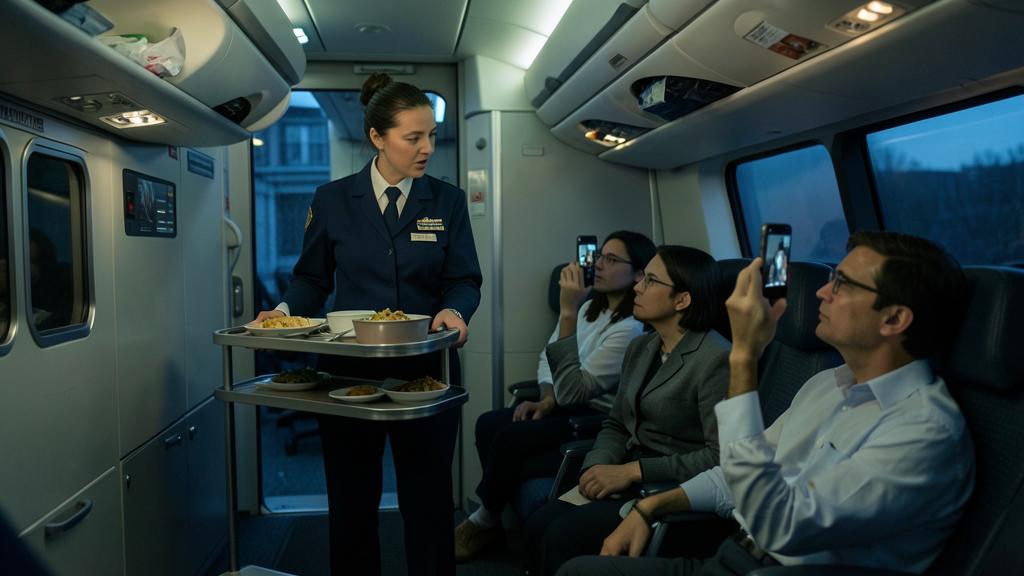
The gray area remains, and it must be named: discreet recording, without operational disruption, without anyone being harassed. It escapes the first two pillars, and the third — the contractual clause — only offers a request without constraint in flight. In the current state, the honest answer is that nothing is demanded: it is noted, traced, and an escalation without foundation is avoided. It is up to the carrier, through its clause and policy, to close this gap if it deems it necessary — not for the crew to improvise it in cruise.
The applicable texts — international, European, and national — as well as your operator’s approved documentation take precedence over this article: in case of discrepancy between what precedes and your operations manual, the latter prevails in operations.


Leave a Reply
You must be logged in to post a comment.