

Pushback at 22:41, deicing line slower than expected: the question is no longer takeoff performance but the 23:00 curfew — is it assessed at brake release, actual takeoff, or scheduled time? An operational restriction is not a simple ban: it is a framework governed by the balanced approach, an incentive system that sorts fleets and shifts schedules. Here’s how it is crafted — and where it is challenged.
The restriction comes last, and this order is enforceable
The balanced approach, formalized by ICAO and transposed into EU law for major airports, mandates four families of measures: noise reduction at source — acoustic certification —, urban planning around the site, low-noise operational procedures, and, lastly, operational restrictions. The order is not decorative: restricting requires setting an explicit noise target, measured with harmonized indicators Lden and Lnight, then proving that the first three measures are insufficient to meet it.
The applicable EU regulation — targeting airports exceeding around 50,000 civil movements per year — entrusts assessment to an independent authority, requires a cost-effectiveness evaluation of candidate measures, formal consultation of stakeholders, and a notice period aligned with aviation seasons. For the operator, this hierarchy is a line of defense: a restriction adopted without a quantified target, without comparing measures, or without consultation is legally flawed.
Les restrictions de bruit ne sont appliquées qu’après avoir essayé d’autres solutions comme améliorer les avions ou changer l’urbanisme. C’est comme un système à étapes : on commence par les solutions les moins chères et on va vers les plus coûteuses seulement si nécessaire.
The raw material: certified noise, not daily noise
The entire system relies on data that the crew carries on board without always checking: the acoustic certificate. Certification measures the aircraft at three points — lateral during full-throttle taxi, flyover after takeoff, stabilized approach — and expresses each level in EPNdB, a unit integrating intensity, exposure duration, and the most annoying tonal components. The sum of deviations from limits forms the cumulative margin, positioning the aircraft relative to its chapter: Chapter 4 requires a 10 EPNdB cumulative margin below Chapter 3 limits, while Chapter 14 adds 7 EPNdB.
Un Airbus A320neo (Chapter 14) avec une marge cumulative de 17 EPNdB sous les limites Chapter 3 aura un impact sonore bien moindre qu’un Boeing 737-800 (Chapter 4) avec seulement 10 EPNdB de marge. Même si les deux décollent à la même heure, le 737-800 consommera plus de quota de bruit.
The certified data makes the system predictable and enforceable: the aircraft carries its noise class with its certificate, regardless of daily wind or piloting technique. It also creates the category with the most impact: the aircraft with a low compliance margin, where the cumulative margin against Chapter 3 remains below a threshold that EU law has tightened over time. These are the targets of partial restrictions — targeted nighttime bans, phased withdrawal at a seasonally capped rate. And this is why a re-engining or nacelle acoustic treatment, by changing certified levels, shifts the aircraft across all downstream quotas.
Curfew, cap, quota: three different mechanisms
Under the same term coexist three mechanisms, often overlapping on the same platform. The curfew bans a time slot: easy to enforce, clear for residents, indifferent to individual noise — the remotorized single-aisle is treated the same as the 1980s widebody. The movement cap limits volume: it contains growth without addressing per-flight noise and pushes toward maximum payload. The noise quota caps aggregated sound energy: each movement debits a count indexed to certified noise, and a 3 EPNdB difference doubles — or halves — the debit.
| Criterion | Couvre-feu | Movement cap | Noise quota |
|---|---|---|---|
| What is capped | A time slot | A number of movements | Aggregate sound energy |
| Signal sent to the fleet | None: new and old aircraft treated alike | Weak: pushes towards maximum payload | Strong: each certified EPNdB gained frees up movements |
| Who bears the constraint | The schedule — night freight, first and last rotations | The airport’s growth | Older fleets and those unable to renew |
| Typical side effect | Flights bunched at the edges of the night | Larger aircraft, pressure on slots | Accelerated renewal, marginal operators squeezed out |
| Flexibility for the operator | Case-by-case exemptions | Internal commercial trade-off | Fly less or fly quieter |
These mechanisms combine: nighttime core banned, shoulders subject to quota, seasonal cap to maintain the whole. The practitioner’s question is never “is there a restriction?” but “which event is counted, against which clock, and which tally?” — and these seemingly technical choices determine who absorbs operational risk.
The quota, a sound energy budget that sorts the fleet
The quota produces the deepest fleet effects; its mechanics warrant a pause. Each type is classified into a certified noise band, and each band typically counts double the previous one in 3 EPNdB steps — a direct reflection of the sound energy doubling every 3 dB, though each platform remains free to define its exact barometer. The operator has a seasonal envelope; each nighttime movement debits it according to the class of the aircraft actually presented.
Le système de quota fonctionne comme un budget : chaque avion consomme une partie du budget en fonction de son niveau de bruit. Plus un avion est bruyant, plus il consomme rapidement le quota disponible. Cela pousse les compagnies à utiliser leurs avions les plus silencieux la nuit.
The consequences follow. A sorting effect: for a given envelope, dropping two bands quadruples possible movements — no incentive device for renewal is as direct. A spillover effect: the constraint shifts to those who cannot renew — express freight on converted cells, wet-lease operators, regional carriers — whose envelope shrinks when the platform reduces it. A programming effect, finally: aircraft assignment is no longer neutral, and the quietest cell in the sub-fleet ends up systematically on nighttime rotations.
Often discovered late: the tally debits the aircraft presented, not the one in the schedule. A last-minute substitution to a noisier cell can consume in one night the debit of several rotations, or even be denied if the envelope is exhausted.
Edge effects on the evening schedule — and the crew
The “procedures” section also lands in the cockpit: low-noise climb profiles translated into the operations manual, mandatory nighttime trajectories, thrust reversers limited to idle. These procedures assume nominal performance, which winter does not guarantee: contaminated leading edge, deicing bleed, and reduced slope can make the published profile incompatible with safety margins — performance then takes priority.
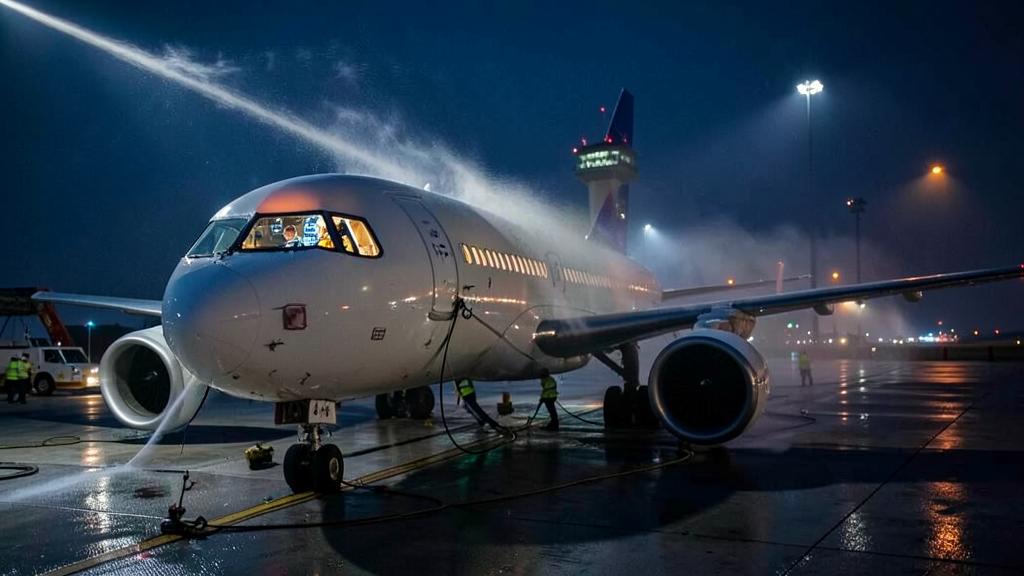
À Paris-Charles de Gaulle, un Airbus A320 devant décoller à 22:55 avec un quota restant de 5 mouvements équivalent A320neo (1×) doit être remplacé par un A320ceo (4×) en raison d’un problème technique. Cette substitution consomme immédiatement 4 mouvements de quota, laissant seulement 1 mouvement disponible pour la nuit.
Then comes the domino effect of delays: a curfew turns every lost minute on the ground into a risk of overnighting. The margin is consumed during boarding, taxiing, deicing — nothing restores it in flight.
Exceptions exist precisely for this, but they are narrow: non-operator-attributable delay, case-by-case assessment, contingent volumes — and repeated use costs credibility in the next consultation. Diversion adds a layer: the alternate has its own schedules, sometimes closed when needed.
The trap: believing the scheduled time is protective. Most regimes are assessed on the actual movement — block hour or takeoff, depending on the text, and the difference can mean ten minutes of taxiing. A flight scheduled before the cutoff but executed after falls into the exception regime, with uncertain outcome. The counted event and reference clock are verified in the aeronautical information publication, not in the last stop’s memory.
The right reflex: check three hours before any evening step. The destination’s closure, the most likely alternate’s closure, and the last departure hour that preserves both — deicing included. Stated at the briefing, they turn a 22:55 discovery into a 20:00 decision.
Building — or challenging — a restriction
The authority’s file is a checklist: quantified noise target; current and forecast Lden and Lnight exposure curves; inventory of candidate measures in the four areas; cost-effectiveness assessment — typically cost per person removed from a curve; formal consultation; decision notified with notice. Each missing link is a ground for appeal.
The strongest arguments follow the construction itself: absent or unverifiable target, depriving the restriction of its basis; upstream measures not exhausted — redistributed trajectories or raised profiles would have met the target; disproportionate instrument — a blanket curfew where a quota window would suffice; discrimination by flag, operator, or traffic type, prohibited regardless of dossier quality.
The most effective lever is not litigation: it’s consultation. An annulment obtained years later does not restore lost slots or sold cells; the operator arriving with a documented fleet trajectory — quota classes, renewal plan, procedure commitments — weighs in on calibration: window boundaries, phase-out rate, exception regime. Litigation freezes positions; consultation negotiates them.
What to check in your own documentation
Four checks are worth doing cold, because everything hinges on local texts. In the operations manual: where network curfews are described, and who decides on a last-minute departure or exception request — the crew or the operations control center. In the flight documentation: the cumulative margin and quota class of each sub-fleet, read from the acoustic certificate rather than assumed based on cell age. In the aeronautical information publications of destinations and their alternates: the counted event, reference clock, and exception regime. On the schedule: quota tracking in season and the rule for assigning registrations to night flights.
A gray area to monitor: the fate of modifications. A re-engined or acoustically treated cell changes certified levels, but the impact on local classifications is neither automatic nor uniform. For those preparing a qualification, the mechanism — why 3 dB doubles energy, why cumulative margin governs quotas — distinguishes recall from understanding; FL330prep modules cover these fundamentals.
The applicable texts — aeronautical information publications, local operational decisions, EU regulations — and the operator’s approved documentation take precedence over this article: it describes mechanisms, it does not replace any operational source.


Leave a Reply
You must be logged in to post a comment.