
A resident sets their phone on the table at the community liaison meeting and reads out loud the figure recorded during the 10:40 p.m. flyover. Someone pulls out the acoustic data sheet for the type concerned: the certified approach level is lower. The room concludes that the official figure has been massaged, the operator retreats behind the certification, and no one points out that the two numbers do not measure the same quantity, were not taken at the same location, or in the same atmosphere. The certified level was never meant to predict what a house hears, and defending it as if it did is the surest way to lose the argument.
Three points, a prescribed flight path, a reference atmosphere
Certification is not decided in an anechoic chamber but outdoors, with real engines and real flyovers. What sets it apart from an ordinary measurement is therefore not the artificiality of the setup: it is that everything is fixed in advance — the microphone position, the flight path, the weight, the engine setting, the weather window, and even the way the signal is processed.
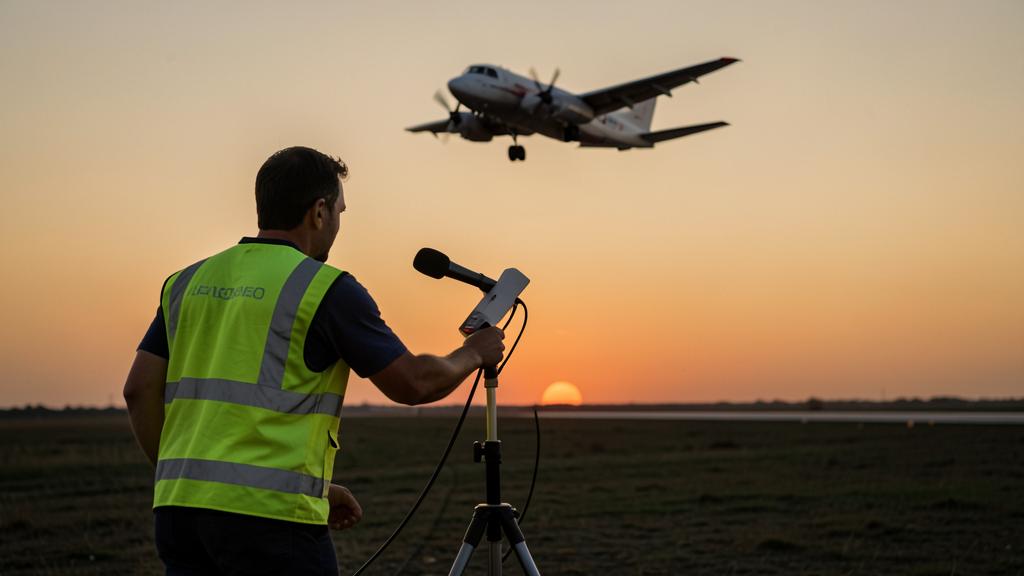
Three listening points, and three only. For jet aeroplanes, the lateral point sits 450 m from the runway centreline, at the point along the ground track where the level recorded during takeoff reaches its maximum: that is where the jet, still at maximum thrust and seen under a grazing angle, is heard loudest. The flyover point lies on the extended centreline, 6,500 m from brake release; by then the aircraft has usually already cut back thrust, and the fan contributes more than the jet mixing noise. The approach point lies on the centreline, 2,000 m before the threshold, which places an aircraft stabilised on a 3-degree glide path at roughly 120 m of height, gear down, in landing configuration, engines at approach thrust.
Certification measures noise under very specific conditions that don’t match real-world situations. The certified level is an average from controlled tests, not what you hear at home. It’s like comparing a lab test to real-world driving conditions – they’re not the same.
An Airbus A320neo certified at 100 EPNdB during approach might measure 85 dB(A) on a resident’s phone. The certified figure comes from a controlled test at max landing weight and specific conditions, while the phone measures a single peak in real-world conditions with different weather and aircraft weight.
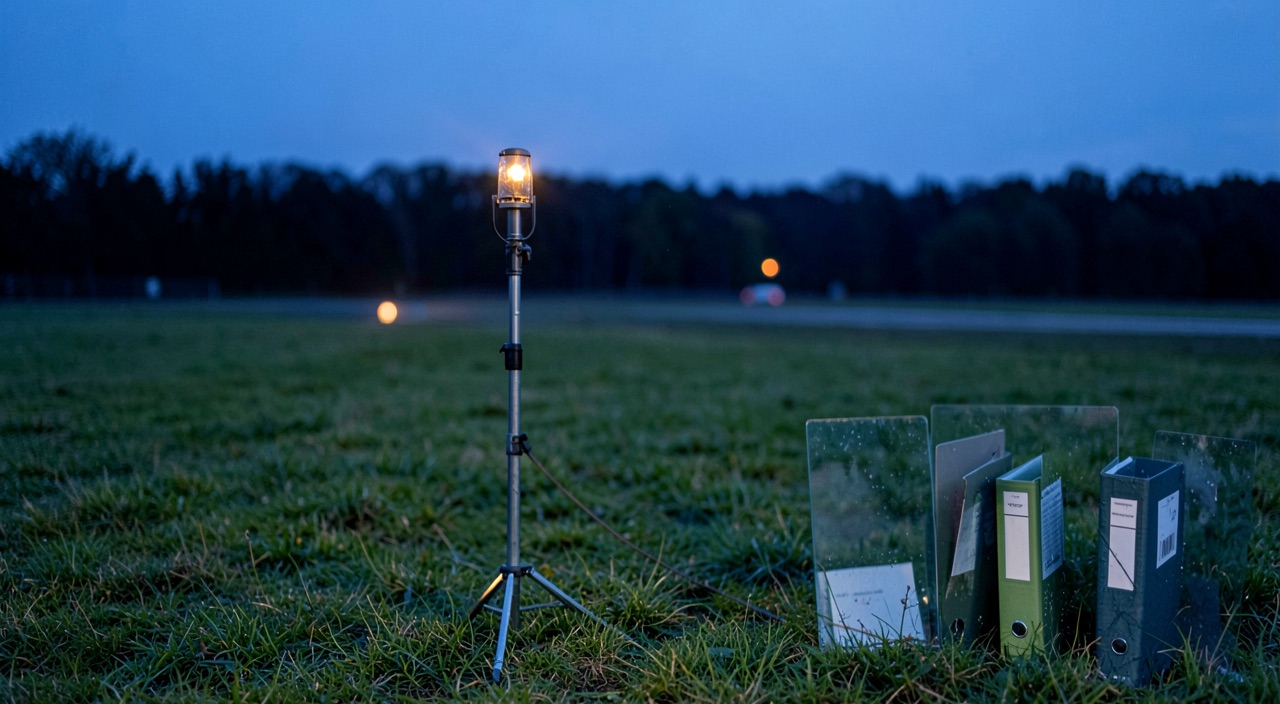
The microphone sits 1.2 m above the ground, on flat, open terrain, with no reflecting obstacle within the field. The weather window is narrow: no precipitation, mean wind and crosswind component capped and measured at a standardised height, temperature and humidity within a range where the atmospheric absorption correction remains defensible, and above all no temperature inversion within the layer traversed. The test is flown at maximum weights: maximum takeoff weight for the two departure points, maximum landing weight for the approach point. What is certified is an envelope, not an average day.
EPNdB is not a sound-level-meter decibel
The certified quantity is the effective perceived noise level, expressed in EPNdB, and its construction alone accounts for a good half of the misunderstanding. The signal is analysed in one-third-octave bands, from audible low frequencies up to the fan’s high frequencies, with each spectrum sampled every half-second. Each band is then converted into a measure of perceived noisiness, and the bands are recombined: the result is an instantaneous level that is already no longer a sound pressure but an estimate of annoyance.
Two corrections finish setting it apart from a sound-level-meter reading. The first is the tone penalty: the algorithm looks, in each spectrum, for a band that stands out clearly from its neighbours, and adds a penalty proportional to that prominence. A fan whine is more annoying than a rumble of the same energy, and the certified figure says so. The second is the duration correction: only the portion of the flyover where the level stays within ten decibels of its maximum is kept, the energy is integrated over that window, and it is normalised to a reference duration. A slow, drawn-out flyover is penalised, a brief one is credited, at equal peak level.
A sound level meter set to A-weighted decibels does something entirely different: a single frequency weighting, no tone penalty, no integration over the event, and the display of an instantaneous maximum. The two numbers do not convert into one another, and the gap is not trivial: for a jet-engine event, the effective perceived level is as a rule the higher of the two, by an order of magnitude close to ten units. In other words, when a resident’s phone shows a number close to the certified level, it does not prove the aircraft is out of compliance with its certificate: in reality, that resident is experiencing an event far stronger than the one flown for the test. The naive comparison flatters the aircraft, which is worth knowing before waving it around.
| Quantity | What it integrates | Who uses it |
|---|---|---|
| Effective perceived noise level (EPNdB) | One-third-octave spectra every half-second, tone penalty, duration correction over the 10 dB window | Type certification, chapter classification, charges and quotas based on that classification |
| A-weighted maximum level | Only the instantaneous maximum of a flyover, with no penalty or duration | Airport monitoring stations, resident observations, local alert thresholds |
| Sound exposure level | The entire energy of the event, normalised to one second | Correlating a radar track with an event, comparing flyovers with one another |
| Long-term indicators, day-evening-night and night | The energy of every event over an average year, increased by 5 dB in the evening and 10 dB at night | Noise maps, planning documents, operating restrictions |
A figure no one has ever heard
Even within the test window, no flyover lands exactly on the reference conditions. Every valid reading is therefore corrected, and that is the point where the figure stops being a measurement and becomes a reconstructed quantity. Atmospheric absorption is corrected band by band, from the day’s temperature and humidity profile back to the reference profile. Geometry is corrected, because the aircraft never passes exactly at the nominal height and distance: the actual flight path is mapped back onto the reference path, with the corresponding viewing angle. Finally, the deviation in engine setting and weight from the declared conditions is corrected.
These corrected readings are then averaged, point by point. The number of flyovers is not left to the manufacturer’s discretion: it follows from a statistical precision requirement, with the 90% confidence interval having to stay within a narrow band. The result therefore carries three properties worth keeping in mind before any public discussion: it is an average, not a maximum; it is a value referred back to an atmosphere that did not exist on the day of the test; and it is an attribute of the type, in a given configuration and at declared weights, not the signature of a specific flight.
This is not a flaw in the method, it is its very purpose: without reference conditions, two types measured on two continents six months apart would not be comparable, and noise regulation would have no traction at all. The price to pay is that the resulting figure has never been heard by anyone, anywhere.
What separates the test from a Tuesday-evening flyover
Between the certification flyover and the one that wakes a sleeper, nearly every parameter has changed, and most often in the direction that pulls the two numbers apart. The table below sets the two columns side by side; it is as useful for drafting a written response as for holding a meeting.
| Parameter | Certification condition | Scheduled flight, a given evening |
|---|---|---|
| Listening point | Three prescribed points, on the centreline and 450 m off it | Wherever the house happens to be, often in a turn or off the centreline |
| Weight | Maximum takeoff weight, maximum landing weight | Actual weight of the day, frequently much lower |
| Thrust | Maximum thrust followed by a standardised cutback at a prescribed height | Thrust reduced right from brake release, cutback per the operator’s procedure |
| Flight path | A single straight climb, approach stabilised on a 3-degree glide path | Early turn, mandated level-off, late interception, offset approach |
| Atmosphere | Corrected to 25 °C, 70% humidity, 1,013.25 hPa, no wind, inversion excluded | Whatever is outside, inversion and wind gradient included |
| Ground | Flat, open terrain, microphone at 1.2 m, no reflecting obstacle | Facades, rooftops, a concrete yard, a windowsill |
| Quantity | Effective perceived level, in EPNdB, integrated and tone-corrected | A-weighted instantaneous maximum, read off a phone |
| Statistics | Average of several valid flyovers, referred back to reference conditions | The worst flyover of the week, the one that is remembered |
Two gaps matter more than the others. The first is the weight-thrust pairing: a real-world departure is almost always flown at a weight well below maximum and at reduced thrust, which lowers the level at the source but also means the aircraft climbs more slowly at first, and is therefore lower above the nearest homes. The second is the noise-abatement profile chosen by the operator: a procedure that favours nearby residents climbs steeply and levels off early, one that favours distant residents accelerates and cleans up the configuration lower down before resuming the climb. Both are legitimate, neither is the certification profile, and both shift the annoyance from one neighbourhood to another without changing the certificate figure by a single point.
The evening when the same aircraft is heard much farther away
That leaves propagation, that is, everything that happens between the nacelle and the ear. Certification neutralises it by imposing a reference atmosphere — 25 °C, 70% relative humidity, standard pressure, no wind — and by prohibiting the test under a temperature inversion. The resident, by contrast, experiences precisely what the test excludes.
Inversion is the dominant mechanism. On a clear, calm night, the ground cools by radiation and temperature rises with altitude over the first few hundred feet. The speed of sound follows temperature: it therefore increases with height, and sound rays curve downward instead of bending upward. The shadow zone that, during the day, protects the most distant homes disappears; sound carries farther and can even become focused. The wind gradient produces the same effect asymmetrically: downwind, rays are bent back down and the level rises; upwind, a shadow zone opens up. This is why a change of runway configuration, with identical traffic, can redistribute the annoyance abruptly.
On top of that come local effects that no certificate accounts for. The test ground is grassy and absorbent, which produces a characteristic interference pattern between the direct wave and the reflected wave; a concrete yard or a gable wall, by contrast, reflect energy back and alter the tone as much as the level. Since night-time background noise is several decibels lower, the same event stands out more. And a phone’s microphone, uncalibrated, set on a reflecting surface and without a windscreen, compresses loud levels and often mistakes wind noise for the aircraft.
What the certified level is actually for
The figure predicts nothing, but it decides a great deal. It first serves to classify: the applicable limits depend on maximum takeoff weight and, depending on the point in question, the number of engines, and a type must stay below the limit at each of the three points, with an overshoot at one point tolerated only if offset elsewhere and kept within a tight envelope. Successive chapters are then no longer distinguished by point-by-point limits but by a cumulative margin: the sum of the deviations from the reference limits at the three points must reach a minimum total, on the order of ten units for the first of these chapters and substantially more for the next, with in addition a minimum margin spread over at least two points. A type therefore cannot buy its classification by crushing a single point.
This classification has very concrete consequences: airport-charge bands, night quotas, banned slots, access conditions to certain airports once an operating restriction has been introduced under the balanced approach. The certified levels also feed, together with additional manufacturer data, the acoustic performance databases used to plot noise contours around airports. The figure is therefore a comparison yardstick between types and a model input, never a prediction at any given point.
The right reflex. Before putting forward any number at all, ask the other party three questions: which quantity, measured where, with what instrument. As long as those three answers are missing, no comparison is possible, and this is a defensible position to hold in a meeting because it does not contest what people feel — it only asks what exactly is being discussed.
Answering the complaint without denying what is heard
The costliest mistake is to pit the certified level against a resident’s measurement, as if the first refuted the second. It does not refute it: it describes a different object. And the audience, which does not have the definitions in mind but is very good at spotting a dodge, comes away thinking the answer missed the point.
The trap. Announcing that a recent type is “quieter” because its cumulative margin is better, then being contradicted by lived experience. The cumulative margin rewards energy integrated over three reference points; it says nothing about the signature perceived several kilometres from the threshold. Very high bypass ratios have shifted the spectrum toward low frequencies, and low frequencies attenuate more slowly through the air, pass through walls more readily, and are felt as vibration. An aircraft can thus be classified markedly better and still remain more present, for longer, to residents farther away. The contradiction is then immediate, and it destroys the credibility of everything else in the case.
The answer that holds up is built in three moves. First, establish the quantity: the certified level is a comparison index between types, obtained at maximum weight at prescribed points and corrected to a conventional atmosphere, with no purpose of predicting a level anywhere in particular. Next, acknowledge the opposing measurement for what it is, an instantaneous maximum in a different quantity, and offer to check it against readings from the airport’s permanent stations, correlated with radar tracks, which speak the same language as the local regulation. Finally, name the actual levers — departure and descent procedure, configuration and reverse-thrust management, runway allocation, fleet renewal — distinguishing what the operator controls from what it endures, starting with the atmosphere and the location of the houses. On this ground, exchanges among professionals who face the same kinds of meetings are often worth more than a pre-written script.
What to check in one’s own documentation
The aircraft’s noise certificate is one of the documents attached to it, and it is more informative than one might think. It specifies a precise combination: type, model, engine fit and rated thrust, configuration standard, declared maximum weights, applicable chapter and the levels recorded at the three points. What remains to be checked is that this combination is indeed the one the aircraft flies with today: an increase in maximum weight, a change of engine rating, or an external aerodynamic modification calls for an acoustic justification and, where applicable, an update to the document.
The documentation reflex. Bring three documents together before any public meeting: the acoustic certificate of the aircraft in question, the noise-abatement procedure actually applied at the airport as it appears in the operations manual, and the quantity used in the local regulation. If these three documents do not tell the same story, the disagreement is not with the resident — it is already inside the file.
There remains a grey area, better known in advance than discovered in a meeting: as a general rule, there is no periodic acoustic check of an aircraft in service. A degraded nacelle liner, a missing seal, a repair that alters the surface finish of an air intake, a cavity under the wing that starts whistling within a narrow band of speed and configuration: none of this shows up on the certificate, and nothing requires it to be remeasured. Airworthiness and maintenance cover these defects through other channels, but the acoustic question is asked only once, at the time of type certification. For anyone preparing for a role as operations manager or environmental liaison, this is a point that must be stated openly rather than avoided, and it is best worked through with FL330 training programmes rather than improvised in front of a room.
The applicable regulations, the aircraft’s acoustic certificate, the approved flight manual, and the approved operating documentation take precedence over this article, whose purpose is to clarify a mechanism, not to replace it.
Questions fréquentes
Can a certified level in EPNdB be compared with an A-weighted decibel reading?
No, the two quantities do not describe the same thing, and no general conversion links them. The effective perceived level integrates the event over the window where it stays within ten decibels of its maximum, penalises tonal components, and normalises the result to a reference duration, whereas an A-weighted level is only an instantaneous maximum. For a jet-engine event, the first is structurally the higher of the two. Comparing the two numbers directly leads to a false conclusion, in either direction.
Is a better-classified type necessarily less annoying for residents?
Not necessarily. Classification rewards a cumulative margin obtained at three prescribed points, at maximum weight and on a single flight path. Very-high-bypass-ratio engines have lowered the overall level while shifting the spectrum toward low frequencies, which attenuate more slowly with distance and pass through walls more easily. At a great distance from the threshold, a well-classified aircraft can therefore remain more present, for longer, than an older but higher-pitched one.
Does the certified level change as the aircraft ages?
No. The level is an attribute of the type in a given configuration and at declared weights; as a general rule, there is no periodic acoustic check in service. A degraded nacelle liner, a missing seal, or a repair that alters an air intake can degrade the actual acoustic signature without the certificate changing. On the other hand, an increase in maximum weight, a change of engine rating, or an external aerodynamic modification calls for an acoustic justification and, where applicable, an update to the document.
Why is the same traffic heard much more at night?
Three mechanisms combine. On a clear, calm night, a temperature inversion forms near the ground: the speed of sound increases with altitude, the rays curve downward, and the shadow zone that protected distant homes disappears. The wind gradient produces the same effect downwind. Finally, night-time background noise is markedly lower, so the same event stands out more. Certification specifically prohibits testing under these conditions.
What use is the certified level to an operator, if it does not predict anything?
It determines the aircraft’s classification chapter, and therefore its access to certain airports, its charge band, its cost in night quotas, and sometimes its right to operate on certain slots. It also feeds, together with additional manufacturer data, the models used to plot noise contours around airports and hence planning documents. It is a comparison yardstick between types and a calculation input, not a level forecast at any given point.
What should you actually say to a resident who shows the figure on their phone?
Do not dispute the measurement, which reflects a genuine experience, but establish what it is measuring: which quantity, at what location, with what instrument, and on what surface. Then explain that the certified level is a comparison index between types, taken at maximum weight at prescribed points and corrected to a conventional atmosphere. Finally, offer to check the reading against the airport’s permanent stations, correlated with radar tracks, and list the levers the operator actually controls.


Leave a Reply
You must be logged in to post a comment.