
Same aircraft, same mass, same published arrival: at five in the morning, the FMS deploys a continuous descent from the top of descent to the interception of the glidepath, without a single level-off. Four hours later, the same trajectory is negotiated with successive level-offs, imposed speeds, and a long low segment with spoilers deployed. Nothing has changed on the aircraft side; everything has changed on the traffic flow side. Here are the orders of magnitude of the gain, in noise and fuel, followed by the structural reason for its rarity during peak hours: the sequencing of arrivals relies on predictability, and that is exactly what the continuous descent consumes.
What the continuous descent physically eliminates
A low level-off accumulates three penalties, and their sum makes the noise of a stepped approach. Thrust first: maintaining speed in level flight requires compensating for drag, thus increasing thrust well above idle — and engine noise closely follows thrust. Altitude next: descending early to hold an intermediate level means flying lower, longer, over a wider strip of land; distance attenuation then works against the overflown areas. Configuration finally: an aircraft kept low and slow deploys flaps and slats earlier, and a highly cambered wing is an acoustic source in its own right, comparable to the throttled engine.
The continuous descent eliminates all three terms at once: engines near idle from the top of descent to the final approach, aircraft higher at a given distance from the threshold, later configuration because energy management is anticipated rather than caught up. The profile is not steeper, it is simply continuous: no segment forces thrust.
A continuous descent keeps engines near idle, stays higher longer, and delays wing flaps. This cuts noise and fuel use by avoiding low, slow, and noisy flight segments.
A real gain, but concentrated on the intermediate approach
We must be honest about the geography of the gain: in the final approach, everyone flies the same thing — glidepath, configuration, and approach speed. The two profiles are indistinguishable there, and the immediate neighbors of the threshold gain practically nothing. The gap widens further down, under the intermediate approach, where the stepped profile would have kept the aircraft low with thrust: that is where the continuous descent reduces, on the maximum perceived level at passage, a difference of a few decibels. On a logarithmic scale, this is a perceptible difference, repeated with each arrival.
An Airbus A320 on a 10,000-foot descent to runway 27L at Paris Charles de Gaulle (LFPG) at 15°C. A stepped approach with two 5,000-foot level-offs at 10,000 and 5,000 feet would add 15 dB of noise over suburban areas 15 miles from the threshold. A continuous descent avoids this, saving 30 kg of fuel per arrival.
Fuel follows the same logic. Each level-off avoided is one less segment of thrust at low altitude: the typical gain is measured in tens of kilograms per arrival for a single-runway airport — modest on the scale of a flight, considerable multiplied by the annual arrivals of a platform. The distribution of the benefit also explains part of the local debates: noise indicators concentrated near the airport poorly value a procedure whose main gain is deposited tens of kilometers from the threshold.
The mechanics of sequencing: why ATC prefers level-offs
The work of a peak approach is a conversion: a disordered flow of arrivals becomes a regular file, spaced as closely as possible at the threshold. Its tools are heading, speed, level, and holding. Yet the most precise of the four is precisely what the continuous descent eliminates: the level-off with imposed speed. A fixed altitude and an assigned indicated speed give a known ground speed, thus a predictable time of passage at the desired point — the tool that tightens two aircraft as close as possible to the minima.
An idle descent, on the other hand, is a trajectory that each aircraft executes in its own way. The arrival time at the convergence point depends on the actual mass, the wind actually encountered over the entire altitude slice — rarely consistent with the forecast end-to-end —, the engine’s own idle, the bleed air, and the speed schedule of the flight management computer. None of these parameters is visible to the controller. The resulting uncertainty is typically in the tens of seconds; yet, at the density of a peak, this is the order of magnitude of an entire spacing. Letting the aircraft descend freely therefore means having to protect the window: adding margin around each aircraft.
The price is paid in runway capacity
During peak hours, the runway is the limiting resource, and its throughput is the inverse of the average spacing at the threshold. The arithmetic is brutal: each second of margin added to each arrival subtracts from the throughput, and a handful of seconds of buffer per aircraft costs entire slots every hour — those that the peak cannot recover.
| Criterion | Low traffic — continuous descent | Peak — active sequencing |
|---|---|---|
| Profil vertical | Continuous, engines near idle | Intermediate level-offs, held segments |
| Main ATC tool | Early clearance, few interventions | Vectors, assigned speeds, levels |
| Predictability of time over the point | Low: mass, actual wind and idle specific to each aircraft | High: known groundspeed on held segments |
| Spacing applied | Minima easily met with sparse traffic | Tight minima, margin reduced to the bare minimum |
| Noise in intermediate approach | Reduced: higher, reduced thrust, late configuration | Increased: low level segments held with thrust |
| Fuel per arrival | Typical saving of a few tens of kilograms | Extra burn on segments held low |
| Runway capacity | Not constrained, demand is low | Sizing constraint, absolute priority |
ATC’s refusal is not conservatism, it is a trade-off — and the paradox goes all the way: poorly introduced, the continuous descent can increase total nuisances. Insufficient capacity generates delays, delays accumulate in holds and vectors at low altitude, and these holds are worse, in noise and fuel, than the level-offs one wanted to avoid.
Reconciling the two: absorbing the delay before descent
The constraint is not the flying technique — any flight management computer builds an optimized profile if given the remaining distance. The constraint is that this distance is known early. Operational solutions fall into three families.
- Extended arrival managers: Calculate sequencing time in cruise, convert delay into speed reduction. Few minutes absorbed in cruise cost less fuel than low-altitude holds.
- Merge points: Aircraft hold a sequencing arc at constant distance from convergence point. Direct clearance gives known distance for continuous descent.
- Time-holding: Commit aircraft to a time of passage at convergence point, allowing ATC to tighten margins.
None of these tools is free: the arc of a merge point is flown in level flight — that is where the delay is absorbed — and time-holding has its limits in strong winds. But all make the time of passage predictable without confiscating the descent.
Degraded conditions: variability increases, continuous descent is the first to go
Winter provides a real-life demonstration of this hierarchy. A deicing chain makes departure slots unpredictable, thus disrupts the mix of departures and arrivals on mixed runways; a contaminated runway lengthens occupancy times and increases spacing; low-visibility procedures further reduce throughput. Each time, variability increases where sequencing was already lacking — and the continuous descent is the first to be sacrificed. It makes sense: when capacity drops, the priority becomes to clear the flow, at the cost of profiles held as close as possible.
On the flight deck: managing an energy budget, not following a slope
For the crew, the continuous descent shifts the work from following a profile to managing an energy budget. The three-to-one rule — three nautical miles per thousand feet — remains the backbone of mental calculations, corrected for wind and increased by the deceleration distance; but it only holds if the remaining distance is correct, and that is what sequencing changes.
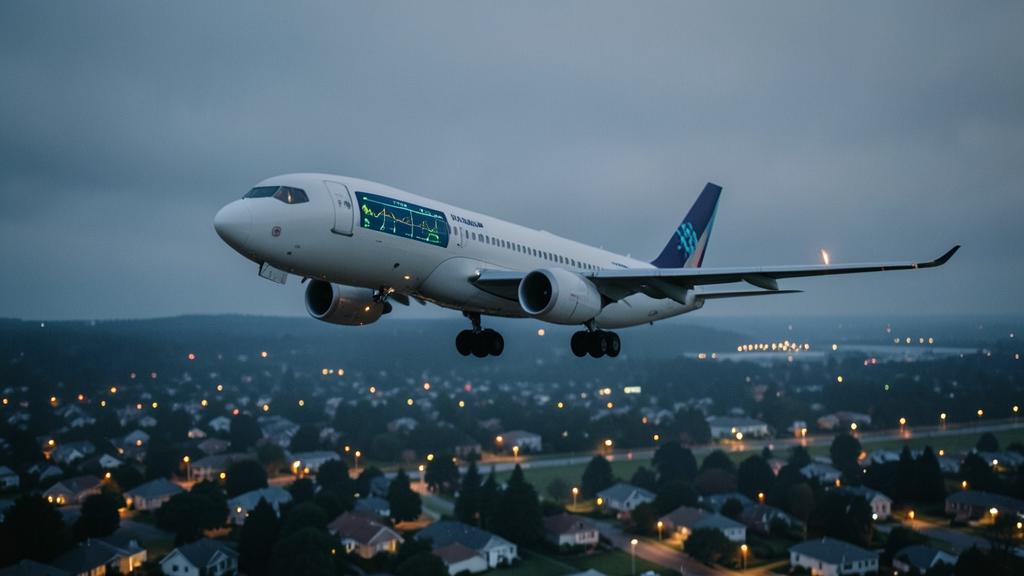
The trap: the direct accepted without recalculation. A shortcut that removes several miles from the planned trajectory leaves the aircraft high and fast. The rest is known: prolonged spoilers, early configuration, workload increasing at the worst moment — and, at the end of the drift, an unstabilized approach. A single poorly negotiated direct can negate all the acoustic and fuel benefits of the day.
The reflex: ask for the remaining miles. As soon as the clearance deviates from the planned profile, the question to ATC — estimated remaining distance — recalibrates the energy calculation in one sentence. And if the numbers don’t add up, announce it early: a refusal formulated during the descent can be managed; discovered in the final approach, it is endured.
To check in your own documentation: the published continuous descent procedures on your regular airports, the operator’s policy on energy management and the use of spoilers, and the stabilization criteria that bound any catch-up. For those preparing for a qualification or selection, the continuous descent is also a formidable revealer in evaluation sessions: it exposes planning, anticipation, and the ability to say no — exactly what specialized preparations work on.
There remains an acknowledged gray area: between the optimal profile of the computer and the profile actually flyable in dense traffic, no boundary is written — it is played out with each arrival. The applicable regulations, ATC clearances, and the operator’s approved documentation prevail in all circumstances over the orders of magnitude and reasoning presented here.


Leave a Reply
You must be logged in to post a comment.