

Light signal illuminated since the start of the descent, seatbelt visibly unfastened, and a second, polite but firm, refusal at row 14. At this moment, the flight is not playing for immediate safety; it is playing for the strength of what can be decided twenty minutes later. A refusal of an instruction is almost never won in the aisle; it is won in the trace it leaves. The graduated escalation is not a procedural courtesy; it is the mechanism that turns a behavior into a file—and a power struggle into the captain’s decision.
What the refusal actually puts at stake
A safety instruction—fasten the seatbelt, adjust the seatback, stow the obstructing baggage, stop using a device, return to your seat—is not a service request. It is based on the operator’s regulatory obligations and the authority that international law grants the captain to maintain order and safety on board. Yet, the refusal rarely creates immediate danger: an unfastened seatbelt in calm cruise does not endanger anyone in the next second. The real issue lies elsewhere, and it is twofold.
First, the precedent: an instruction refused without visible reaction ceases to be an instruction, for that passenger and the twenty others observing. Then, and above all, the consequences: serious incidents almost always begin with a trivial refusal, and everything that can be decided later—formal warning, restraint, diversion, handover to authorities upon arrival—will depend on what was done and recorded beforehand. A captain does not base a heavy decision on “he was unpleasant from the start”; they base it on three time-stamped refusals, a formal instruction given in front of a witness, and a warning issued in due form.
The crew that treats the refusal as a personal affront invites a confrontation; the one that lets it slide arrives at the critical moment with an empty file. The graduated escalation is the third way: each step is calibrated to remain defensible, and each step produces the evidence that authorizes the next.
Refusing a safety instruction isn’t just about the moment—it’s about what happens later. The key is building a clear record of each refusal so the captain can make a fair decision if things escalate. Without this record, the crew has no proof to back up their actions.
On a Boeing 737-800 during descent, a passenger at 14B repeatedly unfastens their seatbelt despite three verbal reminders. The flight attendant notes the time (15:47), seat, and exact words: “I don’t need this.” The purser then gives a formal instruction in front of another crew member, who records the passenger’s response: “You’re not my boss.” This documented chain later justifies a written warning and, if the behavior continues, potential restraint measures.
Four steps, one logic
International references on unruly passengers typically classify incidents into four levels of severity, from verbal disruption to a threat to the flight deck. The graduated escalation is its mirror on the response side: four steps, each defined by three elements—who acts, in what form, and what trace it leaves. It is the trace that makes the step, not the tone used.
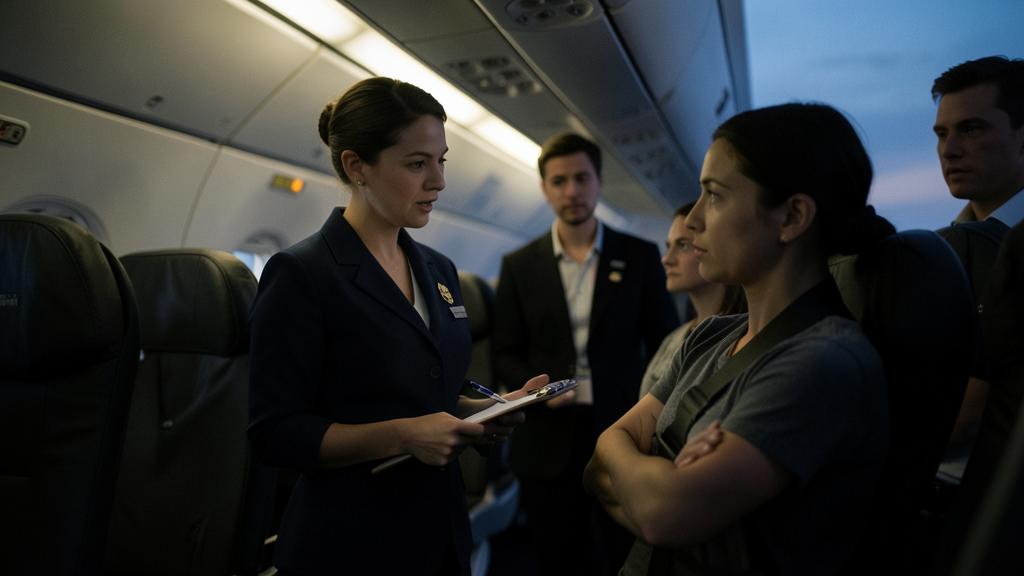
The first step belongs to the cabin crew member in the section: a brief, factual reminder at the row, without an audience if possible. The wording matters—you remind the instruction and its reason, you do not negotiate its validity. The second step raises the form, not yet the severity: the purser rephrases the instruction, explicitly, in front of another crew member. This witness is not decorative: they are the one who will make the refusal actionable.
The third step is the written warning, issued according to the operator’s procedure and with the captain’s approval. Its strength is not the paper: it is the signal, hard to misinterpret, that the file is open and that the next steps will no longer be played out in the cabin. The fourth step is the captain’s decision: restraint measures if the behavior justifies them, request for law enforcement intervention upon arrival, diversion in extreme cases. No rule forces climbing the steps one by one—a physical assault is handled at the step where it occurs—but in the nominal case of repeated refusal, each step builds on the previous one.
| Palier | Who acts | Forme | Trace produite |
|---|---|---|---|
| 1 · Rappel courtois | Cabin crew member for the zone | Verbal, brief, at the row, without an audience | Time, seat and wording of the refusal noted on the spot |
| 2 · Consigne formelle | Senior cabin crew member | Verbal, explicit, in front of a crew witness | Witness identity, passenger’s exact reply |
| 3 · Written warning | Senior cabin crew member, with the captain’s agreement | Handing over the form provided by the operator | Copy retained; refusal to accept it logged where applicable |
| 4 · Captain’s decision | Captain | Restraint, assistance requested on arrival, diversion | Message to the operator, separate reports from each person involved |
The trace is taken in real time, not at the gate
The report written for the destination is only as good as the notes taken during the event. The memory of a busy flight compresses the timeline, merges replies, and rounds the times—three flaws that are enough to weaken a file as soon as two accounts diverge. What must be recorded in the moment is little: the time, the seat, the exact wording of the instruction, the exact response of the passenger, and who saw what.
The most profitable discipline is the separation of fact and judgment. “Refuses to fasten seatbelt after three requests, responds: ‘You have no orders to give me’” is a dated, actionable fact that two witnesses will confirm word for word. “Aggressive and contemptuous passenger” is an impression that the slightest challenge will turn against its author. The first builds the next step; the second weakens it. The medium does not matter—back of a load sheet, tray table, galley notepad—as long as it is dated and preserved. And each participant notes on their own: independent notes that converge are worth infinitely more than a single copied account.
The right reflex. In the minute following each step, note four elements: the time, the seat, the phrase spoken, the phrase received. Ten seconds of writing per step are enough—it is the reconstructed version two hours later that costs the file dearly.
The flight deck enters early and decides late
The mistake exists on both sides of the door: informing the captain too late or asking them too early to arbitrate what still falls under the cabin’s responsibility. The balance point is known: information goes up from the second step, the decision comes down only at the fourth.
Informing early is giving the flight deck time to do its job: assess diversion options if the situation deteriorates, prepare a message to the operator, request what is still missing from the file. The captain is not expected to appear in the cabin: everything goes through the interphone and the purser, the sole interface—a single account goes up, a single instruction comes down.
The international convention on offenses committed on board recognizes the captain’s power to take reasonable measures necessary to maintain order, up to restraint, and to hand the individual over to the competent authorities. This power is broad, but it is exercised all the better when it is based on a documented chain—precisely what the graduated escalation produces. The written warning of the third step is not a cabin formality: it is the act that engages the captain’s authority and prepares, if necessary, the qualification of the facts upon arrival.
The geometry of the aisle counts as much as the phrase
A well-formulated step can fail on a positioning detail. Leaning over a seated passenger is occupying their space and turning an instruction into physical domination; positioning two crew members in their immediate field of vision is cornering them in front of witnesses and making retreat impossible without losing face. The working setup is asymmetrical: one cabin crew member speaks, at row level, slightly at an angle; the second stays one row back, out of the exchange—witness, not reinforcement.
The general announcement has its place in this setup, provided it remains general. Reminding the entire cabin that the sign is on and seatbelts must be fastened re-legitimizes the individual instruction without singling anyone out: the recalcitrant passenger hears the rule become collective again. An announcement that targets them—and the entire cabin decodes it as such—produces the opposite effect: it unites part of the passengers around them.
Neighboring passengers are the third dimension of the problem: potential witnesses whose details will weigh in the file, but also a sounding board—a treatment perceived as humiliating creates allies for the disruptor.
The trap: the skipped step. Moving from a courteous reminder to a threat of police intervention because the refusal was insolent gives the defense exactly what they will exploit: a disproportionate reaction, without an intermediate documented step. It is also the most reliable trigger for a physical escalation in the cabin. Anger makes you skip steps; the file, however, requires that they all existed.
After the flight: a file, not a feeling
The end of the flight is not the end of the event. The report transmitted to the operator feeds three distinct circuits: safety follow-up, commercial decision—up to transport ban with operators who practice it—and, if applicable, the procedure initiated by the authorities. These three circuits will judge the file on the same criteria: precision, chronology, consistency between accounts.
Hence three writing rules. Each participant writes their own report, separately, before any collective exchange: converging independent accounts are evidence, a harmonized account is a doubt. Notes taken in real time are annexed as-is, even if crossed out. And the event is also reported when it ended well: the passenger who complies at the third step still refused two instructions, and this information retains value for follow-up—and for the crew of the next flight.
What to check in your documentation
This mechanism varies from one operator to another, and it is in these differences that bad surprises lie. Where is the warning form physically located on board, and who is authorized to issue it? Does your procedure require the captain’s explicit approval before issuing it, or just notification? On a multi-segment flight, does a warning issued on the first segment survive the layover—and who decides on a boarding refusal on the next segment?
There remains a gray area that few manuals clarify: the passenger who complies after a step, then repeats the offense an hour later. Restarting the escalation from zero weakens the file; resuming at the reached step assumes that the procedure explicitly allows it. Check what yours says—and if it says nothing, the question deserves to be raised through your safety management system channel.
Finally, the framework upon arrival depends on the state where the aircraft lands. The amendment to the convention on offenses on board strengthens the competence of the landing state, but its application depends on ratifications: on a regular destination, the question is worth asking once and for all—what can local authorities actually do with a well-constructed file?
The applicable texts—international conventions, European regulation on air operations—and your operator’s approved documentation take precedence over this article, which describes a mechanism, not your procedure.


Leave a Reply
You must be logged in to post a comment.