
On an evening flight, a passenger loudly contests the bar’s closure, insults the crew, then sits back grumbling. Three rows away, another keeps their seatbelt unfastened with the seatbelt sign on, and refuses when a crew member individually asks them to comply. The first incident will end in three lines in the flight report; the second may end up in court. The difference lies not in volume or rudeness, but in a precise criterion—the obstruction of crew duties—which shifts the incident from service to legal register. The key is knowing where to draw that line during the flight, in the moment, not hours later when writing the report.
Obstruction, not rudeness: what the law addresses
No text penalizes rudeness as such. What the Tokyo Convention, operational regulations, and national onboard police provisions address are acts that compromise aircraft safety or good order and discipline onboard—and, in the most operational formulation for the cabin, the obstruction of crew members in the performance of their duties. The criterion is functional, not moral: it measures not what the passenger says, but what they prevent from being done.
This point justifies everything else. A cabin crew member is not onboard for service: they are required by certification, in minimum numbers, to conduct an evacuation and handle emergencies. Every minute spent managing a passenger is time taken from cabin surveillance, and a flight attendant immobilized at the back during a critical phase is a missing link in the evacuation chain. Incivility, however unpleasant, does not cross the line unless it prevents someone from working. Refusing a safety directive crosses it, because it deprives the crew of a cabin state they are obligated to achieve—and because it is objective, datable, and provable. Rudeness can be debated; obstruction is a fact.
The law doesn’t care about rude words, only about actions that stop crew members from doing their safety jobs. If a passenger refuses a clear safety instruction, that’s a legal problem. If they’re just yelling, it’s just bad manners.
On an A320 at 30,000 feet, a passenger in 12A refuses to fasten their seatbelt despite three direct requests from a flight attendant. The crew must now document this as obstruction, while a passenger in 18C shouting at the bar closure would only go in the flight report as incivility.
Four levels in the grid, two regimes in the law
The grid adopted by most operators, derived from ICAO and IATA work, distinguishes four threat levels: verbal disruptive behavior, physically abusive behavior, behavior endangering others or targeting safety equipment, and attempted or actual intrusion into the flight deck. It enables fast, unambiguous communication between cabin and cockpit, and triggers prepared responses: cabin management at level 1, reinforcement and formal notice at level 2, restraint and diversion considered beyond.
This grid is operational, not legal, and confusing the two produces flawed cases. A level 1 is not, in itself, outside the law: verbal behavior persisting after an individual request becomes a characterized refusal, hence an obstruction. Conversely, announcing a level 2 over the intercom does not exempt anything: the qualification will be based on recorded facts, not the number exchanged between cabin and cockpit. As for safety equipment, they skip intermediate levels: a hand on an emergency exit handle in flight is not analyzed as escalating incivility, but as an immediate threat, regardless of intent.
- Level 1: Verbal behavior – cabin management only
- Level 2: Physical abuse – formal notice and reinforcement
- Level 3: Safety threat – restraint considered
- Level 4: Flight deck intrusion – immediate defense measures
The refused directive: the exact mechanics of the shift
The triggering event for the shift is almost always the same pair: a directive and a refusal. The directive must be legally sound. Three conditions make it unassailable: it relates to safety or good order, not service comfort; it comes from a crew member acting in their duties; it is clearly formulated, individually, in a language the passenger understands or through unambiguous gestures. A general announcement is not enough to establish refusal: it is the request addressed to that passenger that creates the legal fact when rejected.
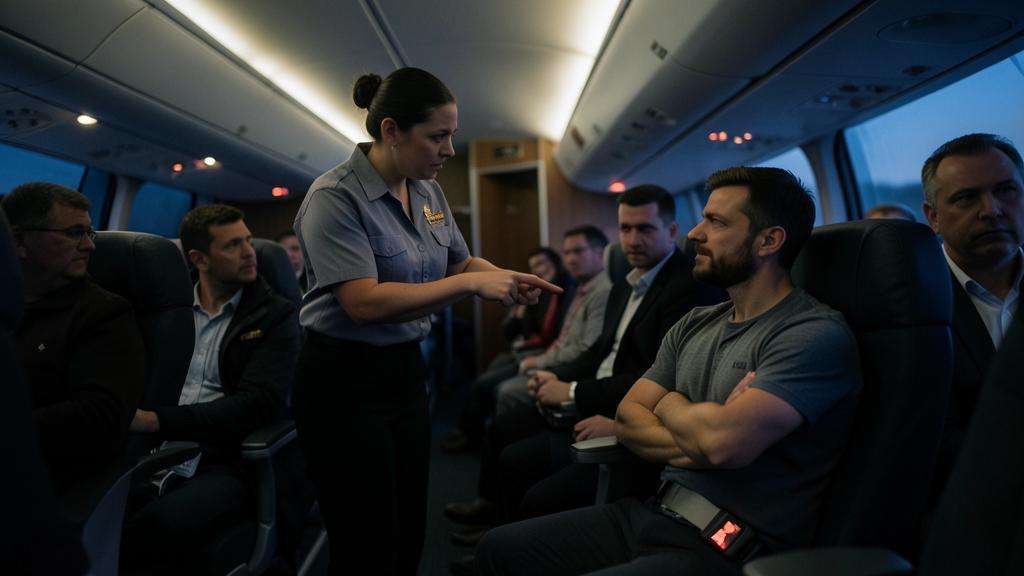
The formal notice—the warning card most operating manuals provide—is not a punishment, it’s a notification. It formally records that the passenger was informed, on behalf of the captain, that their behavior exposes them to legal consequences. Its evidentiary function is twofold: it dates the shift and removes the most common passenger defense— »I didn’t realize it was serious. » Given in front of witnesses, noted with time in the report, it turns a word-against-word situation into documented fact.
| Criterion | Service register | Legal register |
|---|---|---|
| Triggering fact | Incivility, tone, irritation—without refusal of directive | Refusal of a legitimate directive, violence, tampering with safety equipment |
| Who decides the follow-up | The cabin chief, within the service framework | The captain, informed and documented |
| Written record | Mention in cabin flight report | Detailed report, dated formal notice, identified witnesses |
| Post-flight actors | Customer service, possible commercial gesture | Authorities of the landing state, civil aviation authority, operator’s legal service |
| Effect for the passenger | None, or a letter from the airline | Legal proceedings, administrative fine, exclusion list, diversion cost billing under applicable regimes |
The pitfall: issuing a formal notice as a punishment. A notice given for rudeness, without a refused directive behind it, documents no obstruction: it weakens the case, undermines the tool with observing passengers, and may backfire on the crew if restraint follows. The formal notice only holds if based on a precise, stated, and dated refusal.
The captain’s powers: extensive, conditional, protected
Once the incident is qualifiable, the onboard regime gives the captain powers no other civilian authority has. When they have reasonable grounds to believe someone has committed, or is about to commit, an act compromising safety or good order, they can take reasonable measures—including physical restraint—to protect the aircraft and its occupants. They can request crew assistance, seek help from passengers, disembark the person at the first stop, or hand them over to competent authorities of the landing state, notifying them before arrival.
These powers are limited in three ways, and each limitation appears in disputes. The measure must be proportionate to the threat: you don’t handcuff a seatbelt refusal. It is time-limited: restraint is not meant to continue beyond landing, except in specified cases—handing over to authorities, flight continuation, or the person’s consent. And it occurs within a precise window: for these powers, the flight runs from door closure after boarding to door opening for disembarkation. In return, measures taken under this regime are protected: those acting in accordance with the onboard regime cannot be held liable for the treatment of the targeted person. This protection disappears precisely where documentation is lacking—hence the weight of the report.
After landing: who can prosecute, and why so many offenders walked free
The Tokyo Convention assigns jurisdiction to the aircraft’s state of registration. On a domestic flight, the question rarely arises; on an international flight, it created a long-documented blind spot: an aircraft registered in one state lands in another, local police board, find no offense committed on their territory under their law, check identity—and release. The operator bears the diversion cost, the crew writes the report, and the offender leaves. This jurisdictional gap is what the 2014 Montreal Protocol fills, extending jurisdiction to the landing state and the operator’s state.
The mechanism remains conventional: it only applies between contracting states, and the ratification map progresses state by state. For the crew, the consequence is direct: when writing, you don’t know which law will apply or which prosecutor will read it. The report must therefore stand on its own—factual, dated, without corporate culture implications. Other avenues exist outside criminal prosecution: several states delegate to civil aviation authorities the power to impose administrative fines, faster than a trial; and the operator retains contractual levers—refusal to board on return, internal exclusion list, diversion cost billing when the applicable regime allows.
The report: the qualification hinges on what you write
The lawyer who will qualify the incident was not onboard, and the judge even less. The only thing reaching them is the report—often translated, sometimes read in a state that is neither the operator’s nor yours. Its golden rule is simple: facts, not qualifications. « Slurred speech, alcohol breath, unsteady gait » withstands contradiction; « the passenger was drunk » is a conclusion the defense will attack. Qualification is the law’s job; facts are yours.
Six milestones structure a report that holds: the first fact, dated; the directive, with the exact words used; the formal notice, with time of delivery and reaction; the restraint means, with duration and subsequent monitoring; the witnesses, identified by seat number; the handover to authorities, with time and service. Add operational consequences, systematically forgotten yet materializing the obstruction: how many crew members mobilized, for how long, in what flight phase, at the expense of which tasks. This last column turns « a difficult passenger » into « an impeded crew. »
The right reflex: lock in the directive-refusal pair when it happens. Note the time and exact words as soon as the situation calms, have a second crew member witness the refusal, and identify two witnesses by seat number before disembarkation—doors open, they’re gone.
What to check in your documentation
The mechanism described here is general; its implementation is with your operator, and that’s where to look. Where does the operating manual place the formal notice, who delivers it, in whose name, in which languages? Does the manual’s threat level grid match the latest security training, or are two versions circulating? What does the procedure say about assistance from able passengers and the restraint kit—who decides to apply it, who monitors the restrained person until landing? What is the report’s circuit, within what deadline, and who transmits it to the authority?
There remains a gray area rarely mentioned in training: the turnaround. Onboard powers activate at door closure and end at door opening; an incident on the ramp, door open, falls under local police and ground procedures, not the onboard regime. A boarding that escalates is handled with different tools than a flight that escalates—and refusing to board the person is often the only truly available measure until they cross the door. For those preparing for selection or qualification, this is the mechanism to know how to explain: not recite four levels, but explain why a seatbelt refusal after individual request weighs legally more than a string of insults.
The usage note, finally, is not a formula: the applicable conventions, national regulations, and your operator’s approved documentation—operating manual first— prevail over this article for any operational decision.


Leave a Reply
You must be logged in to post a comment.