
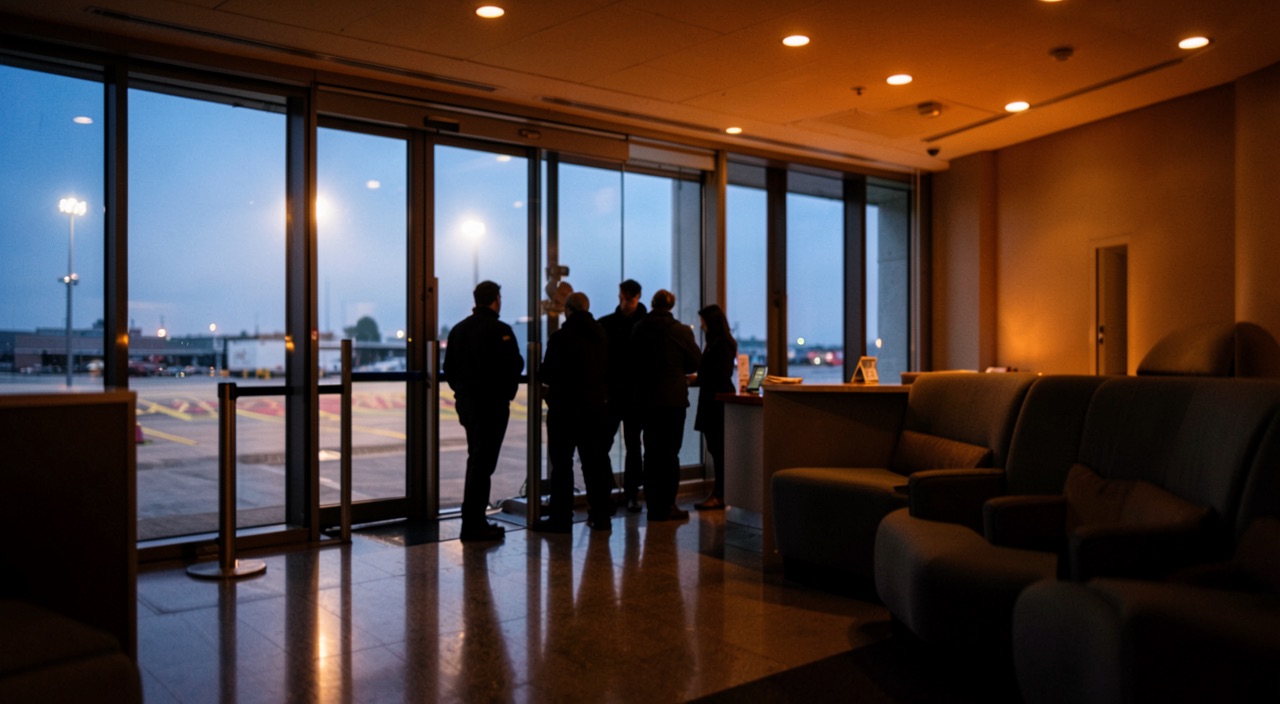
Briefing room, a quarter of an hour before boarding, watch in hand. You are taking your first flight as purser and, of the five people sitting opposite you, three are discovering your name on the crew roster. The items to be covered you know by heart. What remains is how these few minutes turn a list of points into a crew that will know who does what if the first alarm sounds in the cruise.
What a briefing produces, and what it does not
A pre-flight briefing has two possible outputs, and nothing in the record distinguishes them. The first is administrative: the planned items have been covered, the crew is deemed informed, the trace exists. The second is operational: everyone knows, without having to ask, what is expected of them in the first seconds after an alarm.
The variable that separates them can only be measured in a degraded situation: the time to designate. When a burning smell rises from the aft galley, the technical action is not what costs the most. What costs is the moment when two crew members look at each other, each assuming the other is going for the extinguisher. That delay is not a failure of competence: it is the consequence of a distribution that was left implicit.
A briefing that engages makes nobody more competent — training and the maintenance of competence take care of that. It does something else: it removes the negotiation. Work of distribution, not of transmission, and that is where a first command is played out.
A good briefing doesn’t just check if everyone knows the procedures – it clearly assigns specific roles to each crew member so there’s no confusion when an emergency happens. The key is making sure everyone understands exactly what they need to do, not just that they know the theory.
On an Airbus A320 with a galley fire during service, the purser assigns: “Maria, you grab the extinguisher and attack the fire. Carlos, you alert the flight deck. Laura, you prepare the evacuation slides.” This clear assignment prevents the dangerous hesitation where two crew members might both think the other is handling the extinguisher.
The quarter of an hour, and what you do with it
The slot is short, shared with the administrative part — crew composition, particularities of the rotation, security, service points — and it spills over into boarding as soon as you let it drift. Nobody makes up in flight for what was not said on the ground: once the cabin is full, the crew belongs to the passengers.
Hence the only question worth asking: what is the time spent on? The beginner’s reflex is to secure the verifiable part, the part you can prove took place — the part, too, that produces the least effect once the door is closed.
The shift is modest: a few minutes taken from the document review, given back to the assignment of roles and to a scenario walk-through. In the first breakdown, the crew leaves with information; in the second, with tasks attached to names. The documentation remains available on board; the distribution cannot be improvised at the moment it is needed.
Checking or assigning: two briefings in the same slot
The two regimes coexist, and the operator legitimately expects both: verifying knowledge is part of what a briefing must produce. The problem is not that they live side by side, it is that they are confused: you believe you are assigning when you are questioning.
The two regimes coexist, and the operator legitimately expects both: verifying knowledge is part of what a briefing must produce. The problem is not that they live side by side, it is that they are confused: you believe you are assigning when you are questioning.
- What you look at: Making sure the knowledge is there vs. Deciding who does what on this flight
- Form of the question: Closed, single answer, put to the group vs. Situated, addressed by name
- Status of the crew member: Examined vs. Designated
- Effect of a mistake: Public embarrassment, sometimes lasting withdrawal vs. Immediate correction, nothing personal at stake
- Length of the sequence: Open-ended: depends on the answers vs. Bounded: depends on the number of roles
- What remains at boarding: The memory of having been judged vs. A sentence everyone can repeat
A closed question — how many extinguishers in this zone, where are the spare life jackets — measures an item of knowledge, without saying anything about what the person will do. A situated question, addressed by name, produces both results at once: on this cabin version, if the aft lavatory detector goes off during the service, what do you take with you and who do you call?
| What you look at | Verification briefing | Assignment briefing |
|---|---|---|
| Purpose of the sequence | Making sure the knowledge is there | Deciding who does what on this flight |
| Form of the question | Closed, single answer, put to the group | Situated, addressed by name |
| Status of the crew member | Examined | Designated |
| Effect of a mistake | Public embarrassment, sometimes lasting withdrawal | Immediate correction, nothing personal at stake |
| Length of the sequence | Open-ended: depends on the answers | Bounded: depends on the number of roles |
| What remains at boarding | The memory of having been judged | A sentence everyone can repeat |
The drift can be spotted in oneself: if the answers reassure you without changing anything in the distribution of tasks, you are checking, you are not commanding.
The trap: the briefing that turns into a public examination. A crew member corrected in front of the others over a forgotten figure will no longer say that this cabin version is new to them, nor that they are coming back from a long break in activity. You have just closed the source of information you were missing.
The mandate counts for more than the position
The position gives the information: who will see the smoke first, who holds the door, who has a view of the cabin. It does not give the right to act without waiting. That right is delivered by the briefing, and not in bulk: “everyone knows their station” is not an assignment, it is a wish.
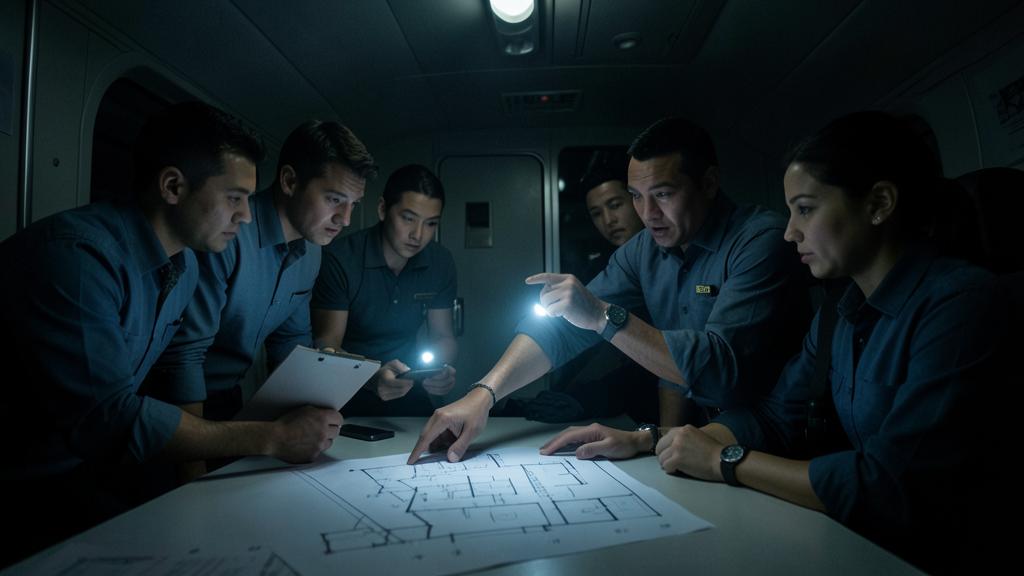
The two costly cells are not symmetrical. The crew member who holds the information without the mandate reports and waits: the delay is visible, it can sometimes be made up. The one who received a vague mandate without the information acts off target, and their action takes the place of the right one.
In practice, three designations per scenario: who alerts, who acts, who holds the cabin. Three names spoken, not three functions written down. And for each name, what that person does if nobody answers at the other end of the channel — that is where elegant distributions fall apart.
The right reflex: have the designated person restate, in one sentence, what they will do — not you, and not the group. A restatement that hesitates over the order of actions teaches you more than ten closed questions, and it costs less than a minute.
Anchoring the emergency case on the day’s flight
The case dealt with at the briefing is only useful if it is plausible today. A generic scenario is listened to politely; a scenario that resembles the day’s flight is retained, because the crew replays it during boarding.
The choice follows from the day’s parameters, not from rotating through a list: length and nature of the sector, proportion of overwater flight, local time on arrival, load factor, passengers requiring assistance, a deferred defect affecting a cabin item, the crew’s actual experience on the type.
Two checks before settling on a case. Does it involve at least two positions? A case that concerns only one person does not test coordination, which is precisely what the briefing builds. Does it contain a decision, and is it known who takes it? Otherwise it turns into a recitation of procedure.
Finally, say what you will not cover: announcing that you will rehearse a fire in an overhead bin and not the evacuation avoids the misunderstanding that the rest matters less.
The first minutes, said out loud
Assigning is not enough if the order of actions stays in the purser’s head. The sequence gains from being stated in time, naming who does what and when one action depends on another.
Three things are visible on such a sequence and not in a list. The parallel tasks: attacking the fire and alerting the flight deck do not follow one another, they are carried out together, by two people. The tipping point: as soon as the flight deck decides, the cabin works to an announced time, which changes the order of the preparations. The feedback: it is the report on the effect obtained that feeds the decision, so it must be planned for, not hoped for.
The framework of the report the cabin will receive from the flight deck is worth recalling, whatever name your operator gives it: nature of the event, intentions, time available, particular instructions. What matters is not the acronym, but that the crew knows it will receive these four elements and that it may ask for them.
Getting those who do not speak to speak
A briefing where only the purser speaks is a briefing you know nothing about. Silence is not agreement: it covers mastery, fatigue, first exposure to the type and the fear of drawing attention, indifferently. These four states do not call for the same handling, and none of them can be told apart until someone has opened their mouth.
Redistributing the speaking does not call for oratory, only for a rule that is kept. Address questions by name rather than to the group. On the day’s case, have the most recently qualified person speak first. Ask for a piece of information rather than for an answer. And leave a few seconds of silence before taking the question back yourself: that is when someone makes up their mind.
In a mixed-language crew, the working language is set at the start, explicitly, and the designations are made in it. An assignment half understood is worth nothing, and the person who did not understand will not say so in front of the others if the briefing has not opened that possibility.
After the door, the briefing continues
Nothing obliges the distribution made on the ground to survive the actual flight. Announced turbulence, a passenger in difficulty, a diversion under consideration, a crew member unavailable: each of these redistributes the workload. An expired assignment is more dangerous than no assignment at all, because it is taken for granted by everyone except the person who can no longer honour it.
Hence two brief reprises: a point in stabilised cruise, when the service workload drops, and a re-briefing before descent as soon as something has changed. The second is the more profitable: it puts the crew back into the phase where the probability of an event rises again.
That is also where the relationship with the flight deck is played out: a purser who has announced when they will call — and when they will not — obtains a channel that stays usable to the end.
What you need to go and read in your own documentation
Three points vary from one operator to another. What the operations manual imposes as minimum content and as a record, and what it leaves to your judgement: the margin is often wider than you think. The action laid down when a safety question reveals a gap. And the place of the joint briefing with the flight deck, its timing, who decides to hold it.
Grey areas remain: the time actually available on a day of delay, what to do when the crew only comes together at the door, the value of an assignment given to a crew member you will never see again. These are worked out in peer feedback, in the field or in the discussions of the professional forum.
For anyone preparing a purser qualification, the lesson is short to state and long to acquire: what is observed on the line is not recited safety, but the ability to bound the time, to name people and to get them to speak.
This article describes a mechanism, not a procedure. In case of divergence, the applicable text and your operator’s approved documentation prevail over everything above, including over the time breakdown proposed here.
Questions fréquentes
How much time should be devoted to the pre-flight briefing?
The useful duration is bounded by the schedule and by what the operations manual imposes: it is undergone more than it is chosen. What can be chosen is the breakdown, and keeping roughly half of the slot for the assignment of roles and a scenario walk-through remains possible in almost every case. A briefing that spills over into boarding is paid for immediately in disorganisation, whereas the document review can be made up on board.
Should a different emergency case be covered on each rotation?
Yes, and it should be chosen on the parameters of the day’s flight rather than by rotating through a list: length of the sector, overwater flight, local time on arrival, load factor, a deferred cabin defect, the crew’s experience on the type. A plausible case is mentally replayed during boarding, a generic one is not. Prefer a scenario that involves at least two positions and that contains an identified decision point.
What should you do with a crew member who does not answer safety questions?
Start by separating a gap in knowledge from inhibition in front of the group: the handling is not the same, and the second is more frequent at the start of a rotation than one might think. The briefing is not the place for a formal check, so take the person aside rather than correcting them in front of the crew. If serious doubt remains about their fitness to hold the position, your operator’s procedure applies and takes precedence over any local arrangement.
Must the commander attend the cabin briefing?
Their authority over the whole crew is not in question, but the arrangements for the joint briefing and its timing are set by the operator’s documentation, and they vary from one airline to another. Check what your manual provides before making it a personal habit. What remains useful in every case is to tell the cabin crew in which circumstances you will call the flight deck, and in which you will not.
How do you assign roles in an augmented or mixed-language crew?
Set the working language explicitly in the first few sentences, then make the designations in that language, by the person’s name and not by their function. In an augmented crew, name for each retained scenario who alerts, who acts and who holds the cabin, as well as what each of them does if nobody answers at the other end of the channel. Have the designated person restate it: an assignment half understood produces no effect on the day it is needed.
What is actually assessed during a purser qualification?
Line observation bears less on the quantity of safety recited than on the conduct of the session: keeping to the time allotted, designating people rather than functions, getting everyone to speak at least once. A candidate who recites perfectly but leaves five people silent has not shown what is being looked for. Your operator’s standard details the criteria actually used and remains the only reference that can be held against you.


Leave a Reply
You must be logged in to post a comment.