

Second hour of the flight, a passenger has a medical episode: the kit is opened, ground medical advice is obtained, monitoring is set up, everything is brought under control. Eighth hour, after two rest rotations, the crew on duty has no idea the kit’s seal is broken and that this passenger was due to be checked on again before the service. Nothing serious, this time. A cabin handover rarely fails on the striking event; it fails on the weak detail that nobody believes is theirs to carry.
What Gets Lost at Handover, and Through What Mechanism
A handover almost never fails on what made noise. The medical episode, the smoke in an oven, the passenger who raised their voice: these things pass on by themselves, because they marked whoever lived through them, who then needs to tell the story. What disappears is the weak detail: a seatback that no longer stays upright at the rear of the cabin, an oxygen bottle used for a few minutes, a row someone promised to check on later. None of these carries any emotional weight, and that is exactly why it does not survive the handover.
The first mechanism is salience: we pass on what we remember, and we remember what surprised us. The second is more insidious. A piece of information known to three people does not have three chances of being passed on; it often has zero, because everyone assumes someone else is handling it. A diffuse owner is the worst kind of owner: an item held by a single person who knows they hold it is far safer.
The third mechanism is decay by relay. A verbal instruction survives one handoff honestly; it survives the second one having lost its numbers, its times and its row references; by the third, only a general impression remains. On a long-haul flight with an augmented crew, information produced before the first service must survive two or three handovers before descent. The arithmetic does not take long.
The problem isn’t big emergencies – everyone remembers those. It’s the small details that get forgotten when passing information between crews. People assume others will mention things, and over time, important details get lost. Writing things down helps them survive multiple handovers.
On a Boeing 777 at 30,000 feet, an oxygen bottle was partially used to help a passenger with altitude sickness. The crew replaced it but didn’t note the usage. Three handovers later, the next crew assumed it was full. When another passenger needed oxygen, the bottle was empty – causing a 20-minute delay while they switched to backup supplies.
What remains is an asymmetry that nothing spontaneously corrects: whoever takes over the position cannot ask about what they don’t know exists. Nobody questions an event they have never heard of. The burden of completeness therefore rests entirely on the person handing over, or on the structure imposed on them.
The trap: the piece of information everyone believed had already been passed on. The more it was shared during the event itself, the less likely it is to reach the handover: everyone remembers that the whole cabin knew, nobody remembers having had to say it. The fix is not to repeat it more, but to designate an owner the moment the information is born: whoever holds the position concerned, and no one else.
A Fixed Order Turns an Omission Into a Visible Gap
The difference between a handover that holds and one that leaks is not decided by how much is said, but by its form. A free-form account has a structural flaw: complete or gutted, it looks exactly the same either way. The listener has no way of knowing something is missing, since they were not expecting anything specific. The omission leaves no trace.
A fixed reporting order changes the nature of the exercise. The receiver is no longer following a story, they are filling in boxes. If the third category is not covered, the gap is noticed within seconds, because the slot existed before the content did. It is the only device that makes an omission detectable to the person who, by definition, does not know what they were not told.
The order also serves the person handing over. It brings to mind categories in which nothing happened, and saying so is a piece of information in its own right. “Nothing to report on equipment” and silence about equipment do not mean the same thing: the first is a dated finding, the second an ambiguity the receiver will inherit without knowing it.
What remains is choosing the order. The most robust one follows the hierarchy of safety priorities rather than the chronology of the flight: whatever protects an evacuation first, people who will need assistance next, whatever might be missing after that, and the operational context last. It has the advantage of staying the same regardless of aircraft type, airline or working language, so it holds up for crews made up of people who do not usually fly together.
The Minimum Content, Category by Category
Exits and Safety Equipment
The only thing that genuinely changes with every rest rotation is the assignment: who is answerable for which exit at that moment. That point is always stated, even when everything is fine, because it exists nowhere except between the two people concerned. Next comes anything that hinders access: a bag that has slid into the aisle, a lavatory door jammed open near an exit, faulty local lighting.
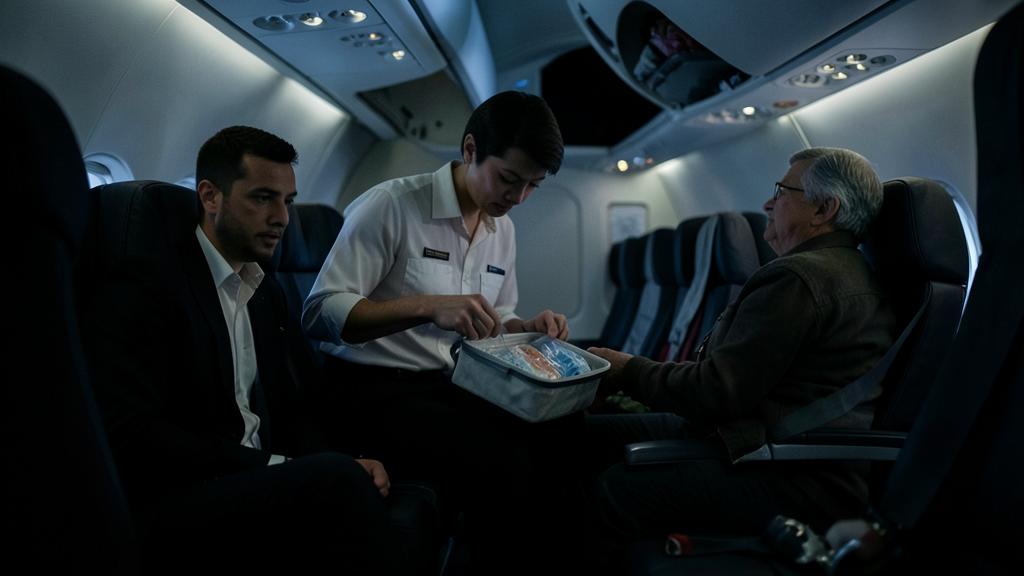
For equipment, the useful rule is broader than “what is out of service”: anything that has been opened, used, moved or lent out is passed on. A mask taken out of its packaging, a seatbelt extension not returned, a fire extinguisher discharged for a second, a broken seal on a kit. The question to ask is not “is it serious” but “is the item still what it appears to be.”
The trap: equipment that has been used but looks untouched. An oxygen bottle partially used and put back in its bracket looks exactly like a full one; the next crew is not counting minutes of endurance, it is counting items present in their place. As long as the consumption is not written down, the item stays counted as available, and it will still be counted that way on the next flight. It is not memory that is missing, it is the outward sign.
Flagged Passengers
The most common mistake is to narrate instead of to hand over. “He was feeling better” is not an instruction; “check on again before the service, seat 42 window, call the purser if symptoms return” is one. What gets handed over is the expected action, its deadline, and the threshold that triggers an alert. The story comes afterward, if there is time left for it.
This category also covers passengers whose evacuation requires assistance and the name of whoever is responsible for them, unaccompanied minors and the status of their supervision, a disruptive passenger together with the escalation level already reached and the exact words said to them, and a declared allergy along with whatever announcement was made in the cabin about it. The level reached matters as much as the incident itself: restarting an escalation from zero destroys the work done before the rest break.
Cabin Defects and Supplies
A defect is passed on together with its practical consequence, never alone. A lavatory taken out of service changes queue distribution and sometimes what needs to be monitored; a seat that cannot be used changes a seating arrangement and therefore, possibly, the assistance planned at an exit; an interphone that is partly dead reroutes the alert circuit, which is a safety matter before it is a service inconvenience. On the supplies side, nobody cares about the full inventory: what matters is the consumables whose depletion changes a procedure or a commitment made to a passenger.
Operational Context
The operational framework of the flight is handed over last because it is the most volatile: an instruction received from the flight deck, forecast turbulence and the window during which service will have to be interrupted, a revised arrival time, how far the service has progressed and the cut-off time set for the second one. If a medical case is ongoing, add whatever the flight deck has already prepared in case of a diversion, since that piece of information expires hour by hour.
| Category | What is said | What is written | What is checked visually |
|---|---|---|---|
| Exits | The assignment at that moment, anything hindering access | A hindrance that will outlast the flight | Area clearance, jump seat, harness, local lighting |
| Safety equipment | What has been opened, used, moved, lent out | Any use, even partial, and any broken seal | Presence, seal, pressure indicator, position in the bracket |
| Flagged passengers | The expected action, its deadline, the alert threshold | Whatever commits the rest of the flight, in the form allowed by the operator | Row and seat, a look before taking over the position |
| Cabin and supplies | The defect and its practical consequence | Any defect that belongs in the technical log or the cabin log | Lavatories, oven, interphone, level of critical consumables |
| Context | Flight deck instruction, turbulence, service window | Only what outlasts the flight | Time, phase, state of the seatbelt sign |
Spoken, Written, Verified: Three Channels, Three Reaches
The spoken word is fast, rich and nuanced: it is the only channel that conveys an intention, a doubt, an impression about a passenger. It dies quickly. The written word is sparse and slow, but it does not wear out: it is the only one that survives several handovers, reaches the next crew after the turnaround, and feeds the maintenance chain. A defect only mentioned verbally does not exist for the next flight. Visual verification, finally, is of a different nature altogether: it conveys nothing, it simply removes the need to take someone’s word for it. What you have seen yourself no longer needs to be accurate in someone else’s account.
These three channels each cost something different, and that is exactly why not everything can go through all three. The useful trade-off is not made on how important the information feels, but on two cold criteria: how long it needs to live, and what is lost if it disappears.
The right reflex: write it down at the moment, not at the handover. A consumption, a broken seal, a monitoring time should be noted when they occur, while the figures are still accurate. Putting off the writing until the handover makes the written record dependent on verbal memory, which strips it of its one advantage.
The Moment of Transfer Is a Contract, Not a Courtesy
Between the outgoing crew member’s “going off to rest” and the incoming one’s “taking over the position,” there is a window during which two people each believe they are covered by the other. That is where failed handovers hide: not in the content, but in the vagueness of the moment. The transfer must be a marked instant, spoken out loud and accepted, on the same principle as the transfer of controls on the flight deck. Before that instant, the outgoing crew member answers for everything; after it, the incoming one answers for everything; there is no shared zone.
The point is far from theoretical. The cabin crew complement required for the flight is not a headcount: its value lies in the exit coverage it represents, and the conditions under which it must remain assured throughout the flight are set by the applicable regulation and then spelled out in the operations manual. An outgoing crew member who leaves their area before their replacement is physically there leaves the complement correct only on paper, and an exit with no one answerable for it. What the incoming crew member receives is not a seat: it is exits, flagged rows, an interphone station and the actions expected of them in the event of an evacuation.
The right reflex: have it read back, then walk it. Whoever takes over the position restates, in their own words, the two or three points that will call for action during their shift, along with their deadlines; the two of them then walk the area together — exits, equipment, flagged rows — before the outgoing crew member leaves. The read-back catches the misunderstanding, the walk catches what nobody thought to say.
Two Circuits That Do Not Substitute for Each Other
A long-haul cabin runs two handovers of a different nature. The first is local, position to position: it is precise, spatial, perishable, and carries what can be seen from one specific spot on the aircraft. The second links the person in charge of the cabin to whoever succeeds them, and carries what crosses zone boundaries: a medical case that could tip into a diversion, a security level, a revised service plan, an instruction from the commander.
The second is not a summary of the first ones, and that is the classic mistake. If only the local circuit is maintained, nobody holds the overview any longer and the flight deck ends up talking to someone who does not know the flight’s history. If only the global circuit is maintained, zone-level detail disappears: the used-up equipment and the out-of-service seat never rise high enough to come back down again.
| Criterion | Position handover | Handover of the person in charge of the cabin |
|---|---|---|
| Reach | One zone, its exits, its rows | The whole cabin and the link with the flight deck |
| Content of its own | Local status, passengers in the zone, galley supplies | Medical case and its possible escalation, security, service plan, instructions received |
| Rhythm | At every rest rotation, position by position | At every change of the person in charge |
| Record | Verbal, supplemented in writing for what lasts | Written as soon as a decision is committed to |
| What is lost if it does not happen | The detail: equipment used up, unusable seat, passenger to check on again | The overview: no one knows any more where the flight stands |
What remains is closing the loop forward. The flight deck needs to know who it is talking to: the person answering the interphone is no longer the same one, and an instruction given three hours earlier to someone who is now asleep is not an instruction received. Announcing the change costs one sentence and prevents a request from going unanswered at the moment it matters.
What You Need to Go Check in Your Own Documentation
Four questions arise when reading your manual, and the answers vary more than one might think from one operator to another. Is the handover described with an imposed order, or left to each individual’s discretion? Is there a written record specific to the cabin, distinct from the aircraft’s technical log, and who is entitled to write in it? What happens to a partially used oxygen bottle: put back in service with a note, marked, or removed? And is the moment of transfer of responsibility defined anywhere, or simply taken for granted?
A grey area remains, and it is better to name it than to discover it the hard way. The most useful piece of information to pass on about a passenger is often a health-related item, whose written recording is regulated. Many operators therefore limit what can be written in the cabin and route the detail toward a dedicated form. The practical consequence is a little perverse: the information whose loss costs the most ends up confined to the most fragile channel. The workaround lies in separation: the expected action and its deadline are not clinical data and can be noted down; the perceived diagnosis stays verbal and goes onto the form provided for it.
For anyone preparing to take on a purser role, the handover is worth working on for its own sake: it is one of the rare moments where a whole behaviour can be observed in full, structure, listening and record-keeping included. Practices vary enough from one airline to another that the comparison is instructive, and the topic often comes up on the FL330 forum, where crews describe home-grown checklists that are sometimes finer-grained than the official procedure.
This text describes a mechanism, not an applicable rule: the regulation in force, the operations manual, and your operator’s approved cabin documentation take precedence in every circumstance over what is written here.
Questions fréquentes
When the handover has to happen in a few seconds, what gets passed on first?
Only two things: the exit assignment at that instant, and every expected action with its deadline. The rest can wait for the first quiet moment, provided the outgoing crew member has not gone off to bed in the meantime. If only one item could get through, it should be the deadline: a passenger to be checked on again in twenty minutes cannot be caught up on later, a broken seat will reveal itself on its own.
Does equipment that has been used but is not empty need to be written down, or is a verbal mention enough?
It is written down, without exception. An item that has been used and put back in its place looks visually identical to an untouched one, so the only sign that survives is the written record. A verbal mention dies at the next handover, while the consequence survives the turnaround and concerns the following crew.
How do you hand over a medical case without recording health data everywhere?
By separating the action from the diagnosis. The expected action, its deadline and the threshold that triggers a call are not clinical data and can be noted soberly. The medical detail stays verbal and goes onto the form provided by the operator, which is the only support authorised to keep it.
Does the purser's handover make position handovers unnecessary?
No, the two circuits carry different information. The global circuit holds the overview and the link with the flight deck; the local circuit holds the zone-level detail, which never rises high enough to come back down intact. Removing either one makes exactly what the other does not carry disappear.
At exactly what moment does responsibility for a position change hands?
At the moment the transfer is stated and accepted, with the replacement physically in the area. Until that sentence has been said, the outgoing crew member still answers for everything, including the exit. It is the same principle as the transfer of controls on the flight deck: without a clear statement, two people believe they are covered by the other.
Should the flight deck be told about a change of the person in charge of the cabin?
Yes, and it costs one sentence. The flight deck needs to know who it is talking to and who to address an instruction to, otherwise a request can go unanswered at the moment it matters. An instruction given three hours earlier to someone who has gone off to rest is not an instruction received.


Leave a Reply
You must be logged in to post a comment.