

Stabilized cruise, ordinary cabin altitude, and a passenger in row 32 turning pale: cold sweats, nausea, a veil over the eyes. The reflex is to conclude a vasovagal episode—statistically, that’s the safe bet. But at 8,000 ft cabin altitude, mild hypoxia can produce a similar picture in a passenger whose respiratory reserve was already compromised on the ground, and the two mechanisms require neither the same monitoring nor the same follow-up. Distinguishing them doesn’t require sophisticated equipment: a timeline, two hands, and reasoning.
What cabin altitude really does to oxygen saturation
Pressurization doesn’t bring the cabin to sea level: it maintains it at a compromise altitude, which certification of transport aircraft caps at 8,000 ft in normal operation. In high cruise, it’s this altitude—not the flight level—that the organisms on board, including the crew, are subjected to. The partial pressure of oxygen in the alveolar air decreases accordingly, and arterial saturation follows.
The curve that protects some and exposes others
Follows, but not linearly—and that’s the whole point. The relationship between partial pressure of oxygen and saturation forms a sigmoid: a long plateau at the top, a steep slope below. A healthy adult boards with saturation around 97–98%, comfortably on the plateau; at 8,000 ft cabin altitude, they typically drop to 90–93%. The loss is real but tolerated: a few points, minimal or no symptoms, slightly more fatigue, slightly reduced alcohol tolerance.
The fragile passenger doesn’t start from the same point. Chronic bronchopathy, anemia, heart failure, ongoing respiratory infection, heavy smoking—the carbon monoxide sequesters part of the hemoglobin: all conditions that place them already lower and further left, at the edge of the steep slope. The same cabin ascent, harmless for their neighbor, tips them into the zone where each lost hectopascal costs dearly in saturation. They decompensate silently, often at the end of climb or the start of cruise—precisely when service begins and a grayish complexion goes unnoticed.
L’oxygène dans l’air diminue avec l’altitude, même dans la cabine. Une personne en bonne santé supporte bien cette baisse, mais quelqu’un avec des problèmes respiratoires ou cardiaques peut manquer d’oxygène plus vite. C’est comme si l’air devenait plus fin, et certains passagers le ressentent avant les autres.
Un passager de 60 ans avec une bronchite chronique et un taux d’hémoglobine de 12 g/dL (normal : 13-17) embarque dans un Airbus A320. Pendant la montée à 35,000 ft, la cabine atteint 8,000 ft. Sa saturation passe de 95% au sol à 82% en croisière, provoquant des vertiges et une confusion, tandis que son voisin en bonne santé reste à 92% sans symptômes.
Two mechanisms that are opposites
A vasovagal episode is a regulatory accident in an otherwise healthy organism. A trigger—pain, emotion, prolonged standing in the aisle, heat, a meal, alcohol—overrides the parasympathetic response: the heart slows, peripheral vessels dilate, blood pressure drops, and the brain, briefly underperfused, disconnects. Loss of consciousness, when it occurs, is brief, and recovery is rapid once the supine position restores cerebral flow. The entire episode fits within a reflex arc.
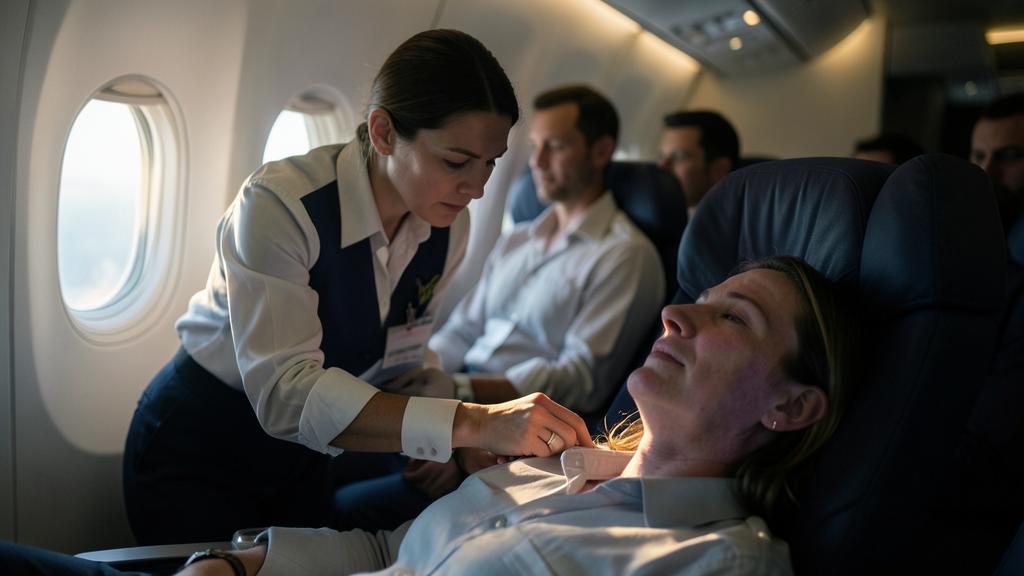
Altitude hypoxia is the opposite: a supply deficit in an organism that compensates. The lack of oxygen triggers a sympathetic response—the heart races, ventilation increases—and it’s the brain, a heavy consumer, that suffers first: impaired judgment, euphoria or apathy, labored calculations, drowsiness. Cyanosis of the lips and nail beds arrives late and is hard to see under cabin lighting. Most importantly, nothing corrects spontaneously: as long as the cause persists, the condition worsens.
This mechanical opposition produces opposite signs, and that’s a stroke of luck: the pulse, the skin, behavior, and response to positioning tell two stories that can be distinguished from the seat, with no other tool than hands and a watch.
| Sign observed | Vasovagal reflex | Hypoxie d’altitude |
|---|---|---|
| Installation | Sudden, preceded by brief warning signs: nausea, feeling hot, narrowing vision | Insidious, over several minutes to several tens of minutes |
| Contexte | Emotion, pain, prolonged standing, meal, heat, alcohol | End of climb or cruise; respiratory or cardiac condition, anaemia, smoking |
| Pouls | Slow, weak, sometimes barely perceptible | Fast, regular, and stays that way |
| Peau | Pale, clammy, cold sweats | Greyish complexion; bluish lips and nail beds at a late stage |
| Comportement | The passenger feels themselves fading and says so | Impaired judgement: minimisation, euphoria or apathy |
| Lying down | Clear recovery within two to three minutes | Little or no effect |
| Oxygen | Of no real effect, but not harmful | Clear, measurable improvement |
| Spontaneous course | Self-resolving | Progressive as long as the cause persists |
At the seat: the signs that separate, those that mislead
The first useful question isn’t “How do you feel?” but “What happened just before?” A passenger who stood in the aisle, pain, fear, a hot cabin, a meal with alcohol: the groundwork for a vasovagal episode is laid. A collapse occurring while seated, without identifiable triggers, in someone already short of breath on the jet bridge or traveling with respiratory medication: the cursor shifts immediately.
The most accessible discriminating gesture remains the radial pulse. Slow, weak, sometimes barely perceptible: the signature of the vagal reflex, and it will disappear with it. Fast, regular, well-defined: an organism compensating—it’s compensating for something, and that something remains to be identified. The skin tells the rest: cold sweats and waxy pallor on one side; grayish complexion, lips and nails turning blue on the other, knowing that cyanosis is a late, insensitive sign, often masked by cabin lighting.
Behavior, finally, is the most counterintuitive discriminant. A vasovagal episode announces itself: the passenger feels themselves fading, says so, apologizes. Hypoxia lies: impaired judgment is part of the picture, and the passenger who assures in a slurred voice that everything is fine perfectly illustrates the mechanism that makes hypoxia so dangerous in the flight deck—the disturbance erases awareness of the disturbance. Faced with a passenger unnaturally calm for their condition, the crew’s concern is worth more than the passenger’s own perception.
The trap: believing the pulse oximeter when it lies. During a vasovagal episode, peripheral vasoconstriction and hypoperfusion degrade the signal the device measures at the fingertip: absent, aberrant, or falsely low value—and a cold or polished finger worsens the measurement. Conversely, in cruise, a value around 90–93% is expected in a healthy adult at standard cabin altitude and does not signify an emergency on its own. The pulse oximeter distinguishes a trend under oxygen; it does not replace the pulse or the timeline.
The therapeutic test: lay flat, time, oxygenate
In the face of an ambiguous picture, the discriminating procedure is also the one that treats—that’s what makes it robust. Flat, legs elevated, collar loosened: if the mechanism is vagal, restoring cerebral flow alone suffices, and recovery is clear in two to three minutes—clear consciousness, returning color, rising pulse. This delay is timed, not estimated.
Without recovery within this delay, onboard oxygen takes over, with the equipment and flow rate specified in the operator’s documentation. This is where the pulse oximeter regains its full value: not for its isolated measurement, but for its trend. A saturation that clearly improves under oxygen indicates a hypoxic component and identifies an underlying condition not to be dismissed—premature weaning will reproduce the picture. A saturation that doesn’t move shifts reasoning toward other causes, cardiac, glycemic, or neurological. At this stage, calling for onboard medical assistance, establishing a link with ground medical support (if the operator provides it), and continuous communication with the flight deck are no longer options.
The right reflex: time, don’t estimate. Note the time of laying flat, the time of oxygen application, and each recorded value. The distinction between the two mechanisms hinges on short durations—two to three minutes for vagal recovery—that the memory of a busy flight systematically crushes. A written timeline guides medical assistance, feeds the report, and protects the crew afterward.
When a fainting spell isn’t one: think cabin
A fainting spell has an explanation; two simultaneous fainting spells in distant rows have another. When several people—passengers or colleagues—simultaneously present headaches, nausea, dizziness, or unusual pallor, coincidence is the last hypothesis to consider. The environment becomes the prime suspect, cabin altitude first, air quality next. The flight deck must know immediately, with dated facts—who, where, what, since when—rather than a general impression.
Slow depressurization doesn’t warn
A slow pressurization drift produces neither noise nor sensation: the cabin altitude rise occurs at the same pace that prevents perceiving it. The dedicated alarm is certified to trigger around 10,000 ft cabin altitude; between the normal ceiling and this threshold lies a range where nothing sounds and the most fragile organisms are already failing. A cluster of “vagal” fainting spells in this window is an operational signal, not a streak of bad luck.
The crew, finally, doesn’t observe the scene from sea level: they are subjected to the same cabin altitude as row 32, plus the physical effort of service, which increases oxygen demand. Difficulty concentrating, delayed calculations, tingling, vision graying upon standing: if reported aloud, these signs become safety data; if kept to oneself, they deprive the flight of its best sensor. And if the cabin depressurizes significantly in high cruise, the time of useful consciousness is counted in tens of seconds: masks first, analysis later—a reflex practiced, never improvised.
What to verify in your own documentation
What this article cannot say, your documentation does: the exact location of the bottles in the day’s configuration, available flow rates and corresponding autonomy, associated masks, criteria in the safety and survival manual for administering oxygen, the decision-making process toward medical assistance and ground support. Verification is worth repeating with each aircraft type or configuration change—this is typically the knowledge that evaporates between recurrent training sessions.
A gray area deserves careful reading: the passenger traveling with their own device—portable concentrator accepted onboard, personal medical oxygen. The boundary between this cruise oxygen, sized for a chronic need, and the operator’s emergency oxygen, sized for an acute event, isn’t always clear in minds; knowing who provides what, and on what authorization, avoids improvising over the Atlantic. For those preparing for a qualification or recurrent training, the topic is a classic in scenarios: the physiology preceding the procedure—dissociation curve, position test, trend under oxygen—is part of the fundamentals revisited in first aid modules at formations.fl330.com.
A final reminder that isn’t just procedural: the regulation applicable to air operations and your operator’s approved documentation—operations manual, safety and survival manual, first aid procedures—take precedence over this article. In case of discrepancy between these lines and your instructions, it’s your documentation, in its current version, that is authoritative.


Leave a Reply
You must be logged in to post a comment.