
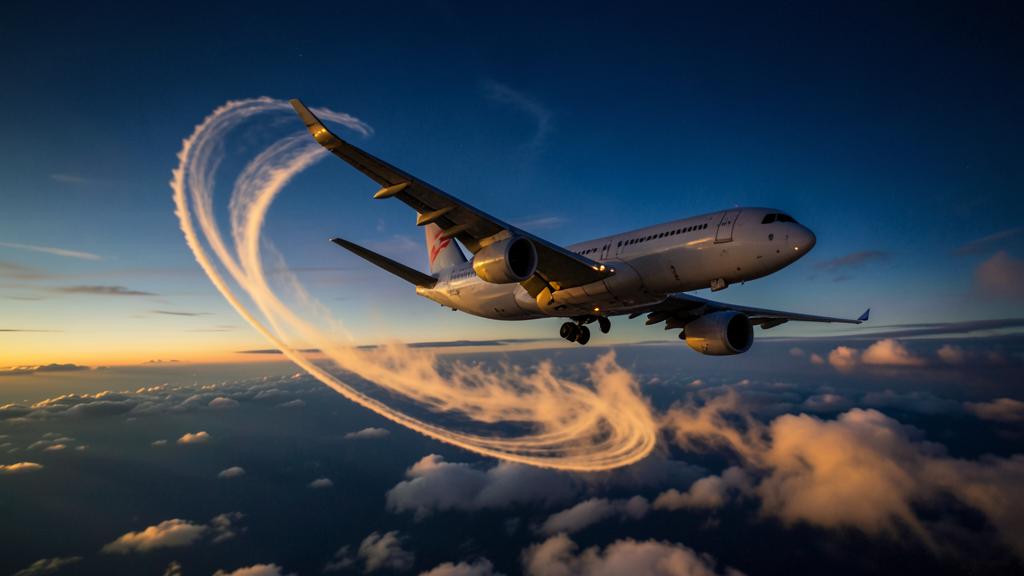
Level 350, autopilot, clear air: two sharp jolts, a roll of about fifteen degrees initiated and corrected in less than two seconds, a cart that veers sideways in the cabin. The crossing traffic passed a thousand feet above, two minutes earlier. No separation was missed, no minimum was violated, and yet the aircraft did encounter wake turbulence. The same pair of vortices, on approach, would have been handled by a well-known standard. In cruise, no such standard exists — because the geometry of the encounter is different.
What an aircraft’s wing leaves behind
Lift is paid for by a pressure difference between the lower and upper surfaces, and this difference doesn’t stop cleanly at the wingtip: the air flows around the wingtip from the lower to the upper surface. This results, across the entire wingspan, in a continuous shear layer whose local intensity follows the lift gradient along the wing. This layer is unstable. In just a few wingspans, it rolls up into two counter-rotating vortices. The key point for what follows is that the total circulation is conserved during this roll-up: the final vortex is no weaker than the shear layer that produced it, it is simply concentrated.
For a wing loaded in a near-elliptical manner, the two vortices stabilize at a separation of about 0.79 b — a quarter of pi, if one prefers the theoretical value. Each induces on the other a downward velocity, so the pair sinks as a whole into the air mass, at a few hundred feet per minute for a large aircraft. First fact to remember: a wake does not stay where the aircraft left it. It descends, and the faster it descends the stronger it is.
When an airplane flies, its wings create swirling air patterns called vortices. These vortices sink below the plane and can last for miles. The bigger and slower the plane, the stronger these vortices are. Other planes flying nearby can get caught in them, which can cause sudden, violent movements.
Around each vortex core, the tangential velocity decreases as the inverse of the distance; inside the core — a few percent of the wingspan — it increases linearly, as in a rotating solid. The maximum is therefore at the edge of the core, and it is measured in tens of knots. However, the following aircraft does not experience this velocity, it experiences its gradient: what causes it to roll is the induced angle of attack difference between its left and right wings. The roll moment received therefore depends on the ratio between its wingspan and the vortex separation. An aircraft with a small wingspan compared to this separation may find itself entirely immersed in a single vortex, and the moment then exceeds what its ailerons can counteract. This is exactly where wake turbulence separation categories come from: they do not classify masses for classification’s sake, they classify generator–follower pairs.
A Boeing 747 (wingspan 64.4m, max takeoff weight 442,000 kg) generates strong wake turbulence. A smaller aircraft like a Cessna 172 (wingspan 11m) flying behind it at the same altitude could experience a sudden roll if it enters the 747’s wake vortices, which are about 50m apart. The Cessna’s narrow wingspan makes it vulnerable to the full effect of a single vortex.
Heavy, slow, smooth: the three terms of wake intensity
The intensity of the wake lies in an equation that can be memorized: Γ = M g / (ρ V b′). The circulation increases with the carried mass; it decreases with the true airspeed, with the vortex separation — hence with the wingspan — and with the air density. Four terms, four distinct operational consequences.
- The mass. It is the day’s mass that counts, not the certificate’s. A long-haul aircraft at the end of a leg is a much less powerful generator than the same type at departure, full of fuel.
- The speed. On final approach, the aircraft flies at a fraction of its cruise speed: for equal mass, it leaves a stronger circulation. This is the most wake-generating phase of the flight.
- The wingspan. For equal mass, a short wing concentrates the same lift over a smaller separation: closer vortices, steeper gradient, more severe induced roll moment on the follower.
- The air density. At cruise altitude, it is about one-third of its ground value. The product
ρ Vis not very different from that of a final approach, and the cruise circulation is of the same order as in approach — sometimes even greater. The high-altitude wake is not a weakened wake.
The configuration, however, does not change the total circulation: it changes its distribution. With slats and flaps extended, the lift is no longer smoothly distributed along the wing; each discontinuity at the trailing edge releases its own structure, and the shear layer rolls up into multiple vortices that rotate around each other. This disorder is good news: multiple structures pair up, stretch, and destabilize earlier. The smooth cruise wing, on the other hand, produces a single, clean, and durable vortex pair.
Three mechanisms eventually kill a wake. Ambient turbulence erodes it, all the faster the higher the dissipation rate — which is why a boundary layer stirred by strong wind is very forgiving. The pairing instability then causes the two vortices to undulate in phase opposition until they meet and close into rings, ending the coherent structure. Stratification, finally, slows and then stops the descent of the pair and produces on its flanks opposite-signed vorticity that wears away the cores. At cruise altitude, these three mechanisms operate at low speed: little turbulence, stable air, low humidity. A wake can live there for several minutes, i.e., several tens of nautical miles.
The category retains one mass, physics demands four
The current classification is based on the maximum takeoff weight: a certificate data point, available in the control room, identical for all flights of the type. Three classes separated by two maximum takeoff weight thresholds — around seven tons for the first, a good hundred tons for the second — to which is added the class created for the very large aircraft. The European recategorization scheme distinguishes six, by crossing the maximum weight and the wingspan: real progress, since it finally introduces b′ into the reasoning, and it recognizes that an aircraft can be a formidable generator without being a fragile follower, or vice versa.
| Parameter | Taken into account by the category | Actual role in strength |
|---|---|---|
| Masse | Maximum take-off, a fixed value for the type | Directly proportional: it is the actual mass on the day that generates it |
| Envergure | Ignored by the historical classification, used by recategorisation | Sets the core spacing and the follower’s sensitivity |
| Vitesse | Non | Inversely proportional: final approach is the strongest regime |
| Configuration | Non | Does not change circulation, but significantly speeds up decay |
| State of the air | Non | Decisive for lifetime: turbulence, stability, wind |
| Phase of flight | Approach and departure, on a common track | An encounter in cruise is not covered by any minimum |
This discrepancy is not a design flaw. A standard must be applicable in real time by a controller who does not know the day’s mass, the configuration, or the local dissipation rate. One simply needs to know what it covers: the encounter on approach and departure, on a shared axis, between two aircraft where one follows the other. It is expressed in nautical miles on radar, or in minutes on departure — typically two minutes behind a heavy, increased to three when the follower aligns at an intersection, since it will take off above the point where the previous wake was already established. It says nothing about cruise, crossing, or vertical offset.
On approach, the geometry is vertical and the ground closes it
On a three-degree glide path, the two aircraft follow the same slope. The wake of the first, however, does not follow it: it sinks below it. A follower who stays on the glide path, or slightly above, therefore sees the threat pass underneath; the one who sets up low, on a steeper path, or who joins late from a high interception, will seek it out. This is the rarely stated reason why “staying on the glide path” is as much a wake turbulence prevention instruction as it is a stabilization instruction.
As the ground is approached, the descent stops. At about half a wingspan in height, the image of the vortex in the ground induces a lateral component on it: the pair stops descending and moves away on either side of the axis, at a few knots. Some even bounce a few tens of feet before stabilizing. The operational consequence is counterintuitive and plays out on very little wind.
The small crosswind trap. A crosswind of just a few knots cancels the lateral drift of the upwind vortex: it remains on the axis, at flare height, while its twin moves toward the parallel runway. Zero wind and strong wind are both more favorable than this weak crosswind, which immobilizes the threat where the follower will exactly pass — and which, on a close pair, transports the other vortex to the neighbor.
In cruise, the wake awaits the aircraft from the level below
A thousand feet of vertical separation, a wake descending at a few hundred feet per minute: the arithmetic does itself. About two to three minutes after the passage, the wake released at the higher level has joined the lower level, a few tens of nautical miles behind its generator. It does not descend indefinitely, stratification stops it — but it stops it willingly in the vicinity of the level that has been assigned below, and the stable air that slowed its descent is also the one that keeps it intact.
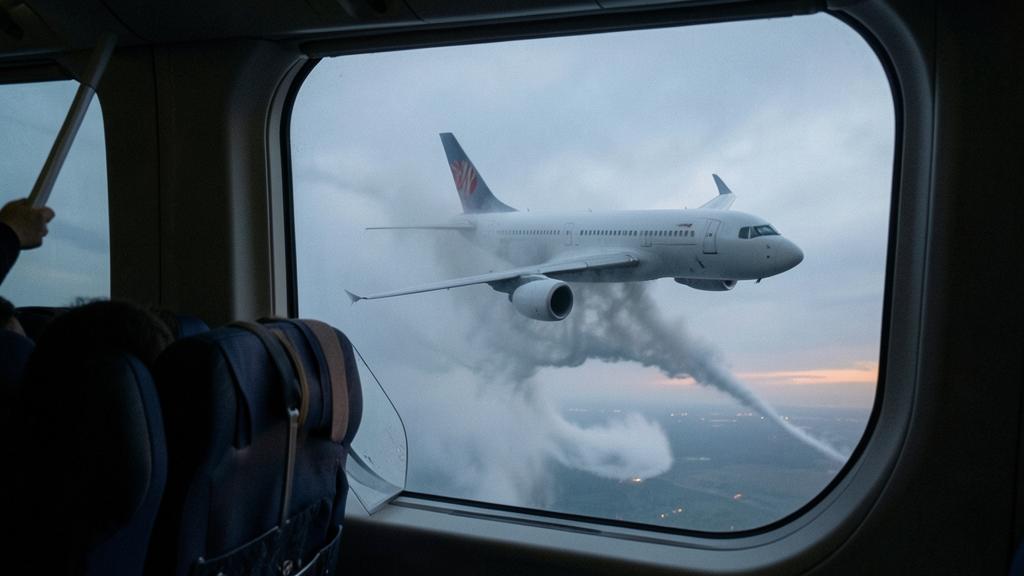
The encounter then changes nature. On approach, one follows; in cruise, one crosses. The crossing angle is arbitrary, the duration of the event is counted in seconds, and there is no warning: neither the weather radar nor the collision avoidance system sees a vortex. The only available indicator is a known, heavier traffic at the higher level, on a crossing or converging route — i.e., information that the crew already has and almost never exploits as a wake signal.
| Item | Encounter on approach | Encounter in cruise |
|---|---|---|
| Position relative | Follower on the same track, behind | Crossing or converging, at another level |
| Vecteur dominant | The pair descends below the glide path | The pair descends through the vertical separation band |
| Timescale involved | Tens of seconds to a few minutes | Two to three minutes, sometimes more |
| Dissipation | Fast: mixed air, configuration extended, ground effect | Slow: stable air, clean wing, little turbulence |
| Protection | Separation minima applied by ATC | No dedicated minimum; lateral offset and seat belts |
| Signal disponible | Category of the preceding aircraft, announced | Traffic above displayed, never interpreted as such |
| Consequence feared | Roll at low height, runway excursion | Injury in the cabin, level deviation, over-control |
The usable mitigation is therefore not separation, it is offset. Moving out of the vertical plane in which the wake descends by about one nautical mile is enough to change the geometry, where airspace and published procedures allow it. The strategic lateral offset procedure in oceanic airspace has been doing this for a long time, for other reasons; the wake benefit is a perfectly real side effect, and several European safety recommendations take up this principle for en-route encounters.
Recognize the encounter, and do not worsen it
The signature is distinguished from clear-air turbulence. The latter builds up, settles, and subsides; the wake encounter starts and ends sharply. It often occurs in two stages — one vortex, then the other — with a roll rate unrelated to the surrounding agitation, sometimes a structural clap, then nothing. A crew that mistakes it for turbulence will file an unusable report; the one that identifies it provides the most missing element to databases: the level, time, offset, and type of the higher traffic.
The response is simple: return to pitch and roll attitude without overcontrolling. The danger in the following second is no longer the vortex, it is the control input. Successive rudder reversals build up loads on the fin that certification never promised to withstand in cumulative terms: the maneuvering limit is guaranteed for a single action, not for a round trip. As for the autopilot, several major manufacturers’ documentation acknowledges that it can remain engaged; the reflexive disconnect turns a three-second incident into manual flying in cold turbulence that has just ceased.
The right reflex. Before crossing a heavier traffic at the higher level, treat it as a known weather phenomenon: illuminated sign, cabin seated, service suspended during the crossing, and lateral offset if the applicable procedure allows it. This is the only window where a decision still has an effect — during the encounter, only the control surface inputs remain.
In the cabin, the event is over before an announcement can be made. No protection is available during: the only one that counts is prior. The injuries recorded during these encounters concern mainly people standing or unbuckled, and the service in progress at the time of the crossing. An operator can perfectly include in its instructions the illumination of the seatbelt sign when approaching a crossing with a large aircraft from the higher level: the measure costs nothing and depends on no equipment.
What to check before the next sector
Three concrete checks, to be done in your own documentation rather than in an article. The first: does your operator apply the European recategorization on its main bases, and what does this change for your type, both in generation and reception? An aircraft that changes class sees its minima move in both directions, and the operations manual reflects this. The second: what lateral offsets do your airspaces actually authorize, and in what form must they be requested or applied? The answer varies by region and by route status. The third: what does the manufacturer’s documentation say exactly about the procedure in case of wake encounter, particularly regarding the rudder and the autopilot? The wording varies from one manufacturer to another, and it is the one that prevails when the report is reviewed.
There remains a gray area that is better named: there is no separation standard for the en-route encounter. The state of the art is limited to prevention — offset, seatbelts, reading of higher traffic — and the report, without which the only available statistic on these encounters will remain that of cabin injuries. For those preparing a type rating or technical interview, the question is never the table of minima, which is found in thirty seconds: it is the reason why the same pair of aircraft gives an answer on approach and no answer in cruise. The exchanges of the professional community FL330 actually revolve more often around this geometry than around the standard itself.
On all these points, the applicable text, the procedures of the relevant air traffic service, and the approved documentation of the operator prevail over this article, which only exposes the physical mechanism and its operational use.


Leave a Reply
You must be logged in to post a comment.