
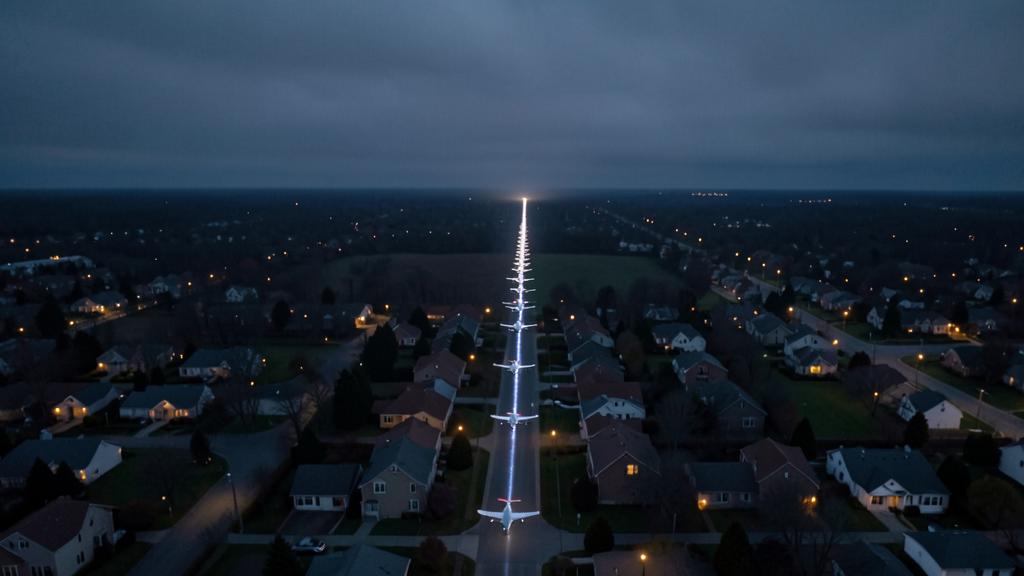
A neighborhood that only received part of the departures now receives all of them, and its neighbor a bit further away no longer hears any. No trajectory has been moved: they have simply stopped dispersing. The transition to performance-based navigation does not change the number of movements or the noise emitted by each aircraft; it changes the law of distribution of ground tracks. It is this law, much more than the decibel, that triggers complaints and contestation of the procedure.
Navigation precision crushes the lateral distribution
Under conventional navigation, the width of the overflown zone was not a defect, but a sum. A radial widens geometrically with the distance from the beacon. The drift correction was calculated and then maintained by the crew, with its own dispersion. The anticipation of the heading change depended on each pilot’s technique, and radar guidance added the variability of the controller and that of the current traffic. These sources are independent of each other, and their composition produced a wide, approximately bell-shaped distribution on the ground, whose extremes could extend several miles on either side of the nominal route.
Performance-based navigation eliminates these terms one by one. The trajectory is no longer a direction from a point, but a sequence of positions; drift is calculated continuously; the turn is coded, with its anticipation or radius; the autopilot maintains the lateral track. What remains, the navigation system error and the flight technical error, is small and above all bounded: it is the very object of the navigation specification to which the procedure conforms.
The consequence on the ground is arithmetic. The area under the density curve does not move, since the number of movements does not move; the base narrows, so the peak increases. The sought-after gain was elsewhere: obstacle clearance, capacity, regularity, fuel. The redistribution of noise comes with it, as a by-product, and is most often discovered during commissioning, when the consultation is closed.
Performance-based navigation makes aircraft fly more precisely along the same path, so noise that was spread out over a wider area now hits fewer places but harder. The total noise doesn’t change, but it’s more concentrated.
At Paris Charles de Gaulle, switching to performance-based navigation for departures on runway 27L concentrated noise over a 1km-wide strip instead of the previous 3km spread. A suburb 2km from the runway saw overflights drop from 20% to 0%, while a town 1.5km away went from 50% to 100% overflights.
The turn is the variable, not the straight segment
One must be precise about where the dispersion was located. In a straight segment near a beacon, the trajectories were already relatively grouped; the dispersion came from the changes of direction. A fly-by turn is flown by anticipating the turning point, and the radius described depends on the true airspeed and the bank angle used: it grows as the square of the speed. Two aircraft following the same coded procedure, one at reduced maneuvering speed, the other kept at high speed by an ATC instruction or pushed by a tailwind in the turn, do not overfly the same streets.
A segment with a fixed radius eliminates this variable. The radius becomes an attribute of the procedure, the system maintains the arc by adjusting the bank angle, and the ground track becomes repeatable in the turn as it is in the straight line. This is the tool that allows bypassing a sensitive area with an expressible guarantee, the same as was presented in the consultation. It is also, for exactly the same reason, the mechanism that shifts all tracks to the ground strip under the arc.
This leads to a counterintuitive property: the best way to save a neighborhood is also the best way to burden another. Coding the turn is not a detail that is adjusted afterward; it is the most significant decision in terms of exposure in the procedure, and it is taken before the first public meeting.
Energy does not disappear, and the indicators do not see it the same way
The noise of an overflight is described with several quantities that do not answer the same question. The energy-weighted average over a period, weighted for the evening and night, groups everything that happened. The maximum level of an event describes a passage. The number of events exceeding a threshold describes the frequency of interruptions. The duration of the rest periods describes what is available between two. Confusing these quantities is enough to make a file incomprehensible to those reading it from their garden.
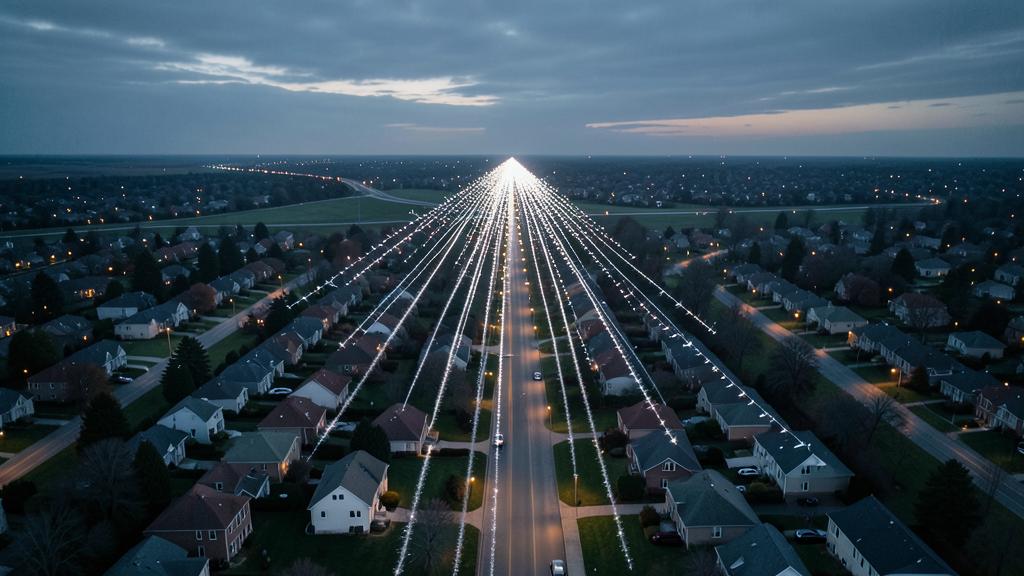
The energy-weighted average behaves like the logarithm of the number of events. Doubling the number of tracks on a route adds three decibels; grouping three trajectories into one adds approximately five. Conversely, it is necessary to halve the traffic to subtract three, and no alternation device with two routes does better under each of the two, at the cost of exposing both.
However, it is not the average that describes the resident. Under a concentrated route, the maximum level of each passage hardly changes: same fleet, same profile, same altitude. On the other hand, the number of events multiplies and the quiet periods disappear. The quantity that changes the most is the one that the energy-weighted average compresses most. At the same time, the area delimited by the exposure contours actually decreases, and it is this figure that appears in the balance presented. The two statements are simultaneously true: fewer people exposed, but a heavier burden for those who remain underneath.
This is aggravated by a well-identified effect in the literature on exposure change: at a similar level, a newly overflown population reacts more strongly than a population that has been exposed for a long time, and the reaction decreases slowly. The benefit of the winners is silent, the loss of the losers is noisy, and the perceived balance is durably worse than the calculated balance.
When flights become more concentrated, the noise at points under the track rises with the number of flights: doubling the number of flights adds about 3 dB to the average noise level. Each overflight is no louder, but it comes far more often. This means that while fewer people hear the planes, those who do hear them much more frequently, and are much more bothered.
| Indicator | What it makes visible | What it hides | Effect of shifting traffic to the route |
|---|---|---|---|
| Energy-weighted average over a period | Overall exposure, the area of the curves, the comparison between years | The distribution of events within the period | Exposed area decreasing, local value increasing approximately three decibels per doubling |
| Maximum level of an event | The intensity of an isolated passage, the instantaneous annoyance | The number of tracks | Almost unaltered under the retained route |
| Number of events above a threshold | The frequency of conversation or sleep interruptions | The intensity of each | Increases in proportion to the displaced traffic |
| Duration and regularity of rest periods | What is available between two tracks, and its predictability | Accumulated exposure during the year | It collapses under the retained route, appears elsewhere |
The vertical profile decides the closeness, the route decides the distance
Two families of noise abatement departure procedures coexist, and they do not target the same residents. The first reduces thrust at a low altitude and delays acceleration as well as the retraction of high-lift devices: the aircraft passes higher over the first kilometers, at the cost of keeping the drag longer. The second accelerates and cleans up early, then reduces thrust once the aircraft is clean: it passes lower over nearby residents, but higher and with less thrust over distant ones.
Neither is the « quietest. » Each shifts the footprint along the runway axis, and the point where the two profiles cross determines who wins and who loses. Its position depends on the mass, configuration, and altitude selected for thrust reduction: therefore, it is not the same for a heavy long-haul aircraft on takeoff and for a light medium-haul aircraft. The choice belongs to the operator’s documentation, sometimes imposed by the State at a given aerodrome, and must be read in light of the population map rather than the company’s habit.
At Amsterdam Schiphol, a Boeing 777 using early acceleration passes 2,000ft over a suburb 5nm from the runway but 3,500ft over a town 10nm away. The same aircraft with delayed acceleration passes 2,500ft over the suburb and 3,000ft over the town. The crossing point is at 7.5nm from the runway for this aircraft type.
The combination of the two effects explains the geography of complaints better than each one separately. The vertical profile sets the amount of energy reaching the ground in the first kilometers; the lateral track sets who receives it. Municipalities located under the turn often combine both: close enough for altitude to still matter, far enough for the geometry of the turn to have already separated the trajectories, or grouped them.
On arrival, the logic is partially reversed. Thrust is low, a significant part of the noise is aerodynamic, and the main levers become maintaining altitude, late extension of the landing gear, and clean configuration. A continuous descent keeps the aircraft higher for longer and eliminates level-offs; it requires a predictable trajectory and, therefore, fits poorly with dispersion schemes that depend on the tactical intervention of the controller.
Dispersion strategies and their cost
Once it is accepted that the total energy does not move, five levers remain, which are not equal in effect or cost. The first is deliberate concentration in a strip chosen for its low population: an industrial valley, a river, a highway corridor. This is, by far, the best response when geography allows it, and it rarely allows it where the turn must be made.
The second is the published route fan, alternated according to an announced schedule. Its value does not lie in randomness, but in the predictability of rest: knowing that one is overflown one week out of three, and which, is better than a random dispersion of the same average. It requires as many designs as routes, each compatible with arrivals and with each other, and complicates the publication as well as the crew training.
The third is the alternation of runways or configurations, which changes who is overflown without changing how many, but depends on the wind and capacity during peak hours. The fourth is the deliberate widening of the design: fly-by turn instead of fixed radius, no speed restrictions, which restores dispersion but abandons the containment guarantee, and therefore the very argument that had made the procedure acceptable. The fifth is maintaining radar vectoring on a segment: maximum dispersion, at the cost of workload, unpredictability, and continuous descent.
| Lever | Effect on ground distribution | Operational cost | Compatibility with continuous descent |
|---|---|---|---|
| Optimized single route, fixed-radius turns | Maximum concentration, guaranteed bypassing of selected areas | Null, or even favorable for fuel | Total |
| Fan of routes alternated according to an announced schedule | Scheduled rest for each group, affected population expanded | Multiplied designs, coordination with arrivals | Good if each route is designed for it |
| Alternation of runways or configurations | Changes who is overflown, not the quantity | Subordinate to wind, aids, and capacity | Good |
| Voluntary widening of the design | Restored dispersion, essentially in turns | Loss of the confinement guarantee | Good |
| Radar guidance maintained in a segment | Maximum dispersion, not reproducible from one day to the next | Workload, unpredictability, extensions | Low |
What the crew really changes, and what it does not
The crew does not choose the route: it chooses its degree of compliance, and only three levers are really in its hands. The first is the speed maintained in a turn that is not protected by any coded radius, since it sets the radius described and, therefore, the streets overflown. The second is the noise abatement procedure applied on takeoff, when the operator’s documentation authorizes more than one for the day’s runway. The third is the acceptance of a shortcut or vectors offered by the controller: the aircraft then leaves the trajectory that was evaluated and published, and shifts the overflight to residents that the file does not mention and who, therefore, have never been counted.
The trap. A speed instruction is a lateral instruction. In a fly-by turn, the radius grows as the square of the true airspeed: accepting a high speed at the start of the turn shifts the ground track outward, by several hundred meters for a common speed deviation, and nothing in the cockpit signals it. The lateral navigation mode remains engaged, the procedure is « followed, » the deviation only appears in the analysis of the trajectories, on the side of the aerodrome operator and the airline, several weeks later, in the form of a widening of the strip that no one knows how to attribute.
The comparison between the flown trajectory and the published one has become a common piece of data, produced by aerodrome tracking systems and presented to local committees. It measures what the crew does not perceive: the cockpit has no ground reference during an instrument turn, and even less a map of the houses.
The good reflex. Know, among your usual departures, which ones include fixed-radius segments and which ones depend on a fly-by turn. In the latter, treat any speed instruction in the turn as a trajectory modification: announce it, or announce that you are unable, instead of absorbing it in the bank angle. And verify which noise abatement procedure applies to the day’s runway instead of carrying over the one from the previous day.
What is not resolved, and what to verify at home
The fundamental disagreement is about the metric and is not about to be resolved. An annual energy-weighted average cannot represent a rest schedule; a count of events cannot compare two populations of different sizes. No one has an accepted rule to arbitrate between a device that halves the number of people exposed and a device that halves the number of events suffered by a smaller group. As long as this is missing, the arbitration remains political, and the exchanges between aviation professionals show that the same procedure is defended and attacked there with the same figures.
The asymmetry of the consultation continues. Concentration produces a small, identifiable, strongly affected, and therefore organized group; dispersion produces a large, diffuse, moderately affected, and therefore silent group until the first passage. A technically superior design can fail for this alone, and a file that only presents the area of the exposure curves deprives itself of any means of response.
In your own documentation, four points deserve a check that takes a few minutes and avoids unnecessary discussions. Which departures from your base include fixed-radius segments and which depend on turn anticipation. What speeds the design assumes, and whether they appear as restrictions or as assumptions. Which noise abatement procedure is applied runway by runway, and whether it is the company’s standard or a State requirement. Finally, what trajectory tracking feedback your operator receives, and who reads it.
For those preparing a qualification, the topic has quietly changed status. Turn coding is no longer a curiosity reserved for procedure design offices: it is a trajectory feature that one must know how to read on a chart, and whose effect must be anticipated when the speed changes. The environmental dimension is not assessed as such; it is already incorporated into the procedures that are applied.
None of the above replaces the text. The applicable specifications, the State’s Aeronautical Information Publication, and the operator’s approved documentation take precedence over this article, even when they impose a profile or trajectory that the general analysis would not recommend.


Leave a Reply
You must be logged in to post a comment.