
A short radar vector, a runway change announced a few miles from the field, and suddenly four hands are on the keypad while the aircraft calmly continues toward a point that no longer has any reason to exist. The question is not whether automation is useful: it holds a flight path better than anyone can, and for longer. The question is at what point it stops paying off, exactly what needs to be disconnected, and how to keep available the skill that is no longer being used.
What Automation Buys, and What You Pay for It
An automatic guidance system buys three things, and it buys them well: a holding precision that no one can match by hand over time, an endurance that does not flag at the end of a duty day, and a stable flight path while the crew looks elsewhere. None of this is debatable, and no argument about manual flying holds up if it begins by denying these three gains.
The bill, however, comes in two lines. The first is the reconfiguration delay: between the moment the desired flight path changes and the moment the machine executes it, someone has to enter it, and during that time the aircraft still follows the old instruction. The second line is the verification cost, which never falls to zero: every action on an automated system produces two tasks, the entry itself and the check that this entry actually produced the expected mode. The second is commonly forgotten, and it is the one that turns an innocuous change into a surprise a few dozen seconds later.
These two lines share a property that decides everything: they grow with the scale of the requested change. Changing a target altitude costs one action and one glance. Rebuilding an arrival, changing runway, inserting a hold, restoring a speed constraint and then checking that the sequence has chained correctly costs an order of magnitude more, and it is paid for in attention taken away from monitoring the actual flight path.
The cost of taking back manual control, on the other hand, is roughly constant. Disconnecting, selecting a heading, selecting a speed, holding it: the action is the same whether the change is minor or complete. Two curves, one nearly flat and the other rising in steps, are bound to cross at some point. The whole skill lies in knowing which side of that crossing you are on, and knowing it before you have started typing.
Automation is great for holding a steady flight path, but it gets slower when you ask it to make big changes. Manually flying is faster for quick adjustments, but you have to know when to switch.
An A320 is vectored for a runway change 10 miles out. The crew must reprogram the FMS, which takes 30 seconds. Meanwhile, the aircraft continues on the old flight path, risking overshooting. Switching to manual heading and speed selection takes 5 seconds and avoids the issue.
This crossing says nothing about the quality of the automated systems. It does not claim that the machine is bad; it merely observes that it is slow to receive complex instructions, and that the resource lacking on approach is never precision, but time.
The Four Configurations Where the Balance Tips
They are recognizable by different signs, and it is better to have named them beforehand, with a clear head.
The Late Change
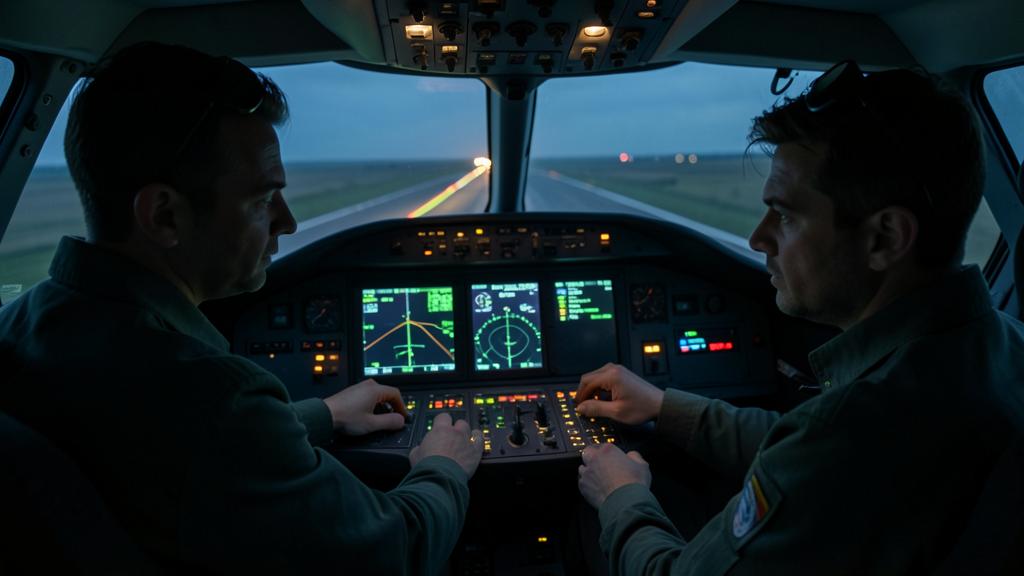
A short vector, a runway change at the interception, a shortcut accepted before gauging what it implies in terms of energy. The common thread in these situations is a sharp gap between the programmed flight path and the desired one, with little time ahead. This is the most frequent case, and the simplest to settle: there is no time for the box to be reset properly, so simple modes are selected and the crew flies.
The Mode Surprise
The aircraft does something that does not match the intention, or it does it without anyone understanding why. The rule here allows no nuance: an automated system is not diagnosed by letting it keep flying. The time needed to understand is indeterminate; the flight path is not. The flight path is recovered first, understood afterward — the reverse order has produced a considerable number of events, and not only among inexperienced crews.
Degradation
Loss of a data source, a discordant sensor, a degraded control law, partially lost protections. The trap is that the automated system can remain engaged while relying on faulty data, or disconnect without the cause being apparent. The right question is not « can it be re-engaged, » it is « what information is it working from now. » Until that answer is established, the level of automation is chosen on the low side.
High Monitoring Load
Storm avoidance, terrain, dense traffic, a short and contaminated runway. This case is more subtle than the other three, because automation remains valuable for holding the flight path: what becomes costly is not letting it fly, but manipulating it. The right compromise here is almost always an intermediate one — the machine holds the aircraft, but the crew stops talking to it through the flight plan and only talks to it through simple, immediately readable modes.
| Configuration | Revealing sign | What the automated system still does well | What it then costs | Default decision |
|---|---|---|---|---|
| Late change | Sharp gap between the programmed flight path and the desired one | Holding the current flight path, which is no longer the right one | The entry time, taken from monitoring | Simple modes selected, or hand-flying, then entry afterward |
| Mode surprise | Observed behavior does not match intention | Nothing reliable, since the intention is not the one believed | An unbounded time to understand | Immediate return to manual control, diagnosis afterward |
| Degradation | Unexplained disconnection, discordant source, reduced protections | Sometimes a lot, sometimes nothing: impossible to settle quickly | Unverified trust in questionable data | Step down one level and only go back up after verification |
| High monitoring load | Flight path held, but attention entirely outside | Fine holding, endurance, stability | Every manipulation, not the flying itself | Keep the automated system, but in simple modes |
These four lines come down to three questions, and the order in which they are asked matters as much as the answers.
Disconnecting Is Not a Switch, It Is a Ladder
The word « disconnect » sustains a confusion that helps no one. Between a flight path fully managed from the flight plan and manual flying with no guidance at all, there are at least two intermediate rungs: selected modes, where the crew sets a heading, a speed, an altitude, and following the flight director without the autopilot. The skill to acquire is not jumping straight to the bottom of the ladder, it is stepping down one rung, and knowing which one.
One rule dominates all others here: consistency between what your hands are doing and what the bars are commanding. Hand-flying while following a flight director executing a mode nobody chose amounts to adding an intermediary instead of removing one. Only two configurations are clean. Either you select the mode that matches exactly what you want, and you follow the bars. Or you remove the bars, and you fly on raw parameters. Any intermediate position creates a silent conflict between two pilots, one of whom is not speaking.
The second point of vigilance concerns thrust. Disconnecting the autopilot while leaving the autothrottle engaged in a mode that does not control speed — a reduced-thrust descent, for instance — creates a situation where no one is minding energy anymore: not the pilot, who believes the throttle is active, nor the system, which is executing exactly what it was told. The physical position of the thrust levers tells you nothing; only the control mode decides.
The trap. Taking back manual control without addressing the rest of the chain: flight director left displayed on an old mode, autothrottle in a mode that does not hold speed, target altitude left at the previous value. The crew has the impression of having simplified things, when in fact they have just created three independent sources of commands. The classic symptom arrives a minute later: speed drifts, and no one feels responsible for catching it.
The right reflex. Announce the level selected, out loud, in three parts: what remains engaged, what is disconnected, and what is expected of the other pilot. « Autopilot off, flight director removed, hand-flying: call out the speeds for me and keep the radio. » The call turns a personal choice into a crew task, and it makes it impossible for one pilot to not know who is commanding what.
Manual Flying Skill Is Perishable, and Not as a Single Block
It is often repeated that manual flying is a perishable skill. That is true, but the phrase hides what matters most: the components of this skill do not erode at the same rate, and it is not the one people assume that fades first.
The inner loop — control feel, pitch and bank attitude holding, coordination — degrades slowly and comes back quickly. A few minutes of flying are usually enough to recover it, and that is exactly why it reassures wrongly: a crew that disconnects after a long period without manual flying holds the track adequately, and concludes from this that everything is fine.
The flight-path and energy loop erodes much faster. Knowing where the speed will be in twenty seconds given the configuration, the slope, and the drag about to be added is a mental model that is maintained through practice and lost silently. And the third component, the most fragile one, is not flying in the strict sense: it is the instrument scan and task-sharing without automation. It shows up through indirect symptoms — talk becomes sparser, the chart is no longer read, radio calls are missed, and questions from air traffic control draw short, delayed answers.
The practical consequence is often misunderstood. When a pilot takes back manual control, the workload is not transferred to the aircraft: it is transferred to the other pilot, who inherits the radio, parameter monitoring, and sometimes navigation. A manual-flying exercise decided without saying so is therefore a decision that commits someone else, and that is exactly why it must be announced.
The honest measure of the skill is not « is the track held. » It is: is the track held while listening to the frequency, anticipating the next configuration, and answering a question. It is residual capacity, not precision, that distinguishes a skill being maintained from one that is fading out.
Where to Practice, Without Borrowing Against Flight Safety
Maintaining the skill requires choosing a moment, and that choice follows simple criteria. On the favorable side: a short, legible flight path, conditions well above minima, a familiar aerodrome, no tight level or speed constraint, a rested crew, a monitoring pilot available and briefed, aircraft in nominal configuration. On the unfavorable side: airspace where altitude keeping is tightly constrained, performance-based navigation with a precision requirement, a barometric vertical-guidance approach in very low temperatures, storm avoidance, a demanding aerodrome, and above all a monitoring pilot already occupied with something else.
One criterion deserves to be singled out, because it is the one most often forgotten: the phase of flight. Manual flying is maintained during initial climb and approach, where the flight path is short and the loop closes quickly. It is not maintained in cruise, where fine holding over time teaches nothing, tires a great deal, and disturbs others.
The type of operation shifts the problem entirely. On short, repeated sectors, opportunities abound, but each one falls in a dense phase, between two frequencies and under sequencing constraints: the difficulty is not finding the opportunity, it is declining it on the days when the workload does not allow for it, and that decision requires a criterion announced in advance rather than a judgment call made in flight. On long sectors, the balance reverses: a handful of takeoffs and approaches per month, often at the end of a night flight and at rarely visited airports, that is, at precisely the moment when the conditions for useful practice are least met. In this second case, the opportunity is not seized, it is prepared: the choice is made at the briefing, together with the task-sharing, not at the moment the aircraft arrives in descent.
Climbing back up the ladder deserves the same care as descending it. Re-engaging cleanly requires first selecting the desired targets, then engaging, then checking what the mode annunciator announces — in that order, not the reverse. A re-engagement done out of sequence reproduces exactly the surprise one was trying to avoid, with the added fatigue accumulated from the manual-control period.
What Is Left to Check at Your Operator
Three documents concretely decide what you are entitled to do, and they do not all say the same thing. The operations manual carries a policy on the use of automation: it almost always exists, it is rarely re-read, and it is worth checking whether it is written as a prohibition with exceptions or as an encouragement with conditions. These two forms of wording produce opposite crew cultures. The manufacturer’s manual, next, sets minimum automation levels for certain operations and certain failures, as well as the conditions for disconnection: that is where, and nowhere else, the technical limits are found. The standard operating procedures, finally, define the callouts to be made on a mode change — a point often treated as a formality, when it constitutes the only verifiable trace of the decision.
For those preparing a type rating or a simulator check, the shift is clear: the session does not evaluate the ability to hold a track, which is assumed to be acquired. It observes the timing of the decision, the callout that accompanies it, and the consistency of the configuration chosen. A candidate who fights a stubborn automated system loses more than one who steps down a level early and flies cleanly, even with somewhat lower precision. Those preparing for this type of milestone will find dedicated scenarios in the preparation modules devoted to automation management.
One gray area remains that nobody really settles: returning to automation after a manual takeover in a degraded situation. The texts say when to disconnect, rarely when to re-engage, and the decision then rests entirely on the crew’s reading of the system’s state. This is probably the most useful topic to bring up in a debrief session, or in exchanges between crews on the professional forum, because it is not something that can be taught through a rule.
The applicable regulations, the manufacturer’s operating manual, and the operator’s approved documentation take precedence over the above: this article explains mechanisms, it does not replace any procedure and does not constitute an operating instruction.
Questions fréquentes
At what point is it better to disconnect rather than reprogram?
The tipping point occurs when the time needed to enter the new flight path exceeds the time available before the action. The cost of taking back manual control is roughly constant, while the cost of data entry grows with the number of elements to change and verify. The practical test is to count, before starting, the pages to open and the validations to check: as soon as several of these have to be chained together on approach, it is almost always faster to select a heading and a speed, then rebuild the flight path once the aircraft is stabilized on the correct route.
Should the flight director be turned off when hand-flying?
Only two configurations are consistent. Either the mode displayed matches the intention exactly and the bars are followed, or the bars are removed and the aircraft is flown on raw parameters. Following a flight director executing a mode nobody chose adds an intermediary instead of removing one, and it is a classic source of divergence between intention and the actual flight path.
What happens to the autothrottle when the autopilot is disconnected?
It remains a system in its own right and keeps executing the mode it is in, which does not always control speed. The physical position of the thrust levers tells you nothing: only the control mode decides the thrust. Thrust must therefore be explicitly settled at the moment of taking back manual control, and announced, otherwise energy is monitored by no one.
How often should you hand-fly to avoid losing the skill?
No universal interval is fixed, and the useful rhythm depends on the type of operation and the length of the sectors. The operational benchmark lies elsewhere: the component that erodes first is not control feel but instrument scan and energy management. Regular, short practice, during initial climb and approach in good conditions, maintains the skill better than long, widely spaced sessions.
Is manual flying seen as a flaw during a check?
No, provided it is decided, announced, and consistent. What is evaluated in the session is not holding precision, which is assumed to be acquired, but the timing of the decision, the callout made to the monitoring pilot, and the configuration chosen. A candidate who persists with a stubborn automated system is judged more harshly than one who steps down a level early and flies cleanly.
Can manual flying be maintained in cruise?
It is the worst time to do it. Fine holding over time teaches almost nothing, it is tiring, and it often takes place in airspace where altitude-keeping precision is tightly constrained. The useful phases are initial climb and approach, where the decision loop closes quickly and energy management is genuinely exercised.


Leave a Reply
You must be logged in to post a comment.