
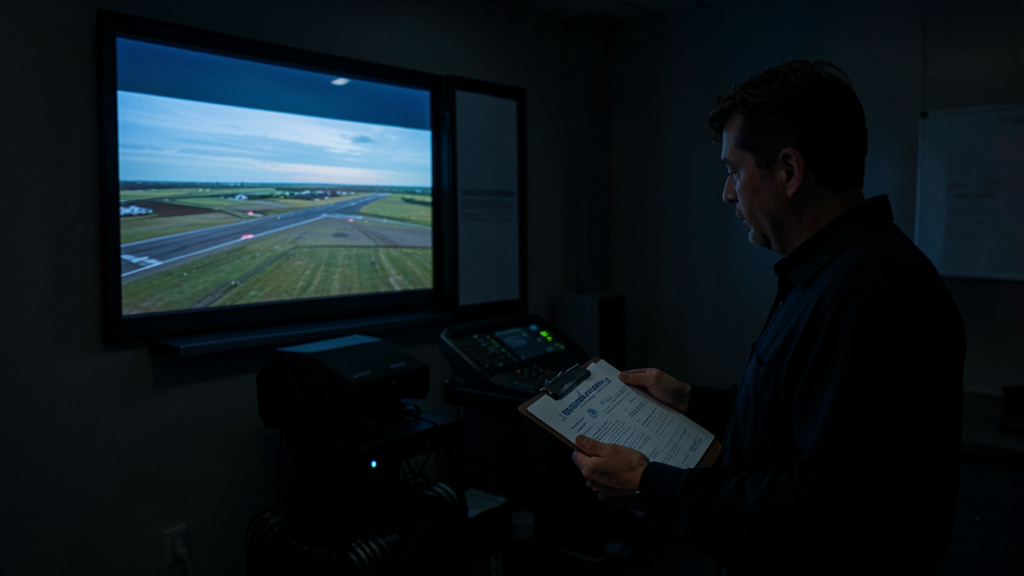
A training device is judged on a certificate, not on an impression. Every instructor has met the fixed-base rig with a wraparound visual that leaves candidates convinced they have flown, and the plain, unglamorous full flight simulator that quietly carries an entire type rating. The difference is not the quality of the illusion; it is what an authority has agreed the device may be used to prove. Understanding that boundary is what stops an operator from buying training hours that credit nothing, and what stops a candidate from arriving at a check with a logbook the examiner cannot accept.
Two signatures, and only the second one credits anything
There are two entirely separate acts, and conflating them is the origin of most disputes about training credit.
The first is qualification. An authority evaluates the device itself — its fidelity against the aeroplane it represents, its handling qualities, its systems logic, its visual and, where applicable, its motion cueing — and issues a qualification certificate naming an aircraft type, a level, and any restrictions. This says what the machine is.
The second is approval of use. A training organisation or an operator holds an approved training programme, and that programme states which exercises are conducted on which device. An authority approves that programme. This says what the machine may be used for, by whom, and for which course.
A device can be fully qualified and still credit nothing for you, because your organisation’s approval does not list it, or because the course you are running requires a feature the certificate restricts. Conversely, no amount of programme approval can push a device above the credits its qualification level allows. Both signatures are necessary; neither is sufficient.
The trap. Booking on the basis of the manufacturer’s brochure level rather than the certificate on the wall. Brochures describe the device as designed and as best configured. The certificate describes it as evaluated, for a named aircraft variant, sometimes with restrictions that were added after an evaluation finding. Only the second document travels to the examiner.
A simulator must be both qualified (certified as accurate) and approved (allowed for specific training) to count. Just because it looks real doesn’t mean it’s accepted for official training.
An A320 simulator qualified for the A320neo variant but missing the latest avionics update won’t credit training for pilots flying the updated fleet. The certificate must match the aircraft exactly.
The families, and what actually separates them
Nomenclature differs between regulatory systems, but the underlying ladder is recognisable everywhere. At the bottom sit devices that reproduce a cockpit environment generically, useful for procedures and instrument flying but tied to no specific aeroplane. In the middle sit type-representative devices with real or faithfully simulated systems but limited or no motion and reduced visual capability. At the top sit full flight simulators: type-specific, with a full systems model, a wide collimated visual system, motion cueing, and sound and vibration modelled against measured aeroplane data.
| Family | What it reproduces | Typical credit ceiling |
|---|---|---|
| Basic and advanced training devices, part-task trainers | Generic instrumentation, a systems panel, or one subsystem in isolation | Instrument time and procedural practice within limits set by the licensing rules; no type-specific credit |
| Flight and navigation procedures trainers | A generic class of aeroplane, single or multi-engine, sometimes with a crew environment | Instrument rating training, multi-crew cooperation, portions of a skill test where the rules allow |
| Flight training devices | A specific type’s flight deck and systems, fixed base, visual optional or limited | Systems and procedures training, some checking items, part of a type rating course |
| Full flight simulators, lower levels | The specific type with motion and visual, but reduced cueing fidelity | Most type rating training and recurrent items; not the credits reserved for the upper levels |
| Full flight simulators, upper levels | The specific type and variant, full motion, wide collimated visual, modelled sound and buffet | Complete type rating training and checking, and the credits that can remove flying from the aeroplane entirely |
What separates the levels is not a single feature but a bundle: the extent of the validation data package, the field of view and quality of the visual system, the number and quality of motion degrees of freedom, sound and vibration modelling, and the number of objective tests the device must pass within stated tolerances. The exact values differ between authorities and between the aeroplane and rotorcraft standards, and they are stated in the applicable qualification standard rather than being universal figures.
Where fidelity actually costs money
Three cost drivers explain almost every price difference between devices, and none of them is the part the visitor notices.
- The first is the data package. A type-specific device is qualified against measured aeroplane data — flight test results, engineering simulation data, and manufacturer-supplied performance and handling information — assembled into a qualification test guide, with objective tests run and their results compared against that data inside defined tolerances. Access to that data package is commercial, negotiated with the type certificate holder, and it is frequently the single largest barrier to building a high-level device for a given type.
- The second is the visual system, and specifically collimation. Displaying a convincing image is inexpensive; presenting it so that both pilots see the same external scene at effectively infinite distance, without parallax between seats, is not. That is what makes visual cueing usable for landing judgement rather than merely atmospheric.
- The third is motion, which is also the most argued about. The training benefit of full motion platforms for airline-type recurrent training has been questioned by research for years; regulators nonetheless require motion cueing at the upper levels, and the standards specify how it must be evaluated. An operator does not get to arbitrate that debate — the certificate does.
The credits that only the top of the ladder unlocks
Most training can be conducted on mid-level devices. A small number of credits cannot, and those are the ones that change an operator’s economics, because they replace aeroplane hours.
| Credit sought | Device generally required | Additional conditions typically attached |
|---|---|---|
| Procedures, systems, flows, checklist discipline | Flight training device or better | Device listed in the approved training programme |
| Instrument flying and instrument rating training | Procedures trainer or better, per the licensing rules | Caps on how much of the course may be conducted on the device |
| Type rating training and the associated checking | Type-specific device, with the higher items on a full flight simulator | Course approved for that type and variant |
| Recurrent training and proficiency checks | Full flight simulator for most items | Alternating programme requirements set by the operating rules |
| Low visibility operations training and checking | Full flight simulator with the relevant visual and, where required, specific qualification for the operation | Operator approval for the operation itself |
| Take-off and landing recency | Full flight simulator qualified for the type, where the applicable rule allows it | The rules state a number of take-offs and landings in a rolling period, commonly three in ninety days |
| Zero flight time type rating conversion | Full flight simulator at the upper qualification levels, with the visual capability the rule demands | Operator and candidate experience conditions, and line flying under supervision afterwards |
| Upset prevention and recovery training | Device with the additional qualification features for the extended envelope | Instructor qualification, and awareness of the device’s validity limits outside the tested envelope |
The pattern is consistent: the closer a credit comes to replacing real flight, the higher the device level and the more conditions attached outside the device itself. Zero flight time conversion is the extreme case — it removes the aeroplane from the type rating entirely, and every authority that allows it surrounds it with experience prerequisites and supervised line flying.
Why a spectacular device can credit nothing
Five situations produce a device that impresses everyone in the room and satisfies no examiner.
It was never qualified. High-end commercial devices built for familiarisation, marketing, or entertainment are genuinely capable and entirely outside the framework. They can be excellent for exposure and for building comfort; they generate no credit.
It is qualified for the wrong variant. A qualification certificate names an aircraft type and usually a variant and configuration standard. An avionics or engine variant difference within the same type can put a candidate’s training outside the certificate. This is a live problem for fleets going through a flight deck upgrade: the aeroplane changes before the device does.
Its configuration has drifted. A device that no longer matches the aeroplane standard it was qualified against — because a modification was embodied in the fleet and not in the simulator — has a defect against its own baseline, and the operator’s exposure grows with every course run on it.
It sits outside your organisation’s approval. A device qualified in another State, or belonging to another organisation, may need the accepting authority’s agreement and must appear in your approved programme before hours on it count.
The exercise flown is outside its validity. Every model has an envelope in which it was validated against data. Beyond that, it still computes something, convincingly, and the behaviour may be wrong. This matters most for stall, deep upset, and extreme configurations, which is exactly why extended envelope training rests on additional qualification features rather than on new lesson plans alone.
The right reflex. Before booking a course, ask for a copy of the qualification certificate and read three lines: the aircraft type and variant, the level, and the restrictions section. Then check that your organisation’s approved programme names that device. Two minutes with those two documents has saved more courses than any amount of technical checking.
Reading the certificate before you book
A qualification certificate is short and almost entirely load-bearing. Each line answers a question that will otherwise be asked at the worst moment.
| Line | What it decides |
|---|---|
| Aircraft type and variant | Whether the training is type-specific for your fleet, or merely similar |
| Qualification level | The ceiling of credits available, whatever the training programme says |
| Configuration or build standard | Whether the flight deck a candidate trains on matches the one they will fly |
| Restrictions and limitations | Exercises excluded following an evaluation finding; these are the surprises |
| Date of the last recurrent evaluation | Whether the qualification is currently valid, not merely once granted |
| Issuing authority | Whether your authority accepts it directly or requires additional agreement |
Keeping a qualification alive
Qualification is not granted once. After the initial evaluation, the device’s baseline results are frozen into a master qualification test guide, and recurrent evaluations compare the device against that same baseline at intervals set by the authority — commonly annual for full flight simulators, with the operator running its own objective tests between evaluations on a defined schedule.
Two mechanisms do the day-to-day work. The first is the discrepancy or defect log: a running record of what is not working, reviewed before every session, with instructors expected to know which defects affect which exercises. The second is configuration control: any change to the device’s hardware or software is assessed for its effect on qualification, and significant changes trigger a re-evaluation before the device returns to credited use.
For a candidate, the practical version is simpler. If the instructor opens the session by listing what is unserviceable, that is the system working. If nobody mentions defects at all across a whole course, that is worth a question. Structured discussion of training organisations and device standards continues in the FL330 training resources.
The ladders do not map one to one
An operator working across regulatory systems needs to be explicit about this. EASA publishes certification specifications for flight simulation training devices, aeroplanes and rotorcraft separately, with full flight simulator levels lettered and the lower families carrying their own names and numbers. The FAA regulates full flight simulators and flight training devices under its own part, with lettered simulator levels and numbered training device levels, and treats lighter aviation training devices through a separate authorisation route entirely. ICAO has published a manual of criteria proposing a feature-based classification, intended to describe devices by the fidelity of the features a given training task actually requires rather than by a single ladder — and authorities have adopted that thinking at different speeds.
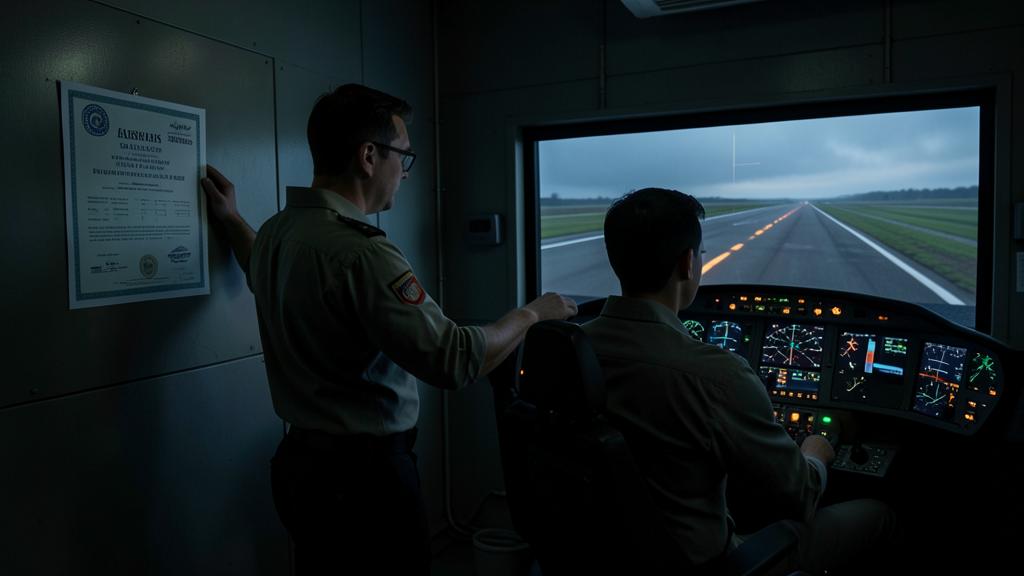
The consequence is that a level designation alone is not portable. A device described as an equivalent level in another system may or may not be accepted for a given credit by your authority, and the answer comes from that authority, not from the manufacturer’s comparison table. When planning training abroad, the question to ask is never what level the device is. It is which of your authority’s credits it has been accepted for, and in writing.
Meanwhile the ladder itself is moving. Head-mounted-display devices, whose first qualifications came in the rotorcraft world, have begun to enter the framework — not because the display is impressive, but because someone assembled the validation evidence and submitted it to an evaluation. That remains the only route from spectacular to creditable.


Leave a Reply
You must be logged in to post a comment.