
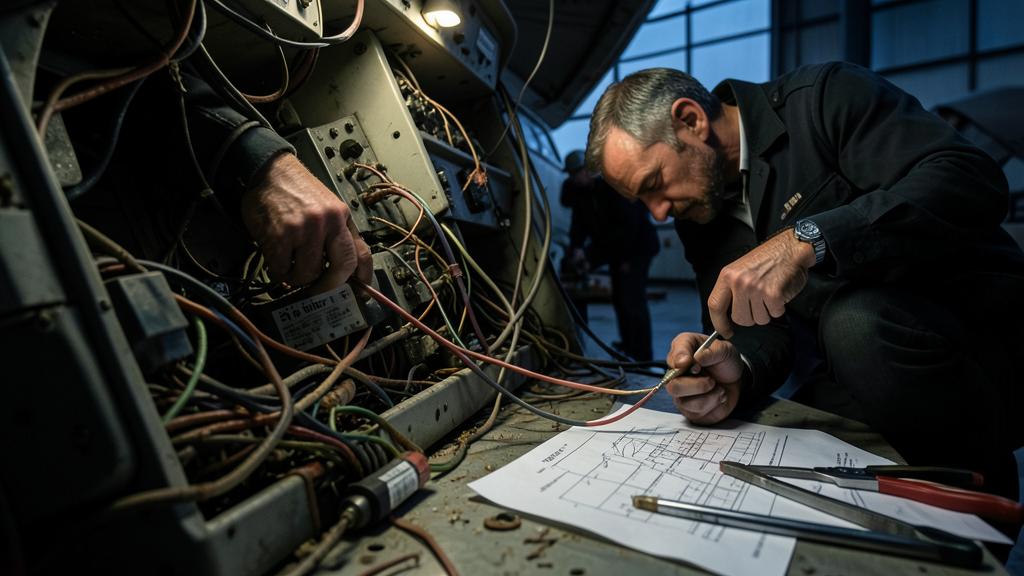
A display retrofit is sold as a box swap. Four screens replace thirty round instruments, and the hardware price is the number that circulates in the meeting. It is almost never the number that matters. The boxes arrive in cardboard and go in quickly; what takes the shop months is everything behind them — the wiring that has to come out, the signals that have to be re-proved one at a time, and the library of documents that stops being true the moment the aircraft changes configuration. This is where a retrofit budget actually goes, and why the cheapest-looking quotations are the ones that quietly left those lines out.
What a display suite quotation covers, and what it silently excludes
A typical avionics upgrade proposal has three columns: equipment, installation kit, and labour hours. Equipment is firm — it is a catalogue price with a lead time. The installation kit is usually firm too, because it is a manufactured harness assembly, brackets, panel cut-outs and circuit breaker provisions supplied against a defined aircraft configuration. Labour hours are an estimate, and they are the only place in the document where the shop is exposed.
What sits outside all three columns is the interesting part. Design approval engineering. Removal of the legacy installation. Rectification of whatever the removal exposes. Requalification of every interface that survives. The rewrite of the maintenance and operations documentation. The revision of the minimum equipment list. Crew and engineer training. And the aircraft’s time on the ground, which for an operator is usually the largest single number in the whole exercise and appears in nobody’s quotation because it is not the shop’s money.
None of that is hidden in a dishonest sense. It is excluded because it is not the vendor’s scope, and a specification that does not name it will not get it priced. The operator who reads the quotation as a total cost discovers the rest sequentially, with the aircraft already in pieces.
The real cost of a cockpit upgrade isn’t the new screens—it’s the work behind them. You have to rewire the plane, check every connection, and update all the paperwork. These hidden costs often get overlooked in the initial quote.
A Boeing 737-300 retrofit with a modern glass cockpit might cost $500,000 for the screens, but the wiring, documentation, and approvals could add another $1.2 million. The aircraft sits on the ground for 60 days while engineers untangle decades-old wiring and update manuals.
Removal is engineering work, not labour
The instinct is to treat the removal of the old panel as unskilled demolition — cut the ties, pull the looms, throw them in a bin. On an airframe of any age it is the opposite. The electrical wiring interconnection system is a certified installation in its own right, and what runs behind an instrument panel is rarely one tidy bundle dedicated to the instruments. It is a shared route, carrying the flight instruments, the lighting, the audio, the ice protection controls and whatever has been added by four decades of modifications, all bundled together with separation rules that were engineered once and have to be respected again.
So removal proceeds wire by wire, against a diagram, with each conductor identified before it is cut. Anything shared is preserved. Anything that leaves a stub gets a properly capped and stowed termination rather than a taped end. Every time a loom is disturbed, the surrounding wiring gets inspected for the classic ageing defects — chafing at bracket crossings, insulation cracking, corrosion at connector shells, contamination from spilled drinks that migrated down from the pedestal decades ago. The zonal analysis logic that underpins modern wiring maintenance exists precisely because those defects are found by looking, not by testing.
This is the part of the job that overruns. The estimate assumes a certain condition of the existing installation; the aircraft delivers whatever it actually contains. On an older airframe, the discovery work behind the panel can rival the installation itself, and no honest estimator commits to it before the panel is open.
The right reflex. Before signing, ask for a survey aircraft. One day of opening panels and photographing the actual routing on your tail number, ahead of contract, converts the largest unknown in the project into a priced line. Fleets rarely match their own drawings.
Every interface has to be proved again, one signal at a time
The deeper cost driver is that a modern display suite does not speak the language of the aircraft it is being fitted to. Legacy panels are populated with analogue instruments driven by synchros, DC ratiometric signals, pneumatic lines and simple discretes. A current suite expects digital data on a serial bus, and where it cannot get it, it needs a converter — and every converter is another certified component with its own failure modes, its own power draw, and its own place in the safety assessment.
The consequence is that the retrofit is not one interface but dozens, each of which must be identified, specified, wired, converted where necessary, and then demonstrated. Demonstration is not a continuity check. It is showing that the parameter displayed on the new screen is the parameter the sensor produced, with the right sign, the right units, the right scaling, the right failure indication when the source is lost, and the right behaviour when two sources disagree.
| Legacy signal form | What it typically drove | What the new suite expects | Consequence for the project |
|---|---|---|---|
| Three-wire synchro | Heading, attitude repeaters, compass systems | Digital attitude and heading data on a serial bus | Either a new reference unit or a synchro-to-digital converter, with its own qualification and failure annunciation |
| Analogue DC or ratiometric | Engine indications, fuel quantity, temperatures | Digital engine and fuel data, or dedicated analogue inputs on an interface unit | Scaling and calibration have to be re-established per sensor, and the source tolerance re-documented |
| Pneumatic lines | Airspeed, altitude, vertical speed | Air data computed by a dedicated module | Pitot-static plumbing is re-routed, the system leak-tested again, and height-keeping accuracy re-established |
| Discretes and lamp drivers | Warnings, gear position, configuration signals | Discrete inputs, often at a different voltage or polarity | Each discrete is individually re-mapped and re-proved, including the failed-and-de-energised case |
| Existing digital bus | Navigation sources on an established data bus | The same bus, but a different label set or a later specification revision | Deceptively easy: the connector fits, the data does not necessarily mean the same thing |
The trap. An interface that physically mates is the most expensive kind. A connector that fits invites the assumption that the signal is understood, and the mismatch surfaces during functional test — after the harness is closed up and clamped, when correcting it undoes days of work.
The approval route decides how large the paperwork becomes
Whether the change is classified as minor or major is the single decision that sets the shape of the project, because it determines who may approve the design and what has to be produced to support it. A major change is approved either as a change to the type certificate, when the type certificate holder makes it, or as a supplemental type certificate when anyone else does — the usual route for a retrofit designed by an avionics supplier or a modification centre.
Two structural points are worth stating plainly for operators who work across regions. First, the European and American systems both use a supplemental type certificate, but an approval issued under one does not simply carry over to an aircraft on the other’s register: it goes through an acceptance or validation step under the applicable bilateral arrangement, largely administrative for straightforward changes and a project in itself for the rest. Second, a modification that a shop has embodied many times before is not thereby approved for your aircraft: approvals are granted against a defined configuration, and the applicability list either includes your serial and equipment fit or it does not.
Where the classification is genuinely borderline, the temptation is to argue for minor. It is usually a false economy: a change touching the primary flight display, the interfaces of systems whose failure would matter, or the crew procedures tends to be assessed as major eventually, and a reclassification discovered late costs more than the honest route taken at the start.
The documentation set is a deliverable, not an afterthought
An approved modification is inseparable from the documents that describe it, and those documents are the part of the project most often left unpriced. They are not optional extras. Instructions for continued airworthiness are a condition of the approval; without them the modification cannot be maintained, and an aircraft that cannot be maintained in its current configuration is not airworthy for long.
| Document | Who owns the revision | What has to change | What happens if it is late |
|---|---|---|---|
| Flight manual supplement | Design approval holder | Limitations, normal, abnormal and emergency procedures for the new equipment | The aircraft has equipment the flight manual does not describe; crews operate without an approved procedure |
| Instructions for continued airworthiness | Design approval holder | Maintenance tasks, intervals, airworthiness limitations, wiring maintenance tasks | The maintenance programme has no tasks for installed equipment |
| Aircraft maintenance manual and wiring diagrams | Operator or continuing airworthiness organisation, incorporating supplier data | Zonal descriptions, routing, connector references, troubleshooting | Line engineers troubleshoot the aircraft that used to exist |
| Illustrated parts catalogue and configuration records | Continuing airworthiness organisation | Part numbers, modification status, loadable software standards | Wrong parts ordered; software standard cannot be proved at audit |
| Minimum equipment list | Operator, approved by the authority | New items, deleted items, revised dispatch conditions and placards | No approved dispatch relief for the new equipment; every fault becomes a cancellation |
| Weight and balance record | Operator | Mass change from the approval data or a reweigh, revised empty mass and index | Loading calculations run against a fiction |
| Operations manual and training material | Operator | Standard operating procedures, callouts, scan patterns, failure management | The fleet flies two different cockpits with one set of procedures |
The minimum equipment list is the item that turns a technical success into an operational failure. A fleet returns from modification with new equipment for which no dispatch relief has been approved, and every fault that would previously have been deferred now grounds the aircraft. The regulatory work takes weeks, during which the modified aircraft is less dispatchable than the unmodified ones — a result that is hard to explain to a board that has just approved the investment.
Downtime is usually the biggest number in the project
For an operator, the aircraft’s absence from the line is a revenue loss that runs every day of the modification, and it dwarfs most of the shop invoice on a productive airframe. That reality argues strongly for one thing: bundling. The panel is open, the floor may be up, access to zones that are otherwise expensive to reach is already paid for. Any other work in those zones — wiring inspection, ageing systems tasks, cabin management, connectivity provisions, structural inspections that share the same access — should be done in the same visit or it will be paid for twice.
The corollary is that a retrofit belongs in a heavy maintenance slot, planned against the maintenance programme rather than squeezed between two seasons.
Ground and flight testing is the other schedule item that gets compressed and should not be: pitot-static and altimetry checks, electromagnetic compatibility verification, functional testing of every interface, and a flight test programme proportional to what the change affects. Testing finds problems, which is the point; a plan with no time reserved for the consequences of a finding will slip.
Operational approval is a separate campaign
The most persistent misconception in avionics retrofit is that airworthiness approval delivers operational capability. It does not. Airworthiness approval says the equipment is properly installed and functions as designed. It says nothing about whether the operator may use it for a given operation.
Performance-based navigation is the standard example. The installation may be approved and the aircraft fully capable, and the operator still cannot fly the procedures until its own side is done: operating procedures, crew training, a navigation database process with a controlled update cycle, monitoring. Some navigation specifications need nothing more; others, such as authorisation-required approaches, need a specific approval on top. The same split applies to low-visibility operations.
The scheduling implication is often missed: the operational approval campaign should start in parallel with the design work, not after the first aircraft leaves the shop. Otherwise the fleet has capability it may not use, for a period measured in months, and the business case slips by exactly that period. Operators comparing notes on retrofit sequencing tend to reach the same conclusion; the discussion threads on the FL330 forums are a reasonable place to see how other fleets ordered the work.
Writing a specification that does not detonate
Most retrofit overruns trace back to a specification that described the desired end state without describing the transition. The end state is easy to write and easy to agree. The transition is where the money is.
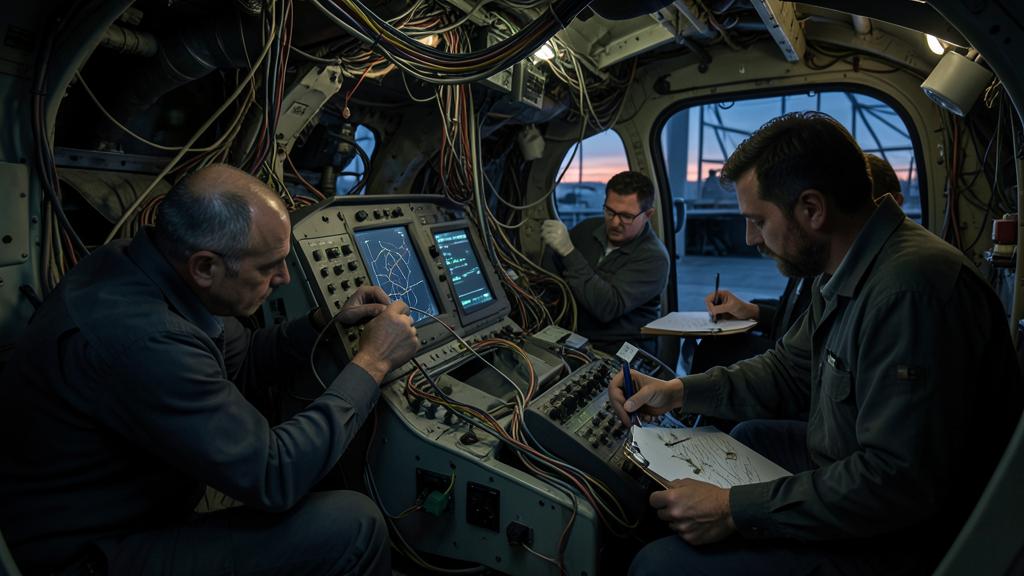
A specification that holds up names the survey aircraft and who pays for the survey. It states whether removal, capping and stowing of superseded wiring is in scope. It fixes the treatment of discovered defects — who decides, against what standard, at what rate. It lists the documentation deliverables individually, with an owner and a date for each, and makes the flight manual supplement and continued airworthiness instructions conditions of acceptance rather than follow-on items. It reserves test time for findings. And it separates airworthiness approval from operational approval, with a named owner and a schedule for each.
| Cost line | Nature | Usually in the quotation? | What drives the variance |
|---|---|---|---|
| Display units and interface hardware | Fixed | Yes | Little — catalogue price and lead time |
| Design approval engineering | Fixed to semi-variable | Sometimes | Classification as minor or major; validation across authorities |
| Harness manufacture and installation | Semi-variable | Yes | Aircraft configuration versus kit assumptions |
| Removal and rectification of existing wiring | Highly variable | Rarely in full | Age and history of the airframe; quality of previous modifications |
| Interface requalification and functional test | Variable | Partly | Number of legacy signal forms retained |
| Documentation revision | Fixed but large | Rarely | Size of the operator library and number of affected manuals |
| Crew and engineer training | Fixed per head | No | Whether the change requires differences training and simulator time |
| Operational approval campaign | Fixed | No | Authority workload and the operator’s own process maturity |
| Aircraft downtime | Variable, often dominant | Never | Slot planning and whether the work was bundled with a scheduled check |
The screens are the visible part of a display retrofit and the least interesting part of its economics. What the project really buys is a re-engineered wiring installation, a re-proved set of interfaces and a rewritten document library — and those three, not the hardware, decide whether the aircraft returns on schedule and dispatchable. Price them at the start and you are buying an upgrade; leave them out and you are buying a discovery exercise with an upgrade attached.


Leave a Reply
You must be logged in to post a comment.