

A technician who has signed hundreds of release documents on a component bench can stand on a wet apron with forty minutes to departure and have no authority to sign anything at all. That is not a judgement on skill. Certifying privileges attach to an environment, a scope and a window of recent practice, and the bench and the line are two different environments. This is what actually has to change during that move, why the recent-experience clause exists at all, and what the maintenance organisation has to be able to produce when an auditor asks how the switch was made.
Two credentials, two issuers, two logics
Most of the confusion around this move comes from treating « being qualified » as a single thing. In the European system it is two things, granted by two different bodies, for two different reasons.
The first is the personal licence. Under Part-66 the competent authority issues an aircraft maintenance licence with categories and subcategories — A for limited line tasks, B1 for the mechanical trades, B2 for avionics, B3 for light piston aeroplanes, C for base maintenance, alongside the lighter categories added later for avionics on smaller aircraft and for sailplanes and balloons — together with type endorsements. The licence certifies that a named individual has passed the modules, accumulated the required experience and, for a type endorsement, completed type training. It is a statement about a person, and it is portable: it follows the holder from employer to employer.
The second is the certification authorisation. It is issued by the Part-145 approved maintenance organisation, under a procedure described in its own maintenance organisation exposition, and it says something much narrower: this named person, holding that licence, may release these tasks, on these types, at these locations, under our approval. It is not portable. It dies the day the holder leaves, and the organisation can suspend or restrict it at any moment without touching the licence.
Here is the point that catches people out. Component work does not require a Part-66 licence at all. Staff who release components in an approved workshop are qualified through the organisation’s own procedures, assessed and authorised in-house, against the ratings held by that organisation. A technician can spend fifteen years overhauling hydraulic actuators or wheel and brake assemblies, sign an authorised release certificate every day, be genuinely excellent at it, and hold no personal licence whatsoever. Nothing in that record converts automatically into a line certification privilege, because the two authorisations were never issued on the same basis.
What the bench certifies, and what the line certifies
The two signatures do not say the same thing, and the difference explains almost everything that follows.
A component release states that a specific item conforms to approved data — usually the component maintenance manual — after defined operations and tests, and that it is eligible for installation. It is a statement about an object, made in conditions the signatory controls: bench, calibrated tooling, test set, documented acceptance criteria, and as much time as the process needs. If a reading is out of tolerance, the item does not leave the bench.
An aircraft certificate of release to service says something wider. It states that the work ordered was carried out in accordance with approved data, and that in respect of that work the aircraft is considered ready for release to service. The signatory has to take a position on the state of the aircraft as a whole in that respect: the deferred defects already carried, the operational and maintenance restrictions attached to them, the configuration after a component change, the placards, the panels closed, the tooling accounted for. The signature is given in a situation the signatory does not control — the aircraft is on the stand, the crew is on board, the pushback slot is booked and the weather is doing what it wants.
The bench certifies that a part is good to install, while the line certifies that the whole aircraft is safe to fly. The line requires more judgement because it involves real-time decisions about the aircraft’s condition, not just a part.
A technician signs off a repaired hydraulic actuator in the workshop, but when they move to the line, they must also decide whether to release an aircraft with a deferred defect under the MEL. The bench work is precise, but the line work involves balancing risks in a time-sensitive environment.
The line is a different set of hazards
Comparing the two work environments item by item makes the case better than any argument about competence. Neither column is harder than the other; they simply fail in different ways.
| Dimension | Component workshop | Line station |
|---|---|---|
| Pace | Set by the process; a step can be stopped and resumed | Set by the schedule; interruption and resumption under pressure are the norm |
| Data in use | Component maintenance manual, test specification, illustrated parts data | Aircraft maintenance manual, trouble-shooting manual, minimum equipment list, wiring data, operator procedures |
| Conditions | Controlled temperature, fixed lighting, clean bench | Night, rain, wind, engine noise, jet blast, live apron traffic |
| Aircraft state | Not applicable | Possibly powered, pressurised systems, fuel on board, passengers boarding |
| Error capture | Functional test on the bench catches most errors before release | Many errors are only revealed in flight; the test is the flight |
| Interfaces | Stores, planning, quality | Flight crew, cabin crew, ground handling, fuelling, de-icing, operations control, air traffic movement |
| Decision content | Conform or not conform against a stated tolerance | Rectify, defer under the minimum equipment list, or refuse the aircraft |
| Consequence of a wrong call | An unserviceable item enters the stores loop | An aircraft departs in a state nobody has correctly assessed |
Read the last two rows together. The line signature includes a judgement the bench never asks for: whether to let the aircraft go with a known defect, under which operational restriction, and for how long. That judgement draws on a body of knowledge — the minimum equipment list and its preambles, the operator’s own conditions, the maintenance procedures attached to each item — that has no equivalent on a component bench. It is learned in the environment, not before it.
Where the recent-experience requirement comes from
The recent-experience clause is often explained as a defence against skill fade. That is part of it, but not the interesting part. Motor skills survive a gap reasonably well. What decays fast is everything that is not a skill: which revision of the manual is current, which service bulletin has just become mandatory, which fleet-wide problem is being watched this month, which trap the last incident report described, how this particular operator words its deferral procedure, who to call at two in the morning when the answer is not in the book.
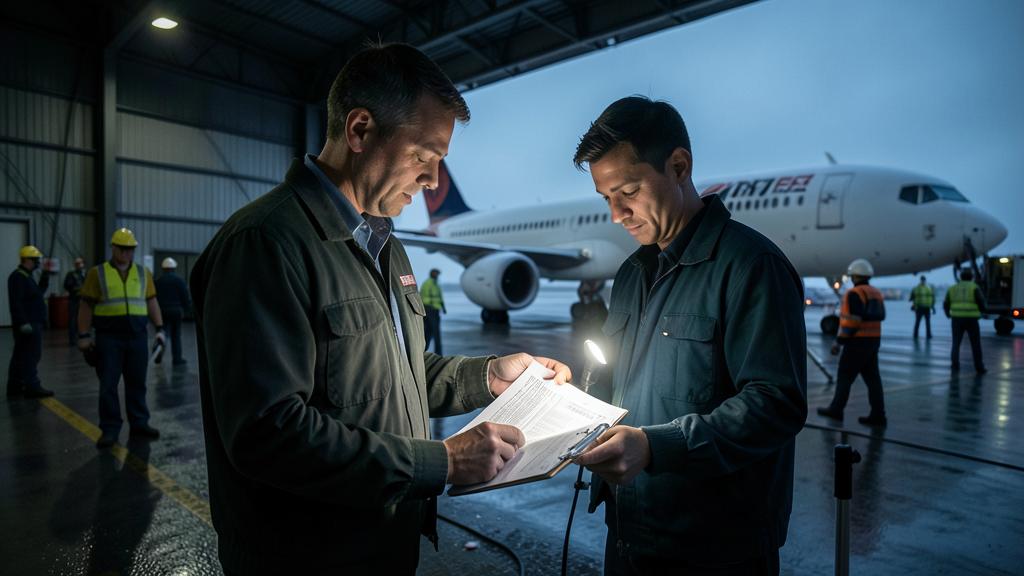
That knowledge lives in the workplace and refreshes itself only by being there. A person can be technically sharp and six months out of date on all of it, and the second condition is the one that produces the finding.
Both major regulatory systems arrive at a similar shape, and the shape is worth noticing: a minimum quantity of relevant experience inside a rolling window, rather than a test. In the European rules the figure that recurs is six months of relevant maintenance experience inside any consecutive two-year period, applied both to the exercise of licence privileges and to the holding of an organisational certification authorisation. Certifying staff are additionally required to receive continuation training on a cycle that does not exceed two years, and that training carries human factors, and — where the type and the scope call for it — fuel tank safety and electrical wiring interconnection system content.
The United States rule is built the same way but sits in a different place in the structure, and the differences matter to anyone working across the two systems.
| Question | EASA framework | FAA framework |
|---|---|---|
| Who holds the personal credential | Licence holder under Part-66, with type endorsements | Mechanic with airframe and/or powerplant ratings, or repairman certificate under 14 CFR part 65 |
| Who grants the right to sign for the operator | The Part-145 organisation, through a certification authorisation of defined scope | The repair station or air carrier, through its own manual system and authorisation lists |
| Recent experience | A defined period of relevant experience inside a rolling two-year window, in both the licence rule and the organisation rule | A recent-experience provision in part 65 built on a comparable window; supervision and technical management can count |
| Repairman-style credential | No direct equivalent; component staff are authorised in-house under the exposition | Repairman certificate is tied to one employer and one facility, and lapses on leaving |
| Type endorsement | Explicit, listed on the licence, with type training and on-the-job training for the first type in a category | No type endorsement on the certificate; type competence is handled by the employer’s training programme |
The practical consequence for the bench technician is unpleasant but clear: neither system lets workshop time substitute for the aircraft experience the rule asks for. Under the European rules what counts is practical maintenance experience on operating aircraft, so however long the workshop career has been, the transition starts close to zero on that particular count.
The trap. A repairman certificate, and an in-house component authorisation, both look like credentials on a wall. Neither survives a change of employer, and neither converts into an aircraft privilege. Anyone planning a career move should check what they will actually be able to carry across before they resign, not after.
What the organisation has to be able to produce
The switch is not a decision, it is a file. When an auditor asks why this person holds this authorisation, the organisation answers with documents, and the absence of any one of them is a finding regardless of how competent the individual is.
| Element | What it establishes | Typical failure |
|---|---|---|
| Personal licence with category and type endorsement | The regulatory basis for the privilege | Type endorsement missing or restricted; licence expired |
| Type training records, theoretical and practical | Knowledge of the actual aircraft | Practical element never closed out |
| On-the-job training file for the first type in the category | Supervised performance of representative tasks | Task list not representative; assessor not appointed in the exposition |
| Recent aircraft experience record | The rolling-window condition | Workshop hours logged as aircraft experience |
| Human factors training, initial and continuation | Error-management competence | Continuation cycle overrun during a busy season |
| Fuel tank safety and wiring training where applicable | Type and scope-specific critical items | Scope extended without the matching training |
| Assessment of competence by a nominated assessor | The organisation’s own judgement, recorded | Assessment signed by someone with no delegated authority |
| Procedures and safety management briefing | Knowledge of how this operator works | Treated as an induction formality |
| The authorisation document itself, with scope | What the holder may and may not sign | Scope written so broadly it covers work never demonstrated |
The single most valuable line in that table is the scope. A well-written authorisation is narrow at first and grows by explicit amendment as tasks are demonstrated. A scope written wide on day one to save administrative effort transfers the whole risk onto the individual, who will be the one holding the signature when something is released that they were never trained on.
Sequencing a real transition
Organisations that do this well run the same sequence, and it takes months rather than weeks.
- Establish the licence position. Which category, which modules are still missing, what experience the authority will accept, and how much of the workshop record can count towards licence issue rather than towards recent experience. These are separate questions with separate answers.
- Place the person on the line under supervision, before any authorisation exists. This is the phase that builds the rolling-window experience, and it cannot be shortened.
- Run the type training, and close the practical element properly. The practical part is the one most often left open, and it is the one that gets found.
- Open an on-the-job training file with a representative task list. Representative means covering the categories of work the authorisation will eventually carry, not the tasks that happened to come up.
- Assess, then authorise narrowly. Start with scheduled work and defect rectification within a defined boundary; leave engine runs, towing, and defect deferral decisions for a later amendment.
- Review after the first months, and extend deliberately. A written review beats an informal impression, and it gives the next auditor the story in one page.
The right reflex. Log aircraft experience and workshop experience in two separate columns from the very first day of the transition, with tail number, task and date. Reconstructing a rolling two-year window from timesheets eighteen months later is the administrative nightmare that delays more authorisations than any technical shortfall.
Coming back after a gap
The same machinery governs a return, and it catches people who never left the trade. Parental leave, long-term sickness, a secondment to planning or quality, a spell in technical records, two years in a training department: all of these can empty the rolling window while leaving the licence perfectly valid. The licence stays; the privilege to exercise it does not.
Recovering it means going back through the supervised phase — not from the beginning, but far enough to rebuild the experience the window requires, and with continuation training brought up to date. Organisations that plan for this treat it as a normal event rather than an exception, and it costs them far less than the ones who discover on a Monday morning that the person rostered to sign has been out of the window since March.
The underlying idea is worth stating plainly, because it also explains why the rule survives every round of simplification. A certification privilege is not a diploma. It is a permission to make a judgement in a specific place, about a specific fleet, under specific pressure, and permissions of that kind are only credible while the person holding them is actually in that place. The bench builds the hands. The line builds the judgement. Neither one substitutes for the other, and the regulation is simply saying so in writing.
Anyone planning this move will find the licence and authorisation questions discussed case by case among practitioners on the FL330 forums, and the training-path side of it laid out on formations.fl330.com.


Leave a Reply
You must be logged in to post a comment.