
Eleven hours of night flying, a full cabin crew, two ways of sharing in-flight rest: two shifts of about three hours each, or three shifts of a little under two. On paper, the total is the same. By the descent, it no longer is — and the gap comes neither from the cumulative duration nor from anyone’s goodwill, but from where each wake-up falls on the internal clock, and from the sleep state it catches you in.
An in-flight rest shift is not a slice of flight time
The first mistake is dividing. Eleven hours of block time do not yield eleven hours to share out: cabin preparation and the briefing must be subtracted, along with the first meal service — on an overnight long-haul it commonly takes on the order of two hours, from tray pass to collection — then the pre-arrival service, cabin securing and the descent briefing. What remains is the usable rest window, and it is noticeably shorter than the flight duration would suggest.
This window is then divided by the number of shifts. But each changeover costs a fixed overhead that does not divide: reaching the rest area, changing, settling in, waiting to fall asleep, waking up, getting dressed again, returning to the cabin and taking the handover from the outgoing shift. This overhead is roughly constant regardless of shift length. Going from two shifts to three cuts the nominal duration by a third, but pays the overhead one more time: the sleep actually obtained falls faster than the displayed duration.
Sleep-onset latency is not the same depending on where the shift falls. A first shift that starts early in the night often lands while the body is still in its resistance-to-sleep phase: one stays awake for a long time, counting the minutes. A last shift starts after several hours of wakefulness and standing work: one falls asleep quickly there, and drops into deep sleep.
The time you actually sleep during a shift depends on when you start and how long the shift is. If you start early in the night, you might take longer to fall asleep. If you start after a long day, you’ll fall asleep faster and sleep deeper. But shorter shifts mean less time to recover, even if the total rest time seems the same.
On an Airbus A350 flying from Paris to Singapore (11h 30m), a two-shift split might give each crew member 3 hours of rest, but with overhead, they might only sleep 2h 30m. A three-shift split could give 2 hours nominal, but after overhead, only 1h 15m of actual sleep. The crew waking from deep sleep in the last shift may struggle with inertia during descent.
The circadian low does not move with the flight plan
The internal clock reads neither the arrival airport’s local time nor the time elapsed since take-off. It follows body time — that of the time zone the organism is acclimatised to — and it imposes, at the core of the biological night, a low-activity window: core temperature at its lowest, sleep-onset latency at its shortest, performance on vigilance tasks at its worst. European flight and duty time limitation rules explicitly name this window and use it to tighten the ceilings: this is not a comfort notion, it is a regulatory parameter.
Two practical consequences follow. First, landing time matters as much as flight duration: the same eleven-hour sector does not ask the same of a crew depending on whether it lands at the bottom of the low or two hours after the morning rebound. Second, the shift that covers the low is by far the most productive — falling asleep is fast there and sleep is stable — while the shifts flanking it pay top price for their rest.
The morning rebound is real, but its worth must be understood: it raises the alertness level without erasing the accumulated debt. A crew that is rebounding is not a rested crew; it is simply less low than an hour earlier.
Two shifts: consolidated sleep, half the crew on a long wake
With two shifts, the window per person commonly reaches around three hours. With latency subtracted, this leaves room for two complete cycles — a sleep cycle lasts on the order of ninety minutes — and, above all, for a shift end that falls in light sleep. The wake-up there is clean: it occurs during a phase where the organism is already climbing back up.
The group that takes the second shift is structurally favoured for the approach. It sleeps through all or part of the low, wakes late in the flight, and arrives at descent with a short continuous wake time. The first-shift group pays exactly the opposite: it gets up in the middle of the biological night, stays standing through the whole low, handles the pre-arrival service and presents itself at the approach with the longest continuous wake of the crew. The inequality is stark and known in advance: it is offset by distributing the pre-arrival tasks.
This scheme, however, runs into a constraint that has nothing to do with physiology: two shifts mean half the crew off station at the same time. The minimum number of cabin crew members required to remain in the cabin does not get suspended. On a crew sized to the minimum, splitting into two shifts becomes unworkable, and it is this arithmetic — not fatigue — that most often forces three shifts.
Three shifts: closely spaced wake-ups, inertia at the wrong moment
With three shifts, the window per person drops to around two nominal hours, and markedly less once the changeover overhead is removed. This leaves room for one cycle, sometimes one and a half. The wake-up therefore has a good chance of falling in the middle of a cycle — and the first half of a sleep period is precisely where deep slow-wave sleep dominates. The shorter the shift and the longer the wakefulness it follows, the greater the risk that the wake-up will occur in the deepest part of the cycle.
This is where sleep inertia comes into play. It is not fatigue: it is a distinct, transient state in which reaction time lengthens, working memory shrinks and the ability to prioritise several simultaneous demands collapses — while the person feels awake. This dissociation between the felt state and the real state is what makes it operationally dangerous: no one declares themselves unavailable because they have just got up.
Inertia dissipates, but not at the same pace depending on the sleep state left behind. Coming out of light sleep, a working level is regained within minutes. Coming out of deep slow-wave sleep, it typically takes several tens of minutes — the equivalent of the entire descent phase.
Comparing the two schemes on what matters: the margin before the approach
The right indicator is neither the total rest duration nor the number of shifts. It is the interval between the last wake-up of the group that will handle the descent and the start of that descent, coupled with a second one: the continuous wake duration of the most exposed crew member at the moment of touchdown. Both can be read on the same timeline.
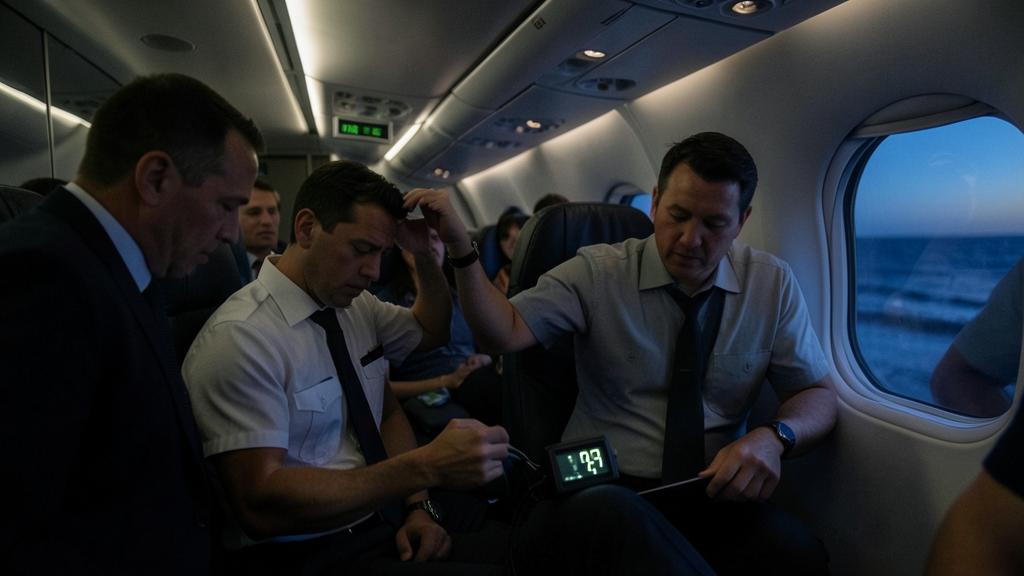
The timeline shows what duty rosters hide: with the same window, both splits end the last shift at the same instant. The margin is therefore not what tells them apart, but the depth of sleep the last group emerges from and the position of the intermediate wake-ups relative to the dark band.
| Criterion | Two shifts | Three shifts |
|---|---|---|
| Nominal duration of a shift | half of the usable window | a third of the same window |
| Changeover overhead paid | twice | three times, over a shorter window |
| Accessible sleep cycles | two complete ones, latency subtracted | one, sometimes one and a half |
| Wake-up during deep slow-wave sleep | unlikely at the end of a shift | likely, especially on later shifts |
| Coverage of the circadian low | one whole shift can cover it | the low is split between two shifts |
| Longest continuous wake | the entire second half of the flight, for the first-shift group | shorter for each person, but two wake-ups instead of one fall within the low |
| Crew remaining in the cabin | half | two thirds |
| Sensitivity to the quality of the rest facility | a long shift absorbs a long latency without losing everything | every minute of latency is taken from the only available cycle |
The trap of “last shift, therefore freshest”. On two long shifts, the group coming out of the second shift is indeed best placed: it has slept in cycles and wakes in light sleep. On three shifts, the same intuition reverses. The last shift is short, taken after a long wake — so it starts with a rapid onset and deep sleep straight away — and it is the only wake-up of the flight with no buffer time before a high-workload phase. Judging freshness by sleep recency then amounts to entrusting cabin security to the most impaired person, and doing so with full confidence.
The class of the rest facility changes the ranking
The same split does not produce the same sleep depending on what it is obtained in. A bunk isolated from the passenger flow, in darkness, allows a horizontal position and true sound isolation: latency there is short and sleep organises itself into cycles. A reclined cabin seat gives neither complete darkness nor silence — latency lengthens, sleep stays light and fragments with every pass down the aisle. A simply blocked passenger seat belongs to a different category: one recovers there, one does not sleep.
The ranking of the two schemes reverses depending on this parameter. On a poor facility, a short shift produces almost nothing: the available time is eaten up by latency and one gets up before reaching deep sleep — which, paradoxically, limits inertia but restores no alertness. Two long shifts are then better than three short ones. On a good-class bunk, three shifts remain workable, provided the wake-ups are placed in the right spot.
| Rest facility | Landing within the biological night | Landing after the morning rebound |
|---|---|---|
| Isolated bunk, complete darkness | three shifts remain workable; place the shortest shift first | two shifts give the best-consolidated sleep |
| Reclined seat isolated from the passenger flow | two shifts: a short shift there produces only light sleep | two shifts, with an earlier final wake-up |
| Blocked cabin seat, without isolation | two shifts and an extended margin; count the rest as partial | two shifts; do not base the final phase on the sleep obtained |
The right reflex: build the split backwards from the start of the descent. First fix the time by which the last group must be operational — not awake, operational — then work backwards by a margin sufficient for inertia to dissipate, and only then place the shifts. A split built the other way round, starting from take-off, systematically ends the last shift too late.
Service dictates the split, and vice versa
In practice, the split is rarely decided on alertness criteria: it flows from the service plan. A second service placed late crushes the last shift’s margin, since the group must be woken early enough to arm the galleys. Conversely, bringing the light pre-arrival service forward by twenty to thirty minutes gives the last shift back a useful margin without taking anything from the passenger — this is a cabin manager’s call, not scheduling’s, and it is made in flight.
The content of the final phase deserves to be looked at for what it is. Cabin securing, equipment checks, exit checks, pre-descent briefing: these are control tasks, where a deviation is being sought, not routine tasks that habit carries on its own. They call on exactly the functions that inertia degrades first, sustained attention and working memory.
Paper arithmetic lies about the sleep actually obtained. Dividing flight duration by the number of shifts yields a figure that corresponds to nothing: it ignores the services, it ignores the changeover overhead paid at each switch, and it ignores latency, which is longest exactly when the shift is shortest. A shift announced as two hours may produce little more than one hour of actual sleep.
Treat wake-up as a procedure, not as an instant. Light, movement, hydration, a few minutes standing before any control task: the dissipation of inertia speeds up with physical activation and light exposure. Building this time into the sequence, rather than sending to their station someone who has just opened their eyes, costs a few minutes and changes the quality of the final phase.
What to check in your own documentation
Three things are found in the operations manual and nowhere else. Who decides the split — cabin manager, commander, or scheduling. Whether there is a duration floor below which a shift does not count as rest. And how in-flight rest interacts with the extension of duty time: depending on the facility class and the share of rest obtained, the extension allowed is not the same, and it is this parameter that makes a split lawful or not.
Grey areas remain that the texts do not close. The minimum margin between the last wake-up and the start of the descent is almost never given a figure: it falls to crew judgement. A prolonged holding pattern or a diversion occurring after the end of the last shift fits into no pre-established split, since the sleep reserve has already been consumed. And postponing a shift because of turbulence shifts the whole chain without anyone recalculating the final margin.
For anyone preparing a qualification or a recruitment interview, what is expected is not reciting a duration. It is being able to explain why their crew settled on a particular split for a particular sector: what minimum cabin complement, what facility class, what arrival time by body clock, and where the margin was chosen to sit. This chain of reasoning distinguishes a learned answer from a held one.
The foregoing describes a physiological mechanism and its interaction with the organisation of in-flight rest; it replaces no rule. The applicable regulation and the operator’s approved documentation prevail over this article under all circumstances, including when they impose a split that physiology does not favour.
Questions fréquentes
Does in-flight rest count as duty time?
In-flight rest takes place during the flight duty period: it does not interrupt it and does not count as a ground rest period. Its regulatory role is to allow, under conditions, an extension of flight duty time. The extent of this extension depends on the class of the rest facility and the share of rest actually obtained by each crew member. The exact terms are set out in the operations manual.
Who decides the split into two or three shifts?
Depending on the operator, the split is either fixed by scheduling or left to the cabin manager in agreement with the commander. In both cases, the non-negotiable constraint is the minimum number of cabin crew members who must remain in the cabin at all times. It is this constraint that often rules out a two-shift split on a crew sized to the minimum. The operations manual designates the competent authority on board.
How much time is needed between the last wake-up and the start of the descent?
The regulations generally do not set a value: the margin is a matter of crew judgement. Physiologically, inertia following light sleep dissipates within minutes, while inertia following deep slow-wave sleep typically takes several tens of minutes. The margin should therefore be sized on the unfavourable case, not the average one, and it is built backwards from the start of the descent.
Is a blocked passenger seat equivalent to a bunk for in-flight rest?
No, and the regulations acknowledge this by classifying rest facilities. An isolated, dark bunk allows sleep organised into cycles; a reclined cabin seat lengthens latency and keeps sleep light and fragmented. With an identical shift duration, the sleep actually obtained is not comparable, and neither is the duty extension allowed.
Should someone be woken before the end of their shift in case of turbulence?
The criterion is the person’s safety in their facility, not the schedule’s convenience. If the facility no longer allows the person to remain safely secured, the shift is interrupted. The entire chain must then be considered shifted: repositioning the following shifts without recalculating the margin before the descent amounts to erasing it without noticing.
Is the crew member who slept most recently the most fit for the approach?
Not necessarily. That person benefits from the most recent sleep, but is also the most exposed to wake-up inertia, especially if their shift was short and taken after a long period of wakefulness. The useful criterion is not sleep recency alone, but the combination of sleep obtained, time elapsed since waking, and where the landing falls on the circadian rhythm.


Leave a Reply
You must be logged in to post a comment.