
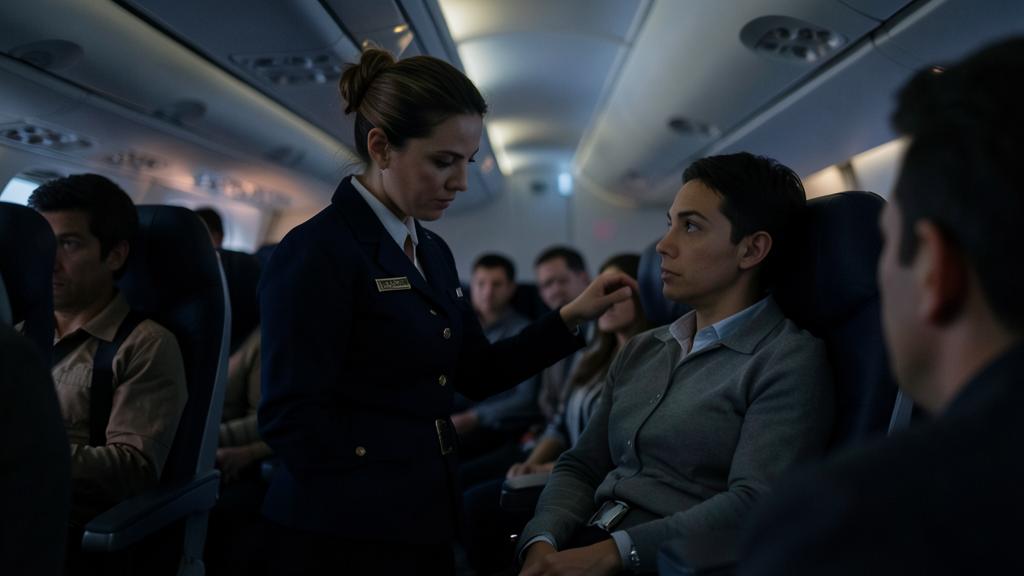
A seat change request takes four seconds to make and can occupy a cabin for the rest of the sector. It arrives dressed as a service question and it almost never is one. What the passenger is really asking is whether the rule applied to them is the same rule that will be applied to the person one row ahead, and they are asking it in a room where thirty people can watch the answer being given. The arbitration has three layers: what safety fixes and nobody in the cabin may move, what the operator sold and crew may not resell, and the narrow band in between where judgement is genuinely exercised. Confusing the three is what turns a seat request into a precedent.
A seat change isn’t just about comfort—it’s about fairness. Passengers are checking if the rules apply equally to everyone. Crew must decide quickly, but their answer affects everyone else on the flight.
On a Boeing 737, a passenger requests to move from an exit row because they can’t assist in an emergency. The crew must deny the request, as exit rows are reserved for able-bodied passengers by safety regulations. The passenger is then offered an unsold seat in another row, avoiding both a safety violation and setting a precedent.
The request is almost never about the seat
A passenger who asks to move is telling you something they have not said out loud. The words are always the same — is that seat free? — but the demand underneath varies enormously, and treating every version as the same demand is the first error. Sorting them takes one question and about ten seconds, and it determines everything that follows.
The underlying demands fall into a short list. Comfort: more room, a different neighbour, distance from a galley. Proximity: a family or a travelling pair split by a schedule change, an equipment substitution or a late reallocation. Avoidance: a neighbour who is loud, unwell, intoxicated, or perceived as threatening. Anxiety: a passenger who needs a window, an aisle or a forward row and will not say why. Value: someone who paid for an attribute they believe they did not receive. And testing: a passenger who watched you refuse someone else and wants to know whether the refusal was a rule or a mood.
- Comfort: more room, a different neighbour, distance from a galley.
- Proximity: a family or a travelling pair split by a schedule change, an equipment substitution or a late reallocation.
- Avoidance: a neighbour who is loud, unwell, intoxicated, or perceived as threatening.
- Anxiety: a passenger who needs a window, an aisle or a forward row and will not say why.
- Value: someone who paid for an attribute they believe they did not receive.
- Testing: a passenger who watched you refuse someone else and wants to know whether the refusal was a rule or a mood.
The first four are usually satisfiable. The last two create precedent, because both are about equality of treatment rather than seating, and both have an audience. A passenger testing the boundary is not being difficult; they are doing what anyone does when a limit looks arbitrary. The answer becomes the reference point for the rest of the flight.
The layer that is not negotiable
Some seats are fixed by safety, and no amount of goodwill in the aisle changes them. Crew need to know which constraints these are, and that they are not theirs. A crew member applying an exit row criterion is not exercising discretion and should not sound as if they are: the criteria were written into the operator’s manual under an approved seating policy, and the cabin is where they are applied, not where they are weighed.
| Constraint | What it forbids | Who can change it |
|---|---|---|
| Emergency exit rows | Occupancy by anyone unable or unwilling to assist: those who cannot understand the briefing, those with restricted mobility, children below the operator’s age floor, and in most schemes passengers accompanied by an animal | Nobody in the cabin. The criteria come from the approved operations manual; crew verify and apply them |
| Passengers with reduced mobility | Exit rows, and any seat where the passenger would obstruct crew access or an evacuation path | Crew may reseat within the permitted set; the underlying right to be carried and accommodated is set in law in the European Union and the United States, not in operator policy |
| Infants and lap-held children | More per row or zone than the cabin’s supplemental oxygen provision and restraint availability allow | Fixed by the aircraft’s certification and cabin configuration; not a cabin decision at all |
| Child restraint devices and extension belts | Use outside approved seat positions | Operations manual; positions are listed, not negotiated |
| Unaccompanied minors | Positions outside the operator’s defined scheme, typically requiring crew line of sight | Ground staff at allocation; crew may move within the scheme |
| Extra seat, stretcher or medical oxygen cases | Any position other than the one planned at booking | Nobody once the aircraft is loaded |
| Zone loading on small aeroplanes | Movement between zones once the loadsheet is issued | The commander, on the ground, by recalculation |
The trap. A move that is invisible in a wide-body is a mass and balance event in a fifty-seat turboprop. On aeroplanes where seating is loaded by zone, three passengers relocating aft after the loadsheet is issued is not a courtesy, it is an unrecorded change to the trim setting the crew has already entered. If the type has zone loading, the answer before doors close is a referral to the flight deck, not a shrug and a nod.
Safety rules on seating are non-negotiable. Crew must enforce them without sounding like they’re making exceptions, or passengers will assume the rules are flexible.
On a 70-seat ATR 72, a crew allows three passengers to move from the front to the back after takeoff. This shifts the centre of gravity. If the load sheet is not updated, the actual balance no longer matches the one used for the performance and landing calculations, and nobody on board knows it.
The layer that is not yours: what the operator sold
The second layer is commercial, and the essential fact is that cabin crew usually cannot see it. Modern seat maps carry paid attributes — extra pitch, forward position, a blocked adjacent seat, priority disembarkation — sold at different prices to different passengers on the same row. Status allocations sit on top of that. Blocked seats may be held for a crew rest, an operational reserve, a passenger boarding later down route, or a booking the crew know nothing about.
Two consequences follow, and they point in opposite directions. A crew member who moves a passenger into a paid seat has transferred revenue without authority, and has told everyone watching that the attribute they paid for goes free to whoever asks most persistently. Conversely, a passenger involuntarily moved out of something they bought has a claim: in the European framework an involuntary downgrade triggers reimbursement of a proportion of the ticket price, scaled by distance — whether or not the crew member knew it.
Crew can’t see which seats have paid extras, so moving someone into a premium seat can cost the airline money. Moving someone out of a paid seat may also trigger compensation.
A passenger in a paid extra-legroom seat is asked to move to a standard seat because another passenger wants the extra space. The passenger loses a service they paid for and can claim a refund of the seat fee, even if the crew didn’t know the seat was a paid one.
The practical rule is narrow and it holds: within a cabin, crew may move a passenger into a seat that is genuinely unsold and carries no paid attribute; across cabins, or into a seat carrying one, the decision belongs to the operator’s process, not to the aisle. Where that process cannot be reached before departure, not before we are airborne is a real answer rather than a refusal.
The layer that is actually yours
What remains is the band where crew genuinely decide, and it is smaller than it feels and more consequential than it looks. It is governed by one uncomfortable asymmetry: a favour granted quietly is seen by everyone, and a refusal given quietly is remembered by everyone. The cabin is not a counter with a queue; it is a single room in which every transaction is public and every passenger is building a model of how you decide.
That model is what people mean by fairness. Passengers are remarkably tolerant of rules they dislike and remarkably intolerant of rules that appear to have exceptions they were not offered. How fair the procedure looks tends to weigh more with a passenger than the outcome itself. A passenger refused with a reason that would clearly apply to anyone else generally accepts it; a passenger refused with an apology and no reason concludes the seat was available and they were simply not worth it.
An order of questions that survives being repeated
Consistency across a crew of six on a busy turnaround is not achieved by everyone having good instincts. It is achieved by everyone asking the same questions in the same order, so that two crew members faced with the same request at opposite ends of the cabin arrive at the same answer. The order below is deliberately blunt; its value is that it can be run in fifteen seconds and produces an answer you can say out loud.
| Question | If the answer is yes |
|---|---|
| 1. Does a safety constraint apply to the seat being left or the seat being sought? | The answer is no, and it is not negotiable. State the constraint, not your regret |
| 2. Is the target seat sold, blocked, held, or carrying a paid attribute? | Not a cabin decision. Defer to the ground process, or to after departure |
| 3. Does anyone have to be asked to move for this to work? | Any move by a third party is voluntary, requested once, and never presented as an instruction |
| 4. Does the reason fall inside the operator’s published policy — family seating, medical need, a documented reallocation? | Grant it if a compliant seat exists, and say which policy you are applying |
| 5. Is there a neutral seat that meets the need without touching anyone or anything sold? | Grant it. This is the band where crew judgement genuinely lives |
| 6. Would you give the same answer, in the same words, to the next person who asks? | Proceed. If the answer is no, you are about to create a precedent, not solve a problem |
Question six is the one that does the work. It costs nothing and it converts an instinct into something defensible. If the sentence you would use to justify the decision contains only general terms — the row is empty, nothing there is sold, nobody is being displaced — the exception is repeatable and therefore not an exception. If the sentence needs this particular passenger to be true, it is a precedent, and the next crew member down the aisle will pay for it.
How one exception becomes tomorrow’s policy
The mechanism is worth spelling out because it operates on a delay and the person who triggers it is rarely the person who absorbs it. A visible exception is granted, for good reasons, to a passenger with a genuine case. A second passenger with a weaker case observes it and asks. Refusing now requires explaining a distinction that is invisible from a seat: the second passenger does not know the first one had a medical note, and cannot be told. The refusal therefore reads as arbitrary, and the crew member who gives it inherits the argument.
Extend that over a season and it stops being an incident and becomes an expectation. Frequent passengers on a route learn what the cabin will concede, and what they learn spreads faster than any policy update. That is how informal entitlements form on high-frequency sectors, and why a report describing a recurring request pattern is worth more to the operator than one describing a single argument.
The right reflex. Give the rule before the answer, not after it. Exit rows are restricted to passengers who can assist, so that row is not available — but 24C is free and I can move you there now lands very differently from I’m sorry, I can’t do that. The first sentence explains a system; the second one describes a person’s unwillingness, and invites negotiation.
The requests you must not arbitrate at all
A small set of requests look like seating and are not. Handling them as seating is the failure mode that produces the reports nobody wants to write. The crew member’s job is not to solve them in the aisle but to route them correctly, and speed matters more than diplomacy.
| What arrives | Default handling | Escalation |
|---|---|---|
| Refusal to sit beside a passenger on grounds of sex, religion, race or disability | Never ask the other passenger to move. Reseat the requester if an eligible seat exists; if none exists, the request lapses | Inform the commander; this is a policy matter, not a cabin judgement |
| Report of unwanted touching, harassment or threat | Separate immediately and secure the person reporting. Do not investigate, do not stage a confrontation | Commander at once; this becomes a report and possibly a law enforcement matter on arrival |
| Neighbour intoxicated or behaving disruptively | A behaviour event, not a seating one. Moving the complainant does not address it | Standard disruptive passenger procedure and commander notification |
| Passenger unwell, or a suspected communicable illness nearby | Medical protocol first; reseating is a consequence of the assessment, not a substitute for it | Commander, and ground medical advice where contracted |
| “My seat is broken” — recline, belt, table, IFE, or a suspect fitting | This is a defect. Reseat if required and record it | Cabin defect log; a belt or seat structure item may be a dispatch matter |
| Group reseating for convenience with doors closed | No while anyone else would have to move; revisit after top of climb | Senior cabin crew member decides, not each crew member individually |
The first row deserves one further sentence, because it is where crews are most often left unsupported. The position most operators have settled on is that the passenger who objects may be moved if a seat exists, and the passenger objected to is never asked to move. That distinction is not a compromise; it is the whole point. Asking the second passenger to relocate makes the operator the instrument of the discrimination, and no service consideration outweighs that. Crews should know their operator’s wording before they need it; if the manual is silent, that silence is itself worth reporting.
Closing the loop, which is where the policy is actually written
The last step is the one most often skipped: telling the operator what happened. A seat argument that ends at the aircraft door teaches nobody anything. Written up in three lines, it is the only channel through which a seating policy that fails on contact with a real cabin ever gets changed.
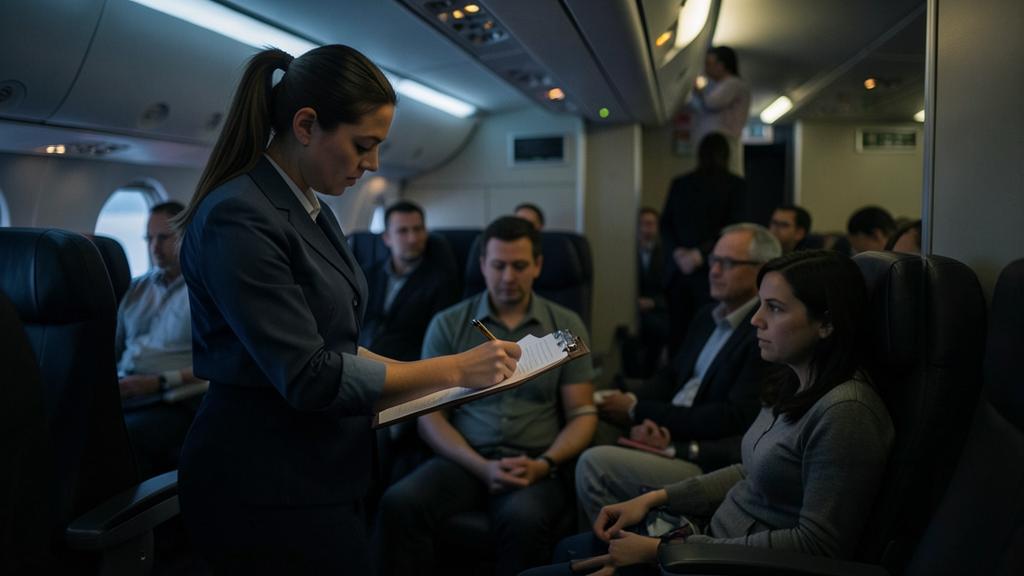
Three things are worth recording. First, structural causes: an aircraft substitution that split families, a reallocation that stacked unaccompanied minors badly, a row of blocked seats nobody on board could explain. Second, recurring patterns on a route, because a request that appears on every rotation is a design problem, not a passenger problem. Third, any moment where the manual gave no answer — silence in a manual reliably predicts two crew members handling the same request differently next week.
There is a handover dimension on multi-sector days. A seat moved for a medical reason, a passenger relocated after an incident, a defect that made a seat unusable — none of it is visible to the incoming crew from the seat map, and thirty seconds of verbal handover stops the next crew unwittingly reversing a correct decision. How other operators word these arbitrations is discussed continuously among peers on the FL330 forums.
None of this makes a seat request pleasant. It does make it short, and survivable for the crew member answering the next one two rows behind. The passenger forgets the seat within a week. They do not forget whether the rule they were given looked like it applied to everyone.


Leave a Reply
You must be logged in to post a comment.