
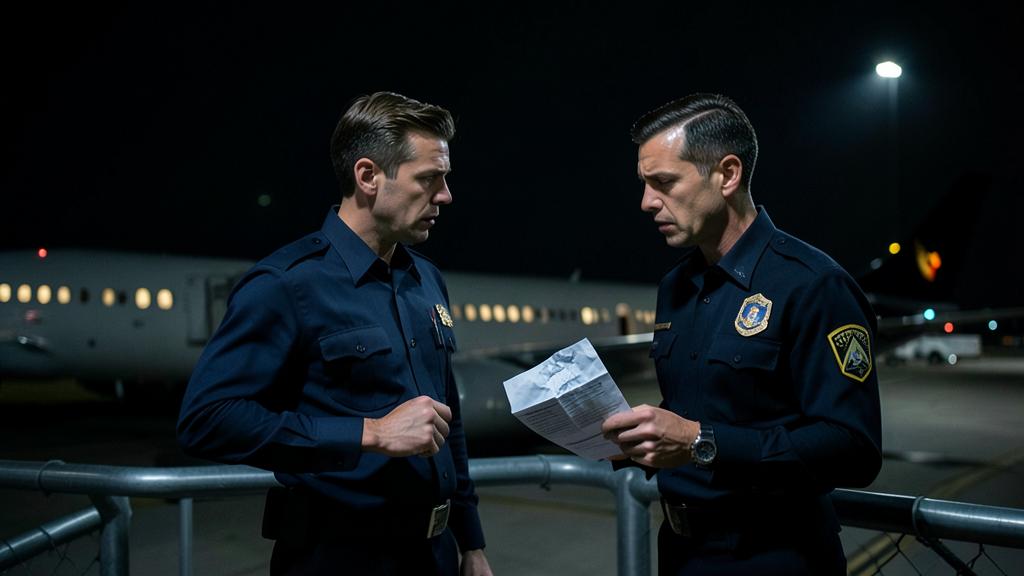
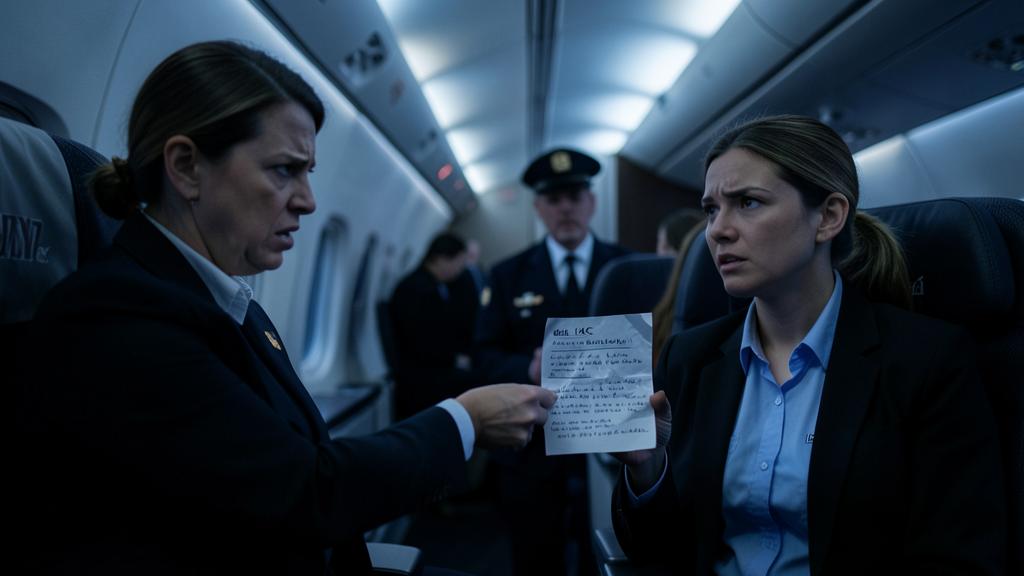
The passenger in 14C refused three times to return to his seat, pushed away a crew member’s shoulder, and then sat back down laughing. The captain issues a written warning; the man crumples it without reading it. Two hours later, at the bottom of the boarding bridge, two officials listen to a three-minute account and ask: « Do you have anything in writing? » What is handed to them at that moment weighs more in the aftermath of the case than the severity of what happened in flight.
A document that punishes nothing
The written warning issued on board is neither a sanction nor a report. A cabin crew does not record an offense: this operation belongs to authorized agents, which the cabin crew is not. What the document produces, it produces on only two registers, and these two registers explain all its mechanics, including its most bureaucratic sections.
The first register is the injunction. The captain has authority on board recognized by international and national texts: he can take reasonable measures necessary to maintain good order, discipline, and safety. The warning materializes the order. It states what must stop, it does so in writing, and it announces what will follow if nothing stops. A verbal order has the same legal value, but it leaves no trace; that’s the difference.
The second register is precisely this trace. The document is filled out during the events, before knowing how they will end. This prior nature gives it its value: a written account after landing, once the decision to file a complaint is known, reads like a reconstruction. A document written in the heat of the moment, in a form that the crew did not design and whose sections were pre-set, resists this criticism much better.
These two registers assign it a precise place in the intervention scale. One does not issue a written warning to someone to whom no one has yet asked anything, and one does not move to physical restraint without having shown that one tried something else—unless the immediacy of the danger prohibited this detour, which is written and explained. The levels used in the industry typically distinguish verbal disturbance, physical aggression, endangering others’ lives, and the attempt to attack the cockpit. The written warning lives in the early stages, and its delivery is precisely what will allow the next level to be considered as crossed knowingly.
Ce document n’est pas une punition, mais une preuve. Il montre qu’on a demandé à un passager d’arrêter un comportement dangereux, et que ce passager a été informé des conséquences. Ce qui compte surtout, c’est ce que le passager fait après avoir reçu l’avertissement – s’il continue ou s’il se calme.
Sur un vol Paris-Dubaï avec un Airbus A380, un passager refuse de s’asseoir et bouscule un steward. Le commandant de bord lui remet un avertissement écrit à 11h30 UTC, alors que l’avion survole la Turquie. Le passager déchire le document. 15 minutes plus tard, il recommence à crier. À l’arrivée, les autorités émiraties utilisent cet avertissement pour justifier son arrestation.
What the delivery creates: knowledge
Most of the charges subsequently mobilized—refusal to obey the captain’s instructions, obstruction, endangering others—require an element that the raw facts do not provide: the person knew. They knew that what was being asked of them came from the authority on board, they knew that their behavior was at issue, they continued. As long as one remains at the verbal level, this element is debated: the person in question will say they did not understand, that they thought it was a remark in passing, that the noise covered everything, that no one had addressed them in particular. Once the document is delivered, the discussion changes: it no longer concerns what they understood, but what was put in their hands.
From this comes a counterintuitive consequence, and it is undoubtedly the most useful to remember: what matters most in the file is not what preceded the warning, but what followed. The ten minutes after are worth everything else. Did the person calm down? Did they resume exactly the same behavior? Did they tear up the document in front of witnesses? Did they ask for an explanation, demand the captain’s name, request a translation? Each of these responses is noted with its time, and each one weighs—including the calming down, which attests that the measure had its effect and protects the crew from a reproach of disproportion.
The same reasoning governs the restraint. When immobilization becomes necessary, what will later be asked of the operator is not whether it was effective, but whether it was reasonable in light of what preceded it. A file that shows a request, a reminder, a written warning, then the persistence of the disturbance, makes the measure understandable to those who were not on board. A file that begins with immobilization forces one to reconstruct after the fact a gradation of which there is no trace, and this reconstruction is always done in a defensive position.
One must keep in mind, when writing, that the document is given to the person concerned. It does not remain in an internal file: it leaves with them, it will be read by their counsel, and it will be used to prepare the opposing version. This is not a reason to say less, but a reason to write only what will hold up.
The mentions that survive on the ground
A poorly filled-out warning is not neutral: it weakens. A single exaggeration, a single box ticked out of caution, contaminates the credibility of the entire crew’s testimony—it is enough to dismiss one to cast doubt on all the others. The sections that hold have this in common: they are verifiable by someone who was not on board.
| Rubrique | What it establishes | What undermines it |
|---|---|---|
| Identity and source of the identity | that the document does refer to this person | the seat number alone, when the cabin has just been reseated |
| Time of the events and time of handover | the chronology, and the link to a portion of the flight | a local time without the time zone, or a single time for both |
| Description of the events | the physical behaviour, verifiable by a third party | characterisations — “aggressive”, “drunk” — that the crew cannot establish |
| Named, contactable witnesses | that the account is not that of a single person | the passenger witness who left without anyone noting how to contact them |
| Manner of handover | that the person concerned was put in a position to understand | the document placed on the tray table of a sleeping passenger |
| Language and, where applicable, reading aloud | actual understanding of the instruction | a version the person concerned cannot read, with no translation or reading aloud |
| Captain’s signature and delegation of handover | the origin of the order and the regularity of the chain | a document issued from the cabin without the flight deck being informed |
Two sections deserve attention. First, the time: it is not there to make things serious. It ties the facts to a portion of the flight, therefore to an airspace, therefore possibly to a jurisdiction. Noted in coordinated universal time, with a delivery time distinct from the time of the events, it matches the flight plan, recorded communications, and the timestamp of the onboard systems. Noted as « toward the middle of the flight, » it matches nothing and adds no strength to the account.
Identity next. The seat number identifies no one: it designates a place, and places change—especially when the crew has just moved someone to lower the tension. What identifies is a name taken from a presented document, or failing that, the explicit mention of how one traced back to them: boarding pass shown spontaneously, seat assigned at the start and occupied without interruption, designation by a travel companion. The source of the identification is as valuable as the identity itself.
The delivery methods form the third decisive section, and the most often botched. A document placed on a tray has notified nothing. A document presented, handed, and read aloud when the person refuses to take it, yes—and the refusal itself is noted, with its time and witness. The reflex to give up in the face of a hand that pushes back is understandable and costly: what matters is that the person was put in a position to take knowledge of the injunction, which requires describing how it was done. The language follows the same reasoning: a text that the person does not read has notified them of nothing, unless there is mention of an oral reading, a translation by a crew member, or a bilingual version actually delivered.
The trap. The pre-printed form invites one to qualify rather than describe, and to check broadly « to cover. » Writing « manifest state of intoxication » or « death threats » is to make a medical or legal qualification that the crew cannot establish and that the defense will dismantle in one sentence, taking the rest with it. One checks what one has seen, leaves blank what one has not seen, and writes dated and numbered action verbs rather than adjectives.
Who signs, who delivers, who saw
The authority is that of the captain and it is not shared; the physical delivery, on the other hand, is delegated. It is almost always the cabin chief who presents the document, because the captain does not leave his post. This dissociation is normal and is documented in one line: the writing comes from the captain, it was delivered by such a person, at such a time, in the presence of such a person. What is not normal is a warning drafted and delivered solely at the initiative of the cabin, without the post being notified: the document then presents itself as the expression of an authority that its bearer does not have, and the operator finds itself defending an irregular document instead of defending its crew.
Next comes the most neglected question: who saw what. A crew member posted at the rear often writes on behalf of the colleague who was in the cabin before them. The distinction between what one has observed oneself and what one holds from a third party is not a writing quirk: it is the difference between a testimony and hearsay, and it is immediately noticeable upon reading. « Directly observed: the passenger pushed away a crew member’s shoulder » and « reported by a crew member: she was pushed away » do not have the same weight, but both are infinitely better than a formulation that suggests the first when it was the second. This is the kind of approximation that, discovered in court, disqualifies an entire crew.
The right reflex. Note the time of delivery, then look at your watch a second time ten minutes later and write what the person did in the interval, even if they did nothing. This short paragraph is the part of the file that will weigh the most on the ground, and it is precisely the one that is forgotten, because at that moment one thinks the matter is closed.
The state that will read the document is not always the one you think
The international convention on offenses and certain other acts committed on board aircraft long entrusted the main jurisdiction to the state of registration. A flight operated under the flag of one state, landing in a second, with an author who is a national of a third, then produced an absurd situation: the state that physically held the person was not the one that could prosecute them, and the person left on the next flight. The protocol that amended this convention extends jurisdiction to the state of the operator and the state of landing. However, it only applies between the states that have ratified it, and all the destinations of a single program are not necessarily parties to it.
Practical consequence, and it is entirely operational: upon arrival, the crew has a very short time and will not know which jurisdiction applies. It is not their job. Their job is to deliver a file that stands on its own, because they themselves will leave—sometimes within the hour, often to another country, and recalling them will cost a rogatory commission. A file that stands on its own includes the warning, the identification of its author and witnesses with a way to contact them other than a flight number, and the operator’s point of contact. A file that assumes the crew will be recalled does not survive the first time zone change.
Three writings, three circuits
The same incident typically produces three documents, and confusing them is costly. The warning is given to the person and joins the procedure. The crew report goes to the operator, feeds its commercial and safety decisions, and serves as an internal memory. The safety event report, finally, enters a protected circuit: it is de-identified, it feeds prevention, and its regime exists precisely so that one can write there what one would not write elsewhere.
| Écrit | Destinataire | Moment | What goes in it |
|---|---|---|---|
| Warning handed over on board | the passenger, then the authority receiving the aircraft | during the events | the instruction, the dated physical acts, the identification and its source |
| Crew report | the operator, security and operations | after the flight, the same day | the full sequence of events, the measures taken, the follow-up requested |
| Safety occurrence report | le système de gestion de la sécurité, puis l’autorité de surveillance | within the regulatory deadline | the mechanism and contributing factors, without naming individuals |
The most frequent error is to put everything into one of these channels. Entrusting the useful detail to the procedure in the safety report alone is to place the probative material in a circuit whose very purpose is to depersonalize it. Conversely, importing the qualification and the nominative designation into the safety report is to introduce a logic of imputation that does not belong there and to weaken the confidence on which this system lives. The three writings come from the same fact; they do not tell the same story and are not written in the same style.
What to verify before needing to
Three checks are done calmly, not in the cabin. The first: where the form is physically located on board your type, and in how many copies—a warning that takes eight minutes to find arrives after the moment it would have been useful. The second: in which languages it exists, and whether the version you are carrying actually covers the destinations of your program. The third: what your operations manual prescribes after delivery—who notifies the post, who notifies the arrival station, by which channel and within what deadline. It is this last point, and only this, that decides the presence or absence of agents at the door: a perfect file delivered to an empty dock produces nothing.
There remains a gray area that nothing has closed. Facts that, in one country, warrant an immediate arrest warrant a business card and a « file a complaint if you want » elsewhere. The written warning does not eliminate this gap; it only makes it practicable, by giving the state that accepts to act something to do it quickly. It feeds two consequences that one forgets to prepare: the request for reimbursement of diversion costs, which requires establishing that the person had been warned and persisted, and the refusal of transport on the return flight, which requires a decision by the operator supported by something other than a memory. For those preparing a cabin chief interview, this is where the question falls: not « what would you have done, » but « what would you have written, and at what time. »
These guidelines describe a general mechanism. In case of discrepancy, the applicable texts, the regulations of the state of landing, and the operator’s approved documentation—operations manual and safety procedures—prevail over what is written here.


Leave a Reply
You must be logged in to post a comment.