

A pilot coming back after a long gap is usually told a number of simulator sessions and assumes that number is the plan. It is not. The simulator settles most of what has gone stale, quickly and at hours nobody else wants, while a short list of items refuses to be settled anywhere but in the aircraft — and it is that short list, not the session count, that fixes the date you fly the line again. Knowing which items sit on which side is the difference between a return measured in weeks and one measured in months.
Recency is three clocks, and they do not stop together
The word covers three separate things that expire independently, are owned by different people, and are restarted by different acts. Treating them as one is the first mistake of every return-to-line plan.
The first clock is the licence and its ratings. A Part-FCL licence does not expire, but the ratings written on it do, and so does the medical certificate that makes the licence usable. The second clock is the legal recency to carry passengers: the familiar ninety-day requirement for three take-offs, approaches and landings on the same type or class, which exists whether or not you work for anyone. The third clock is the operator’s, run under Part-ORO: recurrent training, the operator proficiency check, the line check, and the operator’s own recent-experience rule, which may be shorter than the licensing one and is allowed to be.
These clocks stop at different moments during an absence and they restart in a fixed order. You cannot fly the line-orientated sector that satisfies the operator until the rating is valid; you cannot revalidate the rating without a valid medical; and no amount of simulator time repairs a medical certificate. The item that most often delays a return is therefore not a flying item at all — it is an aeromedical appointment nobody put on the training plan because it does not look like training.
| Clock | Who owns it | What restarts it |
|---|---|---|
| Licence, ratings, medical | The licensing authority, through Part-FCL | Revalidation before expiry, or renewal after it; a fresh medical examination |
| Recent experience to carry passengers | The pilot personally, and the pilot must be able to evidence it | Take-offs and landings inside the rolling window, on the right type or class |
| Operator competence | The operator, under its approved Part-ORO programme | Recurrent training, operator proficiency check, line flying under supervision, line check |
The trap. Planning the return around the rating and discovering three weeks in that the medical lapsed during the absence. Class 1 renewal can involve a specialist referral, and a referral is measured in weeks. Check the medical on day one, before booking anything.
There are three separate deadlines to track when returning to flying: your medical, your licence ratings, and your airline’s requirements. The medical is the first thing to check because it can delay everything else. The simulator can help with most training, but some things must be done in a real aircraft, like take-offs and landings.
A pilot returning to an Airbus A320 after a 6-month leave finds their medical expired 2 weeks ago. They must schedule a medical exam before any simulator or aircraft training. Meanwhile, their airline requires 6 supervised sectors, but only 2 line training captains are available, pushing their return date back by 3 weeks.
What a simulator genuinely gives back
A qualified full flight simulator restores almost everything that lives in procedure, in scan, in memory and in crew coordination — which is most of what actually decays. Instrument flying degrades faster than handling, and it is exactly the part a device reproduces without compromise: the aircraft flies no better an ILS than a Level D box does, and the box lets you fly six of them in an hour.
The device also owns everything that cannot be done in an aircraft at all without breaking something or somebody. Rejected take-offs at the decision speed, engine failures at the worst moment, depressurisations, fires, hydraulic and electrical degradations, windshear encounters, unreliable airspeed, and the long line-orientated exercises that reveal whether the crew still works as a crew. None of these belongs in a revenue aeroplane, and the regulator’s position is not a concession to cost — it is that the simulator is the safer and the more representative environment for them.
Practically, that means the operator proficiency check, the recurrent training that supports it, most of the rating revalidation content, and the whole of the refresher training that precedes them can be flown in the device. If your absence was long but uneventful, the great majority of your programme will be simulator work, and it can be scheduled at night, at weekends, and in another country if that is where the slot is.
The items that refuse to leave the aircraft
The list is short, and critical, and it is worth learning by name because these are the items around which the calendar has to be built.
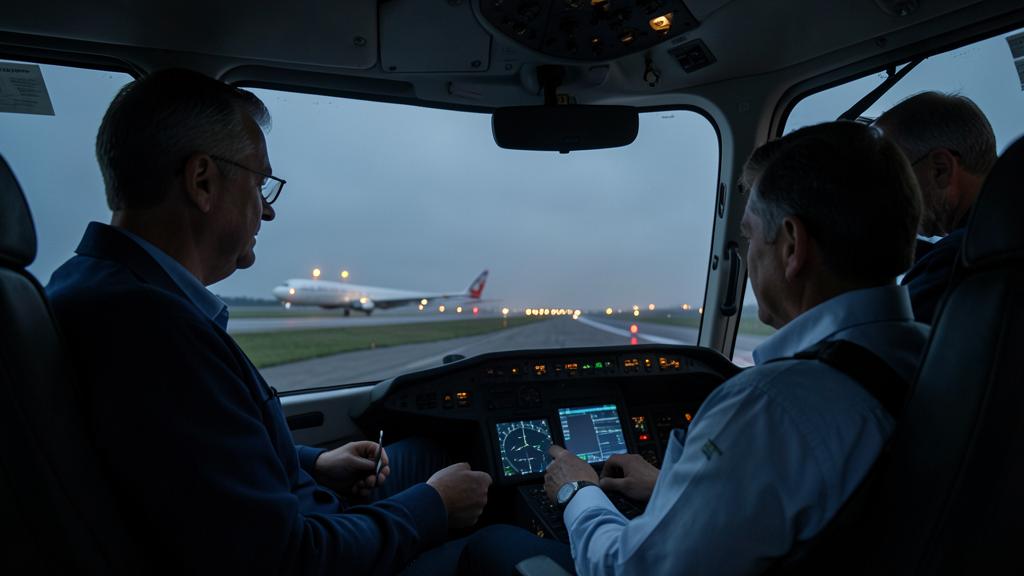
Base training. Where a type rating course is not conducted as a zero flight time course, its take-offs and landings are flown in the aeroplane after the simulator phase. The minimum number is set by the approved course, not by folklore, and it requires an instructor holding the appropriate privileges, an aircraft released from the schedule, an airfield that will accept repeated circuits, and no passengers on board.
Line flying under supervision. Real sectors, real passengers, real dispatch pressure, real weather, and a commander training you while operating a commercial flight. Nothing in a device reproduces the part of the job that consists of being late, being interrupted, and deciding anyway. The sector count comes from the operator’s approved programme and it is flown at the operator’s tempo.
The line check. By definition it takes place on a normal line flight, with an examiner in the aircraft. It cannot be anticipated in the simulator and it cannot happen until the sectors before it have happened.
On-aeroplane upset recovery, where it applies. Part-FCL makes an advanced upset prevention and recovery training course a prerequisite for certain first type rating courses, and its flight instruction is flown in an aeroplane rather than in a device. It touches a return only when that return runs through a new rating rather than the revival of one you already hold; when it does, it is an aircraft item and no amount of device time buys it.
Recency landings — the exception in this list. These are not aircraft-only, and it is worth saying so plainly. European licensing rules allow the three take-offs, approaches and landings to be flown either in the aircraft or in a full flight simulator representing the type or class; other authorities attach their own conditions to the same idea. What varies is the qualification of the device, the approval under which the credit is claimed, and whatever narrower rule your operator has chosen to impose on top of the licensing minimum. Ask your training department for the reference that applies to you rather than assuming, and note that what an American colleague tells you about landing currency under their rules does not transfer.
| Item | Device or aircraft | The real constraint |
|---|---|---|
| Instrument approaches, holding, scan rebuild | Device | Slot availability only; can be flown at night |
| Rejected take-off, engine failure, fire, depressurisation | Device, and only the device | Instructor availability |
| Operator proficiency check | Device | An examiner, and the refresher training that must precede it |
| Base training take-offs and landings | Aircraft | Aircraft off the schedule, qualified instructor, circuit-tolerant airfield, weather |
| Line flying under supervision | Aircraft, in revenue service | Rostered sectors with a line training commander; the airline’s own schedule |
| Line check | Aircraft, in revenue service | An examiner on a normal sector, after the sectors are complete |
| Aerodrome competence for the higher categories | Device briefing or an actual visit, depending on the categorisation | The operator’s approved aerodrome categorisation, which is specific to that operator |
The device’s certificate decides, not its cockpit
A crew reporting to a training centre sees a full-size flight deck with a wraparound visual and reasonably assumes it will be credited for whatever is being flown. What actually decides is the qualification certificate hanging on the wall and the level written on it. A device qualified at one level may be used for procedures and for recurrent training but not for a check; another may be used for the check but not for the landings that restore recency; a third may be approved for one operator’s programme and not for yours, because the approval attaches to the training programme as much as to the machine.
Two consequences follow. First, ask what the device is qualified for before you plan around it, and ask in writing — a training centre’s sales material is not an approval. Second, if a device is downgraded or its certificate lapses between the booking and the session, the session may still be useful training but may no longer be creditable. That happens, and it happens late, which is why a return-to-line plan should never have exactly zero margin on the item that must be credited.
The ladder of lapse: the longer it has been, the less you choose
The regulatory response to an absence is graduated, and the graduation is the reason two pilots with the same gap can face very different programmes. Inside validity, you revalidate: a proficiency check, and the rating continues. Once a rating has expired, you are in renewal, and renewal is not simply a late check — it requires refresher training whose content is determined after an assessment by an approved training organisation, and the organisation, not you, decides how much.
Past a longer threshold the authority itself may take an interest and impose additional requirements. Theoretical knowledge has its own clock, running on rules that are not the same as the ones governing the rating, and reviving it is a different exercise entirely. None of these thresholds should be quoted from memory: they depend on the rating, on the state of licence issue, and on amendments that have moved more than once. The behaviour to remember is the shape, not the figures — the further past expiry you are, the more the decision about your programme passes out of your hands and into the training organisation’s, and then into the authority’s.
| Position | What is required | Who decides the content |
|---|---|---|
| Still valid | A proficiency check within the window | Fixed by the rule; you choose the date |
| Expired, recently | Refresher training, then a proficiency check for renewal | The approved training organisation, after assessing you |
| Expired, at length | Refresher training, possibly extended; a check; potentially further requirements | The training organisation, with the authority involved |
| Theoretical knowledge lapsed | A separate process with its own rules and its own timescale | The authority |
The critical path runs through the aircraft, every time
Draw the plan as a dependency chain and the shape becomes obvious. Medical, then assessment, then refresher training, then the check, then base training if the course requires it, then the supervised sectors, then the line check. Everything up to the check is elastic: simulator slots exist at three in the morning, instructors can be found, a session can be moved by a day without consequence. Everything after it is rigid, because it consumes revenue flying.
A supervised sector needs a real flight, going to a real destination, commanded by one of the small number of line training captains the operator has, on a day when the roster allows the pairing. Base training needs an aeroplane that is not earning money and an airfield willing to accept an hour of circuits. Neither can be compressed by paying more or working harder, and both are the first things sacrificed when the airline has an operational problem. That asymmetry is why an honest plan quotes a range for the aircraft phase and a date only for the simulator phase.
It also changes how you should read a training department’s estimate. « Four simulator sessions » is a statement about the elastic half of the plan. The question that determines your return date is how many supervised sectors are required, how many line training commanders are available on your fleet, and where you sit in the queue behind the new joiners — who are competing for exactly the same resource.
The right reflex. Build the calendar backwards from the aircraft items, not forwards from the simulator ones. Fix the earliest realistic line check date, work back through the supervised sectors at the fleet’s actual throughput, and place the simulator programme so that the check lands just before the first available sector — not weeks before it, where the freshly rebuilt competence sits and decays while you wait for a roster.
Two habits that shorten a return
- Evidence first. The burden of demonstrating recency falls on the pilot, and a logbook that stops mid-page turns a formality into an argument. Reconstruct the record before the first meeting: dates, types, capacities, take-offs and landings, checks and their expiry dates, and the medical. A training manager who can see the position in one page can schedule you; one who cannot will schedule the assessment that establishes it, and that assessment costs a fortnight.
- Ask which half of the plan each element belongs to. When a date is offered, ask whether it depends on a device or on an aeroplane, and if on an aeroplane, on whose aeroplane and whose roster. The answers tell you where the risk sits and what a delay elsewhere will actually cost you. Pilots preparing a return after a long absence trade a good deal of this scheduling reality between themselves on the FL330 forums, and the operator-specific detail there is often more current than a published policy.
Neither habit is regulatory. Both come from the same observation: the paperwork and the simulator are the parts of a return you can control, and the aircraft is the part you cannot, so the effort belongs where it buys margin against the items that will not move.


Leave a Reply
You must be logged in to post a comment.