
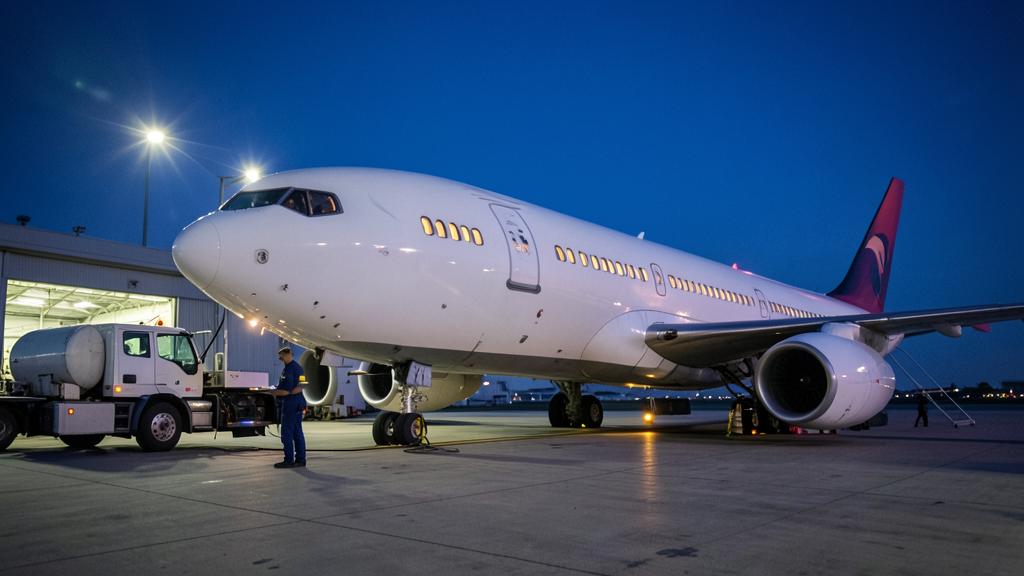
Tankering is one of the few flight-preparation decisions where the arithmetic is genuinely simple and the practice is genuinely difficult. Buying fuel where it is cheap and carrying it to where it is expensive looks like arbitrage, and on the right pair of stations it is. But carrying fuel costs fuel, the penalty accumulates over every hour of the sector, and it is heaviest in the climb, which the aircraft flies already burdened by the very fuel it is carrying for later. There is therefore a price ratio below which the exercise is a net loss dressed up as a saving, and that ratio is calculable in one line. What makes tankering hard is everything the one line leaves out: the fees hidden inside a posted price, the landing weight limit, the payload you could not carry, and a carbon bill that in several jurisdictions now arrives as cash.
What is actually being bought and sold
Strip the operation to its transaction. At the departure station you buy an extra quantity of fuel that the flight plan does not require. Over the sector, some of that extra quantity is consumed purely because it was aboard — you burned fuel to carry fuel. What survives to the ramp at destination is fuel you do not have to buy there.
Three quantities describe this completely. Q is the extra fuel uplifted, in kilograms. P_dep and P_arr are the marginal delivered prices at the two stations, per kilogram. And f is the fraction of Q that the sector consumes as a carriage penalty — the number that does all the work, and the one people guess.
Note what is not in that list. Tankered fuel is not a reserve, it is not contingency, and it is not extra safety. It is a cargo of fuel that happens to be stored in the tanks, and treating it as anything else corrupts both the economics and the fuel records.
The break-even, in one line
The cost of the operation is what you paid at departure: Q × P_dep. The benefit is what you did not have to buy on arrival, which is the surviving quantity at the arrival price: Q × (1 − f) × P_arr. The net gain is the difference:
gain = Q × [ (1 − f) × P_arr − P_dep ]
Set the gain to zero and Q falls out of the equation entirely, which is the first useful result: whether tankering pays does not depend on how much you tanker. It depends only on the price ratio and the carriage penalty — provided the penalty itself does not move with the quantity, an assumption the cruise-level step described below can break. Break-even is reached when
P_arr / P_dep = 1 / (1 − f)
That single expression is the whole economic argument. It says that the arrival station must be more expensive than the departure station by strictly more than the carriage penalty implies — and because the relationship is a reciprocal rather than a subtraction, the required premium grows faster than the penalty does.
Carriage penalty f |
Required price ratio P_arr / P_dep |
Destination must be dearer by |
|---|---|---|
| 5 per cent | 1.053 | 5.3 per cent |
| 10 per cent | 1.111 | 11.1 per cent |
| 15 per cent | 1.176 | 17.6 per cent |
| 20 per cent | 1.250 | 25.0 per cent |
| 25 per cent | 1.333 | 33.3 per cent |
| 30 per cent | 1.429 | 42.9 per cent |
Tankering only makes sense if the fuel at the destination is much more expensive than at the departure. The extra cost of carrying the fuel (the “carriage penalty”) must be smaller than the price difference. For example, if carrying fuel burns 10% extra, the destination fuel must be at least 11.1% more expensive to break even.
An Airbus A320 flying from Paris to London (a 1-hour flight) with a 5% carriage penalty needs the London fuel price to be at least 5.3% higher to make tankering worthwhile. If Paris fuel is $1.00/kg and London is $1.06/kg, tankering saves money. But if the flight is 8 hours with a 30% penalty, London would need to be 42.9% more expensive ($1.43/kg), which is rare.
Read the bottom row before the top one. On a long sector, where the penalty approaches a third, the destination has to be more than forty per cent dearer before a single kilogram is worth carrying. Price differentials of that size exist — they are usually the product of duty, local taxation or a monopoly supplier — but they are far rarer than the differentials that tempt people into tankering on sectors where the arithmetic never had a chance.
The trap. Comparing the price difference with the penalty as if they were both percentages of the same thing. A ten per cent penalty is not beaten by a ten per cent price advantage; it is beaten by 11.1 per cent, and at a twenty-five per cent penalty the gap between the intuitive answer and the correct one is eight full points of price.
Where the carriage penalty comes from
The penalty exists because a heavier aircraft must fly at a higher lift coefficient to hold the same speed and level, and its drag rises with it — chiefly through the induced component, which grows with the square of the lift. The usual working model treats the burn attributable to carried mass as a fixed rate per hour applied to the mass still aboard, which gives an exponential decay: the extra fuel erodes itself, quickly at first and more slowly as it shrinks.
Written out, f = 1 − exp(−k × T), where T is the sector time in hours and k is the cost-to-carry rate. For transport jets, k is typically a few per cent per hour, and it is strongly type-dependent, altitude-dependent and weight-dependent. It is not a number to invent: manufacturers publish cost-to-carry data, and operators derive their own from flight-data monitoring, which is always better because it reflects the actual fleet, the actual cruise levels and the actual routes.
| Sector time | k = 3 per cent per hour |
k = 4 per cent per hour |
k = 5 per cent per hour |
|---|---|---|---|
| 1 hour | 3.0 per cent | 3.9 per cent | 4.9 per cent |
| 2 hours | 5.8 per cent | 7.7 per cent | 9.5 per cent |
| 4 hours | 11.3 per cent | 14.8 per cent | 18.1 per cent |
| 8 hours | 21.3 per cent | 27.4 per cent | 33.0 per cent |
Combine the two tables and the shape of the answer appears. On a one-hour sector the destination needs to be a few per cent dearer, which happens constantly, and short-haul tankering is consequently common. On an eight-hour sector you need a premium in the tens of per cent, which is rare and usually indicates something structural about the destination market rather than a fluctuation worth chasing.
The climb is where mass is expensive
The exponential model is a useful first approximation and a poor description of where the penalty is actually incurred. The extra mass is not carried uniformly across the flight. It is carried in full through the climb, which is the phase that pays for potential energy as well as drag, and where the aircraft is furthest from its efficient operating point.
The consequence is that the penalty is front-loaded. Two sectors of the same duration do not incur the same penalty if one has a long cruise and the other is mostly climb and descent — the short, high-cycle sector suffers disproportionately, which is exactly the operation on which tankering is most often attempted.
There is also a discontinuity hiding in the gradient. A heavier aircraft has a lower optimum cruise level and a lower maximum attainable level. If the extra mass pushes the achievable initial cruise level down one flight level band, the aircraft spends the whole cruise at an altitude where it is less efficient — and that penalty is a step, not a slope. It does not appear in a smooth cost-to-carry rate, it can dwarf the modelled penalty, and it is invisible unless the flight planning system evaluates the level assignment at the tankered weight rather than at the planned one.
The right reflex. Before accepting a tankering recommendation, check whether the tankered weight changes the initial cruise level or the first step climb. If it does, the recommendation was computed on the wrong cruise profile and its saving is fictional.
The price is not the price
The other half of the equation is treated with much less suspicion than it deserves. P_dep and P_arr must be marginal delivered prices — what the next kilogram actually costs the company, all in — and the posted product price is only one component of that.
| Item | Effect on the comparison | When it dominates |
|---|---|---|
| Into-plane and throughput fees | Often charged per uplift or per volume with a minimum; can invert a small differential | Small uplifts and stations with high fixed handling charges |
| Duty, excise and local taxation | Usually the reason a genuine differential exists at all | Domestic versus international sectors under different tax regimes |
| Contract volume commitments | Systematically buying elsewhere can breach a minimum volume and raise the unit price for the whole station | Repeated tankering on a rotation, not one-off decisions |
| Hedging and fixed-price contracts | The marginal price may bear no relation to the spot price at either end | Fleets with substantial hedged positions |
| Currency and payment terms | Moves the effective differential after the fact | Volatile currency pairs, long settlement periods |
| Brake, tyre and landing gear wear | A real but small recurring cost of heavier landings | High-cycle short-haul operations |
The third row is the one that catches operators. Tankering is evaluated flight by flight but purchased contract by contract, and a rotation that systematically avoids a station can move that station’s price into a worse bracket. The saving is booked on the flight; the loss appears on the contract, months later, in a different department’s numbers.
Constraints that bind before the economics do
Well before the price ratio becomes the deciding factor, physical and regulatory limits usually decide for you. The optimum tankered quantity is rarely « as much as fits »; it sits at whichever constraint binds first.
- Maximum landing weight is the most common. Arriving above it is not an option, and on a short sector the aircraft has not burned enough fuel to unload the extra.
- Payload is the constraint that costs real money: on a sector limited by take-off weight, every kilogram of tankered fuel is a kilogram of cargo or a passenger not carried, and the revenue foregone will normally exceed the fuel saving by a wide margin.
- Landing performance follows: a higher landing weight means a longer landing distance required and more brake energy absorbed, which matters on a short, wet or contaminated runway and can lengthen the turnaround if a brake cooling time is triggered.
- Structural and centre-of-gravity limits constrain how the extra fuel may be distributed between tanks.
None of these are economic judgements. They are limits, and a tankering recommendation that violates one is simply an invalid computation.
The carbon bill is now a cash bill
The extra fuel burned to carry fuel produces emissions with no transport benefit whatever, which makes tankering the purest form of avoidable burn in the operation. This was for a long time an argument about corporate responsibility. It is now, in several jurisdictions, an argument about money, because emissions from the additional burn fall under emissions trading and offsetting schemes whose allowances have to be bought.
That changes the equation structurally rather than cosmetically: the cost side gains a term proportional to the burned fraction, which means the required price premium rises above the value in the first table. European work on the subject has found that a substantial share of tankering performed for marginal savings produces emissions out of all proportion to the money involved, and several operators have responded by setting a minimum saving threshold below which tankering is simply not permitted, regardless of what the calculation says. That is a defensible policy: it recognises that the modelling error in f is often larger than the margin being chased.
Keeping the record honest
A tankering programme quietly damages fuel monitoring unless the bookkeeping is disciplined. Tankered fuel must be recorded as tankered fuel on the operational flight plan, separately from contingency fuel, from additional fuel required by the fuel policy and from the discretionary fuel the commander elects to take for operational reasons.
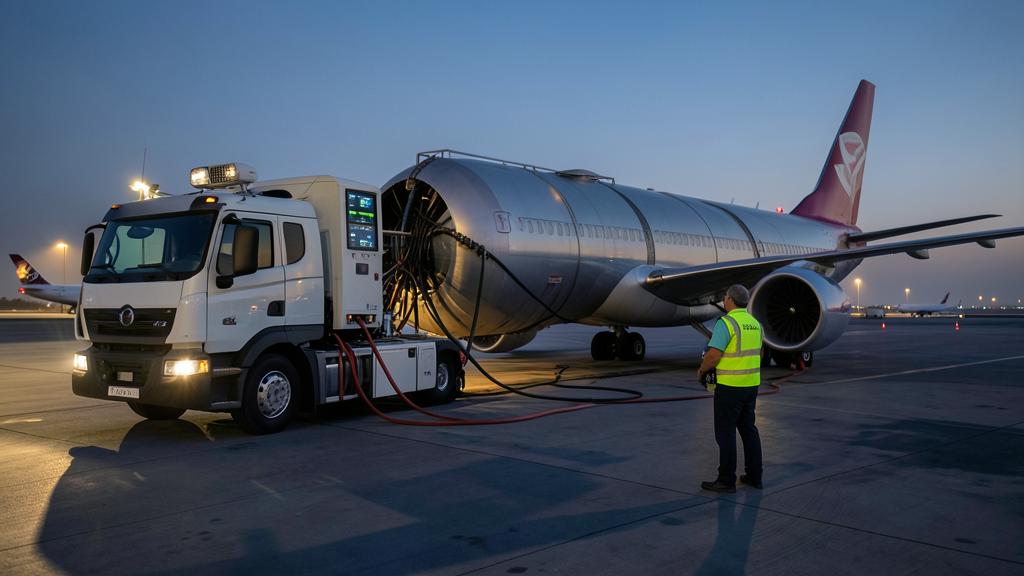
The reason is not tidiness. An operator’s ability to justify its contingency fuel policy — and, where it uses one, its statistical contingency method — depends on a clean record of planned versus actual burn. Fuel carried for commercial arbitrage inflates both the uplift and the arrival fuel, and if it is mixed into the same column it makes the fleet look as though it consistently arrives with more fuel than planned. Decisions then get taken on corrupted data.
The last point is about authority, and it is the one that must never be blurred. Tankering is a commercial optimisation carried out by the operator; the fuel required for the safe conduct of the flight is determined by the fuel policy and, ultimately, by the commander. A tankering recommendation is an input, and the commander may always take more fuel than planned. A recommendation must never be presented, in a system message or in a culture, as a quantity that may not be exceeded — the moment a crew feels that adding fuel requires justifying a lost saving, the programme has stopped being an optimisation and become a pressure. Operators that publish the arithmetic openly, as in the flight-preparation material at FL330 training, tend to have fewer of these conversations, because a crew that can see the break-even is a crew that can see when it does not apply.


Leave a Reply
You must be logged in to post a comment.