

A lateral fuel imbalance is a symptom, and like most symptoms it is compatible with a harmless cause and with a fatal one. The instinct it triggers — restore the balance — is the correct response to the harmless cause and the worst possible response to the other, because it feeds good fuel to the leak. The discrimination does not come from looking harder at the two tank gauges. It comes from a different question entirely: has fuel left the aircraft? Two arithmetic checks answer it, and the order in which the actions follow is not a matter of taste.
Three causes, one indication
The gauges show a difference between tanks. That difference can be produced in three quite distinct ways, and the display looks the same in all three.
The first family is differential consumption. Two engines at the same thrust lever position do not burn identically: bleed demand differs when one pack is off or one engine is supplying wing anti-ice, thrust is asymmetric when the aircraft is trimmed against a drag asymmetry, and engines at different points in their service life have different specific consumption. This family is slow, small, and roughly stable in rate.
The second family is fuel that has not moved as intended. A transfer valve that did not open, a scheduled centre or trim tank transfer that did not occur, a failed boost pump, fuel that is present but trapped. Nothing has been lost; it is in the wrong place. This family often appears abruptly, at the moment a transfer was scheduled, and then holds a roughly constant offset.
The third family is fuel that is no longer on the aircraft. A tank or line rupture, a leak at the pylon or in the engine fuel system, a vent that is discharging overboard. This family is the only one that gets worse with time and the only one for which the balancing action is actively harmful.
A fourth possibility is not really an imbalance at all: the gauging system itself may be wrong. A probe or channel fault can display a difference that does not exist. It is uncommon, but it is the case that makes the aircraft’s own behaviour a useful witness.
| Cause | Typical onset | Rate behaviour | Total fuel on board | Aircraft behaviour |
|---|---|---|---|---|
| Differential consumption | Gradual from early cruise | Slow, steady, small | Matches expectation | Minor trim change as it builds |
| Transfer or feed failure | Often abrupt, at a scheduled event | Offset stops growing | Matches expectation | Trim change consistent with real imbalance |
| Leak overboard, upstream of the flow meter | Any time | Grows, may accelerate | Deficit that increases | Trim change consistent with real imbalance |
| Leak downstream of the flow meter | Any time | Grows | Appears normal against gauges and totaliser | Abnormal fuel flow for thrust set |
| Gauging fault | Any time, often with a system message | Erratic or implausible | Inconsistent with flight plan burn | No trim change at all |
The only question worth asking first
Stop comparing the tanks to each other. Compare the aircraft to itself.
Two independent measurements exist on board. The fuel quantity indicating system gauges what is in the tanks. The fuel flow transmitters measure what passes to the engines and integrate it into fuel used. They share no sensors and no common failure mode, and that independence is the whole basis of the test.
Fuel on board now, plus fuel used since engine start, should equal the fuel that was on board at engine start. If that sum holds within the tolerance of the two systems, nothing has left the aircraft: whatever is wrong is internal, and it is an imbalance or a gauging problem. If that sum is short, and the shortfall grows the next time you run it, fuel is leaving the aircraft. That is the discrimination, and on any aeroplane that displays fuel used it needs no equipment beyond a pen.
Two conditions make it work. The anchor figure has to be trustworthy — the fuel confirmed at engine start, not an estimate — and the interval has to be long enough for the trend to rise above the tolerance of the gauging system. A single reading proves nothing, because a few hundred kilograms of apparent deficit sits comfortably inside normal indication error on a large aircraft. Two readings separated by a defined interval, written down with the times, produce a rate. The rate is the answer.
The right reflex. Write it down. Time, gauged total, fuel used, flight plan figure for that waypoint. Three lines, ten minutes apart. A trend on paper survives a busy flight deck, a change of pilot flying and a handover to the relief crew; a number remembered does not.
If the total fuel on board plus the fuel used doesn’t match the fuel you started with, something is leaking. If it matches, the imbalance is just fuel in the wrong place or a gauge error. You need to check twice to be sure, because a small leak can hide in normal fuel measurement errors.
On an Airbus A320, if the fuel gauges show 10,000 kg in the left tank and 8,500 kg in the right tank, and the total fuel used since takeoff is 3,000 kg, but the starting fuel was 18,000 kg, the math should be 10,000 + 8,500 + 3,000 = 21,500 kg. If the starting fuel was 21,500 kg, the numbers match, and the imbalance is just fuel in the wrong place. But if the starting fuel was 22,000 kg, the math is off by 500 kg, meaning 500 kg of fuel has leaked out.
Where the flow meter sits, and why it changes the answer
The totals test has one blind spot, and it is worth understanding rather than memorising.
The fuel flow transmitter sits in the engine fuel supply. Everything it measures is counted as used. Fuel that escapes upstream of it — from a tank, a wing, a line in the wing or pylon — is never counted, so it shows up immediately as a deficit in the totals test. Fuel that escapes downstream of it, inside the engine, has already been counted as burned. The books balance perfectly while fuel pours out of the nacelle.
The second test catches that case. Compare the two engines’ fuel flow at the same thrust setting, and compare the total burn against the flight plan. An engine leaking downstream of its flow meter demands more fuel than its twin for the same thrust, and the sector burn runs ahead of plan without a wind or level explanation. So the pair of tests covers the aircraft: the totals test finds fuel lost from the tanks and lines, the flow comparison finds fuel lost from the engine.
| Test | What it detects | What it misses | What fools it |
|---|---|---|---|
| Fuel on board plus fuel used, against the anchor figure | Any loss upstream of the flow transmitters | A leak inside the engine | A wrong anchor figure; too short an interval; gauging tolerance |
| Fuel flow compared between engines at matched thrust | A leak downstream of the flow transmitters | A symmetrical loss, and any tank or wing leak | Unmatched bleed configuration; anti-ice on one side; asymmetric thrust |
| Burn compared against the operational flight plan | An overall excess consumption of any origin | The distinction between causes | Wind, level, weight and temperature deviations from plan |
| Roll trim and control demand | Whether the displayed imbalance is physically real | Anything symmetrical | Autopilot masking; genuine aerodynamic asymmetry |
What the aeroplane tells you that the gauge does not
An imbalance of any size is mass placed asymmetrically about the roll axis, and the aircraft compensates for it. The compensation is visible: aileron or spoiler deflection, roll trim, or simply the autopilot holding a control demand it did not need an hour ago. If the display shows a substantial imbalance and the aircraft is flying with no lateral trim demand at all, the imbalance is more likely to be in the indication than in the wing.
The cross-check is free, but it is not a licence to ignore the display. It narrows the field; it does not close it. The correct conclusion from a suspected gauging fault is that you now have an unreliable fuel indication, which is its own problem with its own procedure, and not that the numbers can be dismissed.
The cabin is the other instrument. Fuel leaving a wing or a pylon in cruise usually leaves a visible trail of vapour or a wetted streak, and the people best placed to see it are sitting at the windows. A crew member sent to look, with a specific instruction about which side and what to look for, produces an answer in two minutes. Fuel odour in the cabin is a second and independent signal. Neither replaces the totals test, and neither should be waited for: a leak can be perfectly invisible from inside.
The trap. Balancing before the leak has been ruled out is the error that has ended flights. In August 2001 an Airbus A330 over the North Atlantic developed a leak in the fuel system of one engine; the crew treated the resulting imbalance as an imbalance and opened the crossfeed, transferring fuel from the intact side into the side that was losing it. Both engines eventually flamed out and the aircraft was glided to a landing in the Azores. It was the intuitive response to what the gauges appeared to be showing, and it is exactly the response that the leak caution inside an imbalance procedure exists to prevent.
Rate, not quantity
Once a leak is established, the number displayed on the fuel page stops being planning information. It is a snapshot of a quantity that is falling for two reasons at once, and only one of them is under your control.
Plan on the rate. Take the measured loss over the interval you timed, convert it to an hourly figure, and add it to the planned burn for every leg of the diversion you are considering. Then apply a margin, because a structural leak has no reason to stay constant: an opening in a wing skin or a fatigued line can enlarge, and a rate that doubles halfway to the alternate turns a comfortable arrival into a critical one.
The corollary is uncomfortable. Fuel remaining is no longer a reserve you can spend deliberating with. Every minute spent deciding is charged twice — once at the normal burn and once at the leak rate — so an early decision costs less than the same decision reached correctly but late.
The action order, and the action that must wait
The sequence below is the reasoning, not a substitute for the type procedure. The checklist for your aircraft is the authority, and it exists precisely because the right isolation action is type-specific.
- Note the time, gauged total, fuel used and flight plan figure. Do not act yet.
- Leave the crossfeed closed. Leave transfers alone. This is the single instruction that costs nothing if you are wrong and saves the flight if you are right.
- Run the totals test over a defined interval and compare the two readings.
- Compare fuel flow between engines at matched thrust, with the bleed and anti-ice configuration noted, and compare the burn against plan.
- Send someone to look at the wings and pylons, and ask about fuel odour in the cabin.
- If the totals hold and the flows match, treat it as an imbalance or a transfer problem and follow the balancing procedure, monitoring the totals throughout.
- If fuel is being lost, run the leak procedure for the type. Isolation is type-specific: shutting down an engine will stop a leak in that engine’s fuel system, and will do nothing at all for a leak in a wing tank. Some procedures allow feeding both engines from a leaking tank to consume fuel that would otherwise be lost. Those decisions belong to the checklist.
- Divert to the nearest suitable aerodrome, recomputing with the leak rate and a margin, and tell air traffic control what is happening in terms they can act on.
Step six deserves one more sentence. Following the balancing procedure is not the end of the investigation; it is a hypothesis under test. Keep running the totals during the balancing action, because a leak that was slow at the time of the first test will announce itself in the next one, and the crossfeed is still open.
Why extended operations change the arithmetic
On an extended-range sector the fuel plan is not a comfortable estimate with a reserve stapled to it. The critical fuel scenario, the equal-time points and the diversion times were all computed with an assumption that no longer holds, which is that the aircraft consumes fuel only through its engines. A confirmed leak invalidates the entire fuel plan, not one line of it.
Two consequences follow. The equal-time point itself does not move — it is fixed by speed and wind, not by fuel — but the point beyond which a given alternate is still reachable with the fuel remaining moves towards you the whole time, so the diversion that was affordable when you started thinking may not be when you finish. And a fuel leak sits squarely in the category of events for which the operator’s extended operations procedures require a diversion to the nearest suitable aerodrome, rather than a continuation on the grounds that the destination is still theoretically within reach.
That is the practical reason the discrimination has to be quick as well as correct. Over an ocean, the cost of a slow diagnosis is not measured in fuel; it is measured in the alternates that stop being options while the diagnosis is under way. Crews who want to rehearse the reasoning rather than meet it for the first time in cruise will find fuel system scenarios in the operational courses at FL330 training.
Anchoring the number before you leave the ground
The totals test is only as good as the figure it starts from, and that figure is set on the ground.
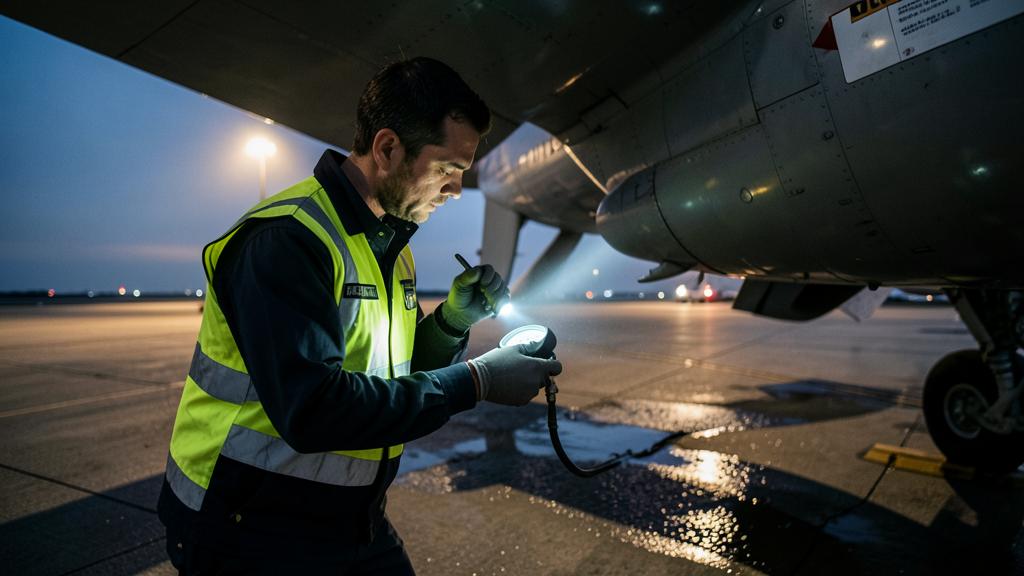
The routine check is worth doing properly rather than initialling: the gauged quantity after refuelling should agree with the quantity before refuelling plus the uplift shown on the bowser or hydrant ticket, allowing for the density conversion between the volume delivered and the mass indicated. A discrepancy found there is a dispatch matter, and it is also a warning: an aircraft that departs with an anchor figure you do not believe cannot run the leak test in flight, because every result will be ambiguous.
Two ground-level items belong here too. Fuel found on the ramp under an aircraft, or a wet patch noted on the walkaround, is a leak until maintenance says otherwise, and the fact that it is small is not evidence about what it will do at cruise pressure and temperature. And overfilling during refuelling can push fuel into a surge tank and out of the vent, which produces a real loss overboard, on the ground, with no system fault at all — the discrepancy check is what catches it before it becomes a puzzle at cruise level.


Leave a Reply
You must be logged in to post a comment.