
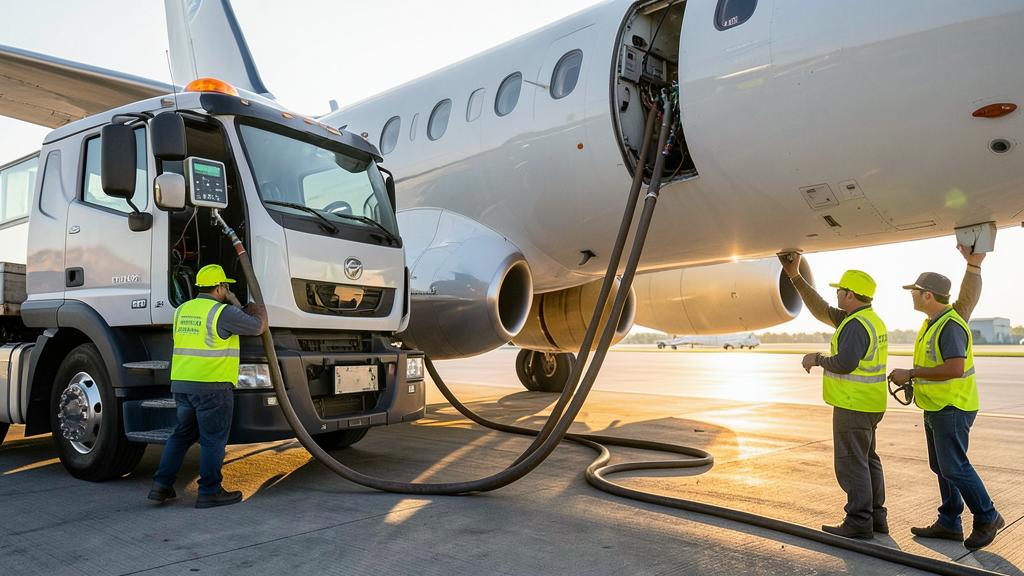
The flight plan is written in kilograms, the truck delivers litres, and nothing in between is a constant. Density varies with the batch and with the temperature of the fuel at the moment it passes the meter, which means the same uplift figure can represent noticeably different masses on the same aircraft on the same day. Most of the time the discrepancy is absorbed silently. The cases where it is not are the ones worth understanding before they arrive.
Two systems measuring two different things
Refuelling puts two measurement systems face to face, and they do not measure the same quantity. The truck or the hydrant meter measures a volume. The aircraft, on modern types, is trying to know a mass: capacitance probes read the fuel level and its dielectric properties, a densitometer, where one is fitted, supplies the density in the tank, and the fuel quantity indicating system computes the result the crew actually needs. Between a volume and a mass sits a single number, density, and everything that follows is about where that number comes from and how wrong it can be.
This is not a marginal conversion. Fuel is generally the largest single variable mass on board, and the figure derived from it goes straight into the takeoff mass, the speeds, the thrust setting, the runway calculation and the trim. An error in the density used is not a rounding issue; it is a systematic bias applied to the largest number on the loadsheet that was not weighed.
The best-known illustration of what happens when the conversion goes wrong remains the wide-body that ran out of fuel over Canada in 1983, after a density figure expressed in pounds per litre was applied where kilograms per litre were required. The mechanism was not exotic. Two units, one conversion, no independent cross-check.
Batch first, temperature second
Two separate effects move density, and they do not have the same magnitude.
The first is the fuel itself. The specification for Jet A-1 admits a range of density at 15 °C — roughly from 0.775 to 0.840 kilograms per litre — and refineries deliver across that range depending on crude, process and blending. That is a spread of about eight per cent between the lightest and the heaviest fuel that both fully meet the specification. Nothing is wrong with either; they are simply not the same fuel.
The second is temperature. Kerosene expands when warmed, and its density falls by roughly 0.0007 kilograms per litre for each degree Celsius, refined by the petroleum measurement tables according to the density group of the product. Across a realistic spread of delivery temperatures — a cold morning in northern Europe against an afternoon on a tropical apron where the fuel farm and the hydrant line have been sitting in the sun — that produces a few per cent.
The consequence is worth stating plainly. Temperature is the effect crews think about, because it is visible and intuitive. The batch is the larger effect, and it is invisible unless somebody reads the ticket.
| Fuel temperature at the meter | Approximate density | Mass actually loaded | Difference from a 0.800 assumption |
|---|---|---|---|
| 5 °C | 0.807 kg/l | about 16 140 kg | about +140 kg |
| 15 °C | 0.800 kg/l | 16 000 kg | reference |
| 25 °C | 0.793 kg/l | about 15 860 kg | about −140 kg |
| 35 °C | 0.786 kg/l | about 15 720 kg | about −280 kg |
Fuel density changes based on two things: what batch of fuel you get (which can vary by up to 8%) and how warm or cold it is (which changes by about 0.07% per degree). Most pilots focus on temperature, but the batch difference is actually bigger and harder to spot.
An Airbus A320 needs 16,000 kg of fuel for a long flight. If the fuel is delivered at 5°C (density 0.807 kg/l), the truck will actually load 16,140 kg. If it’s delivered at 35°C (density 0.786 kg/l), only 15,720 kg will be loaded. That’s a difference of 420 kg just from temperature, before considering batch differences.
This table is an illustration built from one assumed fuel and one order-of-magnitude coefficient; it is not a conversion table and must not be used as one. Its only purpose is to show the shape of the effect: some four hundred kilograms of spread across a thirty-degree range on a mid-sized uplift, before the batch density has been considered at all. Change the batch as well, and the same twenty thousand litres can differ by well over a tonne between two entirely compliant fuels.
Volume is the limit, mass is the plan
Flight planning produces a fuel requirement in mass, because mass is what determines performance and what burns at a rate the aircraft knows. Tanks, however, are a fixed volume. That mismatch has a practical consequence that is easy to miss on a warm day: a lighter fuel means more litres are needed to reach the planned mass, and the tanks may simply not hold them.
This is the mechanism behind the discovery, at the end of a refuelling, that the aircraft is full and the fuel figure is still below the plan. Nothing has failed. The aircraft has reached its volumetric limit with fuel that carried less mass per litre than the planning assumed. On a long sector planned close to maximum fuel, on a hot apron, with a light batch, the three effects work in the same direction.
The reverse case matters too. Tanks are designed with expansion space, and cold fuel loaded to a level indication will occupy more volume as it warms on the ground. This is normal and provided for; it becomes relevant when a long turnaround in the sun follows a full uplift of cold fuel.
The trap. Applying a density measured at 15 °C to a volume that was delivered at ambient temperature. Some meters deliver gross volume at delivery temperature, others deliver volume corrected to a reference temperature, and the ticket may quote density at 15 °C in either case. Mixing the two produces an error the size of the correction that temperature deviation implies — systematically, on every uplift, at that airport, in that season, in the same direction. It is the kind of bias that never looks like a mistake.
What the gauges are actually telling you
On a modern transport the fuel quantity system is not a level gauge with a conversion bolted on. Capacitance probes distributed through each tank respond to the fuel between their plates, a densitometer, on types that carry one, measures the product in the tank, and the processing produces a mass. That is why the indication continues to make sense as the aircraft climbs, as fuel cools, and as attitude changes: the system was designed around the quantity the crew needs rather than the one that is easy to measure.
Two practical points follow. The first is that the gauges and the fuel ticket are, in principle, independent measurements of the same uplift — which is precisely what makes the comparison between them worth making. The second is that the indication takes time to settle after refuelling. Fuel arriving at a different temperature from the fuel already on board does not mix instantly, and a system reading a stratified tank will move for a while after the hose is disconnected. A cross-check performed too early on a large uplift will show a discrepancy that resolves itself, and chasing it wastes time that the turnaround does not have.
| Source | Measures | Needs density for | Where it goes wrong |
|---|---|---|---|
| Fueller meter and ticket | Volume delivered | Converting the uplift to mass | Wrong temperature reference, default density, unit confusion |
| Aircraft fuel quantity system | Level and dielectric, with in-tank density | Nothing, on types with a working densitometer | Probe or densitometer faults, unsettled fuel after uplift |
| Magnetic level indicators or drip sticks | Level only | Everything: the conversion is the whole measurement | Aircraft attitude, wrong density, misread table |
When the gauge is gone, density becomes primary
The third line of that table is where the subject stops being academic. With a fuel quantity system unserviceable and dispatch under the minimum equipment list, the fuel on board is established from level indicators read under the wing, converted through the tables in the flight manual. Those tables take aircraft attitude as an input, because a level reading depends on how the aircraft is sitting, and they take density, because the table converts a volume.
In that configuration there is no independent check left. The density used is not a refinement of a figure the aircraft already knows; it is the figure. This is the one situation where insisting on the measured density from the fuel ticket, at the right temperature reference, is not diligence but a requirement of the method — and where an assumed default value quietly becomes an assumption about the whole fuel state.
Where the error lands
A density error does not distribute itself evenly across the paperwork, and knowing where it lands tells you what to look at.
Zero fuel mass is untouched: it contains no fuel by definition, so an uplift error leaves the aircraft’s dry loading exactly as computed. Takeoff mass takes the error directly, and everything derived from takeoff mass moves with it — the speeds, the thrust or flex setting, the runway limit, the climb performance. On a wide-body a few hundred kilograms is small against the total; on a regional aircraft or a business jet the same absolute error is a much larger fraction of the takeoff mass, and the performance consequence scales accordingly.
The balance effect is usually the smaller one. On most transport aircraft the wing tanks sit close to the centre of gravity, so a fuel mass error moves the balance less than an equivalent error in payload would. It does not move it by nothing, though: the loadsheet builds the takeoff balance from an index in which fuel has its own contribution, and types with active fuel transfer or a trim tank manage the centre of gravity through fuel deliberately. The general rule holds — the mass error is the significant one, the balance error is the secondary one — but the general rule is not the flight manual.
| Where | What happens | Detectable by |
|---|---|---|
| Flight planning | Planned mass converts to a volume the tanks may not hold | Refuelling stopping short of the planned figure |
| Loadsheet takeoff mass | Speeds, thrust setting and runway limit computed from a false mass | Uplift-versus-gauge comparison, before the doors close |
| Balance | Fuel index contribution slightly wrong; larger on types managing fuel for balance | Comparison of zero fuel and takeoff balance figures |
| Fuel on board after uplift | The starting point of every subsequent fuel check is offset | In-flight comparison of fuel used against fuel remaining |
| Dispatch on level indicators | The whole fuel state rests on one unverified number | Nothing on board; only the ticket and the method |
The cross-check that actually catches it
The check is arithmetic and takes less than a minute. Fuel on board before refuelling, plus the uplift converted to mass with the density from the ticket, should equal fuel on board after refuelling as indicated by the aircraft. The operator sets the tolerance, and it belongs in the operations manual rather than in a crew member’s memory.
What makes the check work is that the two sides are independent. The left-hand side comes from a meter on the ground and a density on a piece of paper; the right-hand side comes from probes in the tanks. When they agree, both the uplift and the aircraft indication are supported. When they disagree beyond tolerance, something specific is wrong — a wrong density, a wrong temperature reference, a unit error, a probe fault, fuel that has not settled, or fuel that has gone somewhere it should not have — and each of those has a different answer.
The check that does not work is comparing the ticket to the flight plan. Both are expressed in mass and both can be built on the same assumed density, so they will agree with each other while being equally wrong. Two figures derived from one assumption are one figure.
The right habit. Ask for the density on the ticket, and ask at which temperature it applies. Both questions take a few seconds at the truck and they are what turns the uplift from an assumption into a measurement. If the answer is a default value rather than a measured one, that is useful information in itself: it tells you the ground side is assuming as well, and that the cross-check against the gauges is now the only real check in the chain.
What this means for daily practice
None of this argues for treating every refuelling as a metrology exercise. On the large majority of sectors the density is close to the assumed value, the discrepancy falls well inside tolerance, and nothing needs to happen. The point is to know which situations remove the safety net: dispatch on level indicators, a full-tank uplift on a hot apron, an unfamiliar supplier, a fuel ticket without a measured density, or any change of units between the plan and the truck.
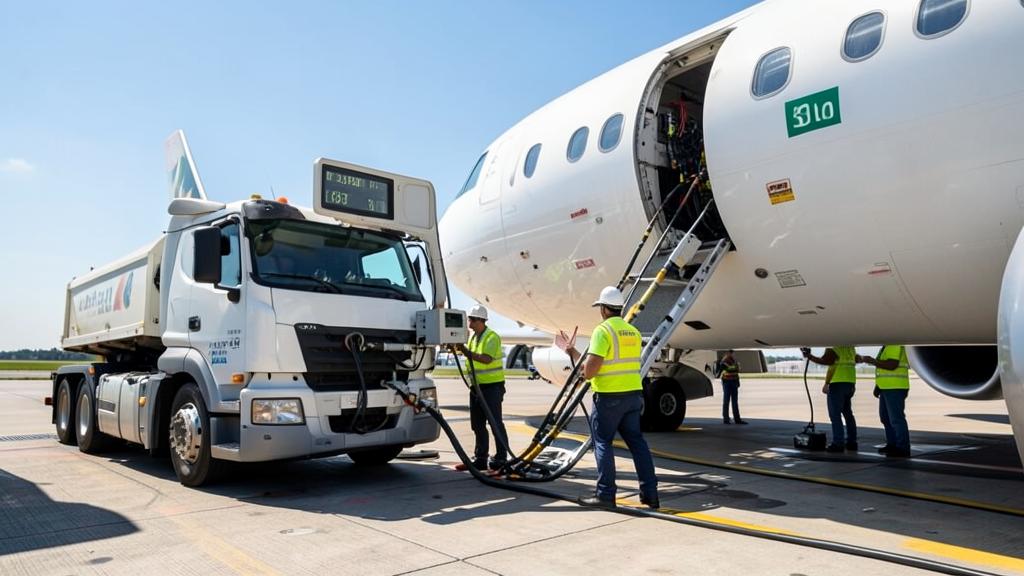
In those cases the density is not a detail on a receipt. It is the coefficient linking the only quantity the ground can measure to the only quantity the aircraft can use, and its provenance deserves the same attention as any other number that goes onto the loadsheet without being weighed. Mass and balance sequences and the fuel checks that go with them are worked through in detail in the operational courses on formations.fl330.com.


Leave a Reply
You must be logged in to post a comment.