
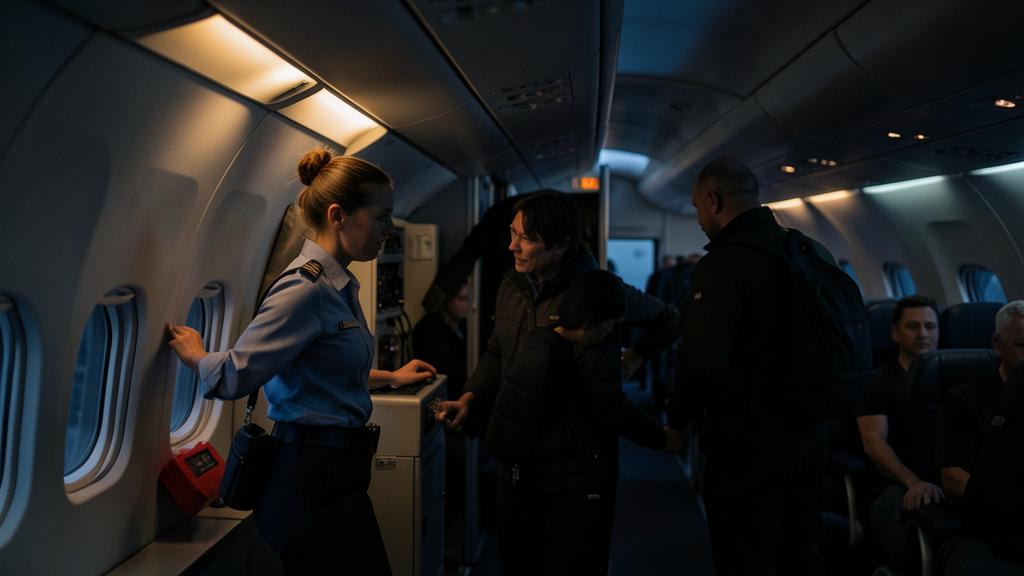
A turnaround is sold to the schedule as a duration and lived on board as a sequence. When the duration is cut, the sequence does not compress evenly: some tasks are protected by physics, some by regulation, and some by nothing except the professional conscience of the people performing them. The third category is the one that moves, and it moves onto the cabin crew. There is a point at which that transfer stops being a service problem and becomes a safety one, and it is almost never the point that gets written down.
A turnaround is a critical path, not a stopwatch
Ground time is not one activity but a bundle of chains running side by side, and its length is set by the longest chain rather than by the sum of the work. On a single-aisle aircraft the governing chain is almost always the same: doors open, passengers off, cabin made ready, passengers on, doors closed. Everything else — catering, fuelling, water and lavatory servicing, hold loading — is designed to run in parallel with that chain and to finish before it does.
The practical consequence is one that ground staff understand and schedules rarely express: a delay to a parallel task costs nothing until it touches the governing chain, and then it costs minute for minute. A catering truck ten minutes late is invisible if boarding was going to take twenty; the same truck on a compressed turnaround pushes the door closure directly. Hence the puzzling inconsistency crews live with — the same event dismissed one afternoon and treated as critical the next morning.
The cabin crew occupies a particular position in this geometry: it is the only party present for the whole ground time. Cleaners, caterers, fuellers and loaders arrive and leave; the crew is continuous. Anything with no other owner at a given instant defaults to the people still there — a reasonable way to run an operation, right up to the point where the defaulted work carries a defined regulatory scope.
The turnaround is like a race with multiple runners. The slowest runner sets the pace, and if one runner falls behind but doesn’t slow the leader, it doesn’t matter. But if that runner catches up to the leader, the whole race slows down. The cabin crew often ends up picking up the slack when other tasks fall behind, even if it means cutting corners on safety checks.
On a Boeing 737 with a 30-minute turnaround, catering is usually parallel. If catering is 10 minutes late but boarding takes 20 minutes, the delay doesn’t affect departure. But if the turnaround is cut to 20 minutes, the late catering forces the doors to close late, delaying the flight.
Who owns what, and what happens when it slips
Ownership needs to be made explicit, because the argument on the aircraft is usually about ownership without either side saying so. The table below is a generic single-aisle turnaround; the real allocation varies by operator and station, and the version that governs is the one written into the ground handling agreement.
| Task | Normally owned by | On the governing chain? | Effect when it runs late |
|---|---|---|---|
| Disembarkation | Cabin crew and ground staff | Yes | Delays everything downstream, minute for minute |
| Cabin cleaning | Cleaning contractor | Yes | Either the departure slips or the scope is cut |
| Aircraft security check or search | Cabin crew, or a dedicated team | Yes, but invisible | Nothing visible happens — which is the problem |
| Pre-flight safety and emergency equipment check | Cabin crew | Yes, but invisible | Same: no external signal that it was curtailed |
| Catering uplift | Catering contractor | Usually parallel | Becomes critical only once boarding is under way |
| Potable water and lavatory servicing | Handling agent | Parallel | Rarely critical, but a missed service is felt in flight |
| Fuelling | Fuel supplier and flight crew | Parallel, with conditions | Overlaps boarding, and then imposes its own constraints |
| Hold loading and load sheet | Handling agent and flight crew | Parallel, closes late | Holds the doors even when the cabin is ready |
| Boarding | Ground staff and cabin crew | Yes | The chain’s last link, and the one everybody watches |
A pattern falls out of the right-hand column. Every task whose lateness produces a visible signal belongs to somebody else; every task whose lateness produces no signal belongs to the cabin crew. The asymmetry is not a conspiracy — it is what happens when the measurement system watches doors rather than checklists.
The tasks with no witness
Security checks have a defined scope, a defined trigger and no external observer. The first is the aircraft security check. European aviation security law distinguishes a security check — an inspection of the interior areas passengers could have reached, together with the hold — from a security search, a thorough inspection of the interior and accessible exterior. Which applies depends on the aircraft’s history and on whether it has been continuously protected, and the answer sits in the operator’s security programme rather than being decided on the day. Neither is satisfied by having looked around while tidying.
The second is the pre-flight check of safety and emergency equipment: the items, the locations and the serviceability indications listed in the cabin crew manual, allocated by station. It is a finite list, and it takes the time it takes. It is also entirely invisible to the passengers now boarding through the forward door.
Both are natural sinks for compression: they generate no complaint when curtailed. A missing meal produces a passenger. A missing check produces nothing at all — until the day it produces everything.
The trap. The compression is rarely a decision. Nobody says « skip the security check ». What happens is that the cleaners leave eight minutes late, boarding is already at the gate, and the check is performed at walking pace with a stream of passengers coming the other way. The task was not skipped, so nothing feels wrong, and nothing gets reported — but the scope was not covered, and the record says it was.
What reduced cleaning actually removes
Reduced clean is a contractual term with a defined content, and that content differs from what most crews assume. Its purpose is to preserve the appearance of the cabin at minimum cost in time: it protects what a boarding passenger sees and sacrifices what they do not.
| Item | Typically kept in a reduced clean | Why it matters beyond appearance |
|---|---|---|
| Visible litter on seats and floor | Kept | Appearance; also loose-article control in turbulence |
| Seat pocket contents | Emptied of rubbish, contents not verified | Safety briefing card presence is a cabin requirement, not a nicety |
| Under-seat area | Often dropped | Life vest stowage and under-seat baggage restraint depend on a clear space |
| Lavatories and consumables | Partially kept | Waste bin flap and smoke detector are the safety-relevant items, not the soap |
| Galley surfaces and waste | Often dropped | Waste left in a galley becomes an obstruction and a fire load |
| Overhead bins | Rarely opened | Items left in a bin belong to the previous flight — a security question |
| Seat and belt condition | Not inspected | Defects go unreported and travel to the next sector |
None of these is dramatic alone. What matters is the direction: the items dropped from a reduced clean overlap heavily with those a security check is meant to cover and with the defects a crew is meant to report. When cleaning is cut, the crew inherits inspection, not tidying — on a shorter clock.
Catering short-loaded: a service problem that migrates
Catering failures rarely arrive as an absence. They arrive as a discrepancy discovered after the doors are closed: a container short, a trolley loaded to the wrong specification, a special meal that is not on board, a seal that does not match the paperwork. Each of those produces work that is invisible on the ground and unavoidable in the air.
The obvious cost is service recovery: recounting, reallocating and explaining, in the aisle, to passengers who did not cause the problem. The less obvious cost is timing. A late uplift is stowed and secured under pressure, and galley securing is the most consequential mechanical action a cabin crew performs — an unrestrained trolley in turbulence is a mass with no seat belt. Latching is fast only when it is not being done alongside three other things.
The security dimension is the one most likely to be swallowed. In-flight supplies travel through a chain of controls whose integrity is expressed by tamper-evident seals and matching documentation. A seal that is broken, missing or inconsistent with the paperwork is a finding in that chain — discovered at the moment of maximum pressure to accept it and move on, because rejecting a trolley costs a delay with a name on it.
The second trap. A discrepant catering seal is not a catering problem that happens to involve security. It is a security occurrence that happens to involve catering, and the correct reflex is the one that costs the delay. If accepting it is genuinely the right call in the circumstances, that decision belongs to someone with the authority to make it and it belongs in writing — not to a crew member alone in a galley with boarding under way.
Fuelling with passengers on board: the task that refuses to compress
Fuelling overlap is permitted against conditions rather than freely, and the exact list is reproduced in each operator’s operations manual: enough qualified personnel on board and ready to initiate and direct an evacuation, two-way communication between the ground crew supervising the fuelling and qualified personnel on board, crew and passengers warned that fuelling is taking place, seat belts unfastened, and the exits and the ground beneath them kept clear so that an evacuation could actually run. Fuelling with wide-cut fuel is treated far more restrictively, and many operators and States prohibit the overlap outright in that case.
The notable property of this task is that it is the one piece of turnaround work that cannot be absorbed: its safeguards consist of people standing in defined places doing nothing else. A crew member stationed for fuelling is not checking equipment, not securing a galley and not completing a security check. The rule has already claimed a share of the crew’s ground time, and it claimed it first.
The right reflex. If the stations required for fuelling with passengers on board cannot be manned because the crew is still completing cabin tasks, that must be said before the truck connects, not after. Once the overlap has started, the only options left are to stop it or to accept a condition that is not met, and only one of those is a decision anybody wants to defend afterwards.
The delay code that does not exist
Every minute of a delay is attributed to a code, and the code assigns ownership: the handling agent, the caterer, the technical department, flow management, the previous rotation. That system is the backbone of contractual performance measurement, and within its own terms it works.
What it cannot express is a departure that left on time because the crew absorbed the shortfall. The station records an on-time departure, the cleaning contract records full performance against its service level, the catering contract records a delivery, and the safety data records nothing because nothing measurable happened. The blindness is structural: the system measures aircraft movements and contractual deliverables, and transferred work is neither.
This is why the operator’s own data will never surface the problem on its own, and why the only mechanism that can is a report written by the crew. That is not a bureaucratic point. An operator’s management system is obliged to act on hazards it knows about; the entire question is whether this one ever enters as data.
Fatigue is the accounting that arrives late
Absorbed work is duty time either way. What is lost is not hours but recovery: a turnaround was also the interval in which a crew ate, sat down and mentally reset before the next sector. Compress it three times in a day and the deficit appears in no duty calculation, because duty limits define the envelope rather than the intensity of what happens inside it. A roster can be perfectly legal and thoroughly exhausting, and the European flight and duty time framework is explicit that compliance with the limits does not discharge the obligation to manage fatigue.
The compounding matters. On a multi-sector day the sector with the least margin is the last, and that margin was spent earlier by turnarounds that produced no record. Hence the case for reporting fatigue as fatigue, separately from any report about the turnaround: two accounts of the same day from two angles are much harder to close than one.
What to write, and where it goes
The most useful habit here is knowing which channel takes which event: a well-written report sent to the wrong system disappears as effectively as no report at all.
| What happened | Channel | What the entry needs |
|---|---|---|
| Security check not completed to its defined scope | Occurrence report, plus the operator’s security reporting route | Which areas were not covered, and why the time was not available |
| Catering seal broken, missing or not matching the paperwork | Security reporting route, and the occurrence system | Seal numbers, trolley identity, who was informed, what was decided |
| Equipment check curtailed or completed after boarding began | Occurrence report | Which stations, which items, at what point boarding started |
| Reduced clean leaving a safety-relevant defect | Cabin log entry, and an occurrence report if it affected dispatch | The specific item — missing briefing card, unserviceable belt, contaminated seat |
| Fuelling overlap without the required conditions met | Occurrence report | Which condition was not met, and for how long |
| End-of-day fatigue after repeated compression | Fatigue report, separate from any delay report | Sector count, actual ground times, what was not obtained |
The European occurrence-reporting framework obliges operators to run a collection system and constrains the use that may be made of the information. That protection is why the mechanism works, and why a factual entry beats a diplomatic one.
Three things a crew can actually do
First, name the governing chain out loud at the start of the turnaround: who is late, and does it touch us? Much of the pressure in a compressed turnaround comes from not knowing whether a visible problem sits on the critical path or beside it.
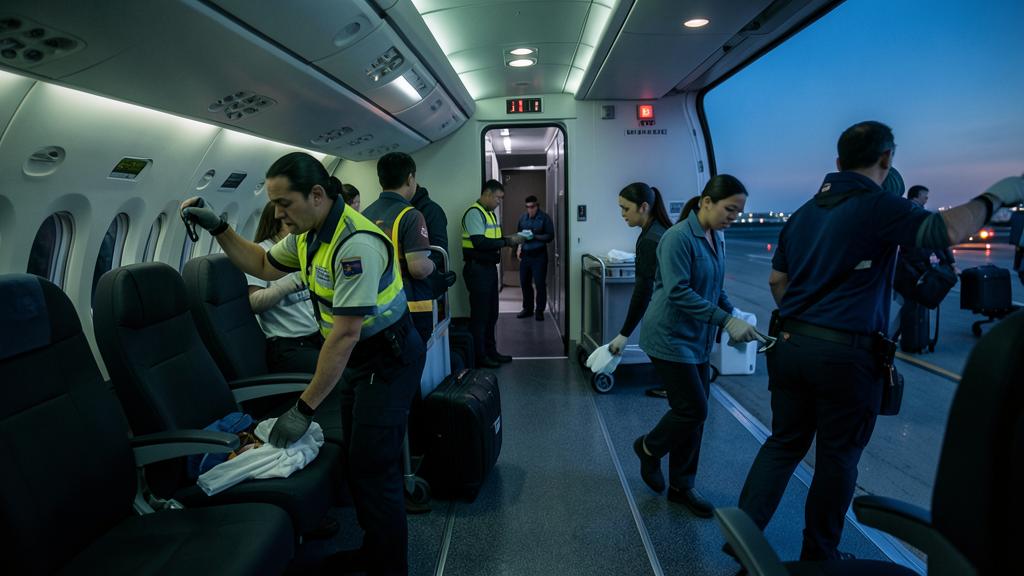
Second, treat the security check and the equipment check as fixed, and say early — to the senior crew member and to the flight deck — if they will not be complete on the current timeline. Announcing a shortfall in advance is an operational statement that someone can act on. Discovering it afterwards is an incident.
Third, write it down, including the delay code that was assigned. When the operational record shows an on-time departure and the safety record shows a curtailed check on the same rotation, the two accounts disagree — and disagreement is the only thing that reliably forces a look at the ground time itself. How this plays out varies enormously by station and by handling contract, and that station-by-station detail is discussed among colleagues on the FL330 forums.


Leave a Reply
You must be logged in to post a comment.