
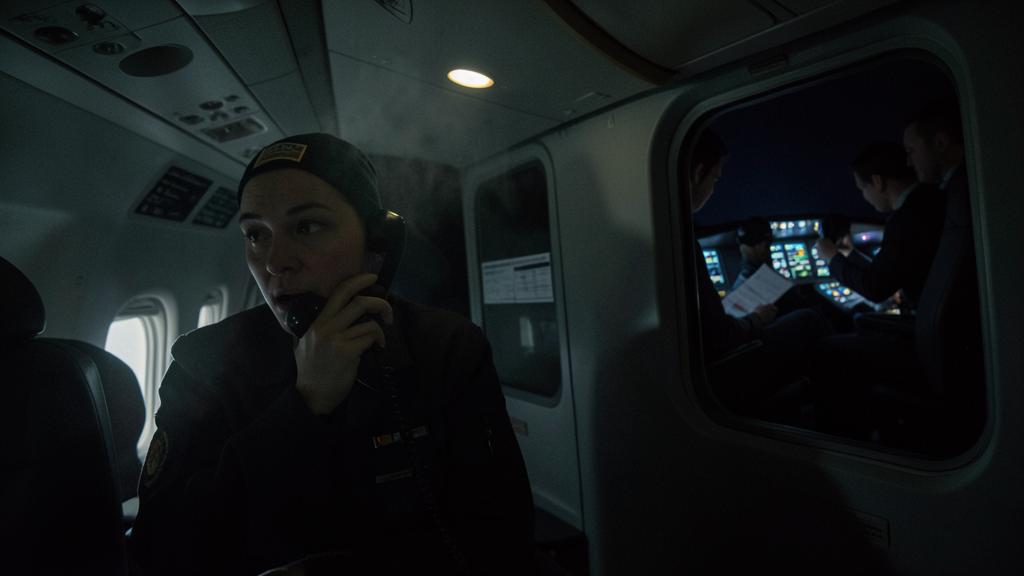
Describe the most useful sentence a cabin crew member ever says on the interphone contains no theory at all. It says what can be perceived, where, how strong it is and whether it is growing — and it stops there. The instinct to add « it is probably the oven » is generous, human, and expensive: it sends a flight deck already inside a branching procedure down one branch on the authority of someone who cannot see the systems. This is what the flight deck actually needs from the cabin during a smell or smoke event, in what order, and why the diagnosis is the one thing that must wait.
What is happening on the other end of the interphone
Deciding When your call arrives, the flight deck is not deciding what the smell is. It is deciding something much cruder and much more urgent: whether this event is growing, whether the source can be isolated, and whether the aeroplane should be on the ground sooner than planned. Manufacturers’ smoke, fire and fumes procedures are generally built around that ordering — the diversion decision sits near the front rather than at the end, because the alternative is discovering you needed it after the options have closed.
The accident record is what put it there. On Swissair 111 in 1998, an unusual odour in the cockpit was followed by impact roughly twenty minutes later. On Air Canada 797 in 1983, a fire that took hold in the area of the aft lavatory ended with the cabin flashing over about a minute and a half after the doors were opened, and roughly half of those on board did not get out. The lavatory smoke detectors, floor-proximity lighting and waste-bin extinguisher provisions that today’s cabin takes for granted are its direct legacy. Neither crew had a diagnosis available in time. Both had observations available immediately.
So the flight deck’s questions are procedural and they are asked in a fixed order. Your report either answers them or forces them to be asked again, one at a time, on an interphone, while somebody flies the aeroplane.
Five words that are not interchangeable
The confusion single most common source of confusion is vocabulary. Smell, fumes, haze, smoke and flame describe five different physical states with five different consequences, and using one for another either over-escalates or, far worse, buries a real event under a mild word.
| Word | What it should mean | What it triggers |
|---|---|---|
| Smell / odour | Perceptible by nose only. Nothing visible. Vision down the cabin unaffected. | Source identification, monitoring, possible isolation of a system |
| Fumes | Odour strong enough to cause physical effects — eye, nose or throat irritation, coughing, headache | As above, plus occupant protection and a stronger case for landing early |
| Haze | Something visible in the air, thin, cabin still fully visible end to end | Visible product of something. Escalates the diversion question sharply |
| Smoke | Visibly dense, obscures, has a direction of travel, usually a source region | Diversion planning starts at once unless the source is found and removed |
| Flame | Combustion visible | Fire drill immediately, no waiting for confirmation |
Say the word that matches what you can see and smell right now, not the word that matches how worried you are. If you are worried and the state is only a smell, report a smell and report your concern separately — those are two different pieces of information and the flight deck can use both.
The four descriptors, and what each one changes
Observations Nature, location, evolution, intensity. Every one of them changes a decision, and every one of them is an observation you can make without knowing a single thing about the aeroplane’s systems.
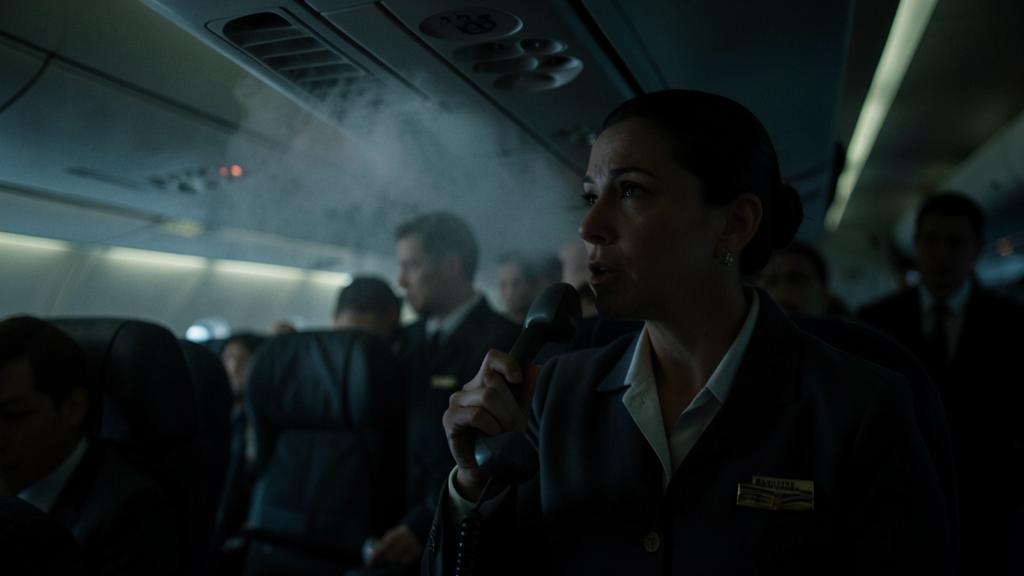
Nature is the quality of what you perceive, in ordinary language. Acrid, electrical, burning plastic, hot oil, sweet, oily, fishy, sulphurous, fuel-like, exhaust-like, hot metal, burnt food, damp or musty. Maintenance and the flight deck map those descriptors onto system families — the well-known « dirty socks » descriptor, for instance, means something specific to an engineer. Your job is to hand over the descriptor precisely, not the mapping.
Location means row numbers, side, and height. « Somewhere at the back » is worth almost nothing. « Strongest at row 28 left, at the ceiling outlets, weaker by row 24, nothing at the rear galley » gives an origin and a direction, which is the difference between a source that can be isolated and a source that cannot.
Evolution is the trend and the clock. Since when, and getting stronger, staying level or fading. This is the datum that drives the diversion decision more than any other, because a fading event and a growing event with identical current intensity are entirely different aeroplanes.
Intensity needs a scale rather than an adjective. How many people are affected, whether anyone has symptoms, whether visibility down the cabin has changed, whether you would still call it faint if it stopped growing right now.
| Descriptor | Costs time | Usable immediately |
|---|---|---|
| Nature | « There’s a burning smell, I think something’s shorted » | « Acrid, electrical, like hot plastic — no cooking smell in it » |
| Location | « It’s in the back somewhere » | « Strongest row 28 left at the ceiling outlet, nothing forward of row 24 » |
| Evolution | « It’s getting really bad » | « First noticed four minutes ago, clearly stronger over the last two » |
| Intensity | « Everyone’s worried » | « Six passengers coughing, two report stinging eyes, cabin still clear end to end » |
The trap. A premature label does not merely waste a question, it anchors. Once « it’s the oven » is on the interphone, every later observation gets interpreted against it, including the ones that contradict it — and the crew member who first said it will be the last to abandon it. Anchoring on a wrong source is a recurring theme in fire and fumes investigations. Anchoring on no source at all has cost nothing.
The flight deck needs to know if the problem is getting worse, not what you think is causing it. Your job is to describe what you see and smell, not to guess the source. The more precise your description, the better they can decide what to do.
On a Boeing 737 at 30,000 feet, a flight attendant reports: “Acrid, electrical smell, strongest at row 15 left near the ceiling outlet, first noticed 3 minutes ago, now stronger, 4 passengers coughing, cabin still clear.” The flight deck immediately starts diversion planning because the smell is growing and could be from an electrical fire.
The phase correlation nobody else can give them
Correlation There is one class of information the cabin owns outright: what the aeroplane was doing at the exact moment the event started, as perceived from the cabin. Engine start. Pushback. Thrust increase or reduction. Gear or flap movement. A galley item switched on. A change in air flow or noise. Top of climb, top of descent.
That correlation is diagnostic in a way that no amount of description is, and it is worthless five minutes later because memory smooths it. Note the phase the moment you notice the event, before you go and investigate. If you genuinely do not know what the aeroplane was doing, say so — an honest « I can’t correlate it to anything » is a real answer and the flight deck will treat it as one.
The right reflex. Before you walk to the source, fix three things in your head or on paper: the time, the phase of flight, and the intensity right now. Those are your baseline. Everything you report afterwards is a comparison against them, and without them your second call cannot express a trend — which is the one thing the flight deck most wants to hear.
What you did, and what happened when you did it
Actions Actions taken belong in the report, always, and not out of politeness. Each one is a live experiment whose result the flight deck cannot obtain any other way.
- Galley or oven power switched off — If the odour stops, the source is bounded and isolated. This is the single most valuable observation available in the cabin.
- A specific item switched off, unplugged or moved — Same logic at a finer grain, and it identifies a passenger device if one is involved.
- Extinguisher discharged, and which type — Whether an agent has been used, how much remains, and whether a water agent has been put onto something that may be electrical.
- Protective breathing equipment donned — A crew member is now on a limited air supply and hard to understand. It also starts a clock the flight deck must track.
- Passengers moved — Cabin geometry has changed, which matters for any later evacuation briefing.
- Nothing done yet — Also information. It tells them the source is not reachable or not identified.
On protective breathing equipment, remember two operational facts. Its protection is certified against a nominal duration in the region of a quarter of an hour, and the clock starts when the unit is activated rather than when you decide you might need it. And speech through it is poor. If a report is due, make the call before you don the hood, or designate someone else to communicate while you work.
The second call: trend beats detail
Trend One report is a photograph. The flight deck needs a film. Agree a follow-up interval when you make the first call — a short one, and hold to it even when there is nothing new, because « no change since my last call » at a known interval is a genuine and reassuring measurement, while silence is indistinguishable from an incapacitated crew member.
Keep the second call short and comparative: stronger, same, weaker, and any change in state from the five-word list. Resist the urge to enrich it with new theories that occurred to you in the meantime. If a new observation genuinely matters — a warm panel, a discoloured fitting, a tripped circuit breaker you can see, a passenger device now identified — lead with it and keep it factual.
The vapour case, and why you still make the call
Condensation The commonest false alarm in a cabin is condensation: white vapour streaming from the ceiling outlets in humid conditions, usually on the ground or at low level, thinning as the air dries out, with no smell attached to it at all. Experienced crew recognise it. That recognition is exactly why it needs care.
You still call, and you call it as what you saw. « White vapour at the ceiling outlets from row 10 back, appeared as the packs came on, no smell, already thinning » is a complete, honest report which the flight deck will classify in two seconds and file. What you must not do is skip the call because you are confident, or report « it’s just condensation » — because the day the vapour is not condensation, it will look the same for the first thirty seconds, and the only distinguishing observation available early is the absence or presence of an odour.
The reverse error matters too. A smell with no visible product is not a minor event. Historically, odour has been the first and sometimes the only warning available while there was still time to act.
Talking to a flight deck that is fully occupied
Communicate Expect delay and do not read it as indifference. The flight deck may be flying manually, running a checklist, on oxygen masks — which makes their speech hard to understand and yours hard for them to hear — or coordinating with air traffic control. Some practical discipline helps.
One crew member communicates. Parallel reports from three positions produce three partial pictures and no timeline. Nominate the reporter early, and let the others feed observations to that person.
Say the headline first, then the detail. « Smoke, mid cabin, growing » before the paragraph. If the connection is cut after four words, those are the right four words.
And treat any smell, fumes or smoke report as overriding sterile flight deck restrictions. Those restrictions exist to keep trivia out of a critical phase, and an unexplained smell is not trivia; your own manual’s wording governs, and it was not written to stop this call. Hesitating over whether an event is « worth » reporting is precisely the failure mode the restriction was never intended to create.
After the aircraft is on the ground
Records Two records outlive the flight. The technical one exists so maintenance can find something: the exact location by row and side, the descriptor in your words, the phase correlation, the trend and the timings. A vague entry produces a « no fault found » inspection and the same event on the next sector.
The second is the occupant record. Who was affected, where they were sitting or working, what symptoms, when they started and whether they persisted after landing. Under the European occurrence reporting framework and the safety management provisions that sit behind it, that information is what turns a one-off report into a detectable pattern — and it is unreconstructable a week later.
Neither record is improved by a conclusion. Both are destroyed by one, because a named cause in a report is what a later reader will anchor on. Describe precisely, correlate honestly, and let the people with the schematics do the naming. Operators comparing cabin reporting practice and the training that supports it will find the working detail in the FL330 professional training catalogue.


Leave a Reply
You must be logged in to post a comment.