
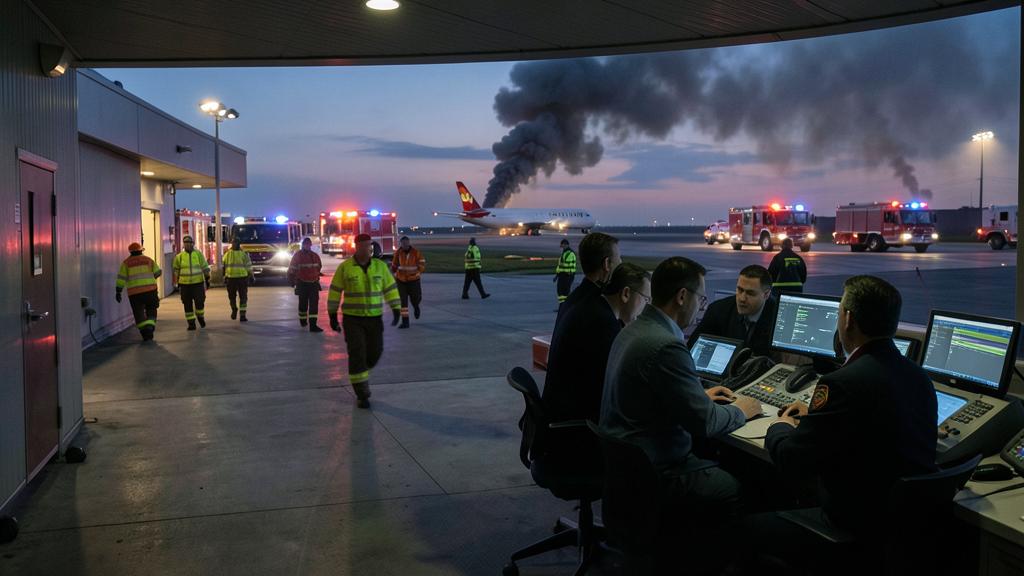
Every operator and every certified aerodrome has an emergency response plan, and almost all are compliant documents. Compliance is not what gets tested when the phone rings at three in the morning. What is tested is whether a designated person responds, whether that person can reach a second designated person, and whether the two plans just activated—the operator’s and the aerodrome’s—actually communicate with each other or simply operate in parallel. An exercise is the only instrument that measures these elements, and it only measures them if it is designed so that it can fail.
Two plans, two triggers, one accident
The first structural fact is that there is no single emergency plan. There are at least two, they belong to different organizations, and they are activated by different people based on different evidence.
The aerodrome emergency plan belongs to the aerodrome operator. It is normally triggered by air traffic services declaring one of the standard categories—a local alert, a full emergency, or an aircraft accident—and it mobilizes the rescue and firefighting service, mutual aid services, medical response, and the aerodrome’s own command structure. Its geography is the aerodrome and its immediate surroundings, and its clock is measured in minutes: the international standard sets an operational target for the rescue and firefighting service of a response time not exceeding three minutes to any point of each operational runway, under optimal visibility and surface conditions, with two minutes as the recommended target.
The operator emergency response plan belongs to the airline. It is triggered by the operator’s duty officer based on information that may come from the crew, the aerodrome, operations control, a family member, or a news alert. Its geography is the entire network, and its clock is measured in hours: notification to next of kin, the mobilization team, reception centers, the humanitarian assistance function, the interface with the accident investigation, and the first public statement.
Separately, air traffic services execute their own alert sequence through the international phases of uncertainty, alert, and distress, which has its own recipients and does not wait for either of the other two plans.
Three organizations, three triggers, three clocks. The exercise exists to discover what happens in the gaps between them.
What the regulation actually requires, and what it leaves open
The obligation to hold a plan is undisputed and comes from several directions at once. ICAO Annex 14 requires a certified aerodrome to establish an emergency plan and test it, with a full-scale exercise at intervals not exceeding two years and partial exercises in the interim to correct deficiencies revealed by the full-scale exercise. ICAO Annex 19 places the coordination of emergency response planning within the safety management system rather than alongside it, making the exercise a safety assurance activity with an audit history, not a public relations event. EASA’s management system rules for operators carry the equivalent obligation for the airline, and Regulation (EU) No 996/2010 requires an EU air carrier to hold a plan for assisting victims of civil aviation accidents and their next of kin. In the United States, the architecture differs: family assistance is coordinated by the accident investigation authority under dedicated legislation, and the airline’s plan is filed accordingly.
What the regulation does not specify is the part that decides whether either of them works: the content of the exercise. The interval, scope, and recording are prescribed. The difficulty is not. An organization can conduct a compliant full-scale exercise every two years for a decade and never discover at any point that its out-of-hours notification chain has a single point of failure, because nothing required it to test that chain when the person concerned was asleep.
Regulations say you must have a plan and test it, but they don’t say how hard the test should be. A good exercise must be designed to fail, because only then can you find the real weak points in your system.
Exercises often reveal this kind of gap. In a typical case, a no-notice exercise shows that the aerodrome’s duty officer cannot access the passenger manifest system after hours. The fix? A dedicated offline backup and regular out-of-hours testing.
Designing an exercise capable of failing
The distinctive feature of a useful exercise is that the outcome is genuinely unknown to the people who designed it. Everything else follows from that.
- Write the objectives before the scenario. Three to six of them, each framed as something observable: the crisis room is staffed with the required functions within the target time, a verified count of people on board reaches the aerodrome commander, the first holding statement is approved and published, the next-of-kin phone line responds to an external call.
- Write the success criteria before the exercise. Criteria invented during the debrief are always met.
- Deliberately seed flaws. A key person unreachable, a room unavailable, a language no one in the team speaks, a manifest that doesn’t match. If the scenario contains no injected failures, the exercise measures the scenario rather than the organization.
- Separate the roles. Participants play, controllers manage the timeline and deliver injects, evaluators observe according to the written criteria and say nothing, and a named safety officer holds the authority to stop the exercise for real danger. Merging the evaluator and the controller is the most common design flaw and it destroys the evidence.
- Keep a register of artificiality. Every compromise made for the sake of the exercise—the simulated phone number, the fictional media, the notional victims—is a line in a register, because the register is where the objectives for the next exercise come from.
| Format | Proves | Cannot prove |
|---|---|---|
| Full-scale, announced | Physical interoperability, access, equipment, on-site command | Whether something works when no one is expecting it |
| Partial or functional exercise | An end-to-end chain—notification, reception center, information management | Interaction between competing chains for the same people |
| Table-top | Decision logic, role understanding, legal and communication judgment | Timing, logistics, capacity, fatigue |
| No-notice call | The call list, out-of-hours reachability, actual activation times | Everything downstream, unless allowed to continue |
| Communications exercise | Bridge capacity, radio interoperability, alternative means | Quality of content and information ownership |
| Media test in a real scenario | Speed and consistency of public position | Whether the underlying facts were verified first |
Failures that appear every time
Exercise reports in the industry converge on a short list. Individual causes vary; the categories do not.
| What breaks | Underlying cause | Sustainable solution |
|---|---|---|
| The call list | Built from names rather than roles; degrades between exercises | Roles with named holders, held by one person, verified on a fixed cycle |
| Out-of-hours activation | Numbers tested only during office hours | No-notice calls at truly uncomfortable times |
| The number of people on board | Multiple sources, no designated owner, corrections arriving late | A named owner of the count and a written rule on when it is published |
| Information on special category passengers | Stored in a system that no one in the crisis room can access | Pre-agreed, tested extraction procedure, with an offline backup solution |
| Telephone capacity | Published number sized for normal volumes of requests | Overflow arrangement contracted in advance and exercised |
| The first public statement | No one authorized to speak before leadership is assembled | Pre-approved holding text, published by the duty officer at activation |
| Access to the reception center | Keys, badges, catering, and network access depend on day staff | Named duty holders and an annual physical opening test |
| Interface with the aerodrome | Both plans activated, neither informed the other | A liaison position in each plan, with a name, location, and means |
The trap. The call list is not an appendix to the plan. It is the plan. Any other arrangement is conditional on the right people being woken up, informed, and in the same conversation, and a contact directory is the fastest-decaying document an organization holds: people move, numbers change, contractors are replaced, and none of these events generates a notification to the person who maintains the list. An organization that verifies its directory twice a year and tests it without notice once a year has done more for its response capability than an organization that rewrites the narrative sections of the plan.
Activation is not coordination
The most instructive discovery that an exercise produces is also the easiest to miss, because on paper everything worked: both plans were activated, both crisis rooms were opened, both organizations logged the right times. Activation was flawless. Coordination did not happen.
Coordination is a specific and observable set of exchanges, and each has an owner on both sides. It fails when a plan describes the exchange without naming who executes it, or names a function that no one fills at night.
| Information | From | À | Why it fails |
|---|---|---|---|
| People on board, and dangerous goods carried | Operator | Aerodrome command and rescue services | No designated owner; the count is still being reconciled |
| Aircraft status, scene status, access constraints | Aerodrome command | Operator crisis room | No agreed reporting rhythm; the operator asks repeatedly |
| Location and movement of survivors | Medical and aerodrome services | Operator and next-of-kin function | Data protection resolved on the fly rather than pre-agreed |
| Public position and its timing | Both | Each other, before publication | No mutual notification rule; contradictory statements within the hour |
| Requirements of the investigation authority | Investigation authority | Both | Evidence preservation conflicts with operational recovery pressure |
| Aerodrome operational status and reopening | Aerodrome | Operator network control | Treated as a commercial issue, outside the crisis structure |
The right reflex. Test coordination by asking a question during the exercise, to both crisis rooms simultaneously: how many people were on board? If the two answers differ, or if one of the rooms has to call someone to know, the exercise has already provided its most valuable discovery—and it provided it within the first thirty minutes, before the scripted part even began.
Closing findings without fixing anything
An exercise generates findings, and the findings generate corrective actions, and that’s where the value most often leaks. Three closure patterns must be treated as red flags in any safety management system.
The first is the reminder. A finding closed by an email reminding staff to follow the procedure has changed nothing, because the procedure was not the failure—the reachability, ownership, or capability was. The second is the document revision. Rewriting the plan to describe what should have happened is satisfying and produces an artifact, but a plan that already described the right behavior will describe it slightly better and still not produce it. The third is closure without re-test. A corrective action that has not been exercised again is a hypothesis, and the next full-scale exercise is in two years.
The credible model is narrower: one finding, one named owner, one date, a change in a system or responsibility rather than a paragraph, and a re-test scheduled in the interval—which is precisely what partial exercises between full-scale exercises are supposed to do. Used this way, they cease to be mere compliance filler and become the verification loop for the findings of the previous exercise.
What a usable exercise report contains
The report is the only part of the exercise that survives until the next one, and most reports are written for the file rather than the successor. A usable report contains the objectives as they were written before the event, the success criteria as they were written before the event, the timeline of injects with the actual times of responses, the artificiality register, the findings with owners and dates, and—the section that is almost always absent—the list of things that were not tested and why. It is this last section that allows the next exercise to be designed as something other than a repetition of the last.
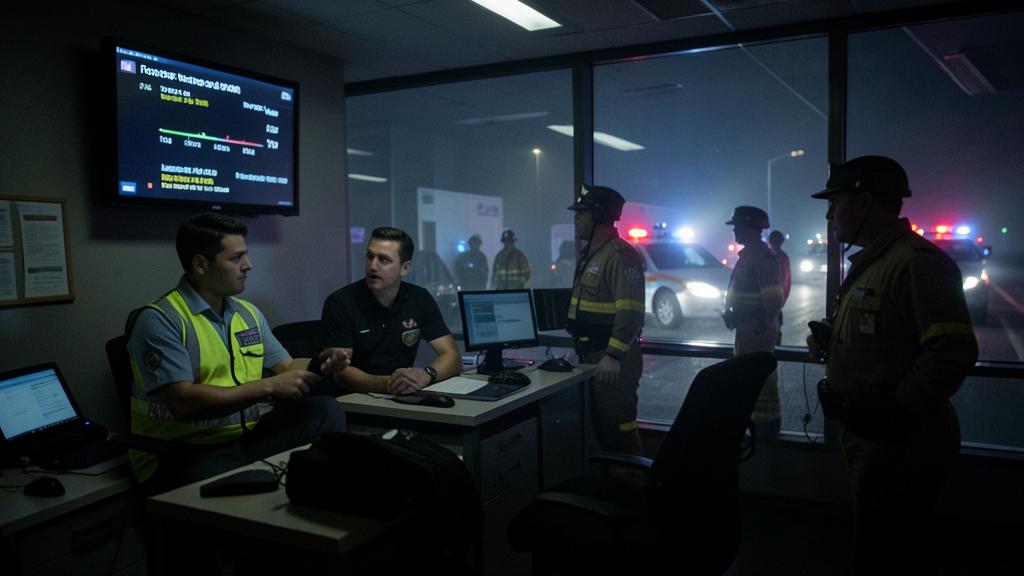
It is also the section that makes the difference visible between an organization that exercises its plan and an organization that maintains a binder. The binder describes a response. The report describes an organization, including the parts that did not work at three in the morning, which is the only time it will ever be needed. Discussions about exercise design and what different operators and aerodromes have deemed worthy of testing are a recurring theme in the professional network FL330, and the recurring conclusions are surprisingly consistent from one organization to another.


Leave a Reply
You must be logged in to post a comment.