
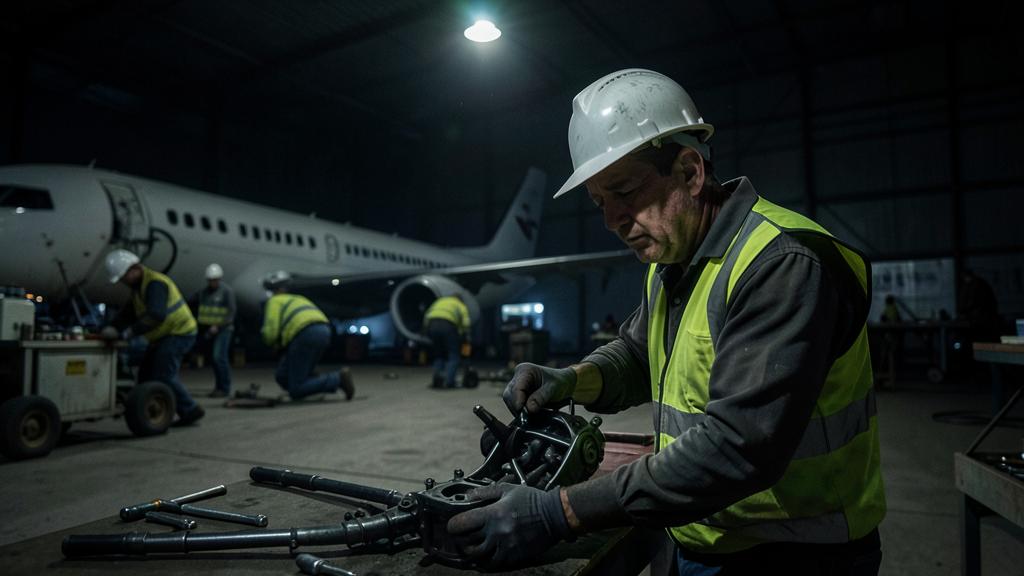
The crew who take the aeroplane away at first light work inside a scheme that counts their night: a duty period with a ceiling, a minimum rest before it, cumulative limits behind it, and a weighting that makes an hour worked at three in the morning cost more than one worked at three in the afternoon. The technician who reassembles a landing gear bay in the same building, four hours earlier, works under nothing of the kind. The asymmetry is not an oversight, and not an argument for extending crew limits to the hangar. It is a design choice that shifts the whole burden of fatigue defence onto the maintenance organisation, and it only holds if that organisation carries it.
Two populations, one aeroplane, two regimes
Flight and duty time limitations for commercial air transport crews are prescriptive. In Europe they sit in the flight time limitation rules attached to the air operations regulation; in the United States, in the flight and duty rules for scheduled passenger operations. Both share one architecture: a maximum flight duty period varying with report time and sectors, a minimum rest period before it, cumulative caps over rolling windows, and a definition of the circadian trough used to shorten the permitted duty when the work falls inside it. Both name the same window, 02:00 to 05:59, as the low point of the body clock.
Maintenance has no equivalent number anywhere in the European rules. Part-145 does not say how long a shift may be, how much rest must precede it, how many consecutive nights a technician may work, or what happens when a task runs past the end of a duty period. It says something structurally different: the organisation must have enough qualified personnel to plan, perform, supervise, inspect and release the work it has accepted, and must take account of human performance limitations when planning it. That is an obligation of result expressed without a threshold. The regulator has declined to write the number and handed the organisation both the freedom and the liability of writing it.
The American rules are marginally less silent: the operating rules for scheduled airlines carry one duty-time provision for maintenance personnel, a required period of relief tied to a seven-day cycle for work performed in the United States. There is nothing resembling the daily ceilings applied to crew, and nothing weighting the hour by where it falls on the clock.
| Element | Flight crew, commercial air transport | Maintenance personnel, approved organisation |
|---|---|---|
| Instrument | Prescriptive flight and duty time limitations, with fatigue risk management required where the limits may be stretched | Approved organisation requirements: sufficient personnel, planning that accounts for human performance limitations, safety management |
| Daily ceiling | Yes, varying with report time and sectors | None in the rule; whatever the organisation writes into its own exposition |
| Minimum rest before duty | Yes, defined and auditable | Not prescribed |
| Cumulative limits | Yes, over rolling windows and calendar periods | Not prescribed in Europe; a weekly relief provision exists in the American operating rules |
| Circadian weighting | Explicit, built around the 02:00–05:59 window | None; a night task and a day task are legally identical |
| Individual responsibility | Stated: report fit, decline the duty when not | Stated in substance through the certifying staff’s personal responsibility for the release |
| Record kept | Duty and rest records, retained and auditable | Task records and authorisations; hours worked are a payroll artefact, not a safety record |
What the crew scheme actually buys
It is worth being honest about what the crew regime achieves, because the hangar is often invited to envy something that works less well than it looks. Prescriptive limits do not measure fatigue; they bound exposure. They make an obviously indefensible roster impossible to build, they give the individual a legally protected point at which to stop, and they produce a record an auditor can read a year later. They do not detect the pilot or the technician who is three nights into a pattern, sleeping badly at home, and impaired at hour six of a perfectly legal duty.
That matters because it defines what the maintenance organisation must replicate. The transferable part of the crew scheme is not the number but the trio underneath it: bounded exposure, a protected right to stop, and a durable record. An organisation that adopts none of the three while pointing out that the rule does not require them has understood the letter and missed the mechanism.
Crews have strict rules on how long they can work, especially at night, to prevent fatigue. Maintenance workers don’t have these rules, but they must still manage fatigue risks through planning and checks. The key is making sure tasks are done safely, not just counting hours.
Why the last third of a night shift is the sharp end
Three effects converge on the same hours, and they are additive rather than alternative.
The first is circadian. Alertness, core temperature and reaction time all fall towards a trough in the small hours, and the fall is not compensated by motivation or experience. The regulator’s own definition of the window — the same window used to shorten a crew duty — describes a physiological fact that does not stop applying because the person holding the torque wrench is standing on a work stand instead of sitting in a seat.
The second is time on task. Night work in line maintenance is rarely one continuous job but a queue: a defect rectification, a deferred item, a check card, a dispatch decision. The technician reaches each new task with less reserve than the last, and the tasks that arrive late are usually the ones nobody planned.
The third is the most underrated: familiarity. The point of maximum risk in a night shift is not the moment the task looks difficult, but the moment it stops looking difficult. A reassembly performed twenty times is exactly the task a degraded operator will run from memory, skipping the card, because nothing signals that anything is being skipped. Published maintenance human factors work has been consistent for three decades: the dominant error is something not reinstalled, not torqued, not locked, not closed. Not something done wrongly, but something not done at all, in a sequence the person is certain they completed.
The trap. A shift that ends on time is not a shift that was safe. The classic pattern is the opposite: the task overran, the aeroplane is needed at 06:00, and the last operations, reinstallation, torque, locking, independent inspection and paperwork, are compressed into the exact window where the operator is least able to compress anything. Schedule pressure and circadian low are not separate risks; on a night shift they arrive together, by construction.
On a 12-hour night shift at an airline’s maintenance base, a technician starts at 20:00 and works on a series of tasks, including a critical landing gear inspection. At 04:30, with only 1.5 hours left in the shift, the technician is asked to perform an additional task—a deferred item from the previous flight. The technician, already fatigued, completes the task quickly, skips the torque verification step, and signs off the work at 05:45. The next morning, the aircraft experiences a landing gear issue during takeoff, traced back to the improperly torqued fasteners. The fatigue-induced oversight was not caught by the independent inspection because it was also performed by the same tired technician in the last hour of the shift.
The two cases everyone in the trade should be able to cite
Two investigations carry the argument better than any statistic. In June 1990, a windscreen departed a BAC 1-11 climbing out of Birmingham and the commander was partially blown out of the aperture. The screen had been changed on the night shift; the great majority of the retaining bolts fitted were of the wrong diameter. The investigation did not find a technician who did not know how to fit a windscreen. It found a shift manager working nights, performing the task substantially alone, relying on his own verification, in an organisation that allowed that combination to exist.
In January 2003, a Beech 1900D crashed on take-off from Charlotte after an elevator control rigging performed during overnight maintenance left the pitch travel restricted, compounded by a loading outside the certified envelope. Again the finding was systemic: overnight work, and supervision and inspection arrangements that did not capture an incorrect rigging.
Both were night reassembly tasks. In both, the check that should have caught the omission was performed by, or alongside, the person who did the work. That is the reason the modern rules attack the problem through error capture rather than through hours.
The barriers the quality and safety system has to supply
Since the rule declines to cap the shift, the defences have to be built into the task rather than into the roster. Three of them are now explicit regulatory obligations for a European approved organisation, and they are the ones an auditor will look for first.
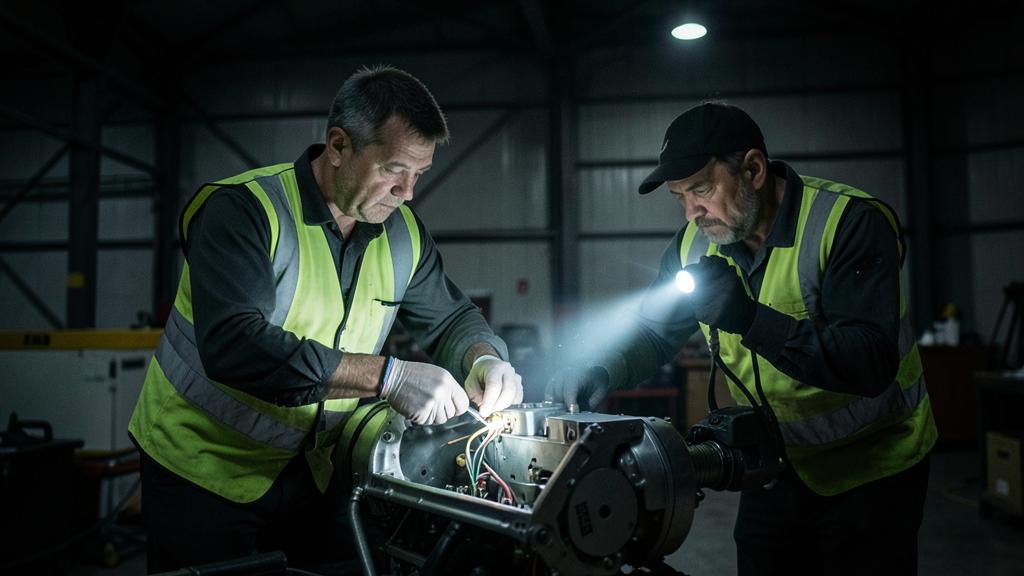
The first is the identification of critical maintenance tasks and the application of an error-capturing method to them. Where a task involves assembling or disturbing a system whose incorrect reassembly would have a direct effect on flight safety, flight controls prominent among them, the work must be checked by a method that does not depend on the person who performed it. Independent inspection by a second qualified person is the standard method; re-inspection by the same person after a break, or an equivalent documented technique, is the fallback where a second person genuinely is not available. The requirement exists because self-verification failed, repeatedly, on night shifts.
The second is human factors training, initial and recurrent, on a defined cycle. Its value is not the classroom hours but the shared vocabulary — the twelve well-known contributors popularised in maintenance training, fatigue among them — which legitimises a technician saying « I am at the end of a third night and I want this checked » without it sounding like an admission of incompetence.
The third is safety management, now a formal obligation for approved maintenance organisations. This is what turns fatigue from a personnel matter into a hazard with an owner, an assessment and a mitigation that can be audited.
| Task class | Failure mode under fatigue | Defence that actually works |
|---|---|---|
| Reassembly after disturbance of a flight control or engine control | Omitted locking device, reversed sense, incomplete connection | Formal critical task designation plus independent inspection by a second qualified person |
| Torque and locking sequences | Fastener torqued but not marked, or marked but not torqued | Torque witness marking applied as part of the operation, verified as a discrete step |
| Panel, cowling and access reinstatement | Fastener left disengaged; tool or part left in place | Tool and part accountability closed before the panel, not after; foreign object check as a signed step |
| Handover of an open task between shifts | Both technicians believe the other completed the step | Written handover at task level with the aeroplane state, not a verbal summary at the tea bar |
| Deferred defect raised near end of shift | Wrong item selected, conditions of the deferral not applied | Deferral decision reviewed by someone not on the closing shift |
| Release to service in the final hour | Certification signed against work not physically verified | Release decoupled from the departure time; no signature under countdown |
Writing the limits the regulator did not write
An organisation that has decided to take the obligation seriously ends up writing into its own exposition and procedures the numbers the rule left blank. That is not gold-plating; it is the only way to make an obligation of result auditable. The commitments that survive contact with operations tend to be these.
- A maximum planned shift length, with a recorded extension procedure: who authorises, on what grounds, and what additional check that triggers.
- A maximum number of consecutive night shifts, and a defined recovery before the next night pattern.
- A rule that a critical maintenance task started in the final hours of a night shift is either completed with its independent inspection performed by staff who are not at the end of that shift, or handed over as an open task with the aeroplane visibly marked as unserviceable.
- An explicit, protected right to declare oneself unfit for a specific task, with a named receiver and no requirement to justify it in front of the shift.
- Overtime and callout counted in the same record as the shift, because the hours that break a pattern are the ones nobody planned.
The right reflex. Judge the arrangement by the last two hours, not by the average. Take a real overrun from the last quarter, and read back who performed the final reinstallation, who performed the independent inspection, how long each had been on duty, and what time it was. If the answer is that the same fatigued person did the work and the check because the aeroplane was needed, the organisation has an exposition that says one thing and a hangar that does another.
What to measure, and what the numbers will not tell you
Fatigue is invisible in the usual maintenance indicators. Technical delay rates, quality escapes and audit findings lag it by months, and the events that would reveal it are the ones nobody reports because nothing happened. A small set of leading indicators is worth carrying, on the explicit understanding that each can be gamed.
| Indicator | What it detects | How it fails |
|---|---|---|
| Share of critical tasks whose independent inspection is signed in the last hour of a shift | Compression of the error-capturing step into the trough | Signature times are recorded loosely; check against the physical timeline |
| Distribution of consecutive night shifts across the workforce | Patterns concentrated on a few volunteers | Contractor and agency staff excluded from the count |
| Planned versus actual shift length, tracked as a distribution | Systematic overrun disguised as an average | Reported as a mean, which hides the tail that matters |
| Reports mentioning fatigue, tiredness or handover | Willingness to name the factor at all | A rise is a good sign that will be read as a bad one |
| Tasks reopened after release within one flight cycle | Omissions that were caught downstream by luck | Recorded as a new defect, severing the link to the night that produced it |
The last row pays for the exercise. An omission caught by the next crew or the next walkaround is the same error as the one that reaches an accident report; only the outcome differs. An organisation that files it as a fresh defect has thrown away its only cheap sample of its own night-shift error rate.
Where the argument actually lands
The asymmetry between the flight deck and the hangar will not be resolved by importing crew duty limits into maintenance. The work is not shaped the same way, and a prescriptive hour cap would be answered with contractor hours the organisation never sees. What can be resolved is the pretence that the absence of a number means the absence of an obligation. The rule has made its choice: the number is the organisation’s to write, the error-capturing method is mandatory, human factors training is mandatory, and safety management sits on top of all of it. An organisation that has written no shift limit, delegated the independent inspection to whoever was still standing at 05:30, and never looked at what time its critical tasks are signed off is not compliant by default. It is simply not yet audited on the point.
Shift patterns, handover formats and independent inspection practice are discussed regularly on the FL330 professional forums, where line and base maintenance experience diverge sharply on the same questions.


Leave a Reply
You must be logged in to post a comment.