
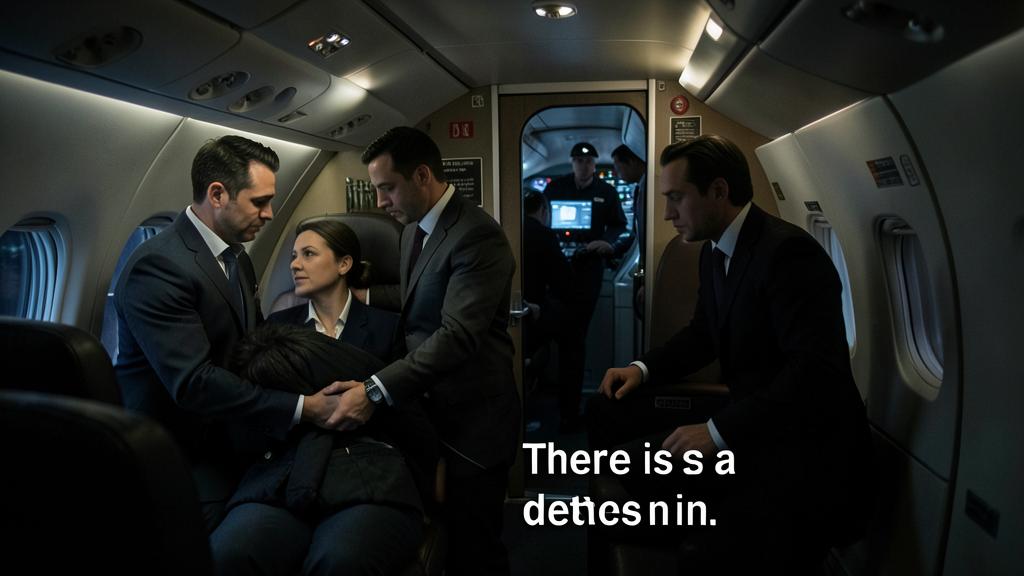
Two events can look identical from row 27 — shouting, a struggle in the aisle, restraints, a diversion — and belong to two entirely different legal regimes. One is disorder on board, handled under the conventions that give a commander authority over the aircraft. The other is an act of unlawful interference, which brings in the security corpus, a state response and a different set of consequences on the ground. The dividing line is not how much violence there was. It is what the act was aimed at.
Why the qualification is an operational question, not a lawyer’s question
Crews tend to file this subject under after-the-fact paperwork. It is not. The qualification decided in the first minutes determines what the commander may lawfully do, what is transmitted on the frequency, what the receiving state mobilises before the aircraft parks, who may prosecute afterwards, and through which channel the event is reported. Getting it wrong in either direction is costly: treating a security event as ordinary disorder delays the ground response, and escalating ordinary disorder into a security event triggers a state machinery that is difficult to stop and that will be reviewed afterwards.
The distinction is also asymmetric in a way that surprises people. A violent brawl between two passengers over a reclined seat, however ugly, is normally disorder on board. A calm sentence claiming there is a device in the hold is an act of unlawful interference, with no violence at all. Intensity is not the criterion.
The key difference isn’t how violent an incident is, but what the person did it for. If they’re just angry at another passenger, it’s disorder. If they’re trying to take control of the plane or threaten its safety, it’s interference.
On a Boeing 737 at 30,000 feet, a passenger attacks another over a seat recline. That’s disorder. If the same passenger then tries to force the cockpit door, it’s interference, even if no violence was used.
What the security corpus actually defines
Acts of unlawful interference are defined in ICAO Annex 17, and it works by naming act types rather than by setting a general standard of seriousness. The list is expressly given as an illustration and not as an exhaustive enumeration, but it is the list that does the work in practice. It names, in substance: unlawful seizure of an aircraft; destruction of an aircraft in service; hostage-taking on board or at an aerodrome; forcible intrusion on board an aircraft, at an airport or into an aeronautical facility; introduction on board or at an airport of a weapon, hazardous device or material intended for criminal purposes; use of an aircraft in service to cause death, serious injury or serious damage; and communication of false information such as to jeopardise the safety of an aircraft in flight or on the ground.
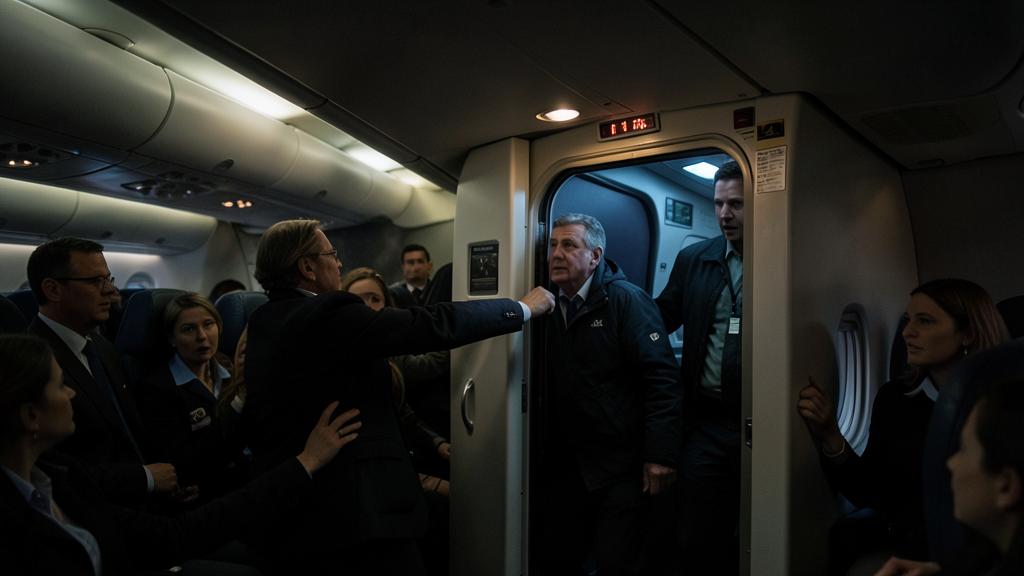
Read that list against a real cabin event and the test becomes workable. What was the object of the act? A person, out of anger or intoxication, in a dispute that has nothing to do with the aircraft — that is disorder. The aircraft itself, its control, its integrity, or the crew as the means of controlling the aircraft — that is interference. An attempt to reach or force the flight crew compartment sits squarely in the second category, whatever the assailant’s mental state.
Around this definition sits a stack of treaties that predate most of today’s fleet: the 1963 Tokyo Convention on offences committed on board, the 1970 Hague Convention on unlawful seizure, the 1971 Montreal Convention on acts against the safety of civil aviation with its later airport protocol, and the 2010 Beijing instruments that modernised the offence definitions. They bind only the states that have ratified them, which is the recurring practical difficulty of this whole subject.
| Criterion | Disorder on board | Act of unlawful interference |
|---|---|---|
| Object of the act | A person, or good order and discipline on board | The aircraft, its control, its integrity, or the crew as controllers of it |
| Reference text | Tokyo Convention and its 2014 protocol; national criminal law | Annex 17 and the national civil aviation security programme; the seizure and safety conventions |
| Basis of the commander’s action | Convention powers plus operator procedures | The same powers, plus the security procedures of the operator and the state |
| Air traffic notification | Normal channels; assistance requested as needed | Specific code and phraseology; state security notification chain |
| Ground response | Police meet the aircraft at the stand | State security response, possible isolated parking position, controlled disembarkation |
| Reporting channel | Safety occurrence reporting, operator systems | Security reporting to the appropriate authority; the safety channel does not replace it |
| Who may prosecute | Historically the state of registration; extended by the 2014 protocol where ratified | Wide jurisdiction under the security conventions, with an obligation to prosecute or extradite |
The commander’s powers come from a treaty, not from the airline
This is worth stating precisely, because it is frequently misdescribed in briefings. The authority to impose measures on a person on board does not originate in the operations manual. The 1963 Tokyo Convention gives the aircraft commander the power to take reasonable measures, including restraint, against a person the commander has reasonable grounds to believe has committed or is about to commit an offence, or an act jeopardising the safety of the aircraft or good order and discipline on board. The commander may require or authorise the assistance of other crew members and request the assistance of passengers, and may disembark the person in a state of landing and deliver that person to the competent authorities.
Three consequences follow that matter in the cabin. First, the measures must be reasonable and proportionate, and they must stop when the reason for them stops — restraint maintained after the threat has ended becomes an act the crew has to justify. Second, the power exists independently of the qualification of the event: a commander does not need to establish that an act of unlawful interference is under way before restraining someone. Third, the operator’s procedures organise and constrain the exercise of that power, but they are not its source — which matters when an event falls outside what the manual anticipated, because the absence of a written procedure is not the absence of authority.
The trap. Reading a cabin disturbance in isolation. Security doctrine has long treated a noisy incident in the cabin as a possible means of drawing attention away from the flight crew compartment. The door policy does not relax because the cabin is busy; that is precisely when it matters.
The jurisdiction problem that used to sink prosecutions
For decades, the standard outcome of a serious cabin assault was no outcome at all. The Tokyo Convention framework attributed jurisdiction principally to the state of registration of the aircraft. When an aircraft registered in state A, operated by an airline of state B, diverted to state C, the authorities of state C frequently had no basis to prosecute, and the offender was released within hours. Crews learned from this and stopped bothering to document events properly, which made the situation worse.
The 2014 Montreal Protocol, which amends the Tokyo Convention and entered into force at the start of 2020, was written to close that gap. It extends jurisdiction to the state of the operator and to the state of landing, addresses the treatment of in-flight security officers, and allows states to permit recovery of the costs caused by the offender. Its limitation is inherent to any treaty: it applies only between states that have ratified it, and ratification is uneven. A commander choosing between two diversion fields is, knowingly or not, choosing between two probabilities of prosecution.
| Basis | Applies to | Practical limit |
|---|---|---|
| State of registration | Offences committed on board, under the Tokyo framework | Often far away and uninterested; extradition rarely pursued for cabin offences |
| State of the operator | Added by the 2014 protocol | Only where that protocol is in force between the states concerned |
| State of landing | Added by the 2014 protocol; also many national laws | Depends on ratification or on domestic legislation applying to foreign aircraft |
| Territorial state overflown | Acts affecting its territory or nationals | Rarely usable in practice for an aircraft that does not land there |
| Security conventions | Seizure, sabotage, hostage-taking, false information | Wide jurisdiction and a prosecute-or-extradite duty, but only for listed offences |
What changes on the frequency and on the ground
Once an event is being handled as unlawful interference, communication changes shape. The dedicated transponder code exists for the case, air traffic procedures provide for acknowledgement without drawing the attention of anyone on board, and the notification propagates to state security authorities rather than remaining an operational matter between the flight and the unit. The aircraft may be directed to an isolated parking position, disembarkation may be controlled and staged, and the crew may be treated as witnesses in a criminal investigation from the moment the door opens.
For disorder on board, the sequence is far lighter: the operator’s ground organisation requests police attendance, the aircraft parks normally, the offender is handed over with the commander’s written statement, and the operation continues. The difference in cost, delay and disruption between the two paths is very large, which is exactly why the qualification should be made on the criterion and not on the adrenaline level.
The right habit. Say what happened, not what you conclude. A transmission that describes the observed act — an attempt to force the flight crew compartment door, a claim of a device on board, a passenger assaulting a cabin crew member — lets the ground apply the correct qualification. A transmission that says only « unruly passenger » flattens all of it into one category.
The diversion decision is a calculation, not a punishment
Diverting is not the automatic answer to disorder, and it is not always the fastest answer to a security event either. The commander is weighing whether the situation on board is contained, whether it will remain contained for the remaining flight time, and what the destination and the alternatives actually offer.
- Containment. A restrained passenger with two crew members monitoring, in a stable cabin, is a different problem from a person still moving and still escalating.
- Remaining flight time. Two hours of contained disorder may be preferable to a diversion; six hours of the same is a different judgement.
- What the field offers. Police who will accept a handover, a legal basis for prosecution, medical facilities if the person is injured or in crisis, ground handling and a stand.
- What the diversion costs the rest of the operation. Fuel, crew duty limits, a possible night stop for two hundred passengers, and the second-order safety cost of an unplanned approach into an unfamiliar field with a cabin that is not fully secure.
- Recovery of costs. Where the applicable law permits it, documented costs can be claimed from the offender — but only if the event was documented well enough to support the claim.
None of this is a reason to hesitate when the flight crew compartment is threatened. It is a reason not to treat every escalation as a diversion trigger.
The four behaviour levels, and what they do and do not decide
The industry’s threat-level classification is a useful common language for cabin response and for reporting, and it is widely used in operators’ manuals. It is not, however, a legal qualification. A level three event may be pure disorder, and a level one event — a verbal claim about a device — may be an act of unlawful interference. Use the levels to drive the cabin response and the reporting, and use the object of the act to drive the legal qualification.
| Level | Behaviour | Typical cabin response | Qualification |
|---|---|---|---|
| 1 | Disruptive, verbal | De-escalation, verbal warning, seat change, written notice | Disorder — unless the words themselves are a threat to the aircraft |
| 2 | Physically abusive | Warning notice, crew coordination, commander informed, restraint considered | Disorder in most cases |
| 3 | Life-threatening, or a weapon displayed | Restraint, passenger assistance, continuous monitoring, ground alerted | Depends entirely on the target of the threat |
| 4 | Attempted or actual breach of the flight crew compartment | Full defensive response, door policy enforced, immediate notification | Act of unlawful interference |
After landing: two paper trails, and neither replaces the other
Safety occurrence reporting and security reporting run through different channels, to different authorities, under different rules. In the European system the mandatory safety occurrence reporting scheme is not the route by which a security event reaches the security authority; the national civil aviation security programme, built on the European security framework, defines that route. An operator that files a safety report and considers the matter closed has satisfied one obligation and missed another.
The crew’s own documentation is the foundation of everything that follows. It should record the sequence of events with times, the words used and the acts observed rather than adjectives, the measures taken and when they were removed, the identities of witnesses including passengers who assisted, any injuries, and the preservation of physical evidence. The commander’s statement is what the receiving state’s authorities work from, and it is written while the memory is fresh or not at all.
The trap. Characterising rather than describing. « The passenger became aggressive » is worthless to a prosecutor. « At 14:22 the passenger struck the cabin crew member on the left arm, then moved forward and pulled twice on the flight crew compartment door handle » decides the qualification on its own.
What to train, and where the gap usually is
Two distinct training obligations apply and they come from different corpuses. The handling of disruptive passengers sits in the operator’s crew training under the European operational rules, alongside cabin safety. Security training — including recognition of an act of unlawful interference, the door procedures and the notification chain — flows from the security framework and the national programme. In many operators these are taught by different departments in different weeks, and the seam between them is precisely where the qualification question falls through.
The practical remedy is a joint scenario: a cabin disturbance that starts as level two disorder and, at a defined moment, changes object — the passenger stops fighting another passenger and moves forward. Crews who have rehearsed that pivot recognise it in real time. Those who have only rehearsed the two events separately tend to keep applying the first script. Operators comparing scenario designs and handover practice will find the subject regularly debated on the FL330 professional forums.


Leave a Reply
You must be logged in to post a comment.