
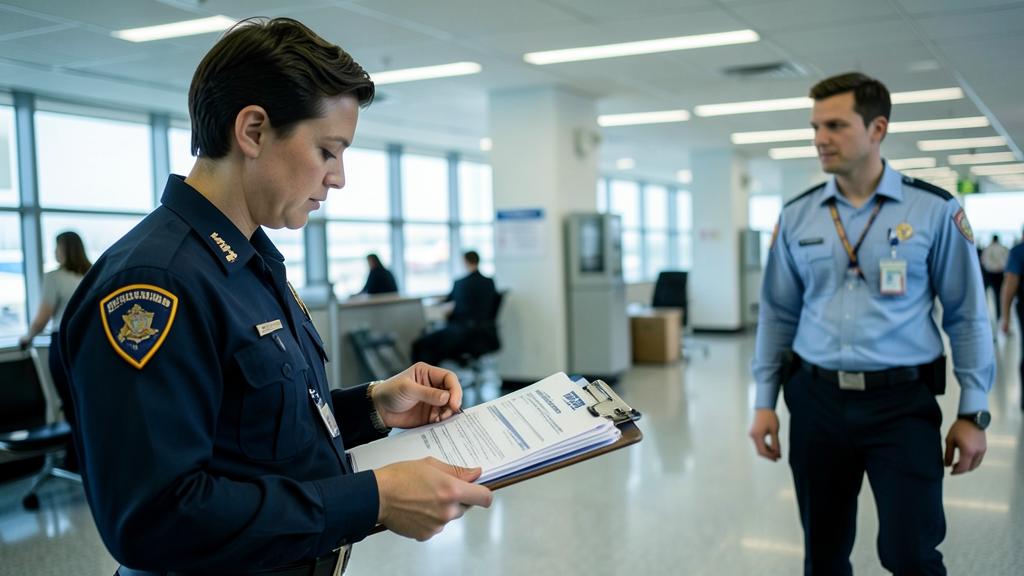
A background check answers one question, and it answers it about a date. On the day the file was closed, this person had no disqualifying record and no unexplained gap in their history. Everything that makes an insider dangerous — debt, coercion, grievance, recruitment, a change of allegiance — happens afterwards, in the years when nobody looks at the file again. The check is not wrong. It is simply a photograph, and the threat is a film.
What a background check actually certifies
The vetting that precedes an airport identification card is a documentary exercise with a defined scope. In the European framework it verifies identity, examines the criminal record held by the States concerned, and reconciles the declared employment and education history against gaps that the applicant must explain. The strengthened version — the enhanced check introduced after the implementing rules were revised — widens the criminal record component and tightens the treatment of unexplained periods. The exact reach of the record check, the period of history examined and the interval at which the check is repeated come from the implementing rules and the national programme together, and the detail differs from one State to another inside the same framework.
What that produces is a negative finding of a particular kind: nothing disqualifying was found, in the records that were searched, on the date they were searched. Three limitations are built into that sentence and none of them is a defect in the process.
- It searches records, not conduct. A person with no conviction has no record, and most people who go on to be recruited or coerced have no conviction at the point of recruitment. The check is designed to exclude the already-known, and it does that well.
- It searches the records of some States. Cross-border record exchange is uneven. A history spent in jurisdictions that do not share, or that record differently, returns a thinner file than a history spent at home.
- It expires by silence. In most national systems nothing revises the finding between one check and the next, unless something happens loudly enough to reach the employer through another channel. A conviction obtained abroad in the middle of a card’s validity usually reaches nobody.
A background check only confirms that a person had no red flags at a specific time. It doesn’t track changes in behavior, financial stress, or hidden pressures that could turn someone into a threat later. The real danger happens after the check is done.
A ground handler in Paris with a clean record passes their background check. Two years later, after losing a business, they accept a small bribe to bypass screening for a suspicious bag. The check didn’t catch this because it only looked at their past, not their present situation.
The regulatory architecture is worth naming, because responsibility for it is rarely where aviation professionals expect. Aviation security in Europe sits under the framework regulation on common rules in civil aviation security and its implementing regulation, administered by the appropriate authority designated by each Member State and expressed through the national civil aviation security programme. In many States it is not the directorate that holds the airworthiness file, and a safety manager who assumes their usual regulatory contacts cover this finds the conversation moving to a different building.
How the snapshot decays
The insider is defined by access, not intent: a person whose legitimate credentials let them do something that an outsider would have to break in to do. The pathway from cleared employee to insider is not a single event, and it is rarely ideological. Four routes account for most of what actually happens in the industry.
- Financial pressure and recruitment. Debt, gambling, a business that failed, an addiction. Organised crime recruits into ground handling, cargo, catering and cleaning specifically because those roles cross the security boundary with equipment and without individual scrutiny. The offer is usually modest, incremental and framed as trivial — move a bag, leave a door, look the other way once.
- Coercion. Family in a jurisdiction where pressure can be applied, an immigration status that can be threatened, a private matter that can be exposed. Coercion produces the most reliable insider and the least visible one, because the person concerned wants nothing and gains nothing.
- Grievance. A disciplinary process felt as unjust, a promotion lost, a redundancy announced, a roster imposed. Grievance produces sabotage and information leakage far more often than it produces violence, and it is the route most likely to be visible to colleagues long before it is visible to management.
- Drift. Rule-breaking that is tolerated becomes rule-breaking that is normal. A door propped for convenience, a badge lent to a colleague running late, a checked item carried through without screening as a favour. None of this is malicious. All of it is the infrastructure a genuine insider needs, and it is built by people acting in good faith.
The trap. The comforting model is a bad person who slipped through. The realistic model is an ordinary person who changed, in an environment where the small violations they needed were already normalised by everyone else. A vetting programme optimised for the first model detects nothing about the second.
What each layer can and cannot see
| Question | Periodic background check | Continuous detection |
|---|---|---|
| Does this person have a disqualifying record today? | Yes, on the day it runs | Only if a criminal-record push service is in place |
| Has this person’s financial situation collapsed? | No, unless the national programme includes a financial component | Partially, and mostly through colleagues and self-declaration schemes |
| Is this person accessing areas their role does not require? | No | Yes, from access-control records, and cheaply |
| Has this person’s behaviour changed? | No | Yes, but only through people, not through systems |
| Are credentials being shared or reused? | No | Yes, from swipe patterns, impossible-transit detection and door-held alarms |
| Has this person been recruited or coerced? | No | Only indirectly, through precursors — and never with certainty |
The honest reading of that table is that neither column is a security programme. The check removes the already-disqualified from the population, which is a genuine and non-trivial reduction. Detection observes the surviving population for change. An organisation that runs only the first has decided that people do not change; an organisation that runs only the second has decided to monitor a population it never filtered.
The three families of continuing signal
Signals divide by owner and cadence, and the division matters more than the list, because a signal with no owner is not a signal.
| Family | Typical signals | Natural owner | How it fails in practice |
|---|---|---|---|
| Administrative | Orphan credentials after a leaver, accumulated access rights that no role justifies, cards not returned, contractor passes outliving the contract, unreconciled card counts | Pass office, with human resources | Leaver notification runs on payroll timing, not on access timing, so credentials survive the employment by days or weeks |
| Behavioural | Unexplained affluence, insistence on working alone or on a specific area, refusal of leave or rotation, sustained expressed grievance, interest in another role’s access or in camera coverage, escorting people with no business reason | Line supervision and colleagues | Nobody reports, because the only visible outcome of reporting is that a colleague loses their livelihood |
| Technical | Swipes at implausible times or in implausible sequences, repeated denied reads, doors held or forced, edits to load, cargo or maintenance records outside normal patterns, privileged account use outside duty periods, bulk export from crew or cargo systems | Security operations, jointly with the information systems function | The data exists, is retained, and is examined only after an incident — because nobody was tasked with reading it beforehand |
The technical family is the one most often bought and least often used. Access-control platforms already record every read, every denial and every door alarm. The gap is almost never the sensor. It is that no named person has the job of looking at the aggregate weekly, with a defined threshold and a defined escalation, and so a body of evidence accumulates that becomes useful only to the investigation.
The reflex. Before buying anything, run one reconciliation: every active credential against every current employment or contract. The count will not match. The difference is your existing exposure, it costs nothing to measure, and it is the cheapest security improvement available to any operator or airport.
Security reporting is not safety reporting
Aviation has spent thirty years building a reporting culture on a specific bargain: report the occurrence, and the information will not be used against you except in cases of wilful misconduct or gross negligence. In Europe that bargain is written into the occurrence reporting regulation and its just-culture provisions, and it works because the reporter’s exposure is bounded.
The insider-threat report offers no such bargain, and pretending otherwise is dishonest. A colleague reporting behavioural concern about another colleague is not reporting their own occurrence. They are initiating something that may end in a suspension, a criminal referral or nothing at all, and in every one of those outcomes they will still be working the same shift as the person concerned next month. Anonymous channels only partly solve this — in a team of nine on a night shift, anonymity is a fiction.
What makes such a channel usable is not anonymity but proportionality of outcome. If the only available response to a report is investigation and suspension, reports will be reserved for certainty and certainty arrives too late. If the available responses include a welfare conversation, a temporary change of duty, a referral to an employee assistance scheme or a debt-support service, then the threshold for reporting drops to where the useful signals actually are. The industry learned this on the safety side, where the pilot support programmes introduced after the flight-crew mental-health debate of the mid-2010s were built precisely so that the first move is help rather than sanction. The security side has been slower to accept the same logic, and it is the same logic.
Watching people is itself a regulated activity
An insider-threat programme is, in data protection terms, systematic monitoring of employees, and that description brings obligations that arrive before the first dashboard.
- A lawful basis and a stated purpose. Access-control data collected to open doors is not automatically available for behavioural analysis. Repurposing it is a new processing operation and has to be documented as one.
- Proportionality, tested and written down. Where the monitoring is systematic and extensive, an impact assessment is required, and it must genuinely consider the less intrusive option rather than record that one was considered.
- Consultation. In several European States, deploying monitoring tools over employees requires consultation with the works council or staff representative body before deployment, not after. Skipping it can render the resulting evidence unusable in the disciplinary process it was collected for.
- Retention and access. Who may query the aggregate, under what authorisation, and for how long the raw records are kept, are questions the programme has to answer in writing before it is switched on.
None of this is an obstacle to the programme. It is the difference between a programme that survives its first contested dismissal and one that collapses in front of a tribunal, taking the credibility of the whole function with it.
Where the regimes diverge
Two approaches to the same problem have grown apart, and a professional moving between them should not assume the local model is the universal one.
The European implementing rules place heavy weight on the boundary itself: staff and the items they carry are required to be screened on entry to a security restricted area, which reduces what an insider can physically move regardless of what their record says. Re-checks of the person are periodic and tied to the card lifecycle.
The United States has invested comparatively more in continuous vetting of the person and less in universal staff screening at the boundary: new arrest information is pushed to the vetting authority through a federal criminal-history subscription service rather than waiting for a renewal date, while physical screening of workers has historically been risk-based and random at most airports rather than complete. Neither model is obviously superior. They fail differently: the European model is weaker against the person who has changed and stronger against what that person can carry, and the American model is the reverse.
A third strand now sits across both. The information security requirements introduced into the European aviation framework as Part-IS oblige organisations to manage information security risks with potential impact on aviation safety, which formally connects the credential, the account and the record system to the safety management system. The insider with a privileged account is now a subject of that framework as much as the insider with a badge.
What a workable programme looks like
The failure mode of insider-threat work is not insufficient technology. It is a programme that has ambitions in the behavioural layer while the administrative layer is still leaking, which produces a suspicion register and an unreconciled badge estate at the same time.

| Stage | What is put in place | What it costs | What it must not become |
|---|---|---|---|
| Hygiene | Credential-to-employment reconciliation on a fixed calendar; leaver revocation driven by the access system, not by payroll; role-based access rights reviewed on transfer, not only on hire | Almost nothing beyond a named owner and a recurring date | An annual audit exercise nobody acts on |
| Observation | Defined anomaly rules on the access estate with thresholds and an escalation path; a weekly reading of the aggregate by a named person | Analyst time, not licences | An alert queue read only after an event |
| Reporting | A channel with proportionate first responses — welfare conversation, duty change, assistance referral — and a published statement of what happens to a report | Management attention and a genuine support offer | A tip line whose only outcome is investigation |
| Governance | Impact assessment, staff consultation, retention rules, and a documented review of thresholds against false-positive rates | Legal and human-resources involvement from the start | Paperwork produced retrospectively to justify a tool already running |
One statistical point closes the argument and deserves to be stated in the open, because it governs the design. The base rate of genuine insiders in an aviation workforce is very low. Any detector applied to a very low base rate produces a majority of false positives even when it is a good detector. That is not an argument against detection; it is an argument that the output of detection must be a conversation, conducted with dignity, by someone trained to have it. A programme that treats every alert as an accusation will exhaust its credibility inside a year, and will take with it the one detector that genuinely works at scale: colleagues who are willing to say that something has changed. Practitioners compare local approaches and national programme differences in the security threads on the FL330 forums.


Leave a Reply
You must be logged in to post a comment.