
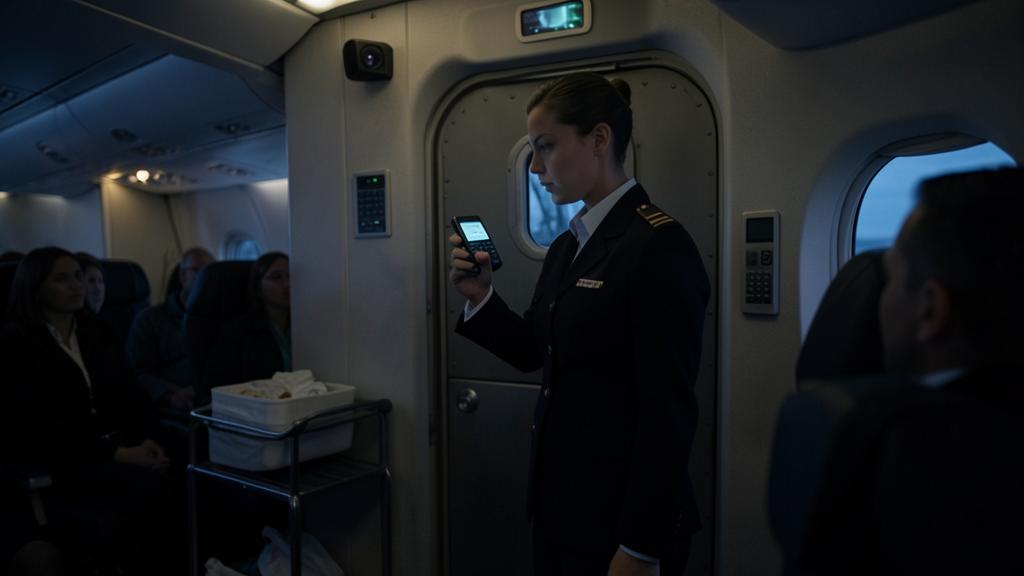
Between a cabin crew member and the flight deck there is now a certified structure, a keypad, a viewing device, a delay and a written sequence, where a generation ago there was a curtain and a latch. Every element was added for a reason that stands up to scrutiny. Taken together, they also lengthen the time it takes to get help to the front of the aeroplane, and they shift a large share of the protection off the hardware and onto the person standing in the aisle. This is what the procedure buys, and what it charges.
A door specified against exactly one threat
The flight crew compartment door is a security device with a narrow written purpose, and it helps to read that purpose in the terms an engineer can build to. ICAO Annex 6, Part I requires that on passenger aeroplanes above a mass and seating threshold — high enough to leave out the smallest regional types, low enough to capture the airline fleet — the door resist penetration by small arms fire and grenade shrapnel, resist forcible intrusion by unauthorised persons, be capable of being locked and unlocked from either pilot station, and be accompanied by a means of monitoring the area outside the compartment from within it — sufficient to identify a person requesting entry and to detect suspicious behaviour or a potential threat.
Read the list again and notice what is absent from it. Nothing in that specification concerns a passenger collapsing in row 30, a purser who needs a decision before the seatbelt sign goes on, smoke in an aft galley, a crew rest handover on the tenth hour, or a queue for the forward lavatory. The door handles all of those situations too, because it is the only door there is. But it handles them as a side effect of a specification written against a single scenario: a person in the cabin who intends to reach the controls.
That is not a criticism of the rule: a requirement that also tried to optimise for medical coordination would have produced a weaker door. It does mean that everything the door does for the other ninety-nine per cent of your working life is unspecified, delegated to the operator, and therefore variable — which is precisely where the operational cost sits.
The cockpit door is designed to stop armed intruders, not to help with medical emergencies or daily cabin tasks. It works well for security but makes routine access harder because it wasn’t built for that.
On an Airbus A320, the cockpit door takes 10-15 seconds to open when following the full procedure. If a flight attendant needs to report a medical emergency, this delay could feel unnecessary, but the door’s real purpose is to prevent unauthorized access, not to speed up routine communication.
What the access sequence actually verifies
Strip the procedure back to its logic and it asks three separate questions before anything moves: is this person who they appear to be, are they acting of their own will, and is the space behind them under control. These questions fail in different ways, they are answered by different things, and only the first of the three is answered by hardware.
| Question | What answers it | How it fails | Who carries the residual risk |
|---|---|---|---|
| Is this the right person? | The viewing device or camera, plus the interphone call and, on most operators, an agreed challenge established at the pre-flight briefing | A face at the wrong angle, low cabin lighting, a single fixed camera view, a crew member the pilots have never met on a mixed roster | Flight crew |
| Is this person acting freely? | Nothing in the hardware. Only the procedure, the wording of the call and whatever the pilots can hear in a voice | A person under coercion is being watched while they speak; the harder the signal is to give, the less likely it is to be given | The crew member at the door |
| Is the area behind them controlled? | Aisle position, a cart or physical obstruction, and the rule that no passenger stands forward during the movement | One passenger stands up, the forward lavatory is occupied, and the person operating the keypad has their back to the cabin | The cabin crew as a whole |
Two of the three checks have no hardware behind them at all. They are carried out by people, under time pressure, in a confined space, once or twice per sector for years without incident — exactly the condition under which procedures erode.
During the opening, the barrier is a colleague
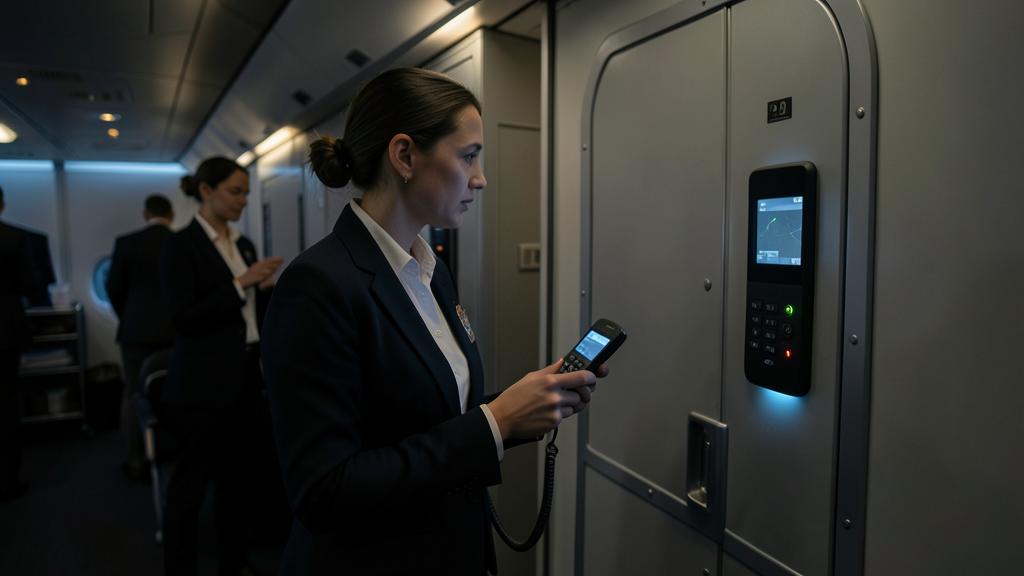
For the seconds during which the door is unlocked and moving, it offers no protection whatsoever. Everything protective in that window is procedural: someone positioned in the aisle, a cart or curtain placed to add a second or two, a rule about where passengers may stand, and a habit of doing all of it the same way every time. The system is designed on the assumption that those seconds are covered by a person.
It is worth being honest about what that person is. They are unarmed. On many narrow-body configurations they are alone in the forward cabin. While operating the keypad they are facing away from the passengers, which is the one direction the threat model says the threat comes from. And a service cart is not a barrier in any engineering sense: it is a delay device, worth a second or two against someone determined, which is the whole of its design intent.
Here the two sides of the Atlantic have taken different views. United States legislation directed the FAA to require an installed physical secondary barrier on newly manufactured airliners, and a rule followed, with compliance dates spread over several years. European rules contain no equivalent requirement, so on most of the European fleet the secondary barrier is a cart, a curtain and a colleague, and will remain so for the life of the aircraft. That is not an oversight awaiting a fix: it is a settled difference between two systems, and your procedure is written accordingly.
The interphone becomes a single point of failure
With the door closed and locked by default, the interphone is not one channel among several. It is the channel. Everything the cabin needs from the flight deck — a diversion decision, a medical notification, a request to open — travels through it, and so does everything the flight deck needs from the cabin.
That channel has predictable failure modes and none of them are exotic. Below the altitude or phase at which the flight deck is sterile — ten thousand feet in the United States rule; European rules speak of critical phases of flight rather than of a fixed height, though many operators’ manuals adopt the same figure — the pilots will deliberately not answer routine calls. A headset can be off. A boom microphone can be stowed. A non-normal checklist absorbs attention completely and legitimately. The call chime is one sound among many on a busy flight deck.
The consequence is an ambiguity that the hardware cannot resolve: an unanswered interphone means either busy or unable, and the cabin has no way to tell which. That ambiguity is the real cost of the locked door, and the only thing that reduces it is a procedure that says, in advance, how long silence is allowed to remain silence and what happens at the end of that period. If your Operations Manual does not answer that in seconds and steps, the answer will be improvised on the day by whoever is standing there.
The trap. Treating an unanswered call as reassuring because the aircraft is still flying normally. An autopilot will hold altitude and track for a long time with nobody capable at the controls. The flight path proves nothing about the state of the people in front of it — which is exactly why the escalation timings exist and why they are expressed in minutes rather than left to judgement.
Four demands that pull the same door in four directions
The reason the flight deck door is not simply a stronger door is that it has to satisfy requirements that genuinely conflict. Understanding those conflicts explains most of the behaviour that seems arbitrary from the cabin side.
| Demand | Where it comes from | What it forces into the design | The tension it creates |
|---|---|---|---|
| Resist forcible intrusion | Security requirements in ICAO Annex 6 and the equivalent regional rules | Mass, reinforced structure, multiple latching points | A heavy assembly that is slow to open and slow to close |
| Relieve a pressure differential | Structural certification of the pressurised fuselage | Panels that open when differential pressure builds across the door | An opening exists in the barrier by design, and always will |
| Let the flight crew out | Emergency egress and evacuation requirements | A means of opening that does not depend on electrical power | Mechanical paths that must be protected against use from the wrong side |
| Let the cabin in when nobody answers | Operational necessity after flight crew incapacitation | An emergency access code and a timed unlock | The same feature is the one an attacker would attempt to use |
The decompression panels are the clearest illustration, and the one most often misunderstood in the cabin. They exist because the door sits on the boundary between two volumes of air that can lose pressure at very different rates. Without a relief path, a rapid decompression on one side turns the door into a piston with a structural load behind it. The panels are not a defect and they are not a security failure that somebody forgot about. They are the price of not having the door become a projectile, and their existence is the quiet admission that impenetrable was never the claim being made.
The fourth line matters just as much. Any system letting the cabin in when the flight deck cannot respond also gives an intruder a documented route, which is why that route carries a delay and why the flight crew can deny it for a period. Both values are type- and operator-specific, and they are the numbers most worth knowing precisely for the aeroplane you actually fly.
Where the friction shows up in line operations
The forward lavatory
A single lavatory placed forward puts a permanent stream of passengers into the exact area the procedure requires to be clear. Every door movement then involves a small negotiation with a stranger who wants something entirely reasonable. Crews manage it, but the management is social rather than procedural, it consumes attention, and it is a common source of passenger complaint arising from a security procedure. Operators that block the forward lavatory during the movement are buying back margin the door design gave away.
The cycle count on long haul
Short haul opens the door once or twice per sector. A long-haul rotation with augmented crew, crew rest and multiple physiological breaks may open it a dozen times. Exposure is not proportional to the length of the flight but to the number of movements, which is a very different quantity and is rarely counted.
Drift, and why it is not laziness
A procedure that never produces a visible benefit, performed several times a day for years, will erode. That is the predictable behaviour of any system giving no feedback, not a character flaw. Drift shows up as the cart placed approximately, the challenge shortened, the colleague on the way rather than in position. None of it is dramatic in isolation, and that is the point: the safety case rests on the aggregate, which nobody in the aisle can see.
The small cabin
On a regional aircraft with one or two cabin crew, a procedure requiring one person at the door and another watching the cabin cannot be executed as written. The procedure must be a different procedure, not a degraded version of the same one. Where an operator runs mixed fleets, this is where the two sets of instructions get confused, and it is worth checking that your manual genuinely has two procedures rather than one with an asterisk.
Coercion, and the limits of a code
The detail of duress procedures does not belong on a public page, for a reason beyond discretion: the implementing guidance for aviation security is restricted, reaches you through your operator’s security programme rather than a document you can look up, and its value depends on it not being rehearsed by the wrong readers.
The structural point can be made without any specifics. Any procedure built on a code is built on knowledge, and knowledge can be taken from a person. Any procedure that asks somebody to perform an extra action while being watched asks a great deal of them at the worst possible moment. The more robust constructions are the ones where the routine action is itself the signal, so that its absence carries meaning and no additional courage is required. Those constructions cost something too: they generate ambiguity and occasional false alarms, and that trade-off is one of the reasons operator procedures differ from one airline to the next even within the same regulatory system.
What is worth rehearsing between recurrent courses
The elements of this procedure that decay first are the timings and the geometry, because both feel obvious until the moment they are needed. Three questions asked out loud during a pre-flight briefing keep them alive, and none of them takes more than a few seconds.
- How long do we wait on an unanswered interphone before treating silence as an event, and what exactly is the next step after the wait?
- On this aircraft, in this cabin configuration, who stands where during a flight deck door movement, and what changes if one of us is in the rear galley?
- What does the flight deck need in the first sentence of a medical or security call, so that they can decide without a second call?
The right habit. Brief the geometry against the actual cabin, not against the diagram. Aircraft of the same type differ in galley layout, lavatory position and curtain fitting, and the procedure is written for a generic cabin. Ninety seconds spent agreeing positions with the crew you are actually flying with removes the hesitation that otherwise appears at the exact moment the door is open.
None of this makes the reinforced door a bad trade, and no serious professional argues for reopening the route it closed. But a procedure whose costs are never stated tends to be applied mechanically, and a procedure applied mechanically is the one that drifts. Knowing what the door does not do — it is not sealed, it protects nothing while open, it turns a routine call into a single point of failure — is what turns compliance into competence. Crews comparing how their operators resolved these trade-offs will find the discussion continues on the FL330 forums.


Leave a Reply
You must be logged in to post a comment.