
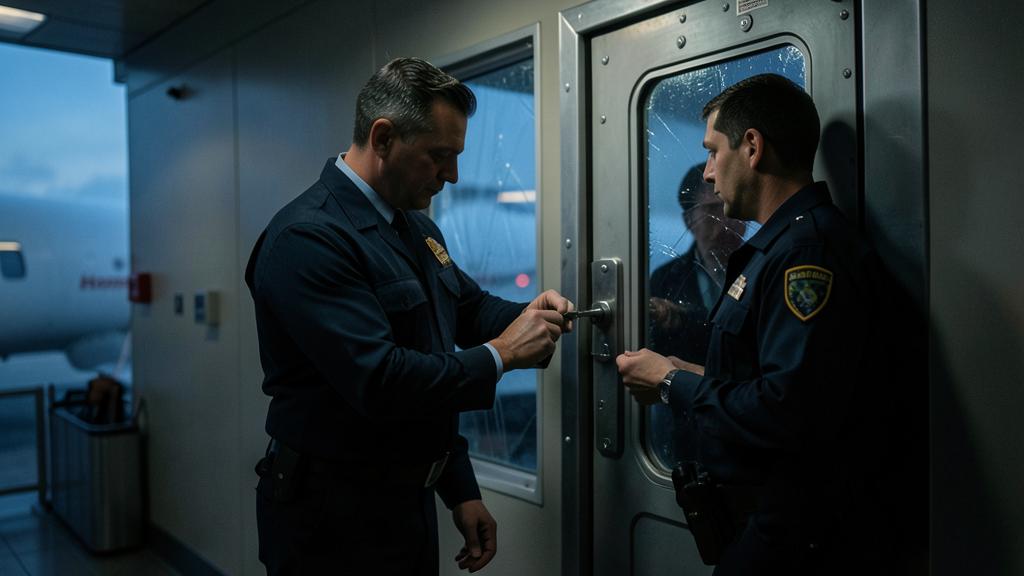
The procedure you follow to get into a flight deck is not the product of a single decision. It is the residue of two catastrophes that pointed in opposite directions: one where the danger came through the door, and one where the danger was already sitting in the left seat. No locking mechanism satisfies both demands, which is why the recommendation that emerged after the second event was issued, applied, and then deliberately handed back to operators. Understanding that arbitration explains why your airline’s procedure differs from the one across the ramp — and why neither of them is wrong.
The doctrine that made sense until it did not
For three decades, the professional response to a hijacking was accommodation. In the United States it had a name, the Common Strategy, and it was taught: comply with the demands, keep the aircraft flying, land where you are told, and let negotiators on the ground resolve it. The reasoning was empirical rather than timid. Most hijackings on record had ended on a runway with the occupants alive, and resistance had repeatedly made outcomes worse.
Flight deck doors existed and could be locked, but the doctrine made locking them beside the point. A crew instructed to cooperate has no use for a barrier. The door was a partition with a latch, designed against curiosity and inadvertent entry, not against force.
There had been a warning. In December 1994, an Air France Airbus was hijacked at Algiers and held at Marseille, where French authorities came to believe the intention was to end the flight in a crash over Paris. The assault that ended the siege was on the ground. The scenario had been articulated, but the doctrine did not move, because the evidence base still said that compliance saved lives.
What 2001 wrote into the airframe
On 11 September 2001 the assumption underneath the Common Strategy was destroyed in the course of a single morning. Access to the controls was the objective, not the leverage. Every element of the doctrine that had been protective became the mechanism of the attack, and the crews concerned were following the procedure they had been trained to follow.
The regulatory response was unusually fast by aviation standards. Within two years, requirements for a reinforced, lockable flight crew compartment door had taken effect across the major systems, with ICAO Annex 6 setting out what the door had to withstand and Annex 17 framing the wider security obligations. The specification is deliberately narrow: resist penetration by small arms fire and grenade shrapnel, resist forcible intrusion, be locked and unlocked from either pilot station, and provide a means of seeing who is outside.
It worked. Whatever else can be said about post-2001 aviation security, the specific route used that morning has not been used successfully since. That is a strong result, and it is the reason nobody in the profession proposes reversing it.
The 9/11 attacks showed that hijackers could use the flight deck to crash planes. So, airlines and regulators made cockpit doors stronger to keep attackers out. But this same door can also trap a pilot who might want to crash the plane.
On 24 March 2015, a Germanwings Airbus A320 crashed into the French Alps. The first officer, alone in the cockpit, locked the door and flew the plane into the mountains. The door worked as designed—it kept him in, but it also kept the captain out.
The threat that was already inside
The industry had evidence of the opposite threat long before it acted on it, and the reluctance to name that category is itself part of the history. In December 1987 a dismissed airline employee used credentials that let him bypass screening, boarded a Californian domestic flight and shot the crew. In April 1994 a company employee riding on the jumpseat of a freighter attacked the operating crew with the declared intention of crashing the aircraft; they survived, barely, and flew it back. Two late-1990s losses were attributed to deliberate crew action by the investigating authority of one State and contested by the authority of the other State involved — a disagreement that left the category politically difficult to discuss.
In November 2013 a LAM Mozambique Embraer was lost in Namibia; the investigation attributed the descent to deliberate action by the captain, the first officer having left the flight deck and been unable to get back in. The pattern was complete and documented, and it changed very little.
On 24 March 2015 a Germanwings Airbus A320 en route from Barcelona to Düsseldorf descended into terrain in the French Alps. The French investigation established that the first officer, alone on the flight deck after the captain left, commanded the descent and used the door system to prevent re-entry until impact. The door held. It held exactly as designed, against exactly the person it had been installed to protect.
Two threat models, one lock
Setting the two scenarios side by side shows why no purely technical answer exists. Every property that makes the door effective against one makes it an obstacle against the other.
| Intrusion from the cabin | Deliberate action from the flight deck | |
|---|---|---|
| Where the danger is | Outside the door, in the passenger cabin | Inside the door, in a crew seat |
| What the door must do | Stay closed against force and against the emergency access route | Open quickly, against the will of the person controlling it |
| What warning looks like | Behaviour visible in the cabin, sometimes seconds in advance | Usually nothing observable in the cockpit; the indicators are historical and medical, not behavioural |
| Who is best placed to act | The cabin crew, then the flight crew by denying access | The other pilot — provided they are on the flight deck at the moment it matters |
| What the countermeasure costs | Delay, cabin friction, an interphone that becomes a single point of failure | A weaker lock, or a rule about who must be present, with its own workload and privacy consequences |
The row that decides everything is the second one. « Stay closed against a determined person » and « open against a determined person » are not two settings of the same requirement; they are contradictory. Since the hardware cannot arbitrate, the arbitration has to happen in procedure — which is to say, in a judgement about which of the two threats is more likely on a given operation.
The recommendation that was made, then handed back
Within days of the 2015 accident, EASA published a safety information bulletin recommending that operators ensure two authorised persons, at least one of them a qualified pilot, are on the flight deck at all times, and a large part of the European industry adopted it immediately. The logic is direct: if a pilot must leave, a cabin crew member takes their place, so the door can always be opened from inside by someone who is not the person you would need to open it against.
The following year the Agency revised its position. Rather than a blanket recommendation, operators were to conduct their own risk assessment and decide whether the measure was appropriate to their operation. Some airlines dropped the practice, others retained it, and that is the direct origin of the variation crews notice today when they change employer or fly under a code-share.
The revision was not a retreat from safety, and it is worth understanding why, because it is a good example of a mature regulator reasoning about a countermeasure rather than about an event. A two-person rule introduces its own hazards. It increases the number of door movements, and every movement is an exposure to the first threat. It places, in the flight deck, a person who is not a pilot, next to controls, at moments of high workload. It removes a cabin crew member from a cabin that may be short-handed. And it produces at best a partial defence: a cabin crew member cannot fly the aeroplane and cannot physically overpower a pilot with any reliability. Against that sits a benefit that is real but difficult to quantify, because the event it addresses is extremely rare.
The trap. Reading a difference between two operators’ procedures as one of them being lax. Where a measure has been delegated to a risk assessment, both answers can be correct, because they are answers to different questions: the fleet, the cabin crew complement, the route network, the recruitment and medical framework and the security environment all feed the calculation. What would be genuinely wrong is an operator that never made the assessment, or one that made it once and has never revisited it.
What the assessment actually weighs
The inputs are not mysterious, and knowing them makes your own company’s procedure legible rather than arbitrary.
| Factor | Pushes towards an occupancy rule | Pushes against it |
|---|---|---|
| Cabin crew complement | Large crews on wide-body operations, where one person can be spared | Minimum crew on regional and short-haul aircraft, where the cabin is left uncovered |
| Sector length | Long sectors with several physiological breaks and crew rest | Very short sectors where the door barely opens in the cruise |
| Crew stability | Large mixed rosters where pilots and cabin crew rarely fly together twice | Small operators where crews know one another and behaviour changes are noticed |
| Medical and support framework | Limited access to confidential support, where a pilot in difficulty has nowhere to go | A functioning peer support programme and an active occupational health relationship |
| Security environment | Networks and airports with an elevated intrusion threat | Operations where the assessed intrusion threat is low and the door movements dominate the risk |
Notice the fourth row, because it is where the centre of gravity has shifted. If the countermeasure at the door is weak and expensive, the more productive investment is upstream: making it likelier that a pilot in difficulty is identified, supported and if necessary removed from duty before they ever reach an aircraft. European rules adopted in 2018 moved in exactly that direction, requiring operators to enable and facilitate access to a proactive and non-punitive support programme for flight crew, adding psychological assessment before line flying and putting in place arrangements for testing for psychoactive substances. Those measures address the threat model that a lock cannot.
Where the systems diverge, and who decides what
Four layers act on this subject, and confusion usually comes from attributing a decision to the wrong one.
| Layer | Instrument | What it settles | What it leaves open |
|---|---|---|---|
| ICAO | Annex 6 for the door, Annex 17 for security, with restricted implementing guidance | That a reinforced, lockable door exists and what it must resist | Almost everything about how it is used in service |
| Region and State | European air operations rules, 14 CFR, the national civil aviation security programme | The framework, the crew training obligations, and in the United States some of the practice as well | The occupancy rule, which Europe delegates to the operator |
| Operator | The security programme and the Operations Manual | The actual access sequence, the occupancy rule, the barrier arrangement and the escalation timings | Nothing — this is the layer that binds you, and it changes when the assessment changes |
| Aircraft type | Flight manual and flight crew operating manual | Access delay, deny function, behaviour on loss of electrical power | Not negotiable by procedure; the procedure must be built around it |
The clearest transatlantic divergence is the physical secondary barrier. United States legislation in 2018 directed the FAA to require an installed barrier between the cabin and the flight deck door on newly manufactured airliners, and a rule followed a few years later with compliance dates spread over the period after that. There is no equivalent European requirement. American operators have applied a two-person practice since shortly after 2001, embedded in their approved security procedures rather than resting on a single federal rule — which is why the measure Europe handed back to risk assessment in 2016 was never in question there.
Where the argument has moved
The door itself is now a largely settled piece of engineering, and the live questions have moved either side of it. Downstream, the insider question has broadened beyond flight crew: screening arrangements for crew and staff before they reach airside still vary considerably between States, and maintenance and ground access are part of the same problem. Upstream, the debate concerns detection — the balance between a medical framework that must be able to ground a pilot and a support framework that only works if pilots believe using it will not end their career. Those two objectives pull against each other in the same way the lock does, and the profession has not finished arguing about where the line sits.
One further category deserves naming without overstating it. At least one major loss remains unresolved, with deliberate action among the hypotheses and no evidence sufficient to establish it. An unresolved case proves nothing, and building rules on it would be poor practice, but it does explain why the subject retains an emotional charge that the statistics alone would not justify. The professional discussion, including how different operators have set their occupancy rules, continues on the FL330 forums.
The right habit. Ask why your operator’s rule is what it is, not just what it is. Every airline that applies or declines an occupancy rule has a documented assessment behind it, and that assessment names the hazards the company believes it faces. Reading it is the fastest way to understand a procedure that otherwise looks like a preference — and the fastest way to notice if it has not been revisited since it was written.
What the two accidents left behind is not a rule but a permanent trade-off, held in tension by procedure rather than resolved by hardware. That is an uncomfortable answer, and it is the correct one. A door that could be made to open against a hostile person inside would also open against a hostile person outside; a rule that puts a second body on the flight deck buys a partial defence by paying in door movements. The profession chose to keep the arbitration visible and revisable rather than to pretend that a lock could settle it, and the version you follow is one operator’s current answer to a question that stays open.


Leave a Reply
You must be logged in to post a comment.