
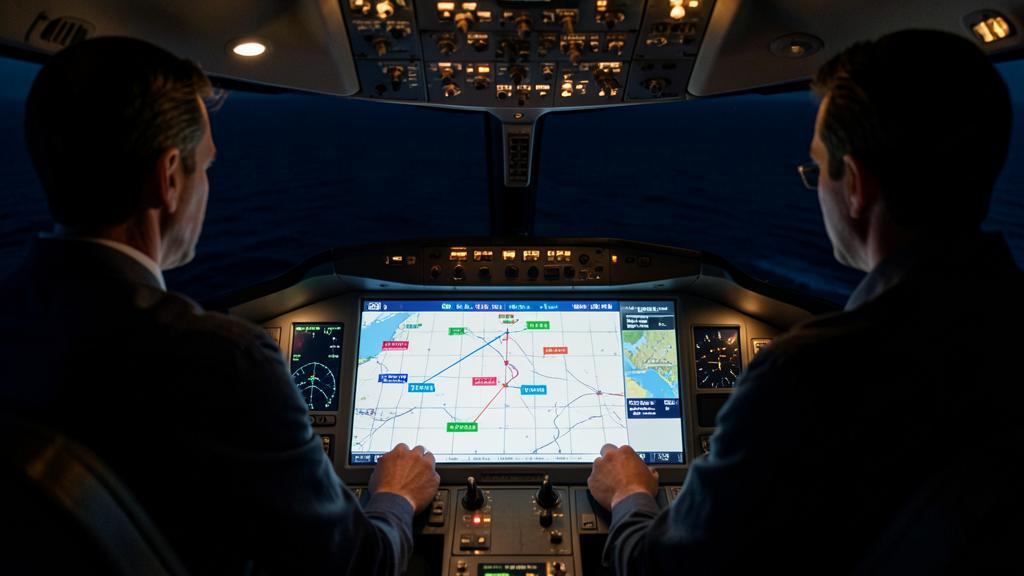
An equal time point is not a place on the chart. It is the answer to an arithmetic problem, and the problem contains three inputs a crew rarely states out loud: which pair of aerodromes, at what assumed true airspeed, in what wind. Change any one of them and the point moves. That is why a single oceanic sector carries several equal time points at once, printed on the same flight plan, sometimes tens of miles apart, and why the only useless question on the day is where the equal time point is without saying which one.
What an equal time point actually equalises
The equal time point — point of equal time, critical point, ETP depending on the house style — is the position along a track from which the time needed to reach a chosen aerodrome ahead is the same as the time needed to return to a chosen aerodrome behind. Before it, turning back is quicker. After it, continuing is quicker. That is the whole of what it says.
Three words in that definition carry all the weight, and each one is a variable, not a constant. Time: the equalisation is temporal, not spatial and not fuel-based, so the point is not the midpoint of anything unless the arithmetic happens to place it there. Chosen: the point exists only in relation to a named pair of aerodromes, and a pair that changes gives a point that changes. Same speed: the calculation assumes an aircraft in a stated configuration flying at a stated speed, and the configuration you assume is the configuration you are planning to be in when it matters — which is to say, a degraded one.
What the point does not say is equally important, and misreading it is the more common error. It does not say you have the fuel to go either way. It does not say the aerodrome is open, above minima, or equipped for what you are carrying. It does not say the shorter time is the better decision. It is a turn-direction instrument for a specific failure, and nothing else.
The equal time point is a location where the time to reach the next airport is the same as the time to return to the previous one. It only considers time, not fuel or other factors, and changes based on speed, wind, and which airports you’re comparing.
On a 1,200 NM track between two airports with a 100 kt tailwind toward the destination, an aircraft at 460 kt true airspeed would have its equal time point at 470 NM from the departure airport. If the wind changes to a 100 kt headwind, the point shifts to 730 NM from the departure airport.
The arithmetic, and the two ground speeds it needs
For a pair of aerodromes A behind and B ahead, separated by a distance D measured along the diversion tracks, the distance from A to the equal time point is:
d = D × GS_back / (GS_on + GS_back)
where GS_on is the ground speed toward B and GS_back the ground speed toward A, both computed at the same assumed true airspeed. The structure of the fraction explains the behaviour. If the two ground speeds are equal — that is, in still air — the point sits at the midpoint of the pair, whatever the speed. Every displacement away from the midpoint is the work of wind.
Three practical consequences follow from that expression, and all three are routinely fumbled.
- The wind component reverses. The return leg flies the reciprocal of the diversion track, so a component that adds on the way out subtracts on the way back. The point therefore always moves upwind: with a tailwind toward the aerodrome ahead, the equal time point shifts back toward the aerodrome behind, and you become committed to continuing earlier than the geometry alone suggests.
- The relevant wind is not the on-track wind. The two diversion tracks generally leave the cruise track at an angle, and they are flown at the diversion level, not the cruise level. Using the cruise-level wind along the route track is a convenient approximation that stops being convenient in a jet stream, where the diversion level can be in an entirely different flow.
- True airspeed is temperature-dependent. At a fixed Mach number, true airspeed rises with air temperature, so a warm day and a cold day give different ground speeds for identical planning and therefore different points. Ten degrees of temperature deviation is worth roughly two per cent of true airspeed — negligible on a short pair, visible on a long one.
The reflex. When an equal time point is quoted, ask three questions before using it: which pair, which failure case, and what wind was assumed. A point quoted without those three is a number without a unit.
Why one flight carries several equal time points
The assumed true airspeed is the multiplier that produces the plural. Each failure case flies a different speed at a different level, and each therefore generates its own point on the same track between the same two aerodromes.
| Case | Level assumed | Speed assumed | What drives the case |
|---|---|---|---|
| All engines operating, pressurised | Cruise level, or a level convenient for the diversion | Normal cruise speed, or the declared all-engine diversion speed | Medical events, unruly passengers, technical problems that do not affect propulsion or pressurisation. Time to definitive care is the constraint. |
| Loss of pressurisation | Descent to a level compatible with oxygen and with terrain — commonly ten thousand feet, higher where terrain or oxygen provisions allow | The speed schedule flown after an emergency descent, which is a low-level speed and therefore a much lower true airspeed | Oxygen duration for occupants and crew, and cabin comfort over long transits at low level. |
| One engine inoperative, pressurised | The driftdown or single-engine cruise level for the weight of the day | The approved one-engine-inoperative diversion speed declared in the operations manual | Terrain clearance during driftdown, and the extended-range diversion time limit if one applies. |
| One engine inoperative and depressurised | The lower of the two levels, so the more restrictive | The slowest of the assumed speeds | Usually the sizing case for fuel, and the case whose point is hardest to guess without doing the arithmetic. |
Two features of that table are worth stating plainly. First, the displacement away from the midpoint follows the ratio of the wind component to the assumed true airspeed, so a slow case is more sensitive to a given wind than a fast one. Second, the levels differ, so the four cases are not four speeds in one wind field but four speeds in four different wind fields — and it is the ratio, not the speed alone, that decides which point ends up furthest out.
Still air and forecast wind are two different constructs
There is a second population of numbers on the same flight plan that looks like an equal time point and is not one, and confusing the two costs real time in a briefing.
Extended-range diversion time limits — the sixty, ninety, one hundred and twenty, one hundred and eighty minute figures, and the extensions beyond — define an area of operation. The distances that bound that area are derived in still air, at standard temperature, at the approved one-engine-inoperative speed, at an assumed weight. They are a certification and approval construct. They do not move with the weather, because they were never a statement about the weather.
The equal time point for the day is the opposite kind of object. It is computed with the forecast wind and temperature for the intended time of passage, and it exists to support a decision in flight. It moves every time the forecast is refreshed, and it moves again when the forecast fails to verify.
The trap. An entry point into an extended-range area and an equal time point can appear within a few minutes of each other on the same plan and mean nothing alike. One says where the area of operation begins under a still-air rule. The other says which way it is quicker to turn today. Neither substitutes for the other, and neither says anything about fuel.
A worked illustration on one pair
The figures below are arbitrary and chosen only to expose the mechanism — they are arithmetic, not guidance, and they belong to no aircraft type. Take two aerodromes twelve hundred nautical miles apart along the diversion tracks, with a jet stream giving a strong tailwind component toward the aerodrome ahead at cruise level. Below the core the flow weakens sharply, so each diversion level sees a different wind — which is what makes the exercise worth doing.
| Case | Assumed true airspeed | Component toward the aerodrome ahead | Distance from the aerodrome behind |
|---|---|---|---|
| Reference: any speed, no wind | Any | Nil | 600 NM — the midpoint |
| All engines, cruise level | 460 kt | 100 kt tailwind | 470 NM |
| Depressurisation, low level | 320 kt | 25 kt tailwind | 553 NM |
| One engine inoperative, driftdown level | 380 kt | 60 kt tailwind | 505 NM |
| One engine inoperative and depressurised | 300 kt | 25 kt tailwind | 550 NM |
The four operational points span more than eighty nautical miles — some nine minutes of cruise on this pair. That spread is the whole argument: small enough that nobody notices it in the briefing, large enough that on the wrong side of it the aeroplane turns the wrong way. Note which case ends up furthest from the midpoint — not the slowest, but the all-engine case, because it is the only one still in the jet core. The two depressurised cases lose more wind than they lose speed by descending, and their points sit closest to the middle.
Change nothing but the wind — reverse the flow — and every one of those points moves to the far side of the midpoint by a comparable amount. The geometry of the pair contributed nothing to the displacement.
Equal time is not equal fuel, and not equal outcome
The equal time point answers a question about duration. Two neighbouring constructs answer different ones, and each is regularly asked to do the others’ work.
| Construct | Question it answers | What it is computed from | What it never tells you |
|---|---|---|---|
| Equal time point | From here, which way is quicker? | Distance between the pair, assumed true airspeed for one failure case, forecast wind at the diversion level | Whether you have the fuel to fly either leg, or whether the aerodrome is usable |
| Point of safe return | How far can I go and still get back to a chosen aerodrome with reserves intact? | Usable fuel, consumption in the assumed configuration, wind both ways, required reserves | Which way is quicker, and whether continuing is legal |
| Critical fuel scenario | How much fuel must be on board at the most critical point so the worst diversion case can be flown to its end? | The worst combination of failure, level, speed, icing, anti-icing use, holding and approach at the en-route alternate | Where to turn, and how long the diversion takes in the benign case |
The consequence is that a turn made at the equal time point is not a symmetrical decision in fuel terms. On a day with a tailwind toward the aerodrome ahead, the return leg is flown into that wind at a low level in a degraded configuration: the same number of minutes, considerably more fuel. Equal time can be an expensive turn, and on a pair where the point sits well upwind it can be the more expensive of the two options despite being, by construction, no slower.
What moves the point after departure
The plan prints the points for the pairs and the forecast that existed when it was produced. Four things then move them, and three of the four move them without anyone recomputing anything.
- The pair changes. An en-route alternate that goes below minima, closes for snow clearance, loses its rescue and firefighting category or suffers a runway blockage is no longer part of the pair. The next usable aerodrome is at a different distance, so every point associated with that pair is void — not shifted, void. This is the single largest source of movement and it is announced by a weather update, not by a fuel figure.
- The wind fails to verify. A component that arrives ten or twenty knots off forecast moves each point by a distance proportional to the error and inversely proportional to the assumed speed. The slow cases move most.
- The level changes. A step climb, or a level held down by traffic, changes the wind field for the cruise but also, sometimes, the diversion level assumed for a driftdown case at the new weight.
- The route changes. A reroute alters the diversion tracks, and therefore the distance between the pair as well as the wind components on both legs.
One thing that must not change is the assumed speed. The one-engine-inoperative diversion speed used in the arithmetic is a declared speed, held in the operations manual and, where an extended-range approval applies, part of that approval. It is not a speed the crew selects to taste on the day. If the aircraft is flown faster or slower than the declared speed during an actual diversion, the planning point that was computed from that speed no longer describes the flight being flown.
Using it on the day
The practical discipline is small and it is mostly about naming things. During the briefing, state the pair, the case and the position together, in that order, for each point being carried. Cross-check that the flight plan’s points correspond to aerodromes you have actually reviewed for the time of passage, rather than to a default list generated by the planning system. Confirm which case the operator’s system used for its headline point, because some print the all-engine case and some print the most restrictive one, and a crew that assumes the wrong default is reading a number for a failure it is not having.

Then keep the decision in its place. The arithmetic identifies the quicker direction for one failure in one wind field between two named aerodromes. It has no opinion about night, approach aids, the medical facility at the field, handling, or what the passengers will be sitting in for the next nine hours. The commander weighs all of that. The point exists to remove one variable from the decision, not to make it. Route planning, en-route alternate selection and the diversion cases are worked through in the operations modules at FL330 training.
The final observation is the one the plural in the title is there for. A crew that speaks of the equal time point has quietly collapsed four different answers into one, and will be right for three of the four failures it does not have.


Leave a Reply
You must be logged in to post a comment.