
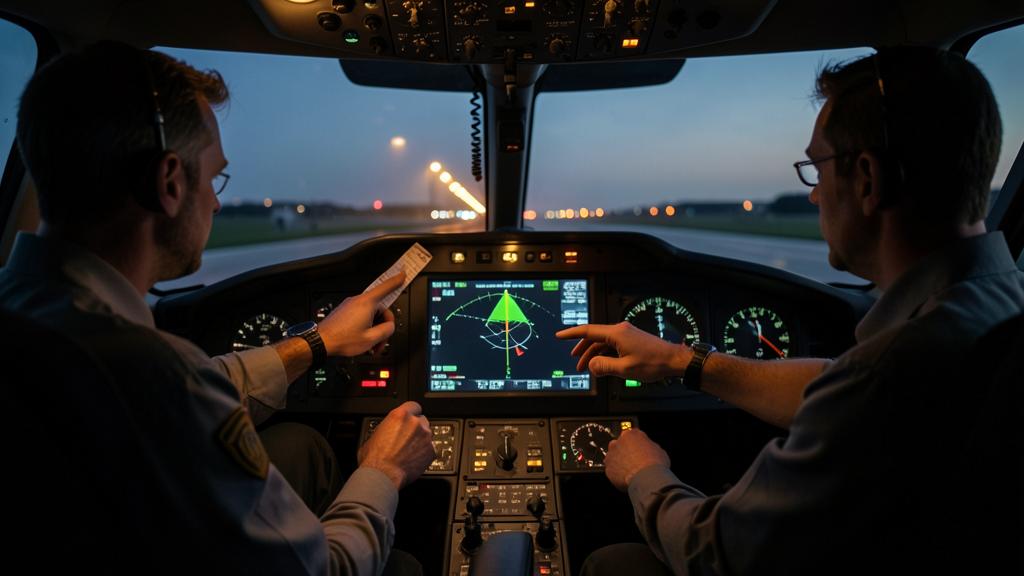
A short flight, an uneventful day: an inoperative item accepted at departure, a runway change during start-up, an ATC instruction applied with a slight delay, a bit of crosswind on arrival, a shortcut offered by control. At the gate, the debrief fits in one sentence: « nothing to report. » It is precisely that flight that the Threat and Error Management model exists to debrief: it provides three categories that force you to name what happened, instead of summarizing it by its outcome.
Three Objects, a Single Sorting Criterion
The model does not classify causes, it classifies observable objects: that is what makes it usable at the gate by two tired people. A threat is a situation that increases complexity and that the crew did not produce: weather, traffic, runway condition, a failure, but also an arrival whose descent constraint falls badly, a slot that compresses preparation, ambiguous documentation. An error is an action or omission that departs from the crew’s intention or from the approved documentation. An undesired state is a state of the aircraft — position, speed, configuration, energy — that visibly reduces margins.
The sort comes down to one question: who owns the object. The threat comes from outside, the error belongs to the crew, the undesired state belongs to the machine. Crosswind is a threat; a drift correction applied too late is an error; the localizer track recaptured at low height with full correction and excess speed is an undesired state. A single flight, three categories, and nothing overlapping. This watertightness forbids merging an event the crew suffered and a crew deviation into the same word, which everyday language does spontaneously.
Threats are then further divided according to what was known about them beforehand. An expected threat was on the briefing card: it is handled through planning, a plan spoken out loud and a decision criterion set before it is needed. An unexpected threat arrives without warning and is handled through real-time task-sharing, through an explicit decision of who flies and who manages. A latent threat cannot be seen from the flight deck: the design of an arrival procedure, the ergonomics of an FMS page, a sequence of rotations that places the third sector at the circadian low. That one is not handled on board. It is reported.
The model helps pilots analyze flights by separating three types of problems: outside threats (like weather), crew mistakes, and dangerous aircraft states. Each has different solutions. The key is to identify them correctly and act on them before they cause bigger problems.
On a Boeing 737 arriving at Paris CDG with 15 knots of crosswind, the crew notices the localizer is off-center at 500 feet. The crosswind is a threat, but the off-center approach becomes an undesired state when they don’t correct it in time, leading to a go-around. The model would analyze: was the crosswind expected (threat), was the correction delayed (error), and when was the off-center condition recognized (undesired state)?
What the Diagram’s Arrow Does Not Say
The usual representation lines up the three boxes from left to right, and this layout induces two stubborn misreadings. The first is to believe the chain is causal, that a threat produces an error which produces an undesired state. That is wrong in both directions: most threats are absorbed without the slightest deviation, and an undesired state can appear without any error having been committed — wake turbulence, wind shear, a failure that puts the aircraft in a state that must be broken out of before it can be understood. The second is to believe that every error descends from a threat, whereas the most mundane deviations — a selection on the wrong panel, an approximate readback — are born from routine.
A loop must be added that the linear diagram does not show: an undesired state increases workload and in turn generates errors, often errors of response. That is the mechanism that turns a high approach into a poorly flown go-around, and the reason you break out of the state before diagnosing what led to it. Debriefing means pinpointing where the chain forked, not unrolling it as a story whose ending was already written.
The Tipping Point Is Detection
The model’s real contribution is not its taxonomy, it is its central claim: the outcome of an event depends on how it is managed, not on its occurrence. Detected and corrected, an error gives back the margin. Detected and then mishandled, it calls for a response that itself becomes an error. Passed unnoticed, it leaves no visible consequence, and that is the most costly case in the medium term: nothing went wrong, nothing will be said, and the same deviation will return the following week under less forgiving conditions.
This last branch explains why an honest debrief talks mostly about what produced nothing. The crew is the sole witness to consequence-free errors: they trigger no parameter exceedance usable by flight data analysis, no technical event, no feedback from air traffic control. Left unsaid at the gate, they exist nowhere.
| Category | What defines it | What is written in the debrief | The countermeasure that matters |
|---|---|---|---|
| Threat | Situation external to the crew that increases complexity | Was it foreseen, and was the plan stated before the deadline | Planning, decision criteria set in advance |
| Error | Action or omission that departs from intention or procedure | Who detected it, in how much time, by what means | Mutual monitoring, cross-checking, standard callouts |
| Undesired State | Position, speed, configuration or energy that reduces margins | At what moment it was recognized as such, and what broke it | Immediate exit from the state, diagnosis afterward |
Countermeasures Fall Into Three Time Frames
A countermeasure is not a good intention, it is an observable act, and training groups them into three moments. Planning countermeasures play out beforehand: a briefing that states a constraint and an abort criterion, explicit allocation of roles, time set aside for preparation when the slot tightens. Execution countermeasures play out during: standard callouts, trajectory monitoring by the pilot not flying, the decision to step down one level of automation as soon as the aircraft stops doing what was expected. Review countermeasures play out along the way and are the rarest: going back on a plan that no longer holds, saying out loud that the situation no longer resembles what was briefed.
The curve above summarizes what review produces: it does not remove the dips, it makes them climb back up. A well-managed flight is not a flight without events, it is a flight where every event was followed by an action that gave back margin. Hence the value of debriefing the delay between the event and the countermeasure rather than the apparent severity of the event.
| Family | Typical form | Detection signal | Most effective countermeasure |
|---|---|---|---|
| Procedural | Deviation from a known and accepted procedure: a skipped step, a selection on the wrong element | A mismatch between the callout and the display, noticed by the monitoring pilot | Systematic callout of the selection, cross-checking |
| Communication | Incomplete message, approximate readback, intention not shared in the cockpit | A response that does not answer the question asked | Rephrasing, verifying with air traffic control rather than between crew members |
| Decision | An operational choice that reduces margins without violating any procedure | A criterion set at the briefing that is currently being crossed | Numerical criteria defined before the deadline, explicit review of the plan |
An Ordinary Flight, Four Lines of Debrief
Let us return to the day described at the start of this article. At departure, an inoperative item accepted under the minimum equipment list: an expected threat, whose only valid countermeasure consists of having read the associated procedures before start-up, not at the moment they are needed. Runway changed during start-up: an unexpected threat, handled by halting the sequence, redoing the performance preparation and cross-checking the departure. An ATC instruction applied with a delay because both pilots were looking at the same screen: a monitoring error, detected by the crew, with no consequence on the trajectory. Crosswind, then a shortcut offered by control: two threats, the second of which was declined.
The debrief then fits into four lines, none of which passes judgment: a poorly prepared expected threat, an unexpected threat correctly absorbed, an internally detected error, two arrival threats one of which was declined. What is generalizable is obvious: read the procedures tied to the minimum equipment list before start-up, and never let both pilots converge on the same screen during a trajectory phase. Two transferable lessons from a flight on which, officially, nothing happened — this is where the model stops being an investigation tool and becomes a progression tool.
Debriefing Without Rewriting History
The reading grid comes down to two questions asked in this order: when was the event seen, and what was done about it. A late detection followed by a correct response costs margin and deserves to be treated as such, even if the flight ended well. An early detection followed by an unsuitable response is a problem of plan, not of vigilance, and is not corrected by the same instruction.
The right reflex. Four lines, a few minutes, in this order: what happened, what was done about it, what made it visible, what would be generalizable to another crew. The third line is the one people skip, and it is the most useful: naming the means of detection — a display mismatch, a callout, a doubt voiced aloud — points to a reproducible countermeasure instead of a personal quality.
The debrief takes place before fatigue rewrites the account, and it begins with chronology: lay out the facts, categorize afterward, judge last or not at all. A crew that starts with an appraisal of performance ends up with a conversation about people; one that starts with the timeline ends up with a conversation about the system.
The Model’s Four Pitfalls
The pitfall. Reclassifying after the fact. An event whose outcome is known sorts itself into the convenient box on its own: the detected error becomes anticipation, the suffered threat becomes an unforeseeable event that nothing could have handled, and the decision that turned out badly becomes an error even though it was reasonable given the information available at the time. The only safeguard is to fix the chronology before classifying, then to ask what was known at the precise instant of the action, not what is known at the gate.
The second pitfall is the catch-all threat. Fatigue, schedule pressure and weather are real threats, but as soon as they become the default box for everything that is unexplained, the model empties out. A threat that leads to no identifiable countermeasure has not been analyzed, it has been invoked.
The third is confusing the error with its consequence. Descending below a cleared altitude is not an error, it is an undesired state; the error may be a faulty selection, an erroneous readback, or interrupted monitoring. Writing down the state instead of the error removes the only information usable in training.
The fourth concerns what lies beyond the flight deck. Latent threats do not appear in any debrief since, by definition, no one sees them from the seat: they only become visible once aggregated. They only surface through voluntary reporting and through line operations observations. A deviation reported by three crews is a design problem; the same deviation, kept silent by all three, remains an individual clumsiness.
What This Changes When Preparing for a Checkride
The evaluation grids in use are built on observable behaviors, and the vocabulary of threats, errors and undesired states forms their framework. A candidate who verbalizes « expected threat, plan stated, criterion set » is not reciting a model: they are making a competency demonstrable. Conversely, a technically clean but silent flight leaves the examiner with nothing to work with, since threat management is judged on what is said and done before the deadline, not on the final stability of the approach.
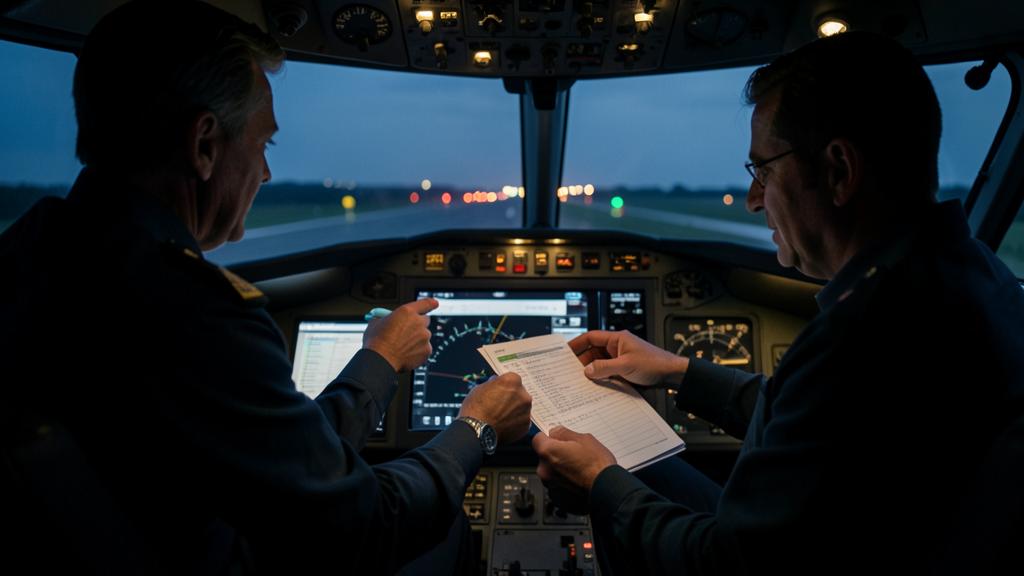
Three checks are worth making in one’s own documentation before the next training session. First, the definition adopted by the operator: some manuals count the undesired state among the events to be reported, others do not, which shifts the boundary of the report. Next, whether a formalized debriefing grid exists in the part of the operations manual devoted to training — often present, rarely used. Finally, how the report form separates, or does not separate, threat from error: a form that offers only a « contributing factor » box produces unusable data, and that should be flagged to the accountable manager.
One gray area remains that the model does not settle: the boundary between error and an unfavorable decision, when no procedure was violated and yet the margin was reduced. This is the ground on which progression plays out after the first few hundred hours, and the one on which human factors courses contribute the most, because no procedure closes it off. The most solid working rule is to classify these cases as decision errors, explicitly stating the criterion that should have been set beforehand, rather than leaving them outside the model.
In the event of a discrepancy, the applicable regulation, the authority’s training specifications and the operator’s approved documentation prevail over this article; the definitions used here are those of the model, not those of any particular manual.
Questions fréquentes
Should an error with no consequence be debriefed?
Yes, and it is actually the most rewarding case to debrief. A consequence-free error leaves no trace: it triggers no parameter exceedance, no technical event, no feedback from air traffic control, so the crew is its sole witness. Left unsaid at the gate, it will recur identically under conditions that will be less forgiving.
What is the practical difference between an expected threat and a latent threat?
An expected threat is known before the deadline and is handled through planning: a plan and a decision criterion are stated at the briefing. A latent threat is invisible from the flight deck — the design of a procedure, the ergonomics of an FMS, the construction of a roster — and no crew countermeasure can reach it. The first is managed on board, the second is reported.
Can there be an undesired state without any crew error at all?
Yes, and denying it is the most common misreading of the model. Wake turbulence, wind shear, or a failure can place the aircraft in a state of position, speed, or energy that reduces margins without any deviation having been committed. The response is the same either way: break out of the state first, diagnose afterward.
How should a flight on which, objectively, nothing happened be debriefed?
By listing the threats encountered rather than the problems suffered. An ordinary flight easily contains four or five — an inoperative item accepted, a runway change, a trajectory constraint, crosswind — and each is judged on the countermeasure applied, not on its outcome. The debrief fits into four lines: what happened, what was done about it, what made it visible, what is generalizable.
Is the model used to evaluate a pilot during a check?
It provides the vocabulary, not the grade. The grids rest on observable behaviors, and stating a threat, a plan, and a decision criterion makes a competency demonstrable to the examiner. A technically clean but silent flight deprives the evaluator of material, since threat management is judged on what is done before the deadline.
What should be done when the crew disagrees on how to classify an event?
Re-establish the chronology before resuming the classification, then ask what was known at the instant of the action, not at the gate. The disagreement almost always concerns an unfavorable decision made without violating any procedure. The most solid working convention is to treat it as a decision error, naming the criterion that should have been set earlier.


Leave a Reply
You must be logged in to post a comment.