
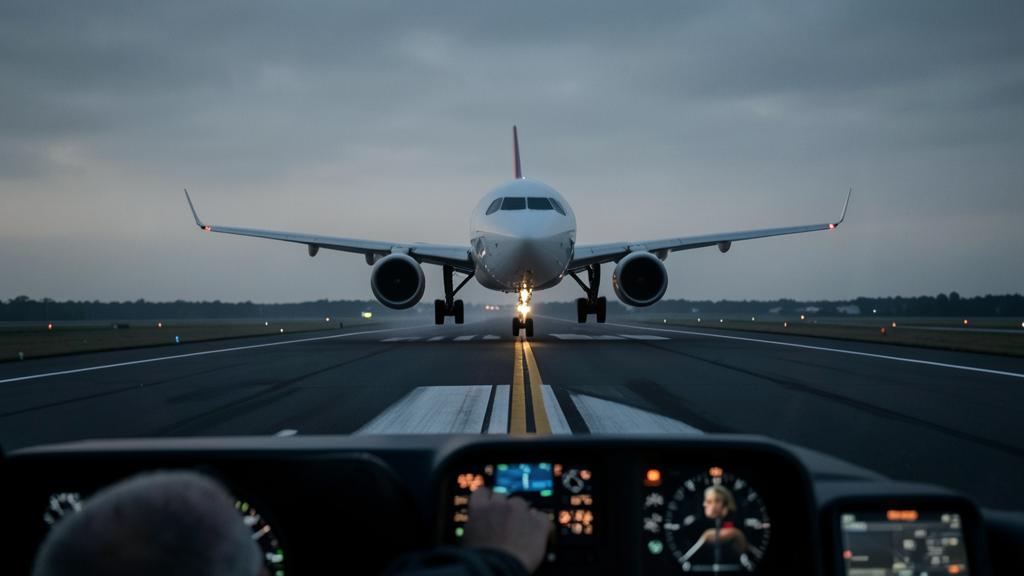
The threshold is crossed ten knots above the approach speed, the crew sees it go by, and the sentence almost always follows: we will make it up on the brakes. The runway is long, the matter seems to be of no consequence. It rarely is, and not for the reason usually given: those ten knots are not paid for once but twice, at two distinct points on the runway and under two different laws. The first of the two bills is already settled by the time the wheels touch down, and nothing on board has displayed it.
Two bills, not one
Landing distance breaks down into two segments that certification treats separately and that cockpit conversation readily conflates: the airborne distance, covered between crossing the threshold at the reference height and wheel contact, and the ground roll, covered between touchdown and stop. These are not two slices of the same problem. They are two deceleration regimes whose means, laws of variation and remedies differ entirely.
In the airborne segment, the means of slowing down are almost non-existent. The thrust levers are at idle, the spoilers are armed but not deployed, the wheels carry nothing: the only force opposing the motion is aerodynamic drag, and its ratio to weight equals the inverse of the lift-to-drag ratio in landing configuration. Gear down, full flap, that ratio is counted in single digits, which places the available longitudinal deceleration in the order of one tenth of the acceleration due to gravity. After touchdown, spoilers deployed, lift destroyed, brakes applied and reverse established, it reaches several tenths on a dry runway. Between the two regimes, the ratio is of the order of three to four times.
It is not the speed difference that costs, it is the difference of the squares
The quantity governing both segments is the same. To go from one speed to another under an assumed constant deceleration, the distance covered equals (V1² − V2²) / (2a). Two consequences follow, and they explain most of the subject.
First: for an equal speed difference, the distance required grows with the speed level onto which that difference is grafted. Losing ten knots starting from one hundred and fifty costs more runway than losing the same ten knots starting from one hundred, since it is the difference of the squares that appears in the numerator. An excess sitting on top of an already high approach speed — heavy weight, reduced configuration, wind additive retained — is intrinsically more expensive than the same excess on a slower machine.
The second: for an equal speed difference, the distance is inversely proportional to the available deceleration. The same excess therefore costs, in metres, three to four times more if it is dissipated in the air than if it is dissipated on the brakes on a dry runway. This is exactly the opposite of what the sentence quoted above assumes: every knot retained until the flare will be paid for at the highest rate on the runway, and it will be paid before the first brake has done any work.
When an airplane lands too fast, it loses speed in two phases: in the air (before touching down) and on the ground (after touchdown). The first phase is much slower because there’s less drag, so the plane travels farther before slowing down. The second phase is faster because brakes and spoilers work better, but the extra speed still costs more runway than expected. The key is that the penalty for speed is worse at higher speeds and in the air.
A Boeing 737-800 with a reference speed of 140 knots lands at 150 knots. The extra 10 knots means it covers about 200 meters more in the air (due to slower deceleration) and about 150 meters more on the ground (due to the square of speed). Total extra distance: 350 meters, even on a long runway. On a short runway, this could mean overrunning.
| What governs it | Airborne distance (threshold to touchdown) | Ground roll (touchdown to stop) |
|---|---|---|
| Available deceleration | Aerodynamic drag alone, thrust at idle: in the order of one tenth of gravity | Spoilers, brakes, reverse: several tenths on a dry runway |
| Effect of excess speed | Twofold: more ground covered per second, and extra time to dissipate the excess | The energy to be dissipated, hence the distance at constant deceleration, grows as the square of the touchdown speed |
| What the crew perceives of it | Nothing measured: only the touchdown point betrays the result | The felt deceleration and the position of the intended exit |
| What makes it worse | Flare initiated high, holding off in level flight, late thrust reduction, drop in induced drag near the ground | Wet or contaminated runway, downhill slope, tailwind, delayed braking |
| Remedy after the fact | None: the distance is consumed while it is being covered | Maximum braking, reverse maintained, abandoning the planned exit |
| Assumption of the manual’s table | A touchdown at the reference point, without floating | Immediate application of braking in the selected mode |
Before touchdown: three effects that stack up
The first is purely kinematic and often the only one that comes to mind. At a higher ground speed, every second spent in the air consumes more runway. A little over seventy-five metres per second for a ground speed of one hundred and fifty knots: the conversion is enough to place the order of magnitude of one second of floating, and to understand why debates about flare technique are not debates about style. That effect remains proportional to speed; for an identical flare duration, it adds only a few per cent to the airborne distance.
The second is the real item of expenditure. To touch down at the intended attitude and at the intended speed, the excess must disappear, and it can only disappear at the deceleration of the airborne segment. With the orders of magnitude above, bleeding off ten knots takes a few seconds — typically three to five depending on the machine, the configuration and the residual engine power. Multiplied by the ground speed, those seconds translate into an order of magnitude of two to four hundred metres of runway consumed before the first wheel touches. That is the order of magnitude to bear in mind: the supplement is not counted in tens of metres.
The third is a matter of handling, and it almost always lengthens the second. At a higher speed, the same elevator deflection produces a stronger normal acceleration: the usual flare input, applied at the usual height, levels the aircraft off above the runway instead of setting it down on it. Added to this is the fact that ground proximity reduces induced drag at the precise moment when it is being relied upon to slow down. The aircraft then has more lift and less drag than on final: it no longer descends and it barely slows down any more. Floating is not a handling error, it is the normal response of a machine asked to dissipate energy in the one regime where it is unable to do so.
After touchdown: the square, then the heat
The ground roll obeys a simpler, and more brutal, law. Kinetic energy varies as the square of speed; at constant deceleration, the ground roll distance follows the same law. On a reference speed of the order of one hundred and forty knots, ten knots more at touchdown give a ratio of squares close to 1.15: about fifteen per cent more energy, and about fifteen per cent more ground roll if the deceleration does not change. Depending on weight, the selected braking mode and the surface condition, a ground roll ranges from a few hundred metres to a little over a kilometre: that percentage therefore translates into several tens to more than a hundred metres, which add to those already consumed in the air. The proportion itself does not depend on the length of the ground roll — it is a ratio of squares, identical on a short runway and on a long one — but the remaining margin depends on it entirely.

But deceleration does not behave in the same way depending on the contributor, and that is where sensitivity to excess speed is decided. Aerodynamic drag and spoilers work as the square of speed: they absorb all the more the faster the touchdown, and their relative share increases with the excess. Thrust reverse delivers a force more or less independent of speed, but it delivers it over a distance: the higher the initial speed, the greater the work provided before the minimum operating speed. Wheel brakes, for their part, are limited by adhesion: their force depends on the vertical load and the friction coefficient, not on speed — on a dry runway at least.
That leaves the heat, which does not show up in runway length but in turnaround time. The fifteen per cent of additional energy ends up as heat in the brakes. A fast landing on a short runway, followed by sustained braking, places the absorbed energy higher in the brake energy schedule, with all that this implies in terms of cooling time, temperature monitoring and margin with respect to fuse plugs. Excess speed is therefore not settled at the stopping point: it is still being settled on the ramp.
| Contributor | Dependence of its force on speed | Effect of excess speed | Its own limit |
|---|---|---|---|
| Aerodynamic drag and spoilers | Grows as the square of speed | Absorbs more; its relative share increases | Effectiveness that collapses at the end of the ground roll |
| Wheel brakes, dry runway | Appreciably independent of speed | Distance to be covered increased in the ratio of the squares | Absorbed energy and temperature, not distance alone |
| Wheel brakes, wet or contaminated runway | Decreases as speed increases | More than proportional penalty: less adhesion where there is more energy | Aquaplaning, whose threshold depends on tyre inflation pressure |
| Thrust reverse | Roughly constant force, work proportional to distance | Increased contribution, and independent of runway state | Minimum operating speed, ingestion, availability |
| Autobrake with controlled deceleration | Regulates to hold a set target | Absorbs the excess in distance, with no particular signal to the crew | Does not replace a manual takeover if distance is lacking |
Tailwind, slope, runway state: the three multipliers
Ten knots are not ten knots. An excess of indicated airspeed and a tailwind component of the same value do not produce the same effect, and conflating them leads to false reasoning in both directions. Excess indicated airspeed acts on the aerodynamics: it increases the lift available, prolongs the flare, delays touchdown, and it also increases ground speed. A tailwind changes nothing in the aerodynamics of the flare — same indicated airspeed, same angle of attack, same lift — but it increases ground speed, hence the runway consumed per second and the energy to be dissipated on the ground. The first creates floating in addition to ground speed; the second creates only ground speed. Both cost, but not for the same reasons.
Slope acts differently again. A downhill slope adds a component of weight along the runway axis, which is subtracted from the available deceleration. It therefore does not add a fixed distance to the balance: it reduces the denominator of the formula, which multiplies the penalty of every excess knot. The same reasoning applies, more strongly, to the surface condition. When the available deceleration falls by half because the runway is wet, the distance required to dissipate the same excess doubles. That is the most useful point to remember: excess speed does not cost a distance, it costs a distance divided by the day’s adhesion.
The right reflex. Base the check on a fixed point and on a geographical criterion, not on an approach average. The speed that counts is the one at threshold crossing, not the one on the last stabilised plateau. And if the excess is still there at the flare, the only action that recovers distance is a firm touchdown at the aiming point, followed by immediate braking — not a hold-off in level flight intended to soften the contact. The late go-around criterion to adopt is one of place: if the wheels are not on the ground within the prescribed touchdown zone, the airborne distance is no longer bounded by anything.
What the manual’s table says, and what it assumes
The approved flight manual provides a landing distance established in flight test according to a reference technique, on a dry and level runway, with no wind, with braking applied without delay. The associated corrections express an increment of distance per knot of excess speed, and that increment is never trivial, for all the reasons above. The operator derives from it increased operational distances, then a landing distance assessment at arrival, made with the actual conditions reported.
Reading it calls for three checks that routine skips over. First, on which speed the correction is indexed: is the difference counted with respect to the reference speed, to the displayed approach speed, or to the speed at threshold? The three differ as soon as a wind additive is applied. Next, which braking configuration the table assumes: a given autobrake mode and maximum manual braking do not consume the same length, and a table established for one does not transpose to the other. Finally, how the corrections combine: they do not necessarily add linearly, and the order of application prescribed by the documentation is not a presentational detail.
The trap. The correction per knot of excess assumes the reference technique, hence a touchdown at the intended point. It quantifies the excess energy, not the geometry. If the ten knots turn into three seconds of floating and a touchdown two hundred metres further on, the distance actually consumed is that of the corrected table plus that overrun: the same cause is billed twice, and the table covers only one of them. That is why a long landing with excess speed leaves the calculated envelope far faster than the sum of the two deviations would suggest, and why the wind additive, designed to be bled off before touchdown, becomes a distance penalty as soon as it is retained all the way to the ground.
What remains to be checked at home
Three things deserve to be opened in one’s own documentation rather than discussed from memory. The exact definition of the approach speed adopted by the operator and the fate reserved for its wind additive: is it meant to be bled off during the flare, or retained until touchdown? The threshold crossing height and the touchdown point assumed by the distance tables, which set the starting point of the count. And the way the documentation treats the combination of excess speed and a long touchdown, if it treats it at all: many sets of tables remain silent on this cumulative case, which leaves the crew alone at the most sensitive point.
The grey area, for its part, will not be closed by a table. No on-board instrument measures the airborne distance; flight data monitoring approaches it through indirect indicators, threshold speed and touchdown position, which tell the result without telling the cause. Floating behaviour depends on the type, the control law and the configuration, and it is rarely documented on the crew side in a usable form. Automatic landing, finally, has its own airborne distance and its own sensitivity to excess speed, without any published comparison with a manual flare: transposing one technique to the other is done by habit, not by figures.
For anyone preparing a type rating or revising a module on transport aeroplane performance, the question asked bears on the structure of the reasoning, never on metres learned by heart: being able to say that the dissipation distance is proportional to the difference of the squares of the speeds and inversely proportional to the available deceleration, and to deduce from it that the air is the worst place to lose knots and the wet runway the worst moment, is enough to handle almost every particular case, from floating to overrunning.
This article sets out a mechanism and its orders of magnitude; it does not stand as a schedule of figures, a procedure, or an approved flying technique. In case of discrepancy, the applicable text, the approved flight manual and the operator’s documentation prevail over what is written here.
Questions fréquentes
Why is it said that ten knots too many cost more in the air than on the brakes?
Because the distance required to dissipate a speed difference is inversely proportional to the available deceleration. In the airborne segment, only aerodynamic drag slows the aircraft, which places the deceleration in the order of one tenth of gravity; after touchdown, spoilers, brakes and reverse provide several tenths on a dry runway. The same excess therefore costs three to four times more runway if it is bled off during the flare than if it is bled off on the brakes.
What is the order of magnitude of the runway consumed by an excess of ten knots before touchdown?
With an airborne deceleration in the order of one tenth of gravity, bleeding off ten knots typically takes three to five seconds depending on the machine, the configuration and the residual engine power. At a ground speed of one hundred and fifty knots, that is a little over seventy-five metres per second, which places the order of magnitude between two and four hundred metres covered before the wheels touch. The order of magnitude is therefore hundreds of metres, not tens.
Are ten knots of tailwind and ten knots of excess speed equivalent?
No, the mechanisms differ. Excess indicated airspeed increases the lift available and prolongs the flare, in addition to increasing ground speed; a tailwind leaves the aerodynamics of the flare unchanged and acts only on ground speed, hence on the runway consumed per second and on the energy to be dissipated during the ground roll. Both lengthen the distance, but only the first creates floating.
Does the flight manual correction per knot of excess cover a long landing?
No. That correction is established for the reference technique, hence for a touchdown at the intended point: it quantifies the excess energy, not the geometry. If the excess turns into floating and a touchdown beyond the reference point, the distance actually consumed is that of the corrected table to which that overrun is added. As the two deviations have the same cause, they accumulate while the table covers only one of them.
Why does the speed penalty increase so much on a wet or contaminated runway?
Because the surface condition acts on the denominator of the calculation and not on a fixed distance. If the available deceleration falls by half, the distance required to dissipate the same excess speed doubles. Added to this is the fact that the friction coefficient decreases as speed increases on a wet surface, which makes the penalty more than proportional, and that a faster touchdown may place the start of the ground roll above the aquaplaning threshold.
Should the aircraft be held off in level flight to soften the touchdown when the speed is excessive?
That is the action that makes the outcome worse, since it prolongs the one segment where the aircraft has no effective means of slowing down. A firm touchdown at the aiming point, followed by immediate braking, transfers the dissipation into the regime where it is three to four times cheaper in distance. If the wheels are not on the ground within the prescribed touchdown zone, it is the go-around that bounds the airborne distance.


Leave a Reply
You must be logged in to post a comment.