
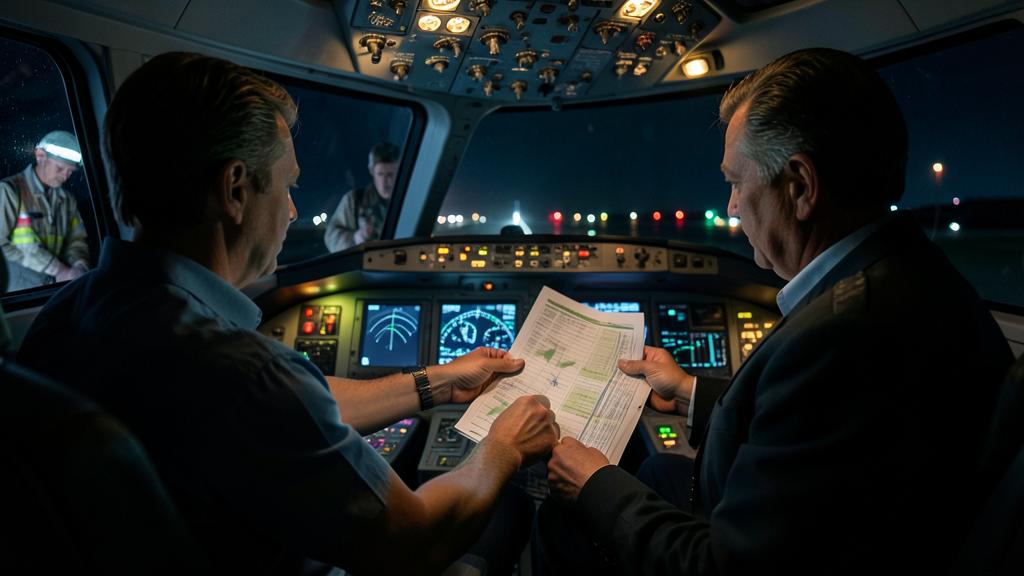
Two operators of the same aircraft type do not handle the same failure in the same way: at one, three memory actions are performed before opening a document; at the other, the hand goes to the manual as soon as the failure is announced. Both sets of documentation are approved, both crews are trained and checked. What separates them is neither caution nor corporate culture, but a compromise between two quantities that can be named and measured: the time left by the situation and the cost of an irreversible action.
The severity of the failure says nothing about the format
Intuition classifies abnormal procedures by severity and assigns memory to the most severe. It is wrong twice in the same sentence. The loss of several hydraulic circuits is among the most severe situations a transport crew can face, and it is managed from start to finish with the manual open: the aircraft is in flight, the fuel is counted in hours, the difficulty lies in the calculation of the landing, in the configuration to choose and in the coordination with the cabin. Speed does not help here; a hasty action, on the other hand, eliminates options.
Conversely, a cabin altitude alert in cruise does not present, at first glance, any spectacular failure: the aircraft is intact, the engines are running, nothing is vibrating. The first actions are nevertheless memory items, because the clock in question is not that of the machine, but that of the occupants. The format criterion therefore has nothing to do with the severity of the failure. It is based on two questions, asked in this order, at the time when the procedure is written and not at the time when it is applied.
First quantity: the delay before the situation develops
Between the alarm and the first action, the path to the document includes an incompressible chain: perceive, identify what is at stake, take out the manual, find the page, check that its title corresponds to what is observed, read the first line. Each link is short; their sum is not. In cruise, with a rested crew and no surprise, it is measured in tens of seconds. After a genuine startle, with a pilot in manual flight and a flight path to maintain, it lengthens, and it is precisely in these circumstances that it is called upon.
The clock on the other side does not depend on the failure, but on the context. At high altitude, the time of useful consciousness is counted in tens of seconds and decreases rapidly as one climbs: no reading chain fits in this budget. After a failure at takeoff, the clock is that of energy and obstacle clearance margin, and it is measured by the number of seconds during which the flight path remains acceptable without intervention. In both cases, the comparison is arithmetic: if the available time is shorter than the chain, the reading arrives after the end of the story.
If you have very little time to react (like in a cabin decompression at high altitude), you must act immediately from memory. If you have more time (like in a hydraulic failure), you can safely read the manual. The key is matching the time you have with the time the procedure needs.
During a cabin decompression at FL350 (35,000 feet), pilots have about 30 seconds before hypoxia affects their ability to think. They must put on oxygen masks immediately from memory. For a hydraulic failure at the same altitude, they have hours to work through the manual because the aircraft remains controllable.
A third case is incorrectly grouped with the first. It happens that time is not lacking, but the documentation becomes unusable: a cabin full of smoke, a flight deck without lighting, a masked crew who can no longer hear each other. The page is there, and it is unreadable. That is why crew protection—mask, goggles, restoration of communication—is included in the memory actions of almost all documentation. Not because the event is faster than another, but because these actions condition access to everything else, including the manual.
Second quantity: what a quick hand cannot undo
The second question concerns the cost of an error. Some selections can be reversed without damage: a pump put back into service, selective heating, an electrical source reconnected. Others cannot be undone in flight: a fuel cutoff, a fire extinguisher discharge, a thrust lever brought to idle on the engine that was still running. The cost is not in the action, it is in its irreversibility, and this irreversibility is no more correlated with the severity of the failure than with its frequency.
Now, memory pushes for speed, and speed is the enemy of identification. The dominant failure mode, in memory lists, is not forgetting: that is rare and visible. It is the correct application of a correct list to the wrong control. A serious design compensates by framing definitive actions with a confirmation protocol: physically pointing at the control, announcement, explicit agreement of the second pilot before any movement. This protocol deliberately reintroduces the time that has just been gained, and that is precisely its purpose—it places a second barrier where the first, that of the procedure title, has just been removed.
Hence a drafting rule that is found everywhere procedures are well designed: a memory item does not contain a condition. A memorized line that begins with « if » is a design flaw, because a branch executed under startle is exactly what human memory cannot do. Conditions, special cases and variants belong to the document. Memory only carries a short, ordered and unconditional sequence, each step of which is verified by an observable state: a light, a position, a noise.
Three response formats, not two
Framing the question as memory versus reading hides a third category, which is wrongly lumped in with memory because it does not use a document either: the reflex maneuver. An unusual attitude, an emergency maneuver in case of ground proximity warning, a resolution advisory do not constitute procedures, they are actions. They do not require any diagnosis—the alert replaces the diagnosis—are not stated item by item, and are evaluated as a motor skill, not as memorized knowledge. Grouping them with memory actions leads to reciting them in class, which predicts nothing about in-flight performance.
| Criterion | Reflex Maneuver | Memory Actions | Immediate Reading |
|---|---|---|---|
| Trigger | A perception or an alert, without prior diagnosis | An identified, announced and confirmed failure | An identified, announced and confirmed failure |
| Time left by the situation | Immediate, the trajectory is at stake | Shorter than the reading chain | Longer than the reading chain |
| Support at the time of action | None, never | None; the document takes over afterwards to confirm | The document, open to the correct page |
| Admissible content | A single motor sequence | A few ordered actions, without conditions or branching | All useful logic, including special cases |
| What the controls measure | The correct action under startle | Recall in context, not recitation | The discipline of reading and cross-verification |
| Dominant mode of error | Hesitation, late response | The correct list applied to the wrong control | The page found too late, or read without representing the effect |
This distinction has a direct consequence on the preparation of a session: the reflex maneuver is trained by repetition and by surprise, the memory action by execution in context, the immediate reading through disciplined role sharing. Three different training objectives, three different forms of checking, and one common error—treating all three as « memory items ».
Each memorized element is paid for in recurrent training
An action entrusted to memory is not free: it must be learned, maintained and checked. A procedural sequence that is not practiced degrades, and it degrades from the ends—the order goes first, the content after. The slope of this degradation depends much less on the difficulty of the actions than on the number of items held together, which has an unpleasant consequence for the designer: lengthening a list degrades the recall of all its items, including those that had been acquired.
Added to this is the interference between neighboring lists. When three different sequences start with the same action and diverge at the second, the probability that a crew under load continues down the wrong branch is no longer negligible, and grows with the number of lists faster than with their length. This is what has led, for decades, to the systematic reduction of memory lists in transport aircraft. Items were not removed to lighten training: they were removed because the benefit of an additional item eventually becomes negative.
The operator who locally adds a memory item therefore pays twice: once in recurrent training time, once in the reliability of everything that already existed. The same reasoning applies to the instructor who passes on to students two « common sense » actions not included in the approved documentation. This does not make the crew safer: it creates a divergence between crews that will be paid for on the day two pilots trained differently fly together.
The two excesses are symmetrical
The first is known and widely corrected. The culture of long memorized lists produces crews who act before they understand; it instills the idea that speed is the cardinal virtue; it weakens the discipline of reading for everything else, since the document becomes the refuge of minor cases. Recent documentation has reduced these lists, sometimes to the point of keeping only a very small number.
The second excess is less known, and it is progressing. By referring everything to the document, we obtain crews who no longer know how to do anything without it—not out of laziness, but because the mental model of the system has never had the opportunity to form. Reading then becomes mechanical: the lines are executed without picturing what they produce, therefore without detecting the case where the procedure does not correspond to the real situation. Now, a procedure is written for the failure it names, never for the combination that presents itself. Knowing which action will be taken remains, to this day, the only prerequisite that cannot be delegated to paper or screen.
The trap: the defect is almost never to forget the list, it is to apply it correctly to the wrong control. The manual imposes a ritual whose value nobody notices as long as it is there: find the procedure, read its title, confirm that it corresponds to what is observed. This check completely disappears as soon as one recites, precisely at the moment when the indication is ambiguous and when two parameters move on both sides. A memorized list has no title page.
The good reflex: declare out loud the stopping point before starting, and not during. « Three memory items, then the manual » delimits the sequence, gives the second pilot a criterion to interrupt, and turns a possible omission into a visible deviation. And no irreversible control is moved without being physically pointed at by both pilots, even when the list is short—especially when it is short, because that is when it feels risk-free.
In an aircraft with electronic checklists, the limit moves without disappearing
In types where the alarm screen sequences the actions, most abnormal situations switch to reading, but a reading of a particular type, with its own restrictions: the line that remains as long as it is not satisfied, the imposed order, the strict division between the one who reads and the one who acts. Memory actions do not disappear there; they are reduced to a residue of well-defined nature: what must be done before the system has finished speaking, and what the system cannot guide because it does not see it.
| Situation | What establishes the clock | Can an erroneous action be reversed? | Format that follows |
|---|---|---|---|
| Cabin pressure loss in high cruise | The physiology of the occupants, on the order of a few tens of seconds | Yes, putting on a mask costs nothing | Short memory, then document |
| Smoke or fumes in the cabin | The documentation becomes unreadable before it is even opened | Yes for the protective equipment | Memory to protect, document to isolate |
| Engine failure shortly after takeoff | The available energy and the obstacle clearance margin | No, an engine shutdown cannot be reversed in flight | Flight path and threshold first, then type-specific format |
| Doubtful speed indications | Flight path drift while the doubt persists | Yes, an attitude can be recovered | Attitude and thrust from memory, tables in the document |
| Loss of several hydraulic circuits | The fuel, therefore hours | No, some selections are definitive | Immediate reading from start to finish |
The specific trap of these aircraft is waiting. The crew used to being guided waits for the line, and the line, in case of pressure loss, does not arrive at the pace of physiology. The comment also applies to checklists carried on a tablet: the device is consulted faster than a paper booklet, does not start up any faster, and has its own failure modes, including those of the power supply. Having a backup format that can be consulted without electrical power is a question of flight deck design, not a collector’s precaution.
The second trap: two variants of the same type, operated by the same company, do not necessarily have the same memory list. A crew that alternates variants in the same week maintains in memory two similar sequences that diverge by one item, which is the most unfavorable possible configuration. This point rarely appears at the top of course material; it is found in the manufacturer’s documentation, variant by variant.
What to check in your own documentation
The criterion described here is that of the designer. What concerns the line pilot is narrower, and can be verified in a single work session, sources in hand.
- The exact list of actions entrusted to memory for his type and his variant, taken from the manufacturer’s documentation and not from course material.
- The differences between variants operated by the same company: it is the most frequent and least signaled source of divergence.
- The repetition of these actions in the quick reference handbook in a form that allows them to be confirmed afterwards. If this repetition does not exist, the verification happens nowhere.
- The threshold, in altitude or in configuration, below which his documentation does not authorize any action other than flying.
- The confirmation protocol applicable to irreversible controls, and how it fits with the reading order of the alert display.
- The way in which recurrent checking evaluates these items: recitation on the ground, or execution in context with distraction. The two do not measure the same thing, and only one predicts something.
- The memorized actions of the cabin crew and their articulation with those of the cockpit: in case of decompression or fire, the two sequences are executed simultaneously and do not see each other.
A gray area always exists, and it is worth watching. The extension of reduced crew operations puts the criterion back on the table, since it removes the second reader along with the second pair of eyes. What is maintained today because two people monitor each other—the confirmation before a definitive action, the reading by one and the execution by the other—has no obvious equivalent when only one remains. For those preparing a type rating or a conversion course, it is the area where the examiner’s questions are shifting: less « recite the memory actions to me » than « how do you recognize that it is not the right one? »
These references describe a design mechanism; in case of divergence, the approved flight manual, the approved operator’s operations manual and the applicable texts prevail over what is written here.


Leave a Reply
You must be logged in to post a comment.